Tag: chicago

  • Good News From NYC, Not-Bad News From Baltimore, Horrible News from Chicago

    In New York City, year to date, murders continue to be lower than last year (124 vs 140) and higher than record-low 2014 (112). Given the rise of homicide in so many other cities, this is great news.

    In Baltimore there were 26 murders in May. It’s hard to call this exactly “good news.” But last year, post riot, there were 42 murders in May. In previous years, May typically saw about 21 murders. Year to date (though May) 110 murders is not particularly good news. But it could be worse.

    In 2014 Chicago saw about 155 murders through May, last year there 173, and this year about 265 (just through May). Coinciding with this huge increase in murder is the fact that Chicago police are shooting far fewer people than ever! In 2014 CPD shot 45 people. This year they’re on pace for 15. The obvious conclusion is that police are less likely to proactively engage with violent criminals. This is great news for the police-are-racist-harassers-of-innocent-black-men camp. But not great news if you happen to be a young black man in Chicago getting shot.

    Yes, there might be a real trade-off between 30 people not shot by police and 1,400 more people shot by criminals. I’m not saying it’s direct cause-and-effect (it’s not like police were shooting all the bad guys) as much as mutual causation (police are interacting less with potential criminals).

    This certainly doesn’t fit the narrative from the left that police use-of-force is the paramount criminal justice issue of the day. But while the streets run red some people’s faces will go blue saying, “we don’t know why crime is up in Chicago!” What we do know is that no other standard factor has changed so much in Chicago in the past two years.

    If one happens to think, as I do, that most police-involved shootings are justified, this isn’t good news. Seems to me that police are not proactively engaging with potential murderers, and this matters. (And it matter more than, say, reducing the racial disparity in juvenile arrests based on population demographics.)

    I bet arrest numbers are down, too. [Well, I know they are, but why is it so hard to get Chicago arrest numbers?] Best I can find is this from 538.com.

  • The New York Times goes to the Hood

    I applaud any effort to focus on the victims of violence in America. Too often nobody knows or cares about this real carnage in this country.

    So over Memorial Day weekend the New York Times went to the bad parts of Chicago to sightsee:

    [We] dispatched a team of reporters, photographers and videographers to virtually all of the shooting scenes across the city. Working around the clock through the three-day weekend, The Times interviewed relatives, witnesses, police officers and others, and captured how much violence has become a part of the city’s fabric.

    After that self-congratulatory moment (wow, did they really work “around the clock” on a “three-day weekend”?!) I really did have high hopes for this 5,000-plus word article. But I was left feeling empty. Though I can’t quite put my finger on the problem, let me try.

    Murder victims should be humanized. You’re not just a homicide victim. You’re a real living human being with lives and stories and loves and problems. (And also, as cops know all too well, with soft flesh and blood and sometimes spattered brain matter.)

    This weekend, among the six killed are a father, Garvin Whitmore, who loved to travel but was scared of riding on roller coasters; and Mark Lindsey, whose outsize personality brought him his nickname, Lavish. The oldest person struck by a bullet is 57. The youngest person to die is Ms. Lopez, a high school student and former cheerleader.

    And so the logic of one Chicago mother, who watches another mother weep over her dead son in their South Side neighborhood, is this: She is glad her own son is in jail, because the alternative is unbearable.

    “He was bound to be shot this summer,” she says.

    That last part is powerful. Let’s be clear: a mother says she’s happy because her son is in jail, because otherwise he would probably be killed. As Yakov Smirnoff says, “what a country“!

    The Times reports that one victim was just watching the Newlywed Game on TV. Another has an “outsize personality.” (Though I’m not certain what that means, his nickname of “Lavish” raises my eyebrow. And how can you a “former cheerleader” at age 15? But maybe I protest too much….) I’m torn between my usual line, “damnit, these victims are Americans we should care about!” and “damnit, this is tear-jerking PC bullshit!”

    I quibble with this Times’ portrayal because most murder victims in Chicago (and other cities) are not just normal hard-working people with normal jobs who happen to be in the wrong place at the wrong time. Sure, sometimes the street draws in kids despite loving moms. Maybe mom is too busy working poorly paid jobs to keep an eye out on her child. But too many never had a loving parent when they needed to be brought up right.

    Cops see this all the time: living situations where little kids are growing up without any structure, much less electricity or a functional loving parent. Dad might be dead or in prison; mom might be turning tricks to support her addiction. Then what? What happens to the kids sleeping around mice and roaches, three to a bare mattress? Nobody talks to the kids, much less reads to them. Kids are simply ignored or neglected, ineffectively raised by siblings and cousins. What if you parents try to sell you for drug money? [Update: What if your dad shoots your grandfather at your uncle’s funeral?] How do you think you’re going to turn out?

    These things need be discussed, but the Times doesn’t want to go there. You might say I’m blaming the victim (because I am), but my point is not that “these people” deserve to get shot and killed (call me a pinko-lefty, but I’m firmly in the camp of those who believe that nobody deserves to be shot and killed). The problem is that if we don’t accurately address the real problem and characters involved — if we only romanticize victims and blame bad luck — we’re never going to get at effective solutions.

    This gets more at the truth:

    Sometimes only minutes after the gunshots end, a computer system takes a victim’s name and displays any arrests and gang ties — as well as whether the victim has a rating on the department’s list of people most likely to shoot someone or be shot.

    Police officials say most shootings involve a relatively small group of people with the worst ratings on the list. The police and social service workers have been going to some of their homes to warn that the authorities are watching them and offer job training and educational assistance as a way out of gangs.

    Of the 64 people shot over the weekend, 50 of them, or 78 percent, are included on the department’s list. At least seven of the people shot over the weekend have been shot before.

    For one man, only 23 years old, it is his third time being shot.

    As a cop, this makes me question the operational effectiveness of the “strategic subject list.” But as an editor, I would say this point needs to be more developed.

    You can’t say with certainty that an individual who is shot is also a shooter, but you can hazard a bet that a 23-year-old who has been shot on three separate occasions has also pulled the trigger a few times. On the front end of every murder is a murderer. Collectively the pool of murder victims is the pool of murderers. An exclusive focus on victims as victims glosses over the fact that many of the victims are the problem. They are murderers. (And, as the article points out, these murderers are not being arrested.)

    The Times quotes a Mr. Hallman:

    “Why did I gang bang?” asks Johnathan Hallman, 28, who lives on the South Side. “Just to be around something, like just to be a part of something, man. Because when you growing up, man, you see all these other people, older people that’s in the gang life or whatever. They making they little money and they doing they thing. You see the little ice, the car they driving. It’s just an inspiration, man.”

    Mr. Hallman says he joined a gang at a young age, but eventually decided it was not all he thought it would be. He got out, he says.

    Is he a good guy because he got out of the game? Hell if I know. But what about all the people who never got involved in the first place? Even in bad neighborhoods, it’s not normal to gang bang, shoot people, or be shot.

    Or take Mr. Roper, 24:

    who grew up in the Englewood neighborhood, says he had occasionally carried a gun to protect himself from being robbed, but never used it. “I have to have a gun to scare them off,” he says.

    Poor Mr. Roper. Personally I’m thinking that Mr. Roper is part of the problem. Does the Times really think Chicagoans should carry illegal guns for protection? Their editorial board has certainly preached to the contrary. Are young men who don’t carry guns irrational or somehow wrong? So what is the Times position on people’s needs to carry guns in Englewood?

    And then there’s Ashley Harrison, 26. She and her fiancée, Mr. Whitmore

    had been sitting in the car outside a liquor store, in a South Side neighborhood accustomed to gunfire, when, in broad daylight, shooting started. Mr. Whitmore was fatally shot in the head.

    “Broad daylight!” Like shooters don’t even have the common courtesy to kill at night. But it’s the intransitive almost-passive voice that kills me: “shooting started.” Like nobody actually shot a gun. Those guns, they just start shooting. And poor Mr. Whitmore got shot. And in “broad daylight”!

    So what would you do if you were with your fiancée in a car, and he gets shot? I suspect you wouldn’t be as bad-ass as Ms. Harrison, who grabbed her illegal gun, jumped out of the car, and popped off a few “warning shots” in return. (She has since been charged.)

    This is not the normal urbane behavior one might expect in a civilized society. But it goes unquestioned by the Times.

    By my count, the article talks about 12 of the 64 victims. What about the other 52? So far it doesn’t seem to be a random sample. Eight of the weekend’s 64 victims are 39 years or older. The Times mentioned four of them (out of the 12, total). The median age of the victims in the Times is 32. That’s more than 5 years older than the average murder victim over the weekend. Except for the 15-year-old “former cheerleader” — and to mention the youngest is pretty much obligatory — what about the other 21 victims under age 23?

    Who are these young black (and occasionally hispanic) men? The Times doesn’t tell us. I suspect this is because most of these young victims are less sympathetic than those who “love to travel but are afraid of roller coasters.”

    I don’t know if this is superficial reporting, a desire to avoid being “judgmental,” or something else. Is it because older victims are more sympathetic? Is it because younger victims would not talk to reporters? Is it because reporters couldn’t or were afraid to approach the younger victims and their friends? I don’t know.

    The Times mentions “52 of the shooting victims are black, 11 Hispanic and one white.” Just one white? Think of what that means for policing. The black/white disparity in shooting victims this weekend was 52(!)-to-1! And yet when police hassle/stop/arrest/shoot more blacks than whites, the Times and others scream bloody murder about racist policing and implicit bias. When I highlighted this racial disparity to explain/defend/justify racially disproportionate policing, I was called (by the Times no less) a “denier.”

    Jose Alvarez, 28 — AKA “Chi Rack Alvarez” (red flag!) — is mentioned. There’s a video of Chi Rack flashing signs disrespecting a gang. He was on the receiving end of 15 shots.

    The police describe Mr. Alvarez as a gang member and say he may have been the intended target of the shooting.

    You think?

    Mr. Alvarez insists that the police are wrong in labeling him part of a gang.

    Well, I bet the police are right. But who am I to judge?

    There’s Mark Lindsey (AKA Lavish), whom a friend calls, “one of the success stories.” “Lavish” was targeted in his car. (The last sentence on “Lavish” mentions, just barely, that he was arrested the previous day on domestic battery and released on bond. Hmmm, that is, as we say in the police business, “a clue.”)

    Or take Calvin Ward, 50. Two young men come up the street and fire is his direction six times. One bullet goes inside a home and hits his wife. Ward says he has no idea why people would shoot him, “I ain’t no gangbanger or nothing.” But Ward was “convicted several times of battery and aggravated unlawful use of a weapon.” I’m thinking that he may not be fully out of the game. But what do I know?

    If we want to reduce violence — and we do — police need to be more aggressive and focus on on the criminals who are linked to violence. When somebody gets killed there’s almost always a link to public drug dealing (even if the actual murder stems from some more mundane beef).

    If the goal of the Times is to show that murder victims are people too, great. That should be done. But most murder victims in Chicago are young black men who never realistically had a chance. They grew up with absent or bad parents (this point cannot be stressed enough). They dropped out of school (and you, gentle reader, have worked damn hard to make sure your precious little angels aren’t even in the same school buildingas them). These cast-offs are functionally illiterate. They have no mainstream social skills. They’ve never had a legal job. Nobody wants to hire them. They have no money. They hustle to get by. Then one day their luck runs out, and they’re slow on the draw. Rather than shooting someone, they get shot. This is reality that most of American and the Times still won’t touch.

    Statistical postscript: The Times also refers to a poll (an interesting poll by the way) in which 54 percent of blacks say calling the police will “make the situation worse or won’t make much difference.” That sounds damning. What do you think that means?

    The same poll also says — the same damn question! — that 84 percent of blacks say calling the police will “make the situation better or won’t make a difference.” Given those two statements (both are true because 42 percent say “calling police won’t make much difference”), how would you summarize the results?

    Their analysis is either statistical ignorance or intellectual dishonesty. Statistically and logically, it makes more sense to take out the middle (“won’t make a difference”) and observe that blacks are 3.5 times more likely to think police make the situation better than make than the situation worse (42 percent to 12 percent).

    This question isn’t a Likert scale, where a 3 is halfway between 1 (“strongly disagree”) and a 5 (“strongly agree”). These are three distinct non-linear answers. Hell, I called police in New Orleans even though it wouldn’t “make a difference” simply because because calling police is the right thing to do.

    The poll also has some interesting data that go beyond the scope of this post or their article, but they’re worth mentioning in light of the “progressive” context much police-related reporting.

    Compared to blacks, a greater percentage of whites have “had interactions with police officers in the past 6 months” (and this does not include close friends or family members). If this is true, what is going on? Given the level of violence in black Chicago, this is odd and even problematic.

    Thirty-seven percent of blacks (a plurality) say that “lack of strong family structures” plays the biggest role in Chicago’s high crime rate. The Times won’t touch this with a 10-foot pole. (Next on the list is “lack of good jobs.”)

    Also, even though 72 percent of blacks in Chicago consider themselves Democrats (compared to 53 percent of whites), blacks are just as likely to be “conservative” as “liberal” (compared to 17% conservative, 40% liberal breakdown for white Chicagoans. “Progressives” always seem to know what is best for other people, but they and their Bernie supporters doggedly refuse to acknowledge that collectively, blacks aren’t actually liberal like them. (Blacks are also much more likely than whites to be religious and go to church. And I never arrested any kid who went to church.)
  • Chicago Police Report

    It’s kind of hilarious that Chicago Mayor Rahm Emanuel is trying to present his cover-up-and-dictate style of management as concern for police misconduct. But leaving that aside, a task-force he appointed has released its report.

    Some of what it says needs to be said: “From 2011-2015, 40% of complaints filed were not investigated by IPRA.” And: “These events and others mark a long, sad history of death, false imprisonment, physical and verbal abuse and general discontent about police actions in neighborhoods of color.”

    And let’s not forget the false (and consistently false) police reports and (mayoral?) cover-up related to the killing of Laquan McDonald:

    Not until thirteen months later — after a pitched legal battle doggedly pursued by local investigative journalists resulted in the court-ordered release of the dash-cam video of the shooting — did the public learn the truth: McDonald made no movements toward any officers at the time Van Dyke fired the first shot, and McDonald certainly did not lunge or otherwise make any threatening movements. The truth is that at the time Van Dyke fired the first of 16 shots, Laquan McDonald posed no immediate threat to anyone.

    They really should have added that McDonald didn’t pose any threat when the last shots were fired.

    There are the ignored red flags:

    The enduring issue of CPD officers acquiring a large number of Complaint Registers (“CRs”) remains a problem that must be addressed immediately. From 2007-2015, over 1,500 CPD officers acquired 10 or more CRs, 65 of whom accumulated 30 or more CRs. It is important to note that these numbers do not reflect the entire disciplinary history (e.g., pre-2007) of these officers.

    The inability to act on red flags:

    Sadly, CPD collects a significant amount of data that it could readily use to address these very troubling trends. Unfortunately, there is no systemic approach to addressing these issues, data collection is siloed and individual stakeholders do virtually nothing with the data they possess.

    And the perennial problem with “community policing”:

    Historically, CPD has relied on the Community Alternative Policing Strategy (“CAPS”) to fulfill its community-policing function. The CAPS brand is significantly damaged after years of neglect. Ultimately, community policing cannot be relegated to a small, underfunded program; it must be treated as a core philosophy infused

    But here’s where ideology begins to trump common sense. It’s claptrap to advocate for “community policing” without defining community policing or offering any evidence to its effectiveness. Yes, police right now need better relations with the non-criminal public in minority neighborhoods. But the main job of police, lest we forget, is to deal with the criminal public.

    And then there’s the absurdity — the dangerous and even racist absurdity — of promoting racial balance in police activity and use of force.

    Police Officers Shoot African-Americans At Alarming Rates: Of the 404 shootings between 2008-2015:

    • 74% or 299 African Americans were hit or killed by police officers, as compared with

    • 14% or 55 Hispanics;

    • 8% or 33 Whites; and

    • 0.25% Asians.

    For perspective, citywide, Chicago is almost evenly split by race among whites (31.7%), blacks (32.9%) and Hispanics (28.9%).

    Really? That’s your perspective?

    The idea that police should stop, arrest, and even shoot and Tase people in proportion to population demographics is nutty. For real perspective, consider that of 3,021 Chicagoans shot last year, just 25 were shot by police. 79 percent of murder victims were black; 4 percent were white. For known assailants (which is known just a shamefully low 26 percent of the time) the figures are comparable.

    With this perspective, the use-of-force stats seem quite reasonable. To say this is not to deny a historically troubling legacy or even current problems. But if the benchmark for success in policing is racial parity in use of force, then Chicago and Chicagoans are in for more bloody years.

    Chicago is 5.5 percent Asian. As a benchmark of success, will we not rest till more than 5 percent of those shot by police are Asian?

    Overall, use of lethal force by the Chicago Police Department is on par with the national average (0.33 per 100,000 for the CPD, compared with 0.31 for the nation). Chicago is below LA, Houston, Atlanta, San Francisco, and most cities. The Chicago Police Department may have 99 problems, but an excessive use of lethal force and a racial disparity in that use of force doesn’t seem to be one of them.

    Still, there is a room for improvement. The NYPD kills people at an outlyingly-low rate of 0.08. Maybe, instead of suing police departments into institutional paralysis, folks could determine what the NYPD is doing right and advocate better — rather than less – policing based on best practices. (But who on the Left wants to talk about what the NYPD is doing right?)

    But I’ll finish on a positive note:

    The findings and recommendations in this report are not meant to disregard or undervalue the efforts of the many dedicated CPD officers who show up to work every day to serve and protect the community. The challenge is creating a partnership between the police and the community that is premised upon respect and recognizes that our collective fates are very much intertwined.

  • Why fewer police-involved shootings in Chicago might be bad

    Why fewer police-involved shootings in Chicago might be bad

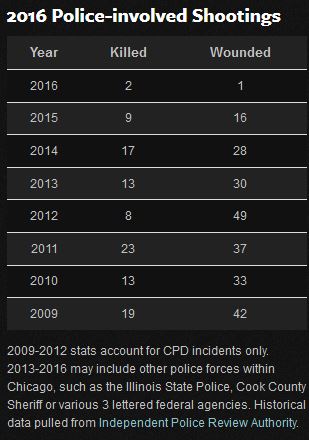
    Police-involved shootings in Chicago are way down.

    From heyjackass.com

    This is great news for advocates of police reform.

    Chicago in 2016 will probably see police shoot just 15 or so people (based quite sketchily on January through March figures). This compares to 45 people shot in 2014. The decrease is without doubt due in part to those who keep a laser-like focus on police misconduct. The number of those shot by Chicago Police has plummeted for two consecutive years.

    But it’s also very likely that Chicago will see close to 3,500 people shot this year. That would be 500 more than 2015. And that was 500 more than 2014. And that was 500 more than 2013. And for each 500-person increase in shootings, roughly 480 victims are black or hispanic.

    What if — hypothetically of course and absent any corresponding decrease in violence in general — what if police-involved shootings served as a proxy (an indirect indicator) for police officers’ engagement and interaction with violent criminals and the criminal class? It’s not inconceivable. Another indicator is that police stops in Chicago have also plummeted.

    In the police world we’d call these facts “clues.” Of course in the academic world I’m “just guessing.” But I’ll have a lot of time to guess before “hard social science” (that’s a joke, by the way) can prove what’s going on.

    But hey, why focus on the negative? Why focus on criminals and dead young black and hispanic men when we can just keep the heat on police? Let’s assume heroic police behavior is criminal. Let’s criminally prosecute innocent cops and drive other cops who defend themselves into hiding. Let’s build a social movement on (what turns out to be) a lie and then pretend it doesn’t matter because, well, it could have been true. And then, when police do less and crime goes up, deny it. And then, when you can’t deny it any longer, say we don’t know why crime is up. Or better yet, blame the police.

    But police-involved shootings are way down!

    Update: here’s the same data but compiled on June 6:

  • Chicago violence

    Chicago violence

    Maybe killers don’t dress with such flair in Chicago as they do in Detroit. But what Chicago murders lack in quality, they make up for in quantity.

    Some experts prefer to put their head in the sand and hope it all goes away:

    “Trying to read too much into this is a grave mistake,” said Craig B. Futterman, a clinical professor of law at the University of Chicago. “We’re all just guessing.”

    Really? A “grave mistake” when homicides are almost doubled compared to the same time last year? No. It’s high time for everybody to give their best guess. Here’s mine:

    Since January, officers have recorded 20,908 times that they stopped, patted down and questioned people for suspicious behavior, compared with 157,346 in the same period last year. Gun seizures are also down: 1,316 guns have been taken off the streets this year compared with 1,413 at this time last year.

    And convictions in gun cases are getting hard to win:

    In part, that’s because of the public’s concern over police tactics in the wake of high-profile shootings of African-Americans by police officers around the country, according to both prosecutors and defense attorneys.

    It’s not so much as a “guess” as connecting the dots. That decrease in stops was by design:

    …tied to a departmental change that took effect in January, requiring officers to fill out a far more detailed form for each one. The change was imposed after the American Civil Liberties Union raised questions about whether officers were targeting minorities in their stops.

    Well, of course they were. How are you going to target homicides in Chicago without a focus on minorities? Of 3,000 people shot and 506 killed in Chicago, 80 percent were black and another 15 percent hispanic. 95 percent of those killed are black or hispanic in a city that is roughly two-thirds black or hispanic.

    So yeah, when it comes to preventing gun violence in Chicago, the police would be remiss if they didn’t focus on minorities. And men, too (90 percent of victims). Should police stop more Polish-American women in Jefferson Park? Jefferson Park would love more police presence (if that were possible). (To my surprise, there even was a murder in Jefferson Park last year. One.)

    Of last year’s murder carnage just 123 suspects have been arrested. The clearance rate was 25 percent. So there’s room for improvement there, too. Right now literally hundreds of active murderers are walking around the streets of the South and West Sides of Chicago. 142 murders just through March.

    Look, maybe an increase in shootings in Chicago isn’t related to decreasing interaction between police and criminals. Maybe there is no cause and effect between attempts to limit and control police activity against young black and hispanic men and an increase in violence among some of these same young black and hispanic men. Yes. It’s a guess.

    But what if aggressive policing — and inevitably some of that will cross the line to an illegal stop or search — actually prevents violence? What if there were a cost to a laser-like and exclusive focus on police misconduct? Reducing police stop in general is one way to reduce illegal police stops and citizen complaints. But maybe it’s the wrong way. What if one consequence of focusing only on police misconduct were fewer gun convictions? What if it were more murders? (And God forbid you call this relationship something like the Ferguson Effect, because that doesn’t exist.)

    Hey, on the plus side, police-involved shootings in Chicago were down in 2015. Mission accomplished, I guess.

    Here’s the most shameful response to more murdered black men:

    Some experts… point out that the numbers in recent years have been below those in the early 1990s, when more than 900 murders were reported some years.

    Wow. And so effing what?! Talk about the soft bigotry of low expectations. Imagine saying we needn’t worry about institutional racism because it’s so much less today than it was in the 1960s (and 1860s, for that matter). Or check into a hospital where mortality is up and their response is: “Trying to read too much into this is a grave mistake. We’re all just guessing. Besides, mortality was so much greater in the past.”

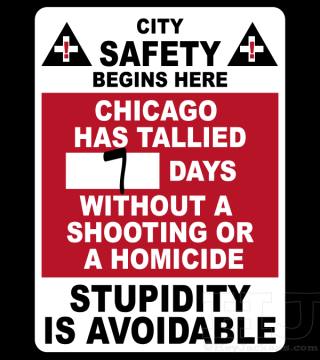
    Also, from the fun info at heyjackass.com, Chicago saw but 7 days in 2015 without a reported shooting or homicide. Seven.

    Also, on the subject of the CPD, I’m happy an insider seems to have been tapped to be the next chief of police in Chicago. I have no idea who the person is. But I’m happy it’s not another outsider with no real clue coming in to save the day.

  • A Toddlin’ Town

    From AP:

    In all, Chicago has paid a staggering sum — about $662 million — on police misconduct since 2004, including judgments, settlements and outside legal fees, according to city records. The payouts, for everything from petty harassment to police torture, have brought more financial misery to a city already drowning in billions of dollars of pension debt.

    The Chicago police said there were 45 firings and 28 suspensions from 2011 through 2015 in a department of about 12,000. Some cases remain open.

    The city’s top lawyer, Stephen Patton, says his office has reduced costs with new strategies: It has cut the number of outside lawyers by more than 80 percent, taken more cases to trial (the corporation counsel’s office won 21 of 28 last year), whittled down a backlog and spread the word it will no longer settle small cases routinely.

    Burge cases — including settlements and outside lawyers — have cost the city more than $92 million (about $109 million, if county and state expenses are included), according to Taylor, who keeps his own tally.

    And I’m just going to beat Pirate to the punch.

  • Stop paperwork (2)

    Stop paperwork (2)

    An email from a Chicago Police Officer (emphasis added by me):

    I wanted to go through our new “investigatory stop report (ISR)” training before I replied. By now you realize we have an extremely long form to fill out every time we do a street stop. The form is ridiculous and redundant but fortunately the department has created a shorter form that will we start using on March 1st. I think they missed the point with the gripes about low street stops. The form sucks, is burdensome, and redundant, but it’s just paperwork.

    The issue is that there is still heavy oversight by the ACLU and many private attorneys and their quick access to all information on ISRs. So now, instead of just your sergeant deciding if you have articulated enough reasonable suspicion, each ISR has to be approved by a sergeant, the integrity unit, and then combed over by an endless amount of lawyers looking for the slightest hiccup in the report. Private attorneys have started contacted people stopped about two weeks after each incident, by phone and/or mail and asking them how the police treated them while they were stopped. This is really unsettling.

    All of this seems like a direct result from the McDonald shooting, even if it’s not. Although no one is talking about it (the media has moved on to other police issues from where we park to the “thin blue line” code of silence). Immediately after the dashboard camera video came out, most cops were defending the shooting even after seeing the video. I get it. I would not have shot, but I understand why Van Dyke did. A crazed maniac on PCP with a knife is certainly dangerous and it doesn’t morally bother me that he was shot. I do think it was a bad shooting, but not by much. Although, I come from a newer generation of policing with a different mindset I suppose.

    After the protests and eventually when the ISR system came out, everyone started to vilify Van Dyke as the cause of all this oversight whether or not they believed it was a good shoot or not. Those that believed it was a good shot, no longer say anything about it, if that makes any sense. Basically, no one is supporting Van Dyke anymore, at least not openly. Meanwhile, street stops are down an astronomical percent and homicides are at at 12-year high through February. On the 11th, the superintendent sent out an email to the department reminding them that it’s still okay to do street stops. No one took it seriously but the bosses have to do something to get numbers.

    The idea that every report is being read by people looking to sue police officers is not a way to encourage productive proactive discretionary police activity.

    The first two months of 2015 saw 51 homicides. 2016 has seen 101. That’s double, for those slow in math. If you don’t want to call this a “Ferguson Effect,” fine. I’ve never liked the term. But perhaps we can agree that if police feel they can’t do their job for fear of lawsuits and/or criminal prosecution and thus do their job differently and then crime goes up, something is going on?

    So if you don’t like “Ferguson Effect,” how about we call it the “when police feel they might get in trouble for doing their job, so police — mostly to satisfy critics on the left who seem not to care how many people die as long as police are not involved — get out of their car less, stop fewer people, interact with fewer criminals, and then murders skyrocket” effect?

    See part of the police job is to harass criminals. Maybe you can think of a better word than “harass,” but I use that work intentionally. Because policing isn’t all please-the-old-ladies-going-church. People don’t like to talk about it, but there is an actual repressive part of the job — legally and constitutionally repressive, but repressive all the same. When that doesn’t happen, criminals commit more crime.

    [What I also find interesting in that a change in police culture with regards to what constitutes a good shooting is happening in front of our very eyes in Chicago.]

    And here’s the email from the Acting Chief:

    Good Evening Everyone,

    I want to clarify concerns regarding the Investigatory Stop Report (ISR) and the Department’s Agreement with the American Civil Liberties Union of Illinois (ACLU). I have heard your concerns and I am working toward a solution.

    First, since January 1, 2016, Illinois Law requires all law enforcement agencies in Illinois to document investigatory stops and protective pat downs. We are not alone in this endeavor; the entire state is tasked with documenting investigatory stops and protective pat downs. Neither the law nor the Department’s Policy has changed as to when stops and pat-downs are appropriate; merely the documentation has changed.

    Second, Officers will not be disciplined for honest mistakes. I know that the Department ISR Policy has been in effect since January 1, 2016. The Department is working tirelessly to train everyone on the ISR policy and procedures. I know there is a learning curve and I appreciate your understanding as we make this transition.

    Third, I would like to clarify the agreement between the Chicago Police Department and the ACLU. The Department has not relinquished any control of our policies and procedures to the ACLU. The agreement does not provide the ACLU with any role whatsoever with respect to individual officers’ compliance with the Department’s policies. The Department alone is responsible for supervising compliance with policies and procedures. Rather, the Department’s agreement with the ACLU provides that a former federal judge, the Honorable Arlander Keys, will review CPD’s policies, practices, and data regarding investigatory stops and recommend any changes that are reasonable and necessary to comply with the law, and that the ACLU will have an opportunity to review and comment upon CPD’s policies, practices, and data.

    Fourth, our Department is working to reduce the burden on officers. Remember, completing an ISR is in the best interests of Officers based on the Illinois State Law. A properly completed ISR helps protect the officer by documenting the basis for the stop and any resulting pat-down. Additionally, the transparency of the agreement with the ACLU and the ISR create a trust and mutual respect between our agency and the communities we serve.

    Lastly, officer safety is one of my greatest concerns, and continues to be a valid basis for a protective pat down. Officers simply need to describe in the ISR why they believe their safety was at risk. To perform a stop, an officer must have reasonable articulable suspicion, based on the facts and circumstances, that a crime has been, is being or is about to be committed. And, before an officer conducts a protective pat-down, he or she must have reasonable articulable suspicion that a person stopped is armed and dangerous and therefore poses a threat to the officer’s safety or the safety of others. Neither of these requirements are new policies.

    I appreciate all of the hard work that each of you do on a daily basis. Additionally, thank you for your service and dedication to the people of Chicago. Take care and stay safe.

    Sincerely,

    John J. Escalante

    Interim Superintendent of Police

    Chicago Police Department

    Here’s the long form in question and my previous post on “stop paperwork.”

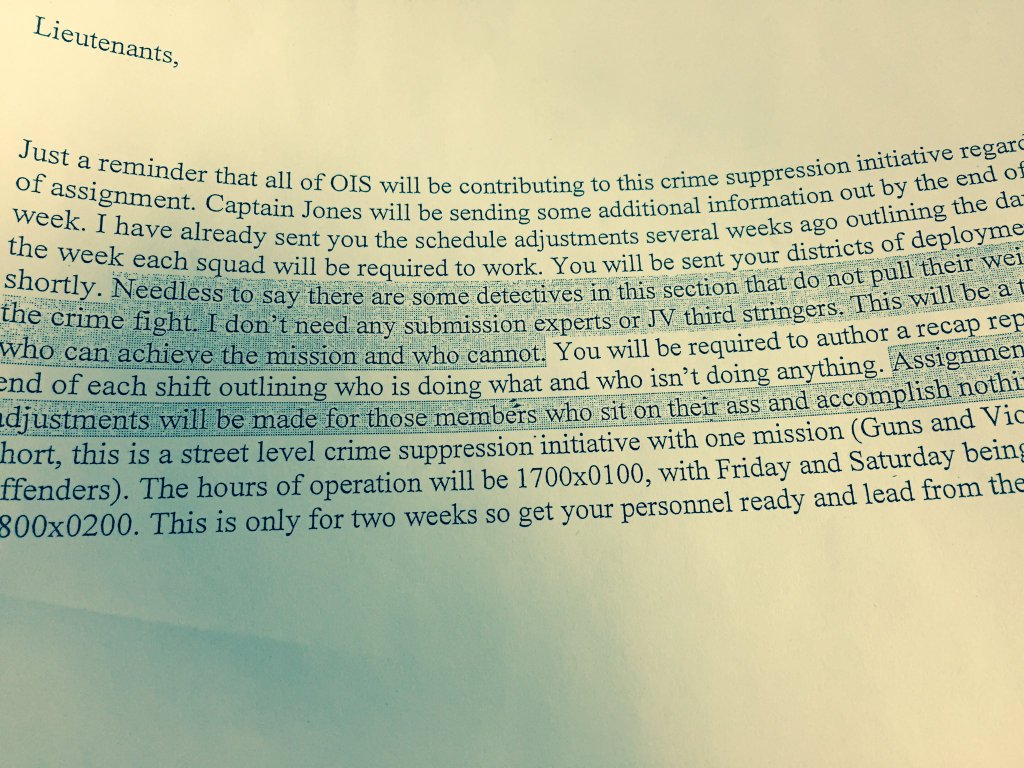
    Maybe Chicago could learn from the Baltimore way of motivating cops: pull your weight; and no “submission experts” or “JV third stringers” need apply!

  • Defining the Ferguson Effect

    Denying the Ferguson Effect and any link between policing and crime has become almost a cottage industry in some circles. It’s sort of the liberal equivalent of conservatives denying climate change and, er, on the small chance it is changing, any link between global warming and human activity. Sure, the world may be warmer. But God works in mysterious ways. Same with crime, if you listen to many of the Left.

    Here’s a new study :

    There is no evidence to support a systematic Ferguson Effect on overall, violent, and property crime trends in large U.S. cities.

    OK. But the author do admit:

    The disaggregated analyses revealed that robbery rates, declining before Ferguson, increased in the months after Ferguson. Also, there was much greater variation in crime trends in the post-Ferguson era, and select cities did experience increases in homicide.

    OK…. So doesn’t that mean there is a Ferguson Effect? Apparently not:

    Overall, any Ferguson Effect is constrained largely to cities with historically high levels of violence, a large composition of black residents, and socioeconomic disadvantages.

    “Constrained to”? Isn’t “constrained to” synonymous with “present in”? Aren’t cities with “historically high levels of violence, a large composition of black residents, and socioeconomic disadvantage” exactly where you’d expect to find a Ferguson Effect!? I mean, I wouldn’t expect to find a Ferguson Effect in Winnetka, for crying out loud! (Winnetka, Illinois: median income $211,000; 0.3 percent black.)

    Liberals, myself excluded, have long tried to discount the efficacy of policing vis-à-vis crime prevention. And now academics seem to want to deny any “Ferguson Effect” because… I don’t know. Just guessing, but maybe it goes against a Progressive narrative that police are racist enforcers of bourgeois heteronormative values?

    There’s no reason the Ferguson Effect needs to be universal or even linked specifically to one event in August, 2014. The question shouldn’t be if all cities haven’t seen an increase in all crime but rather why why some cities — most cities, in fact — have.

    What if, hypothetically to be sure, a laser-like focus on police-violence reduced police-involved killings but simultaneously allowed hundreds and even thousands of more murders to happen? If that were true, then what?

    What if “hands up don’t shoot” were built on a false narrative? What then? What if, just for the sake of debate, we assumed that most police-involved killings were actually justified (since most are) and even life saving? What if the goal of eliminating police-involved killings was, in part, counterproductive? Then what?

    Different cities have had different “Ferguson Moments.” It wasn’t like something magically changed everywhere when Michael Brown was (justifiable) killed. All policing is local.

    In New York City the Ferguson moment may have been protests after the death of Eric Garner. Cops were verbally attacked, physically attacked, and two were killed and another bludgeoned with a hatchet. If you think none of that matters… well then you haven’t talked to any New York City cop.

    In Baltimore, just thinking out loud here, perhaps it was the protests and riots after the death of Freddie Gray. And the misguided criminal prosecution of innocent cops. In Cleveland, not that I know much about Cleveland, I would assume policing changed related to the killing of Tamir Rice. In Nashville? Beats me. But maybe it was giving hot chocolate and coffee to protesters. I applauded that move. Liberals like me love that shit. But I bet it pissed off a lot of the rank-and-file.

    So no, it’s not Ferguson per se. Call it whatever you effing want. (I’ve never been a fan of the actual term “Ferguson Effect.”) I’m talking about the real-world effect of an anti-police narrative, the fear cops have of getting in trouble for doing their job, and perhaps the first-hand experience of policing anti-police protests.

    Meanwhile, in Chicago:

    Cops say they have avoided making many of the stops they would have routinely done last year. They fear getting in trouble for stops later deemed to be illegal and say the new cards take too much time to complete.

    Their reluctance to make stops was borne out by a police statistic released Sunday: Officers completed 79 percent fewer contact cards in January 2016 than over the same period last year.

    January 2016 was the deadliest first month of the year since 2001

    Just coincidence, of course. There’s no way to prove any of this. But I sure haven’t heard any good alternative explanation. (At some point, I am partial to Occam’s Razor.)

    The ACLU rejects any correlation between declining street stops and rising violence…. Other cities have scaled back their street stops without an explosion of shootings. The reduction of “invasive” street stops is actually a good thing.

    Really? Well, yes, the NYPD scaled back its stops and crime did not increase. (Not only did crime not increase, between 2011 and 2013 homicides in New York City plummeted 35 percent!)But that doesn’t mean that all police stops are bad and to be prevented.

    The ACLU released a report in March that found blacks accounted for 72 percent of [Chicago] stops between May and August of 2014, but just 32 percent of the city’s population.

    Again?! Once again we have a denominator problem. Eighty percent of Chicago homicide victims are black. And presumably murderers, too, since most homicides are intra-racial. Should only 32 percent of those arrested for homicide be black? I don’t think so. Are only 32 percent of public drug dealers black? No. So why would one expect only 32 percent of those stopped by police to be black?

    Look, cops aren’t always right. And cops will always complain. But if homicide is going up and cops are saying, “Uh, here’s the problem: I can’t do my job. And this is why….” Perhaps we should listen. What worries me is the goal to eliminate virtually all discretionary police activity couched in the language of social and racial justice. But if you want police to do less, there’s no better way than mandating a two-page form for every stop.

    We will see what happens. But crime already is up in many cities. And that — not reducing the number of police stops — should be our first concern.

    [see also this]

  • The 1 percent

    Out of 12,000 Chicago Cops, 124 are responsible for a third of misconduct lawsuits settled by the city since 2009, costing $34 million. The Tribune(behind a paywall unless you good for the article) reports that 82 percent of the department’s officers were not named in any settlements. (Keep in mind that a good chunk of that 82 percent haven’t interacted on-duty with a member of the public since Richard J. Daley. The proper denominator here would be the number of cops on the street.):

    Of the more than 1,100 cases the city settled since 2009, just 5 percent were for more than $1 million…. [The rest still] cost the city millions of dollars…. A vast majority, 85 percent, were settled for $100,000 or less, which meant the deals did not require City Council approval. And Chicago officers accused of misconduct are rarely disciplined.

    Of course there are many unfounded complaints. Just as there are many BS lawsuits filed for a quick monetary settlement. I know that. But just like a criminal arrest 20 times — God only knows how many crimes he committed without getting caught — a cop with 57 complaints? God only knows how much shit you really did. Not every mope complains.

    While many officers as well as police union officials attribute claims of misconduct to the rough and tumble of working in crime-ridden neighborhoods, complaints against Campbell, Sautkus and their colleagues have often occurred while the group patrolled relatively low-crime areas, focused on quality-of-life issues.

    The three officers have earned hundreds of awards and commendations from the department for their work. They’ve also racked up 16 lawsuit settlements since 2009 among them and two other officers who also live in the neighborhood… The city paid $1.5 million to settle those cases.

    How the hell does one officer get sued (with payout) seven times in seven years and average about 6 complaints a year? Good God. Hundreds of awards. As long as he kept finding the drugs, he gets awards. Doesn’t anybody look for red flags?

    I can’t help but think of my friend and squadmate who retired as a noble patrol officer after 33(!) years on the mean streets of Baltimore. He once confided in me, half gleefully and half sheepishly, that he hadn’t received a single serious complaint in his entire career. Now mind you, in his 30th year, he wasn’t exactly setting the curve in number of arrests. But he did his job and did it well. His secret? He was a good cop. He didn’t take shit, but he also treated everybody with respect, even those who didn’t deserve it.

  • Chicago Cover Up

    From the mayor on down to the officer on scene, the cover-up seems pretty big. Multiple false reports are very worrisome. Though a detective taking a statement from Van Dyke shouldn’t qualify as another false report. But Van Dyke’s partner, Walsh, is certainly culpable.

    Update: The New York Timessays “at least five other officers on the scene that night corroborated a version of events similar to the one Officer Van Dyke.”