A reader pointed out a good article in Chicago Magazine by John Conroy, “A Mugging on Lake Street.” It’s a bit heartbreaking to learn that John Conroy, whose name I recognize as a quality journalist, doesn’t have a regular gig. But at least he got this assignment. Too bad it all started with Conroy getting jumped while riding his bike home through the West Side of Chicago. (Actually Conroy was “banked” more than “jumped,” but only those in Baltimore will understand that subtle distinction.)
The story that follows is all about crime and race and punishment. It’s worth a complete read.
I was ambushed on the West Side last year, an attack that on its face made no sense. I’d never seen my assailant before; he’d never seen me; no words were exchanged; nothing was taken. Like many crime victims, I wanted the incident, which changed my life for the worse, to have some meaning. I’m white, he is black, and in time it was hard not to wonder if race had something to do with it.
…
I stopped by the 15th District police station, at 5701 West Madison Street, hoping to thank the officers who’d helped me. Looking for help in finding them, I asked for an acquaintance, T. C. McCoy, an African American officer who lives in the district and has worked there for 24 years. When he heard my story, he said, “It’s a hate crime.”
Conroy wants to meet his offender. He does. He wants to interview him. He doesn’t.
But in the process Conroy learns what it’s like to be a victim in our f*cked-up criminal justice system. It’s not good and Conroy ends up being had. But read the whole article because I can’t do it justice in excerpts. And it’s far deeper than a simplistic tale of a naive liberal who got mugged (though there’s some of that, too. I wonder if he’ll becomes conservative, as the old cliche goes).
His article hits home with me for many reasons.
1) I was born in Chicago.
2) I bike around cities in all neighborhoods at all times. I’ve never been the victim of violent crime (or been hit by a car), on or off a bike. I hope to keep it that way.
3) My father grew up less than two miles from where Conroy was jumped. I drove through this area coming back from my father’s funeral last year. Before my father died he liked to say that his block on N. Avers Avenue (the eight or ten-hundred block?) looked basically the same as it did when he was a kid, except now everybody is Mexican and Puerto Rican.
My in-depth knowledge of Chicago basically ends in 1989 when I went to college. I still call L lines by their destination and can’t get over the fact that yuppies live around Cabrini-Green. Cabrini-Green was a no-go area when I was a kid. So was the West Side.
So my first thought when I saw Conroy’s piece was, “What the hell is a white boy doing biking down Lake St?” In my slightly dated mind, the map of Chicago turns to dragons and winds west of Greektown and Halsted Street. My how times have changed; Conroy was biking home.
Of course sometimes sh*t just happens. But it usually takessh*ts to dosh*t. And most people choose to live as far as possible from sh*t.
You could say that Conroy was just in the wrong place at the wrong time. But some neighborhoods have more wrong places and wrong times than others. The corner of Lake and Laramie is a wrong place. There’s a liquor store, a check cashing store, a phone store, a Chinese take-out, loitering people, and a vacant lot. Presumably it was the vacant lot from where Conroy was attacked.
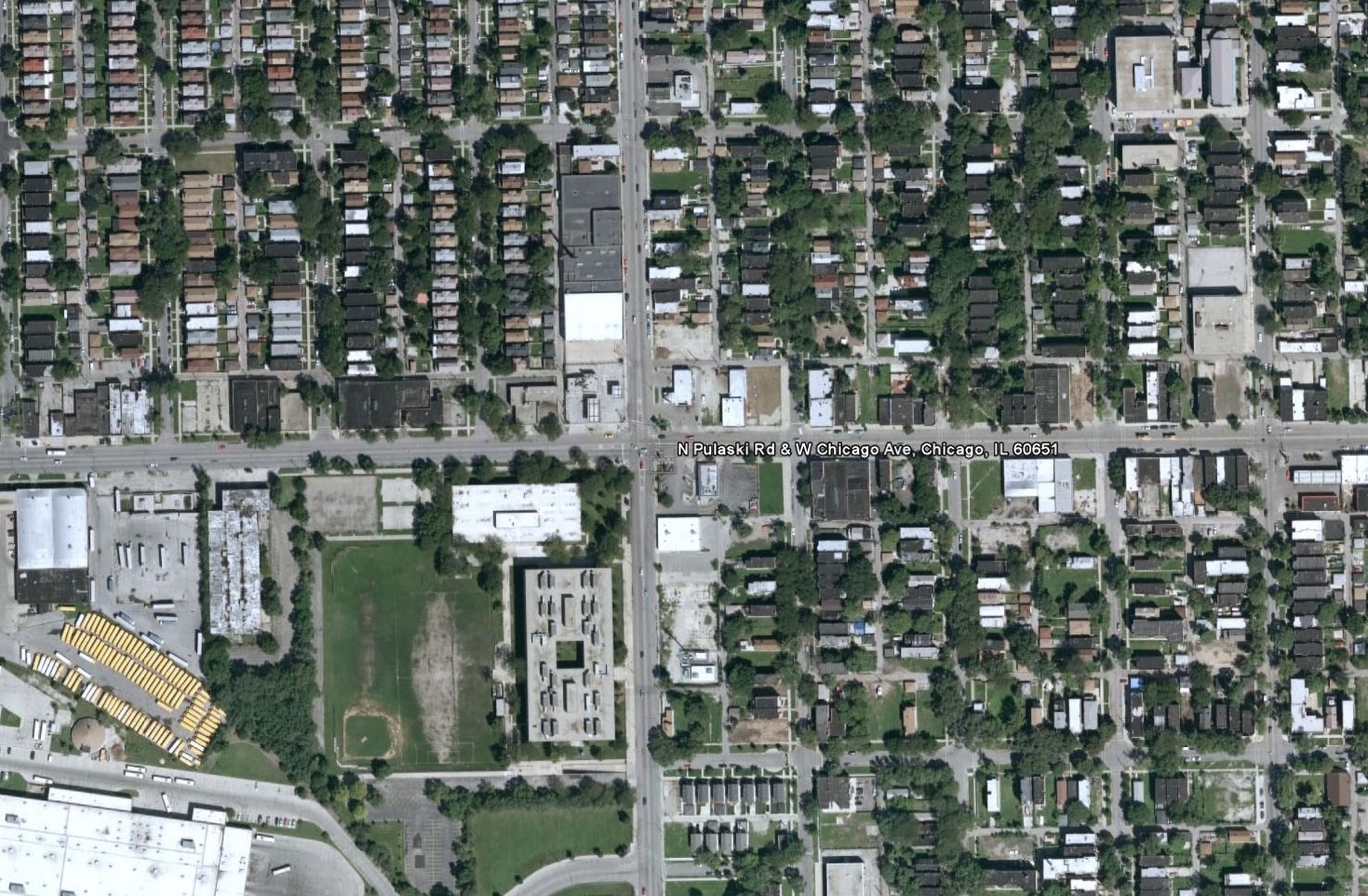
I learned that from google earth’s street view. You can learn a lot about a neighborhood from google earth. If you like google earth (and who doesn’t?), zoom in on the intersection of Chicago and Pulaski, north of Garfield Park in Chicago and cornering a big industrial zone.
To the northwest you get row upon neat row of Chicago bungalows. All’s well there. That’s probably what Conroy’s block looks like.
To the northeast is where my father grew up. Things still look OK. You have homes and trees. But a few vacant lots are very worrisome. Still, you can even see nice block party / church festival being set up by Our Lady of Angels. That’s where my father went to school (before the horrible fire) until the family moved out to Albuquerque.
But go south on Avers past Chicago and things start to git grim. Now you’re in the rough black West Side. From above, you can see fewer trees, more vacant lots, roofs in disrepair, trash in backyards, and abandoned cars littered to and fro. The street view shows boarded-up buildings next to well kept-up homes.
It’s always the abandonment that strikes me. Entire city blocks empty. And just a short distance from where people pay half-a-million dollars for a “tear-down” lot. Crime, fear of crime, and race matter so much that in just miles property goes from being worth millions to being worthless and literally abandoned.
Ta-Nehisi Coates comments on Conroy’s article here and here. As usual, he’s insightful, bold, and more often right than wrong (and who can resist the title, “The Logic Of The Bumrush”).
I was struck by Conroy’s quest to find a deeper meaning in what happened to him. This may be more about me than him–but my sense of what always makes the hood so dangerous is the actual lack of real meaning, the random nature of violence, and how it pervades everything.
…
Put bluntly, it’s not that they treated [Conroy] like a honky–it’s that they treated him like one of their own, like a nigger.
And
Eventually you tire of the whole dynamic. At least those of us who aren’t built like that, do. And make no mistake, most of us aren’t.
One thing I learned policing in Baltimore is that I canhandle tough streets. I just don’t want to. Luckily for me, I don’t have to.