Tag: courts

  • Page Croyder is mad as hell

    She’s the former prosecutor who has taken to writingabout her former office and its overreaching prosecution of the six Baltimore cops who in the neighborhood when Freddie Gray died in police custody. Here’s her latest:

    I said in my first blogon Freddie Gray, days after Mosby sensationally announced her charges, that she was setting up the false expectation that a crime was committed and that convictions would follow. She showed only the weakest of evidence in her probable cause statement, and it got worse over time. When the autopsy report revealed that she could not prove her case, the Sun said nothing. NOTHING. It had been moralizing and pronouncing legal judgments all over the place (see below), but went silent when the autopsy report made clear that an accident had occurred. The editors never delved into, never elucidated for its readers, the difference between civil and criminal standards of conduct, but instead helped perpetuate the false belief that they were one and the same. All it wanted after the autopsy report was leaked was for the trials to stay in Baltimore, where it was most likely that citizens would also confuse the issues. Take a quote from a citizen in the same edition as the editorial: “The city gave the family all that money. They practically said [Porter] was guilty. How can the jury not find him guilty?” And nearly every other quote from Baltimore citizens expressed surprise at the failure to convict.

    Wouldn’t it have been refreshing had the editors said, “Our bad. We trusted that Mosby had the evidence, that she knew what she was doing, and we were wrong. Instead they wrote two pusillanimous editorials after the verdict defending themselves.

  • “What led to a mistrial”

    Luke Broadwater and Ian Duncan summarize the issues in The Sun.

  • Hung Jury in Porter trial

    Hung on all four counts. That is not what I expected. I expected acquittal on the major charges, and perhaps a hung jury on the minor charge of “misconduct.” But no conviction is still a big setback to the prosecution.

    What does this mean? Since I’m no legal expert, best to turn to those who understand these issues. Here’s Richard Thornburgh, former Attorney General, being interviewed by Ali G’s:

    Thornburgh: All bets are off. They have to try him again. Hung jury.

    Ali G: But surely da size of their dongs, whether they is hung or not, won’t affect their judgement.

    Thornburgh: Well, uh, I don’t see the connection.

    Ali G: You was saying dat if you was hung, you know, if all the jury members…

    Thornburgh: No! That’s a figure of speech. A figure of speech. A hung jury is one that can’t agree. It has nothing to do with the physical characteristics.

    Ali G: So it ain’t like 15 blokes that is like well packing down there?

    Thornburgh: No, I’m sorry I should have make that clear.

  • Maryland Pattern Jury Instructions

    The jury, which is currently in deliberation, will be given this (or something very similar to this) to help them decide if Officer Porter is guilty of these charges: involuntary manslaughter, reckless endangerment, misconduct, and second degree manslaughter.

    (thanks to a reader.]

  • Why the stops matter

    Why the stops matter

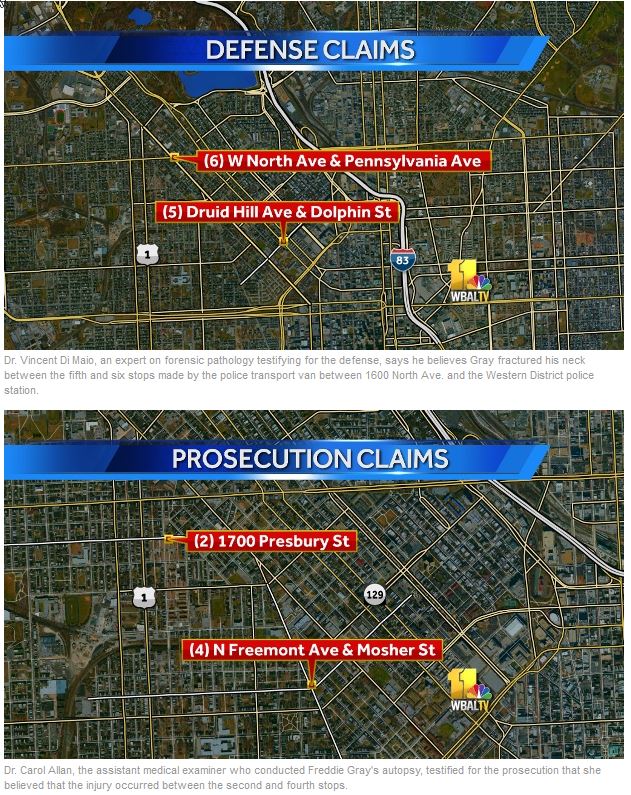
    These stops are confusing and the numbering system is never consistent, but they still matter. Here are some maps from WBAL:

    The summary from WBAL:

    Prosecutors contend Porter is criminally negligent for Gray’s death, because he didn’t call a medic when Gray requested one, and he didn’t buckle Gray into a seat belt at the police van’s fourth stop [labeled 5, above] at Druid Hill Avenue and Dolphin Street, the stop where Porter testified he helped Gray from the van floor onto the bench.

    Porter said he didn’t call a medic, because Gray wasn’t specific about an injury, and he didn’t see any signs of external distress. Porter told the jury, at this point, he assisted Gray, who used his legs and could support his own weight.

    Officer Mark Gladhill testified for the defense Thursday and said at the van’s fifth stop [I’m not clear if this is 5 or 6 above] he saw Gray leaning, but he was supporting his back and his head:

    “You are positive that Mr. Gray was holding his own head up?” [Gladhill] was asked, to which he replied, “Yes. I’m positive.”

    This wouldn’t be possible if Gray had already broken his neck. If Gray wasn’t seriously hurt when Porter dealt with Gray, Porter can’t be neglectful for not taking care of an injury that hadn’t yet happened. There’s still the seat belt issue, but that’s weak in relation to Porter. Prosecutors contend Gray got hurt earlier. (I’m not exactly certain how the prosecution asserts how they know that the injury happened earlier.) Gladhill’s statement is important.

    From the Washington Post:

    Porter responded after the police van’s driver, Officer Caesar Goodson Jr., put out a call for a welfare check on Gray. Porter testified this week that he helped Gray off the floor of the van, asked him if he needed a medic (but never called one) and told Goodson to take him to a hospital. Those actions, [Baltimore police Capt. Justin] Reynolds testified, go “beyond what many officers would have done.”

    From WBAL:

    Porter said he asked Gray at the fourth stop if he needed to go to the hospital and Gray said yes. Porter said he told van driver, Officer Caesar Goodson, that Gray needed to go to a hospital. He said, “I could not order Goodson to do that.”

    Gray wasn’t Porter’s prisoner. That matters. Again from the Post:

    At the fifth van stop, Gray again told Porter that he needed a medic, and Porter told his supervisor, Sgt. Alicia White, that Gray needed to go to a hospital. Reynolds said it was “absolutely reasonable” for Porter to expect the supervisor to get help. White has also been charged in Gray’s death.

    Reynolds said that Goodson was ultimately responsible for Gray’s well-being and that the department’s general orders are “guidelines,” not strict requirements.

    “There are parts of general orders you have to violate to do your job,” Reynolds said. He cited a much-ignored rule that officers be quiet and civil at all times as an example. He added: “Common sense prevails over everything else.”

    If I were on the jury, I’d have more than reasonable doubt.

    If Baltimore were a white-majority city with a white political power structure, the political Left would be screaming at the racism and injustice of prosecutors charging an innocent black man.

  • “When is failing to act a crime?”

    Ian Duncan of the Sun explores the issue:

    David Harris … said American criminal laws are usually of the “thou shalt not” variety, rather than “thou shalt.”

    “We’re pretty stingy in this country and this culture with obligating people to do stuff,” Harris said.

    Legal experts also said it’s difficult to find criminal cases against police officers accused of inaction.

    David Gray … said the jury could decide to convict Porter of manslaughter — the most serious charge that carries a sentence of up to 10 years — based on one of two legal theories.

    Under one, the jury could convict Porter if they find beyond a reasonable doubt that he knew his failure to act posed a “substantial and unjustified risk of death or severe bodily harm,” the professor said.

    Under another, they could convict Porter if they find that he should have known the risk and that “his failure to recognize that risk was so wanton as to represent a gross deviation from the standard of care that any reasonable officer” would have given.

    Philip Stinson, a professor at Bowling Green State University who maintains a database of police misconduct cases, found just two incidents among thousands he has logged between 2005 and 2011 in which police were charged with negligent homicide in a death that didn’t involve a gun or an automobile crash.

    “The Maryland judiciary has, as far as I can tell, produced a surprisingly vague body of homicide law,” [Serota] said.

    Judges have called the state’s laws “treacherously ambiguous,” and “perplexing,” Serota wrote in a recent law article. In Maryland, he noted, the criminal code doesn’t define manslaughter other than to say it’s a felony and to outline the penalties.

    [In another case after a jury convicted a Maryland police officer of involuntary manslaughter], the Court of Appeals threw out the verdict, finding that there was insufficient evidence. The judges ruled that reasonable officers would have acted the same way as [the cop], so he could not be found criminally responsible.

    The judges instructions to the jury will be very important. Are those public?

  • “There is no such crime as ‘homicide by no seat belt’”

    “Mosby is getting her rear end kicked in court. Not by a brilliant defense strategy, but by the facts. Facts that she could have discovered had she conducted herself professionally and ethically.” So saysPage Croyder, who retired in 2008 after 21 years with the State’s Attorney’s Office. My last post highlighted her insightful blog.

    In police trials like this, people look for solutions to grand moral and historical issues. But criminal prosecution is about the guilt of an individual. If you’re looking for answers to society’s problems, or just someone to blame for all the wrongs in the world, a criminal trial isn’t the right place.

    Even among those who love the idea of prosecuting cops, ideologues who lap up and purr any time they hear “progressive” talk, I’ve yet to hear anybody actually defend Mosby’s choices or competency. Even those who don’t trust cops (sometimes for good reason) may have to accept that these cops are innocent.

    Here is Croyder’s take on the current trial of Officer Porter (the first of six officers to be tried). She wrote this op-ed in the Sun from back in May. But her similar blog piece throws some extra punches.

    A later piece, also from May:

    I already discussed Mosby’s failure to use the important tools available to her that any competent prosecutor would have taken. I was willing to believe that this reckless failure stemmed from inexperience.

    But her press conference was troubling in how far it strayed from a prosecutor’s duty. She addressed herself to protesters across the country, embraced their cause, called for sociological change, promised justice for the young and for Freddie Gray.

    These words, together with her demeanor, drew praise from newspaper editors, TV reviewers and many in the public. But they were the words of a politician, not a prosecutor. As a prosecutor her performance was awful, violating her ethical duty and generating suspicion that her charges were political.

    Mosby is in the wrong office. Once elected as State’s Attorney, she had to abide by ethical rules that she repeatedly ignores…. Politicians can lead wherever they choose. But unless prosecutors are bulwarks against politics in the criminal justice system, that system fails.

    From June:

    Death by no seat belt or medical delay would ordinarily be a case headed for civil court….

    What to me remains most indicative of Mosby’s mindset is her pursuit of the two arresting officers, who we now know for certain had nothing to do with Gray’s death. On duty after Mosby’s office urged greater crime suppression in that exact location, these officers justifiably pursued someone who fled from them on sight, and with ample legal precedent behind them, took him down and patted for weapons. By turning this into a crime, Mosby has told all police officers that they cannot do their jobs as they have been trained to do them.

    Mayor Stephanie Rawlings-Blake and [now former] Police Commissioner Leonard Batts are taking all the heat for the crime spike since Mosby charged the six officers. No one locally wants to point the finger at Mosby. I will. It’s mostly on her.

    I said much the same thing. It’s not just that cops were worried about making a terrible mistake and then being prosecuted. It’s the legitimate fear Baltimore cops have of being criminal charged for doing their job correctly.

    From October:

    The decision of Judge Barry Williams to keep the trials of the six police officers charged in the death of Freddie Gray in Baltimore City demonstrates that judges, too, are human.

    Legally speaking, Judge Williams should have moved the trials out of Baltimore…. If the top prosecutor, whose sole job it is to follow the facts and the evidence, was influenced by the unrest, wouldn’t the citizens of Baltimore be similarly influenced?

    By deciding to keep the case in Baltimore, Judge Williams has created a substantial argument for reversal, something that trial judges try – or should try – to avoid for the sake of all parties.

    Judge Williams has proved that he will work hard. A number of lazy Baltimore judges would have moved the case just to get out of the work this case entails. Nevertheless, those lazy judges would have been legally correct.

    December 3:

    In the first year of her administration, with a million issues to confront, Mosby is being paid over $238,000 to watch a trial. It doesn’t take a genius to figure out why: she has staked her reputation on this case, and she wants the judge and jurors to know it, to influence them by her presence. Never in my two decades as a Baltimore prosecutor did I see the State’s Attorney watch a trial. They had too much work to do.

    December 10:

    Mosby and her team lack the judgment, priorities and experience needed to run an effective prosecutor’s office anyway. Mosby was a run-of-the-mill prosecutor who became a run-of-the-mill insurance attorney before election to the largest prosecutor’s office in the state.

    Here’s her most recent post:

    Her own probable cause statement did not support her sensational indictments. The autopsy report didn’t either, despite it’s legal conclusion (that was clearly influenced by Mosby.) And now the facts reveal that not only are the charges not provable beyond a reasonable doubt, but the officers are actually innocent.

    In any event, there is no such crime as “homicide by no seat belt.” If one wants to call it negligence — despite other police departments (not to mention other transit vehicles, like buses) not using seat belts — then fine. That’s why the city paid the Gray family over $6 million. But there was no police brutality or a criminal disregard for Gray’s safety.

    When Mosby loses and the officer walk free, then what? Bad leadership has consequences.
  • “A small glimpse into the lazy, egotistical, dysfunctional world of key players in criminal justice system”

    Page Croyder spent two decades with the Baltimore State’s Attorney’s Office. A few weeks ago I discovered her blog (thanks to a comment). The prosecutor’s office — the State’s Attorney in Maryland — and the court system in general is a big Skinner box of unknown for most people. Croyder offers insight.

    People get arrested and somehow they end up in jail or prison. Even if the courts have the power, the prosecutors may be the puppet masters of the system. They shape police behavior and tactics. They determine who walks and who doesn’t. And all this in an elected underfunded office not represented by any union. The courts have no constituency to fight for dollars. Most people don’t really care what happens in the courts as long as they don’t get called for jury duty.

    Croyder was never the most prolific blogger, which makes it all the more readable as small glimpse, “a small glimpse into the lazy, egotistical, dysfunctional world of key players in criminal justice system.”

    I assume Croyder is to the right of me politically. Or maybe not. She’s no fan of O’Malley, but then, who is?

    Funny thing is, if liberals read my blog with open minds they would see that I am no Attila-the-Hun. I support improved prisoner re-entry programs, bail reform, effective alternatives to incarceration, a radically new approach to drug crimes, reducing the barrier of criminal records to employment, and so forth.

    But I do believe that there are people who need to be locked up for the public’s safety and well-being. Not forever (for most), but until the period of their greatest dangerousness passes. This makes liberals scream. They want more rehabilitation and prevention programs.

    Fine. There’s no conflict there. But the existing criminal justice system still needs to improve its focus, prioritization and performance right now with the resources at hand.

    I see her writing as refreshingly untainted by ideology.

    Here are some highlights in chronological order. From 2012:

    And the city doesn’t need such quick turnover. Having four different police commissioners in the O’Malley mayoral years wrecked the Police Department. We need stability… to conceive a plan, develop it, and achieve significant results with violent criminals over the past six and a half years.

    We had plenty of stability at the top of the prosecutor’s office before Bernstein [under Jessemy], but insufficient competence. Now we’ve got competence. Add stability, and we achieve long term success.

    From 2013:

    The problem between police officers and judges over warrants has been going on a long time and should have been resolved ages ago.

    Baltimore city judges are supposed to take turns being “on duty” for one week at a time. Since there are about 60 of them, this means they should have this duty less frequently than once a year….

    But judges and police have fussed about this ever since I can remember. Judges feel that police bother them after hours for non-emergencies.

    To minimize their own inconvenience, individual judges often make their own rules for reviewing warrants. Many, for example, refuse to sign any “narcotics” warrants after hours, which they regard as routine.

    To me the solution is simple: police officers should do their best to present their warrants during reasonable hours, while judges should resign themselves to the fact that for one week out of every 60 they will be reviewing warrants after they leave the courthouse. They should just go home and be mentally prepared for the police to come over, not whining about officers interrupting them while they are out at dinner or the mall.

    From 2014:

    Marilyn Mosby, who just defeated Bernstein in the primary election, lacks the experience to fully comprehend the enormity of the task in front of her, let alone be able to hit the ground running. And the state’s attorney’s office will hemorrhage experienced people these next six lame-duck months, making the task that much harder. It doesn’t mean that Mosby, should she win in November, can’t eventually succeed. But her learning curve will be very steep and at public expense.

    That’s some foreshadowing.

    Next postI’ll highlight Crowder’s take on the current prosecutions related to Freddie Gray.

  • Porter trial: Dec 7.

    The prosecution rested. Judgment of Acquittal did not happen, alas.

    Judge Williams did rule that prosecutors failed to disclose that Freddie Gray had allegedly told a police officer the month before he died that he suffered from back problems. From the Sun:

    Porter’s attorneys asked that Williams dismiss the charges against Porter, grant a mistrial, or strike the testimony of the medical experts who had testified. Williams did not grant those requests but said the defense could use the information.

  • Fiddlesticks!

    @PeterMoskos wins the “Most Profanity in One Quote” Award. https://t.co/Rt22OJRYjy

    — Jeffrey Butts (@JeffreyButts) December 5, 2015

    I’m humbled and honored to win the Golden Middle Finger award. I’d like to thank all the sailors and pirates who taught me everything I know, gosh darnit.

    In all seriousness, this Guardian piece by Baynard Woods might be the first fair thing The Guardianhas written about police since the Coldbath Fields Riot of 1833:

    “I can imagine for Porter it’s difficult,” said Leon Taylor, an African American who served as a Baltimore City police officer for over a decade. “It’s more difficult when you feel that you’re part of the community and the community is willing to negate all of the positive things that you’ve done and all the greater things you could have accomplished because of this incident.”

    “If he’s convicted then his lawyer is under an ethical duty to present Porter with other alternatives to being sentenced for the crime or crimes for which he was convicted,” Colbert [a professor of law at the University of Maryland] said. “That’s where he’ll be faced with being offered a negotiation that would likely require his testimony against other officers in exchange for leniency in his ultimate sentence.”

    Peter Moskos, a former member of the Baltimore police department who is now an author and professor at the John Jay College of Criminal Justice in New York, acknowledged that there is a blue wall but said it only goes so far.

    “The general rule of thumb is: No, cops will not go out of their way to say bad things about another cop certainly,” he said. “But cops also aren’t willing to go to jail for the misdeeds of another cop. ‘Why am I going to risk my pension and my job for your fuck up’ is the general attitude … To some extent, when the shit hits the fan, all bets are off. You do have to cover your ass first.”

    “It seems like they’ve adopted a divide and conquer strategy to get the desired outcome of the case,” Taylor said of the prosecution, but noted that ultimately it depends on the outcome.

    Moskos was a bit more fatalistic.

    “I mean the problem is, even in the best case scenario for cops, they’re still fucked because Freddie Gray went into the van alive and came out dead,” he said. “That can’t happen.”

    Yeah, I got four bad boys and two f-bombs in there, thank you very much. Just for the record, we chatted for half an hour and there were long stretches without single a curse word.

    As a side note, it always cracks me up when people who don’t know policing talk confidently about the “Blue Wall of Silence”: “There’s a very strong police culture that values and enforces a code of silence,” Colbert says. How the hell would he know?

    Cops testify against cops all the time. Cops are testifying against cops right now. And right now people will insist it never happens. I mean, I bet Colbert knows a few professors, maybe some lawyers, who haven’t always been on the level. What has he said? How many of you would go out of their way to rat out a colleague? Do students tell on other students who cheats? Not in my experience. Hell I know of a married sociologist who slept with a student. Have I said anything? No. And this isn’t out of some academic “wall of silence.” I don’t even like the guy. But what can I do? It’s not a crime. And I can’t prove it. Policing is no different.

    But one thing Colbert said does make perfect sense. Mosby needs to get a conviction against Portor. She needs to. Because if she does, she can leverage the sentence over him. “Reckless endangerment” can get up to five years (though it’s a misdemeanor… how is that possible?). Five years would mean three years with good time. Or, they tell him, you can walk free if you testify enough against Ceasar Goodson to get a felony conviction (Goodson is the only one of the six who might be found guilty of anything real). Such proscutorial games are standard practice, of course. But that doesn’t make it right. Still, if Portor is acquitted of everything, which he will be if he does well on the stand (which is not a given), this whole “charge everybody who was there” is going to come crashing down on Mosby, as it should.