Tag: courts

  • Jury Duty

    Jury Duty

    How do I talk about jury duty without sounding like I’m whining about jury duty?
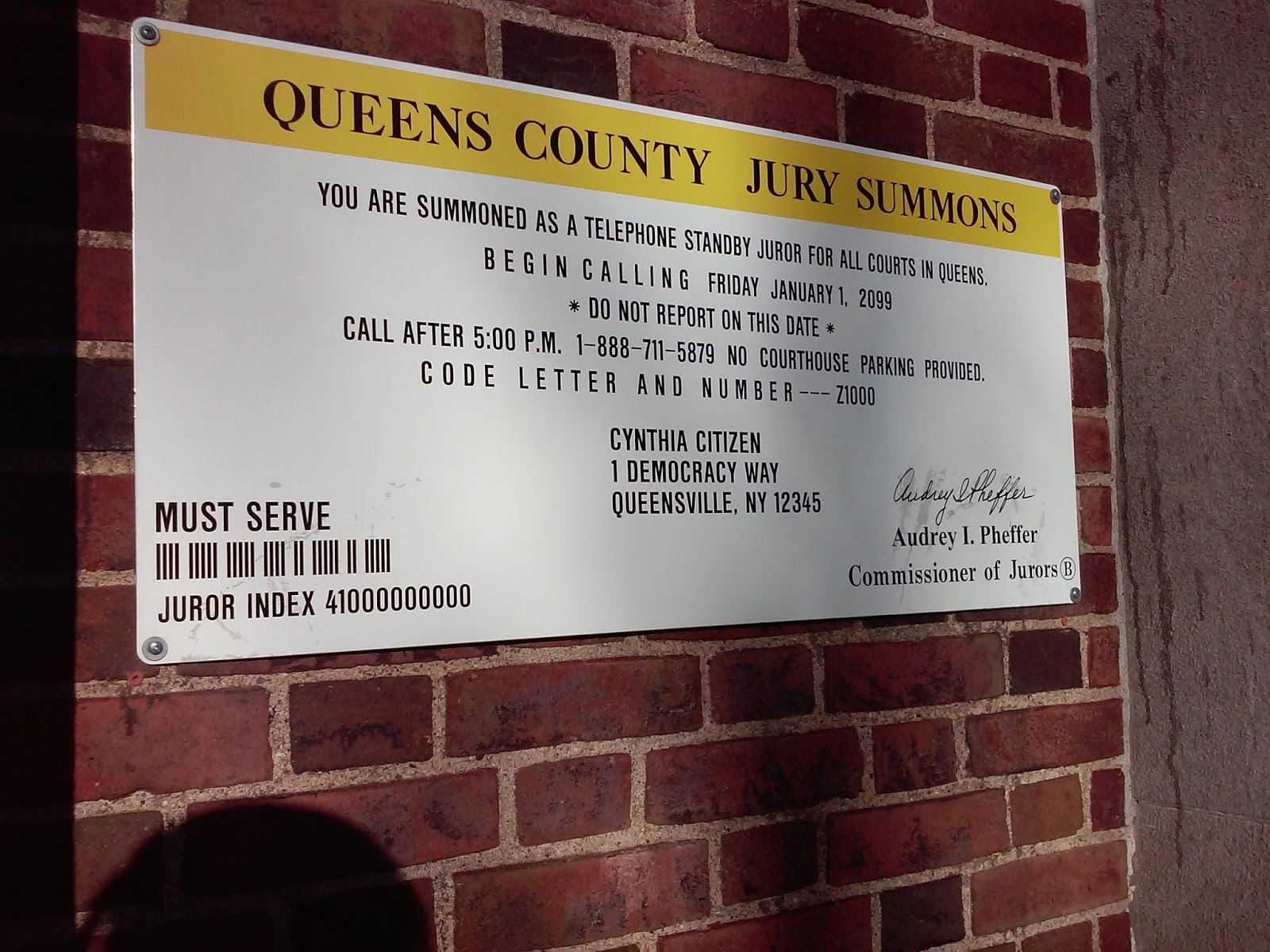
    (As to Cynthia Citizen on 1 Democracy Way in Queensville…. They can’t fool me. I know the system. That’s no Queens address.)

    I don’t want to whine, but I will mention the security line to get in the building in the morning takes 20 minutes. It makes airport TSA look incredibly efficient. Seriously.

    There were 60 jurors in our pool. Add that to the cost of the drug war. It was a drug case. 60 people missing three days of work. If you figure $100 a day of missed wages (You get paid $40 if you don’t get paid because of jury duty), that’s $18,000 right there. And for what? I bet they’re still dealing drugs in Jamaica, Queens.

    I found something slightly amusing about people griping at the inefficiency of it all. Leaving aside it’s not supposed to be efficient (but sure could be more efficient) I thought how this is a lot of peoples’ first real dealing with the justice system. And if you think it’s bad as a potential juror, just imagine how it works as a potential criminal! Still, I couldn’t help but think, “The last time I was waiting around in court, at least I was getting paid time and a half.” But except for getting up early for a commute that took an hour and a missed trip to DC, it wasn’t a terrible inconvenience to me. It could have been worse. I don’t have kids. I still get paid.
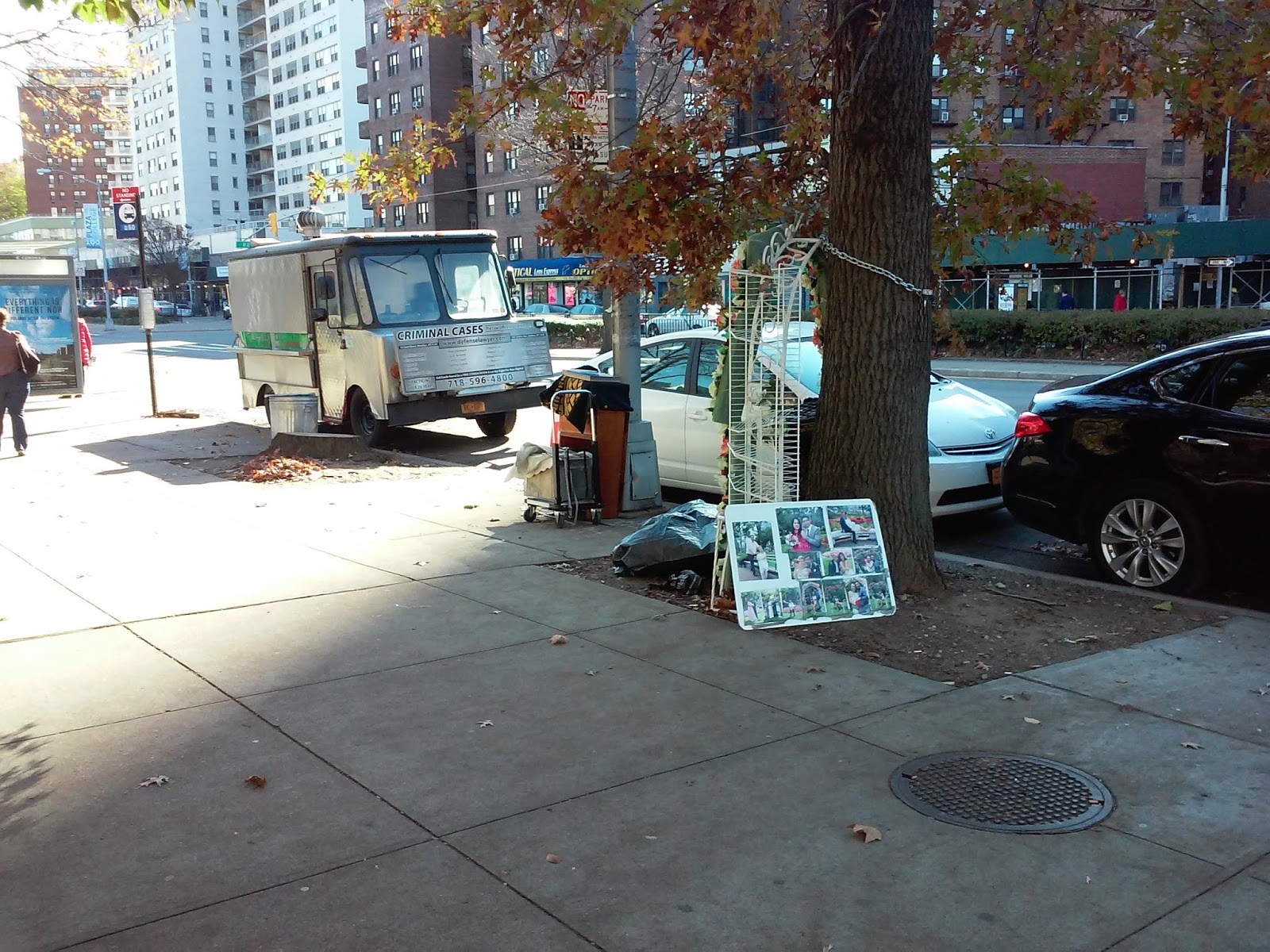
    (Nothing says Queens County Court like a food truck with a lawyer’s ad and a two-bit street take-your-wedding-picture-here operation.)

    I like “civic duty.” I actually wanted to serve. Given what I do professionally, I want to see the criminal justice system from the jurors’ box. But whatdayaknow? My educated friend-are-cops professorial ass was voir dired right off an undercover police buy-and-bust cocaine trial.

    But I had time to think. A lot of time to think. I was on telephone call from last Monday. Last week would have been a good time to serve. But I wasn’t called into the Queens Courthouse till Friday. On Friday, we were told to come back on Monday.

    On Monday, my afternoon class didn’t get taught. We were told to come back at 2pm. Half the jury was sat. The rest of us were told to come back Tuesday. I had a train ticket and hotel in DC Monday night for police conference in DC. I didn’t make it because of jury duty.

    On Tuesday, the other half was sat. We were freed at 1pm. Can’t be called for four years. I’m at least happy I was kicked off rather than simply sent home.

    Every jury was asked his or her education, marital status, occupation, occupation of family and grown children, criminal conviction, and if they or loved ones were ever the victim of a crime. The judge, the good natured and pleasantly demeanored Hon. Barry Schwartz, asked everybody if they could be fair, if they convict based on beyond a reasonable doubt, and if we wouldn’t demand more than beyond a reasonable doubt. This explaining takes a long time. Especially when it is done person by person. It was explained that most or all of the testimony would come from police, that the defendant, a black man about my age, didn’t have to testify, and that the burden of proof lay entirely on the prosecution.

    The prosecutor made it clear there was no DNA or fingerprints. This was not TV. Could we still convict based only on eyewitness testimony? Yes, I nodded.

    The prosecutor raised silly examples about the chefs at a hypothetical “Cheesecake Factory” being an important part of your dining experience even though you can’t see the chef. And annoyingly did this to each box of jurors, even though we were all in the courtroom. So we got to hear it twice. She used the Cheesecake Factory as a kind of everyman’s restaurant. Something we would all know. (“What an stupid example,” said my wife, “There are no Cheesecake Factories in New York City!” Good point. The only Cheesecake factory I’ve ever seen is in Chicago. I suspect the young prosecutor lived in suburban Long Island.

    She also made a point about how you might be a teacher and students might say you’re mean just because you told them to be quiet a bunch of times and they wouldn’t listen. Just because students complain doesn’t mean you really are mean. Right? This could happen. Yes. Yes. I get it. There are complaints against the cops.

    I’m pretty sure I was nixed by the defense attorney, because it was he who was asking me a lot of questions about what exactly I taught. He also asked, “do you know what a buy-and-bust case is?” I said I did. I wanted to add the Ali G line, “I’ve done a few of them myself,” but that wouldn’t have been true. It never actually came up I was a cop. I guess they figured I was too educated for that. But they did confirm I have lots of cop friends. And it was the defense attorney who admitted to me in the jury box, that this is your basic undercover buy-and-bust case. I suspect he didn’t want jurors to know how routine it was. The harder to cast reasonable doubt.

    Too bad the defense attorney had no idea that this had the potential to be the jury-nullification non-violent drug case of my dreams! Sure, I think the defendant is guilty as sin. That doesn’t mean I wouldn’t put my money where my mouth is. Hell, I was probably the only hope he had.

    My own personal highlights?

    • The Muslim who discovered religion on Day Three when he said he couldn’t possible convict based on just one person’s testimony. “It is against my religion!” There’s something in the Quran about needing three witnesses or something. He didn’t mention any religious objection when asked the day before. He was not sat.

    • The chatty older white “hard-working day laborer, your honor” who complained in the hall about losing $300 a day. A fair enough complaint. But then I didn’t believe him when he said he couldn’t possibly be a fair juror given that he had a family member who had been the victim of a crime. “I just don’t like criminals.” The judge reminded him he didn’t have to like criminals. He was here to judge if this guy was a criminal. The laborer stuck to his guns, promising he couldn’t be fair, logic be damned. He was not sat.

    • I actually recognized and called out a Kinyarwanda name! That’s never happened before. She was a very nice older woman, the wife of a retired African diplomat. We sat next to each other on the jury box and had a very pleasant conversation about life and politics during pauses in the action. Her favorite posting? Ottawa. Why? “We still have friends from there. It was the only place we became good friends with out neighbors!” Oh, Canada. Try to be nicer, why don’t you?! She got sat.

    • The young black woman who, the day before, tried to get out by saying she drove through the intersection we were to stay away from (where it went down) to get to work. The judge pointed out A) she wouldn’t be working and B) she could drive an alternative route. She later asked a court cop what would happen if she didn’t come back. She did come back. And then told the judge she couldn’t be fair. I don’t remember why. I don’t think she got sat.

    • The majority of the jurors had been or had close family members who had been mugged.

    • The courthouse has a mail dropand phone booths. Alas, they were all sealed and non-functioning. Once we used to build grand things. Oh, the humanity.

  • Terry v. Ohio

    For such a Landmark Case, I was curious how Terry v Ohio (1968) was reported at the time. I was thinking it would have been hard to see its potential implications at the time (though William Douglas did so in his dissent).

    Indeed, on June 11, 1968 the New York Times said:

    Held, 8 to 1, that the police may constitutionally stop and frisk suspicious persons, even if the officers do not have probable cause to make an arrest.

    That’s it.

    In July 1974, the Times gave Terry six paragraphs in a long obituary on Earl Warren:

    One notable exception to this [“‘anti police’ pattern”] came in 1968, when a political backlash was building up against the Court’s restrictions on the police, and even some liberals were beginning to wonder if the Court had not been too rigid in ruling out all evidence obtained in violation of the Supreme Court’s procedural rules.

    He then declared, with obvious reluctance, that weapons sized by “frisking” could be used in evidence — a decision that civil libertarians lamented as a serious breach in the Fourth Amendment’s shield against unreasonable searches and seizures.

    One way to see the growing influence of Terry is to look at the increase in citations over time. Using ProQuest’s newspaper search, there were only 3 references to “Terry v Ohio” in the entire decade of the 1970s. This grew to 7 in the 1980s, 11 from 1990 to 1999, 36 in the 2000s, and 56 in the 6 years since 2010.

    It’s interesting to me, listening to the oral argument (for the first time as I didn’t know you could do that!) that a big part of the debate circles around the idea of whether Terry was “arrested” at the moment he was stopped and not free to leave. The answer now seems obvious, but this is where “stop” — the idea of “temporary detaining” — got put in “stop and frisk.”

    Brennen asks:

    It’s certainly not an arrest in the sense of taking him to the station house and booking him for a crime; but, if he’s detained, isn’t it in the nature of an arrest?

    Lawyer Payne:

    The first seizure of the person was at the time that he ordered them into the store.

    Brennan, Jr.:

    You mean when he took Terry and swung him around there was no seizure of the person?

    Payne:

    I think there was a temporary detaining, or interference with his person.

    Brennan, Jr.:

    Well, he had his hands on him and he switched him around.

    Surely — there was no seizure of the person?

    Black:

    What is the difference between seizure and arrest?

    You know, a seizure — you don’t seize a man — I mean, you may seize him because you seize something tangible, but that’s not what you are talking about in a seizure in the Fourth Amendment.

    I thought it was an arrest?

    Payne:

    …and some may term that as a seizure of the person himself; but I would not term that it as a seizure of the person himself unless he has the intention of taking that person into custody, even though he may lay hands on him at that particular time.

    Payne won the day.

    [As a refresher course, Terry was extended to allow drugs based on “plain feel” if “immediately obvious” in Minnesota v. Dickerson (1993). (People v. Diaz says this does not apply in New York State.)]

  • Prop 47 in California

    In the Washington Post.

    In the 11 months since the passage of Prop 47, more than 4,300 state prisoners have been resentenced and then released. Drug arrests in Los Angeles County have dropped by a third. Jail bookings are down by a quarter.

    Robberies up 23 percent in San Francisco. Property theft up 11 percent in Los Angeles. Certain categories of crime rising 20 percent in Lake Tahoe, 36 percent in La Mirada, 22 percent in Chico and 68percent in Desert Hot Springs.

    It’s too early to know how much crime can be attributed to Prop 47, police chiefs caution, but what they do know is that instead of arresting criminals and removing them from the streets, their officers have been dealing with the same offenders again and again. Caught in possession of drugs? … Caught stealing something worth less than $950? That means a ticket, too.

    “Frustrating, frustrating,” said Zimmerman, the police chief…. “Just sending our officers to deal with problems that never get solved.”

    “Aren’t we lulling him into a sense of security?” Goldsmith said. “How does it end? There’s no more incremental punishment. We let the behavior continue. We let the problems get worse. And all we can do is wait until he does something terrible, until he stabs somebody or kills somebody, and then we can finally take him off the street.”

    Does America have problems? Yes. Is prison the answer? No. Seriously, if we can’t figure out a better solution to mental illness, drug addiction, and vagrant crimes than — at great expense — locking losers in cages forever, we’re pretty effing stupid!

  • The car-stop game is rigged

    Cops can stop a driver for any violation of any traffic rule. And there are a lot of traffic rules. Whren v. United States (1996) is a good illustration of how much discretion the Supreme Court has given police officers. It doesn’t even matter what the officers’ motive are. (Except for equal protection issues raised by race and intentional discrimination.)

    Whren permits “pretextual” car stops. This is when an officer wants to stop a person for some specific reason (usually drugs, but the Court doesn’t care what the reason is), and then cherry picks a violation in order to stop the car. I think Whren is a bad decision, but my opinion doesn’t matter. As a cop I made pretextual car stops; I played by the rules of the game. And the rules were in my favor. The reason I bring this up is because a similar logic applies to ordering somebody from her car during a car stop. From Whren (but referring to Robinson):

    A lawful post-arrest search of the person would not be rendered invalid by the fact that it was not motivated by the officer safety concern that justifies such searches…. “[s]ubjective intent alone . . . does not make otherwise lawful conduct illegal or unconstitutional.”

    Subjective intentions play no role in ordinary, probable cause Fourth Amendment analysis.

    But wait…. Isn’t a true that officers can always find a minor traffic violation? Yes. And the Court is fine with that.

    [Some say] the “multitude of applicable traffic and equipment regulations” is so large and so difficult to obey perfectly that virtually everyone is guilty of violation, permitting the police to single out almost whomever they wish for a stop.

    The Court slaps this down with vengeance:

    We are aware of no principle that would allow us to decide at what point a code of law becomes so expansive and so commonly violated that infraction itself can no longer be the ordinary measure of the lawfulness of enforcement. And even if we could identify such exorbitant codes, we do not know by what standard (or what right) we would decide.

    The Court goes on to say (and this gets into the legal weeds a bit) that even an “objective” standard of “reasonableness” (from Mimms, 1977) would be too “subjective. And Scalia (who wrote the unanimous opinion in Whren) don’t play that subjective game! All police need is “probably cause” of a traffic violation. And that is a very low bar indeed.

    Ordering somebody from a car during a car stop is distinct from the “reasonable suspicion” to stop or frisk (Terry v. Ohio, 1968) or the “probably cause” needed to search or arrest (4th Amendment). Officers must “articulate” (Florida v. Royer, 1983) the relevant facts based on the “totality of the circumstances” (Illinois v. Gates, 1983, Burnham v. Superior Court, 1990 & United States v. Arvizu, 2002). The latter issues are connected to the “reasonableness” found in the 4th Amendment. If it’s not “unreasonable,” the Fourth Amendment doesn’t kick in. But controlling people in a car stop is something else. In a car stop, you’ve already been “seized.” Going back all the way to Prohibition (starting with Carroll v. US, 1925), car stops have been a bad place to look for 4th-Amendment rights.

    Ordering somebody out of a car (or telling them to stay in the car) is rooted in a concern for officer safety. But officers don’t have to justify that order based on officer safety. Permission comes with the car stop. The link between ordering a person out of a car an officer safety is more like your mom saying you should carry an umbrella because it might rain. “But it’s sunny,” you say. It doesn’t matter. You can still carry that umbrella because one day it might rain. And you don’t have to wait before opening it.

    One comparison is with “search incident to arrest” (all people get searched after an arrest). Search incident to arrest is also based on concern for officer safety. And like ordering a woman for a car, there does not have to be any suspicion regarding the individual. No justification, articulation, or reasonableness is necessary. It’s permitted. End of story.

    Could any of this change? Sure. If the Court issues a new Landmark Decision. But until then these are the rules we have.

  • Atwater v. Lago Vista (2001)

    Fifteen years ago I published my very first op-ed. Sniff. You never forget your first, even though it was kind of a forgettable op-ed. (I’ve published close to 30 op-eds since then… jeeze.)

    Atwater was a Texas case, no less, in which a woman (Gail Atwater) was arrested for a seat belt violation. Now a seat belt violation wasn’t even a jailable offense. But the Court said it was constitutionally OK to arrest someone, even for a non-arrestable offense. I still don’t understand this logic. Now these arrests could be prohibited by law or policy (which the Court recommended) but constitutionally the Court said it’s OK to arrest people for even the most minor of traffic violations.

    Keep in mind this isn’t really relevant to Bland’s arrest. She was initially placed under arrest for some variation of failure to obey (or maybe not, maybe the officer decided to arrest on the discretion granted to police in Atwater?) and then charged with assaulting a public servant, a felony. Either way, it’s worth pointing out that the legal standard for an arrest — particularly traffic related, particularly coming out of Texas — is really low.

  • Question:

    Why was Sandra Bland kept in jail for 3 days after her arrest?

  • “Conservator of the peace”

    “Conservator of the peace,” you say. I was skeptical about how/if Mayor Rawlings-Blake could legally declare a curfew in Baltimore. Turns out she can:

    Circuit Judge Paul Alpert determined that a curfew was within Rawlings-Blake’s powers as a “conservator of the peace.”

    The powers of that title are not clearly defined in the city charter or state law, but City Solicitor George Nilson has said there was “substantial supportive authority” for a conservator of the peace to impose a curfew.

    While the curfew could be imposed, the judge dismissed the charge because he found that there was no established penalty for a curfew violation.

    Baltimore Deputy Public Defender Natalie Finegar argued that only Gov. Larry Hogan had the authority to impose a curfew, and the mayor needed City Council approval.

    During the riots that followed the assassination of Martin Luther King Jr. in 1968, Gov. Spiro Agnew imposed a citywide curfew at the request of Mayor Thomas D’Alesandro III. The Maryland Court of Appeals, the state’s highest court, later ruled that once the governor declared a state of emergency, “control over the citizens of Baltimore, in our opinion, lay in the hands of the governor of the state.”

    But a curfew imposed in 1979 by Mayor William Donald Schaefer after a massive snowstorm was upheld by a district judge, who found it was part of his powers as a “conservator of the peace.” People arrested for violating that curfew were sent to jail.

    Legally and substantively, is a curfew the same as martial law?

  • summertime reading / to explain legal issues / haikus for police

    Cops are famous for having short attention spans. Who wants to read a whole book? Or article? Or legal bulletin? And since twitter is perhaps the worst place in the world to give legal lessons or any nuance, I thought I’d give it a try. Given the limitations of 140 characters, naturally I used haikus:

    don’t be so certain

    if you say “I know my rights!”

    you probably don’t

    must “articulate”

    “reasonable suspicion”

    for a “stop” or “frisk”

    it’s more than a “hunch”

    “reasonable suspicion”

    from Terry, says Court

    but “more than a hunch”

    and “less than probable cause”

    is still kind of vague

    In Terry, Court said

    “frisk” for “officer safety”

    “patdown” “outer clothes”

    In Terry, Court said

    “frisk” for “officer safety”

    patdown “outer clothes”

    4th amendment says

    police need “probable cause”

    to “search” or arrest

    hands in pants’ pockets

    can be an illegal “search”

    too common and wrong

    unless police have

    “probable cause” for bad stuff

    based on “plain feel”

    see hear smell or touch

    if cops are legally there

    It is all fair game

    the legal standard

    “beyond a reasonable doubt”

    only applies in court

    minor B.S. can

    give police “probable cause”

    smart cops will use it

    with arrest comes search

    called incident to arrest

    oh, the game is rigged

    you hope for the best

    if you search and find nothing

    let the person go

    contraband is felt

    “plain feel” gives “probable cause”

    in a legal “frisk”

    running *is* legal

    (illinois versus wardlow)

    but you can be “stopped”

    warrant exceptions

    despite the 4th amendment

    are easy to find

    “inventory” car

    “search incident to arrest”

    “within lunging reach”

    “consent” is OK

    happens much more than you’d think

    courts kind’a hate it

    even when legal

    a “stop” isn’t an “arrest”

    so it can’t take long

    “Miranda” kicks in

    only when questioned / can’t leave

    not part of arrest

    despite their urging

    don’t tell cops about your crime

    they will lock you up

    but telling the truth

    can bring about leniency

    from cops used to lies

    am I being “detained”?

    won’t make friends… but fair to ask

    if no, walk away

    legally what counts

    is the “totality of

    the circumstances”

    when cops use language

    that doesn’t come naturally

    They’re quoting the Court:

    “immediately

    apparent” / “furtive gestures”

    (whatever that means)

    leaves fall in autumn

    police work goes on and on

    until the pension…

  • Hey, it’s just the jobs and potential freedom of six police officers.

    Nobody seemed to believe Baltimore’s FOP last week when Robert Cherry said:

    “We have a state’s attorney who used an opportunity of crisis to quell the riots.”

    “The unrest had nothing to do with my decision to charge,” says Mosby. “I just followed where the facts led.”

    Score this one for the FOP. The Sun reports:

    By charging six police officers in the arrest and death of Freddie Gray, State’s Attorney Marilyn J. Mosby restored order to Baltimore “before the entire city became an armed camp or was burned to the ground,” her office argues in a new court filing.

    Thanks, Mosby. Glad you solved that riot problem. And so nice to see you in all the magazines. I don’t think I need to point out how wrong of a justification that is to take into account while deciding whether or not to criminally charge people with crimes.

  • Police/Community relations in Baltimore

    They weren’t good then. They’re not good now. From Cop in the Hood:

    While the police see good communication between the public and the police as essential to fighting crime, relations are quite poor. This shouldn’t be surprising. Drug users are criminal. If they want to stay out of jail, they and those who care for them have every reason to be wary of police. One officer complained:

    “Nobody here will talk to police. Half the public hates us. The other half is scared to talk to us. I would be, too. But we can’t do anything without the public. They know who’s dirty and who’s not. They know who’s shooting who. We don’t know. They live here. We just drive around in big billboards. How are we supposed to see anything? The public doesn’t understand that nothing will ever go to court if nobody talks. We can only do so much. As long as nobody ever sees anything, things aren’t going to change.”

    New or not, the impact of silence is hugely detrimental to police and prosecutors. Even without personal risks, there is little incentive to testify. Nobody gains through interaction with the criminal justice system. You don’t get paid for it; there is no guarantee that testimony will result in conviction and jail time; and after the second or third postponement, a sense of civic duty usually fades. The hassles of court–passing through metal detectors, wasted days, close contact with crowds of criminals–combined with practical matters such as work and childcare make it far easier, even smarter, to see nothing, hear nothing, and mind your own business.

    That’s the real wall of silence we need to break down. And I have no idea how to do it. Especially given the rules of the game, both judicial and criminal. Make no mistake about it: snitches do get stitches. Witnesses get killed. Not that often, mind you. But just enough to shut people up. (This also seems relevant if you’ve read Ghettoside, which I wrote about in a comment to this post.)