Tag: crime

  • Murder down for whites but not blacks

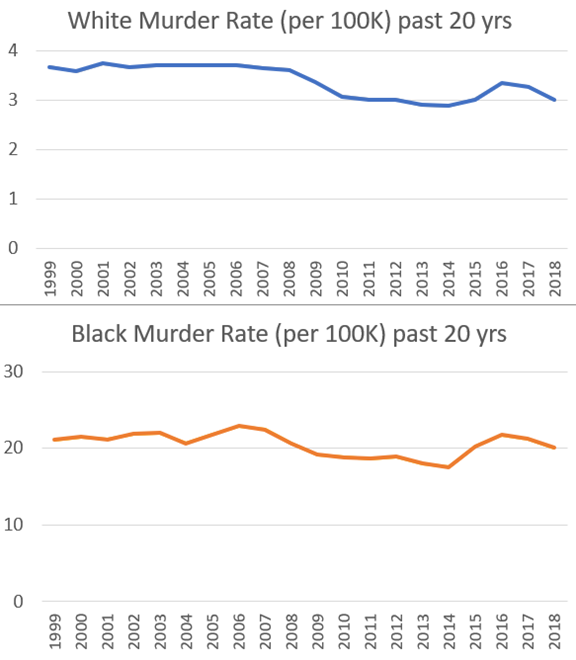
    The 2018 murder rate is down from the previous two years, but higher than we’ve seen in 6 of the past 10 years. Last year’s murder rate is the same as 2015. And 2009! And yet I keep hearing every year that violence is down. So what’s this trend? And sort of related, why do some people insist on the “violence is down” message year after year, even when it’s not true?

    Yes, violence is lower than it was in 1991. Violence will hopefully always be lower than 1991. But that doesn’t mean violence is trending down year after year. If we keep starting the graph around 1991, violence will always look downward trending.

    The murder rate in the US actually peaked in 1980 at 10.2 (per 100K). And then there was the lesser but better-known crack-trade-related murder peak of 1991 (9.8 per 100K). So we’re down from there, no doubt.

    Violence plummeted in America between 1994 and 1999. It might be worth pointing out that is right after the Biden-supported and now maligned crime bill. I don’t actually think that’s why crime went down, but it does correlate. And it didn’t hurt. It might have helped.

    Whatever the causes — and I do think better policing (along with changes in drug dealing) was a huge part of the solution — many lives were saved between 1994 and 1999. Of course, as always, there were racial disparities. Blacks benefited most from the decline in violence. From 1994 to 1999 the number of black murder victims dropped from about 12,000 to 7,000 per year! White murder victims declined, too (but less so, from 11,000 to 8,000). This brings us to 1999.

    Since 1999, the murder rate for whites has dropped even more, another 20%. Great news! But not for blacks. In absolute numbers, more blacks were murdered in 2018 than in 17 of the past 20 years. That’s not a good trend.For African Americans, murder has been up and down over the past 20 years. But the murder rate is no better in 2018 than it was in 1999.
    Image


    What bother me is some of my friends who insist “violence is down” are well intentioned white people who live in safe neighborhoods, hashtag#BLM, and believe those who advocate less policing in other people’s neighborhoods. (Neighborhoods they won’t set foot in, mind you.)


    Yes, violence is down compared to 1991. But is it a sustained “trend”? Not really. Not if you start the clock in 2000. And not for non-whites. Not for young black men in particular. So when people say violent crime is down, ask “For whom?”
     

  • Progressive Misbelief

    For well over a century, “progressives” have a proud tradition of not only exposing what is best for other people (often correctly, I might add) but also thinking they know what other people believe (often incorrectly). There’s a paternalism inherent to the progressive movement that can come awfully close to racism (or at least a white-savior complex) when it comes to policies that impact non-white people.

    A recent article points out how white liberals (of which I count myself) have, on issues of race, moved to the left of black Americans.

    If you, like me, hang around mostly with a liberal white set, you might believe 1) the greatest problem in poor black neighborhoods is the risk of being shot by police; 2) crime is down everywhere; 3) black neighborhoods are over-policed and 4) any attempt to apply policing solutions to neighborhood problems of crime, violence, and fear is part of a right-wing plot to throw more blacks in prison. There are other crazy things I hear as well, like, for instance, proven crime-reduction strategies — take hot spots policing and Broken Windows (minus the zero-tolerance) — are racist because they disproportionately impacted African Americans.

    I’ve seen this for a while now on issues of policing issues, and it frustrates me to no end. Everybody is entitled to their own opinion, but white liberals and “progressives,” particularly the woke set, seem to have a certain fondness for thinking they know what other people should believe. That is a privilege you should check.

    So if, like me, you read the New York Times and listen to NPR, here are some things that might surprise you:

    • Blacks want more police presence more than whites want more police presence. Only 10% of blacks want less police presence. Read that again, if you have to. I remember having a discussion about this fact with a nice editor at a major national magazine. At first she simply didn’t believe it. It didn’t fit her worldview nor the view of her (mostly white) coworkers. It didn’t fit the narrative.
    •  Almost 70% of lower-income nonwhites have “confidence in local police.”
    •  Over 70% of Americans feel safe walking alone at night in the area where they live. For very low-income non-whites, it’s just over half. This is on par with residents of Nicaragua and Zimbabwe! Sigh. What a country.

    So if a majority of lower-income blacks feel unsafe and generally want more (and also better!) policing, why do so many of my well-off white liberals friends keep telling me that “their” problem  is over-policing? And yeah, some of my best friends are black. And they tell me they don’t like your paternalistic BS either.

    On Tuesday 11 people were shot in Baltimore. Eleven! In one day. It made the local paper. 6 more yesterday. And perhaps another 4 or 5 today (the day isn’t over). Think of the trauma that comes from this violence. The impact not just on victims but on family, friends, kids, and the entire community. It’s hard to imagine. When I brought this bad day to somebody, the response was responded “there are not jobs.” No shit! But there were no jobs in 2014 before violence doubled. There were no jobs on Monday. There will be no jobs tomorrow. Public order and safe streets are preconditions to fixing society’s greater problems. If you don’t feel safe leaving your house, very little good is going to happen.

    I know there are things police cannot do. But some problems — from squeegee boys right up to murder — can be mitigated and even solved by good policing. And we’ve moved away from that in some of our cities. And that has happened, in part, because people with influence and power — the liberal elite, if you will (a term I do not like because by most definitions I’d be part of it!) — have bought and drunk the Kool-Aid with regards to issues of policing, race, and crime.

  • Cops in Conservative Cities Shoot & Kill More Often

    Cops in Conservative Cities Shoot & Kill More Often

    Forbes came out with a list of the 10 most conservative and liberal cities in America.

    Top ten conservative, in rank order:

    Mesa

    Oklahoma City

    Virginia beach

    colorado springs

    Jacksonville

    Arlington, TX

    Anaheim

    Omaha

    Tulsa

    Aurora

    Top ten liberal, in rank order:

    San Fran

    DC

    Seattle

    Oakland

    Boston

    Minneapolis

    Detroit

    NYC

    Buffalo

    Baltimore

    I’m not going to argue with the rankings. I don’t really care. But here’s what I thought: I bet police shoot a lot more people in the conservative cities. Related to and perhaps correlated with the fact police shoot more people, per capita, in states that are more white.

    How’s this for a working hypothesis? Other things being constant (they rarely are), police shoot more people when nobody cares about police-involved shootings. And white people — particularly conservative white people — don’t really care about police-involved shootings. Period. No matter the race of those shot. And when there’s never any pushback or criticism of police, laws and training and culture do not change.

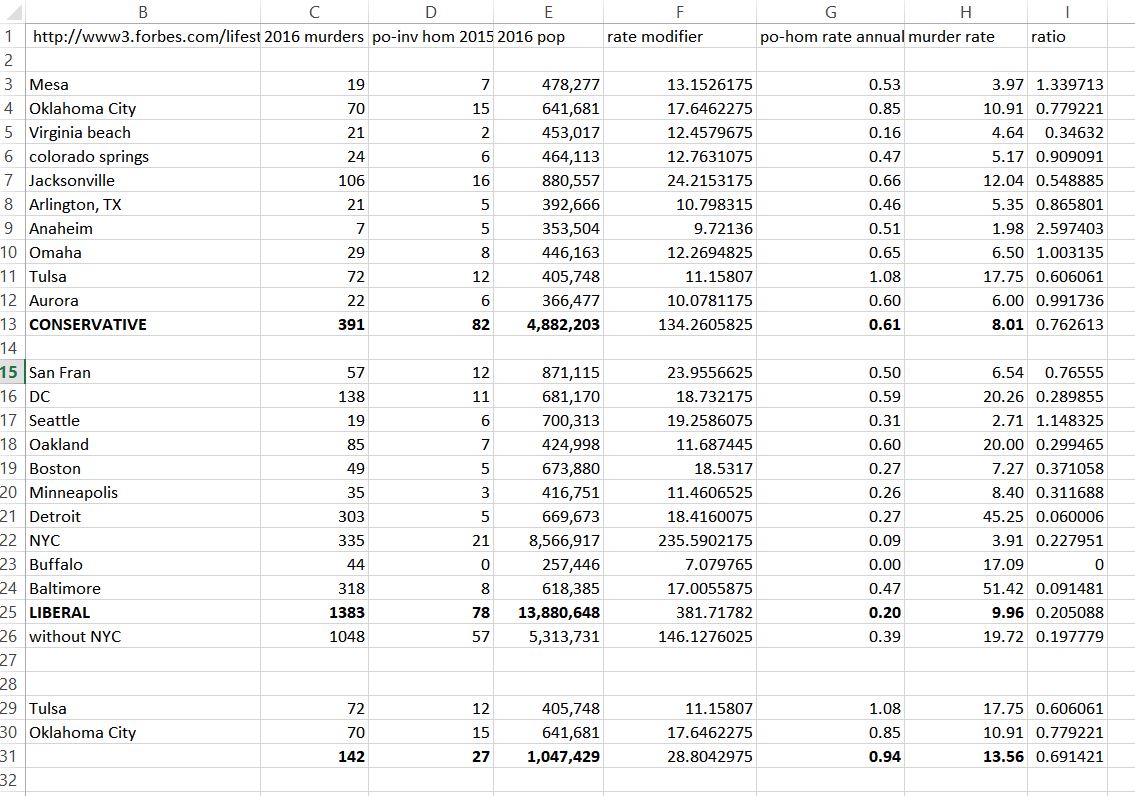
    Based on Washington Post data from January 2014 through September 2016, the annual rate (per 100,000) of police-involved homicides in the top 10 conservatives cities (n = 82) is 0.61. The annual rate of police-involved homicide in the top 10 liberal cities (n=78) is 0.20.

    Now New York City accounts for a lot of that, in terms of population. But even were one to remove NYC for simply being too big, the rate in the liberal cities is 0.39, or 64 percent of the conservative city average. Even without New York, cops in the most liberal cities are more than a third less likely to shoot and kill people. Are other factors involved? Sure. And they might be correlated to political ideology. Go figure them out, if you wish.

    Also of note, and I’m just looking at 2016 murder numbers, the murder rate in the top ten liberal cities in 9.96, which isn’t that much higher than the homicide rate of 8.01 in the top 10 conservative cities. If you take NYC out of the equation, the homicide rate for the other 9 liberal cities goes way up to 20. But if you consider that murder is higher in the top-10 liberal cities, the lower rate of police-involved homicides is all the more impressive.

    I mean, think of it this way: community violence and police-involved violence are very related. A lot of the people police shoot are violent criminals with guns, some in the process of using them. The more violent criminals there are running around shooting people, the more people police will shoot. Always has been, always will.

    That said….

    There were 138 murders in DC last year and every year (for the past 2.75 years) police shoot and kill 4 people. In Tulsa and Oklahoma City (which combined have 1 million people) there were 142 murdered last year and police shoot and kill 10 people. That’s a big difference. Police do shoot a lot more people out west. And it’s not just in conservative cities. In fact, given the low levels of murder in Seattle and San Francisco, the high number of people killed by police stand out.

    Anaheim had but 7 murders last year and police shot and killed 5 people since 2015. In Boston, Arlington and Detroit, police also shot and killed 5 people in the past 2.75 years, but there were 49, 21, and 303 murders, respectively, in these cities. Why? My guess: a combination of cops being better trained, less afraid, and less trigger happy in these cities combined with cops also being less proactive.

    Here’s the raw data I used. (Rate modifier is used in column G, (population/100,000)/2.75, because I’m using 2.75 years of police-involved homicide data.)

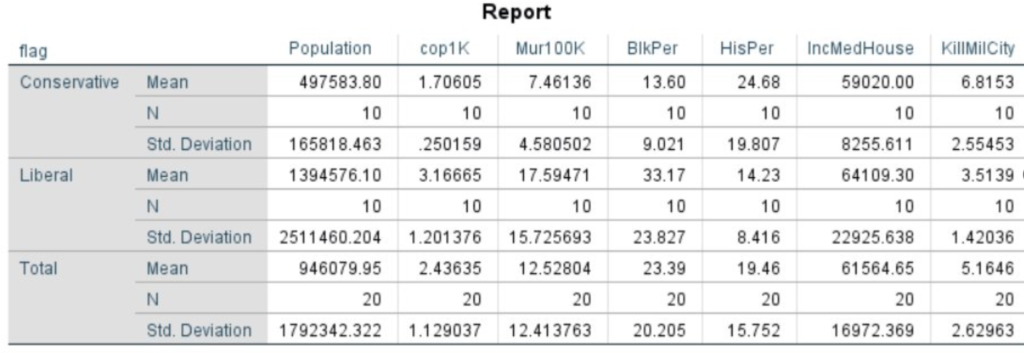
    September 2020 update: I re-ran these cities using better Fatal Encounters data. Compared to top 10 liberal cities, top 10 conservatives cities have less murder, fewer cops, and shoot/kill much more often. KillMilCity is annual rate of cops killing (per million). (Leaving out NYC doesn’t change much except the mean population, drops lib cities to 603K)

    Worth noting that DC, Seattle, Oakland, Minneapolis, NYC, and Buffalo jump out for having a lot of anti-police protests. None of the conservative cities do, even though cops shoot and kill many more people, even with (or because of) fewer cops. From twitter.

  • Tweet this

    I’ve got over 2,500 posts on this blog. But I can’t help but notice I’ve only posted six times in the past three months. That is a record low. So what have I been doing? Well, I do have a job. But also I’ve been on twitter a lot more. See, writing is work. And this work here? It don’t pay.

    Twitter scratches much the same itch for me as posts here, but with a lot work from my end. In terms of being engaged intellectually in police issues, Twitter is more interactive. Plus, on twitter I get to “meet” people like Jeff Asher. [See my previous post.]

    Jeff has written some great stuff over at 538.com, which for some reason I simply did not know about until today. Take thison the effect which people insist shall not be known by the Ferguson Effect. Or on the rise in violence in Chicago, in particular, or nationwide, in general.

    And I’m not shutting this blog down. And these things go in phases. Right now police simply aren’t in the news like before Trump was elected. But if you want to know what I think about some current police issue and don’t see it here, I’ve probably written something about it, but in 140 characters or less.

  • “Ronnie Goldman has a brand new cane”

    Good God, I haven’t posted in a while. Well, I still get paid.

    Here I am on Glenn Loury’s Bloggingheads TV today, talking about the issues I discuss here.

    Anyway, what to post about next? I don’t want to be let the perfect post be the enemy of the good. This is hardly an important post, but I couldn’t resist this story:

    “Good Samaritan” beats unarmed black man senseless. Called a hero. Gets a lifetime bus pass.

    A bus driver gets attacked for no reason. An old poor man with a cane beats the attacker senseless. Beats him so hard, in fact, he breaks his cane. No big thing. He just goes about his night. There’s a small quest to find this “hero” so he can be feted in proper fashion. Turns out he wants a new cane cause he needs one but can’t afford a new one. Welcome to America.

    Despite the narrative on the TV news (“it’s a story about a new friendship”), Goldman didn’t hit the attacker thus “allowing the bus driver to escape.” The first smite came after the driver gets away. And the subsequent ten, too. But then perhaps Ronnie was just making sure the attacker couldn’t get up and hurt him. Fair enough.

    The attacker was arrested. But thank God this “hero”is not a cop, or white. Cause if he were either, there would be protests. But would they be justified? A cop would be fired and charged with assault. I wouldn’t defend a cop doing this. Despite the feel-good narrative, I can’t help but notice Goldman beat the crap out of an “unarmed man.” But Goldman isn’t a cop. But when is it OK to beat up a man attacking a (female) bus driver? I’m on the justice-is-served side of the equation.

    What’s the lesson to cops? Or citizens? I think he should just let him go with a wink and a nod. And perhaps a verbal warning. The bus company has no problem with street justice. They game Goldman a lifetime bus pass. And for his efforts, Goldman got two new canes. Good. He’s salt of the earth. And needs a cane. One was wood and the other metal. He liked the metal one more. Why?:

    In case I have to put in on somebody again, I won’t have to put in on too bad. You know, two or three hits with this, and you’ll act right.

    I was glad I was there.

    If I’m on the bus and it happens again, I’m gonna do the same thang.”

    I believe him. And this is why people don’t like riding the bus.

  • White-On-White Crime (lots, but without homicide)

    [This relates to my previous post]

    Years ago, like when I was 13, I was with my father, driving from NYC to Chicago, on a baseball road trip (he drove). Between Philadelphia and Pittsburgh, we spent one night in Johnstown, PA. (Remember the Johnstown Flood!). After watching the Johnston Jonnies play baseball, we had dinner in a local bar. My father, known for being gregarious and getting along with all races, religions, and education levels, looked around at the pale depressed clientele and said to me in a hushed tone, “These are not my people.” It’s the only time I ever saw him uncomfortable in a crowd.

    Based on my last post, I looked up East Liverpool, Ohio. It’s very white (93 percent) and quite poor. The median household family income of $23,138 is about half the national average. A quarter of the population (and 35 percent of children) are below the poverty line. The population of 11,000 is down from a 1950 peak of 24,000.

    East Liverpool is the biggest city in Columbiana County, which seems to straddle coal, rust, and rural. The county has a total population of just over 100,000 people and is 96 percent white. It’s also poor, with a median family income of just $34,200 (but interestingly, the poverty rate is below the national average). And it’s increasing Republican. It’s Trump country.

    What I’m saying is, kind of like Obama and Clinton, I’ve never felt much kin with this part of America (the Appalachian Scotch-Irish folk of southeast Ohio, northern W. Virginia, and southwest Pennsylvania). If they’re more worried about immigrants, gun rights, and encroaching Sharia Law than about moving forward and letting people help them get out of poverty and not overdosing in from of their grandson, I’m inclined to let them be and not give a damn.

    But here’s the thing. No matter how hopeless and messed up things might be in East Liverpool and Columbiana County, Ohio; no matter how the jobs are gone; no matter how loose the gun laws are; no matter where junkies are shooting up; no matter how much crime there is; no matter how forgotten by the government and mocked by east-coast elites they might be, the good folks of Columbiana County somehow manage not to murder each other. And there is crime in East Liverpool, Ohio. In fact, if the data is accurate (and that is a big if, coming from a small place), the violent and property crime rates of East Liverpool are twice the national average.

    Neighborhood Scout (not exactly an ideal academic source) puts it this way:

    With a crime rate of 53 per one thousand residents, East Liverpool has one of the highest crime rates in America. With a population of 10,951, East Liverpool’s [crime rate] is very high compared to other places of similar population size.

    Best I can tell, this entire county of about 100,000 has maybe one homicide a year. Some years there seems to be none. Other years maybe two. (I’m basing this on Columbiana County, East Liverpool, and Salem City police departments). This homicide rate, 1 per 100,000, is about 1/4th the national average.

    Meanwhile, Baltimore City has a poverty rate lower than East Liverpool. Baltimore’s median household income is higher than East Liverpool. Hell, the average income even in poor East and West Baltimore is higher than East Liverpool. And yet in the past 365 days (Sep 10, 2014 to Sep 10, 2015) 329 people in Baltimore have managed to put themselves in harm’s way and get killed. Now Baltimore has more than six times the population of Columbiana County. So if Baltimore were 1/6th the size, it would have 55 murders. Columbiana County has 1.

    Even whites in Baltimore managed to get murdered 17 times last year. That’s of course a fraction of the number of black homicides, but whites in Baltimore (fewer than 200,000) get murdered eight times as often as the good folks of heroin-addicted poverty-living can’t-find-work police-are-asking-for-help Columbiana County.

    What gives?

    Baltimore City has more unemployment (7.4 percent vs. 5.3 percent). Yeah, sure. And there’s more poverty and extreme poverty in Baltimore. I’m not saying that doesn’t matter. But deep down, no. Poverty is a red herring. Culture matters. Columbiana County’s unemployment could be 20 percent and the murder rate would still be lower that Baltimore City.

    There’s something else going on. The nexus of violence is not poverty and racism but public drug dealing and drug prohibition. I suspect addicts in Columbiana County buy their heroin from friends and family and coworkers. Not from Yo-Boys on the corner. Push drug dealers inside and violence plummets. But when police try and do that in Baltimore, the DOJ complains about systemic racism.

  • Enough with the “Fakery”

    John McWhorter on the developing taboo of using the phrase “black-on-black crime.” (Spoiler alert: “We need to nip the burgeoning of this new and useless taboo in the bud with all deliberate speed.”):

    “What’s wrong is to refer to black on black crime as evidence of something uniquely pathological about black people.

    [But] to instead classify the term “black on black crime” as a slur, period — and this is what is happening of late — is illogical. Moreover, it detracts attention from genuine concern for black communities.

    And finally, treating “black on black crime” as a new “bad word” will only create fakery, and the way we discuss race in this country already has enough of that. Enlightened people’s impulse to avoid causing offense to black people and to always demonstrate that they are not racists will force a certain attendance to the pox on saying “black on black crime.” It will become a cocktail party cliché to dutifully observe “But white people are more likely to be killed by whites!” and shrug, with the implication that anyone who doesn’t understand that is “one of them,” unenlightened, and likely willfully so, impeded by their inner racists from giving black people are fair shot.

    But under the radar, plenty of people will always know that this taboo doesn’t really make sense, and that it even seems to pull attention away from what real black people living real lives think of as their real problems.

    We should, to the extent we can, use language with clarity and honesty. Pretending it’s always wrong to refer to something called “black on black crime” is antithetical to that mission, and we need to nip the burgeoning of this new and useless taboo in the bud with all deliberate speed.

    I came across thisat the same time I was responding to a request for some data. Somebody asked if there was any hard data backing up an assertion I made that blacks want more (not less) police presence.

    A quick search with the ol’ googlay found this 2015 Gallup poll: 38 percent of blacks want more police presence (and this compares to just 18 percent of whites). Only 10 percent of blacks want less police presence. Wanted more police and wanting fewer bad police are not mutually exclusive, of course.

    People — particularly black people, particular people more likely to be victimized by violent crime — want more police. So when you hear people say blacks are over-policed and want lesspolicing, you might wonder for whom they speak. Meanwhile, the Movement for Black Lives (which is or overlaps heavily with Black Lives Matter) released a platform that is more concerned with the problem of Israel(?) than black-on-black crime. (Did I miss it? Is there really nothing in this platformabout crime when not perpetrated by cops?) Fear of crime and criminals always trumps fear of police and over-policing.

    A short while back another person with knowledge of crime issues asked me if it were really true that blacks are more likely than whites to commit serious violent crimes. It’s good not to highlight this point out of context (lest racists go to town) since poverty and other variables account for much of the racial disparity, but indeed, yes.

    In 2014 (latest UCR numbers, when homicides were fewer) 6,095 blacks and 5,397 whites were murdered in America. There are 42,749,0000 blacks and 247,814,000 whites in America. That comes out to a black homicide rate of 14.3 and a white homicide rate of 2.2 per 100,000. [Just FYI, last year the homicide rate in Baltimore’s Eastern District was 100 per 100,000.] This is a huge disparity. Blacks are 6.5 times more likely than whites to be killed. I kind of thought this was common knowledge. But maybe I’m in too deep.

    So this goes back to the usage of “black on black crime.” I don’t care to engage in semantic debates when lives are at stake. I won’t be silent. But if it helps move the discussion toward solutions, I’m very willing to drop “black on black crime” and talk instead about black homicide victims or something. But talking about black homide victims begs the question of who the killers are. And since most crime is intra-racial, we’re left with a certain circular logic that goes back to “black on black” crime! [And look, I just combined three questionable phrases in one paragraph! Along with “black on black crime,” I’m not really certain if I did “beg the question” or if my logic was “circular.” But my point is to get my point across.]

    Not so long ago a friend of mine commented on the phenomenon of white folks who complain they can’t use the “n-word.” His point was “Why? You gotta ask yourself, why do you want to use it? What are trying to express that demands using this work?” (He was using the abstract “you” and not referring to me, just FYI.) If your point is simply to offend, then maybe it’s best to keep your trap shut. See, the value of political correctness isn’t to march in lockstep with some ideology, it’s to not be an asshole.

    So it’s fair to ask, “Why do you want to use the phrase ‘black-on-black crime’?” And the answer is because too many people are trying to distract from a real problem. Like too many cops, I’ve seen the carnage of “black on black crime” first hand. Last year the homicide rate in Baltimore’s Eastern District was 100per 100,000. I, like many police officers, too often feel that we are the only people who actually give a shit. Murders don’t make the papers; victims won’t even tell you their names. Who else (apart from EMS, nurses, and doctors) spends most of their waking hours trying to save lives? Now this sentiment may not be true, but when you get home after hearing gunshots, canvassing for witnesses, and riffling through the bloody clothes of another young black male victim, it’s an understandable sentiment.

    Call it what you will, but rather than make another phrase taboo, we should, as McWhorter says, pay more attention to “what real black people living real lives think of as their real problems.” Sometimes those voices are too hard to hear.

  • “I had to blame myself for a lot of things too”

    This is not the usual message I’d expect from a man whose armed son was just killed by police, provoking a bit of burning in Milwaukee:

    What are we gonna do now? Everyone playing their part in this city, blaming the white guy or whatever, and we know what they’re doing. Like, already I feel like they should have never OK’d guns in Wisconsin. They already know what our black youth was doing anyway. These young kids gotta realize this is all a game with them. Like they’re playing Monopoly. You young kids falling into their world, what they want you to do. Everything you do is programmed.

    I had to blame myself for a lot of things too because your hero is your dad and I played a very big part in my family’s role model for them. Being on the street, doing things of the street life: Entertaining, drug dealing and pimping and they’re looking at their dad like ‘he’s doing all these things.’ I got out of jail two months ago, but I’ve been going back and forth in jail and they see those things so I’d like to apologize to my kids because this is the role model they look up to.

    When they see the wrong role model, this is what you get. They got us killing each other and when they even OK’d them pistols and they OK’d a reason to kill us too. Now somebody got killed reaching for his wallet, but now they can say he got a gun on him and they reached for it. And that’s justifiable. When we allowed them to say guns is good and it’s legal, we can bear arms. This is not the wild, wild west y’all. But when you go down to 25th and center, you see guys with guns hanging out this long, that’s ridiculous, and they’re allowing them to do this and the police know half of them don’t have a license to carry a gun.

    I don’t know when we’re gonna start moving. I’ve gotta start with my kids and we gotta change our ways, to be better role models. And we gotta change ourselves. We’ve gotta talk to them, put some sense into them. They targeting us, but we know about it so there’s no reason to keep saying it’s their fault. You play a part in it. If you know there’s a reason, don’t give in to the hand, don’t be going around with big guns, don’t be going around shooting each other and letting them shoot y’all cause that’s just what they’re doing and they’re out to destroy us and we’re falling for it.

  • If a protest against violence falls in a street without reporters, does it make a sound?

    Lois Beckett in the Guardian:

    But black Americans in neighborhoods that see constant gun violence do try to make their voices heard, in protests like the one Truehill helped organize: community led, often small and largely ignored by news organizations.

    Thirty people showed up on Friday, most of them black men and women in their mid-20s. Gun violence was deeply personal to them. One 24-year-old, Chris Head, said he had lost 30 friends. He was “blessed”, he said, that it was only that many.

    “At least I can count,” he said. “Some people can’t count.”

    The march and vigil lasted two hours, buoyed by waves and cheers from people along the route and honks of support from cars. No television crews or reporters from local news organizations showed up. The single reporter present had only learned about the protest by chance, from one of Truehill’s mentors, a local pastor.

    Four years ago I wrote:

    If you’ve never heard of any of these protests, might I suggest you ask yourself, “why not?” Perhaps you want to blame the media. Or perhaps you don’t care. That’s your right, I suppose. But it’s not your right to say other people don’t care just because you’re ignorant.

  • 20 People Shot at Florida Nightclub (ho hum)

    From the Times:

    Two teenagers were killed and at least 18 people were wounded early Monday when attackers raked a crowd with gunfire outside a nightclub here that had been hosting a party for young people, the authorities said.

    Sound familiar? Yeah, because it is. But this isn’t even the main story of the day.

    It kind of started as news, but then, you see, the victims weren’t gay, or white, or blacks shot by cops, and the shooter (or shooters) wasn’t a “terrorist,” which really means he didn’t have an Arabic last name, nor a “troubled” white kid.

    Obama won’t speak about it; Trump won’t claim he can fix it. You know, it was just one of our “routine” mass shootings. The story is demoted to “Fort Myers shooting: 2 dead outside teen party at club,” like these lives don’t matter. Like this is acceptable in a civilized society. No matter a 12-year-old was killed, it’s just “ghetto” crime. Dog bites man.

    Just think of the news editors who really ask these questions before keeping “Convention Tension” as the lead story of the day.

    What a country.