Tag: crime prevention

  • Murders in concentrated locations

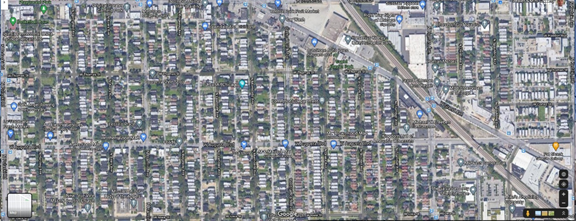
    There’s an article by Frank Main in the Chicago Sun-Times about the deadliest police district in Chicago. It’s a small area on the West Side of Chicago. My eyes went to the blue area, below. About 3 by 15 square blocks. Maybe 34 of those blocks are residential. Perhaps about 650 houses in all. Nice housing stock. Maybe 5,000 residents? I don’t know. Just a guess. (3,000 or 10,000 people is a big difference, but it doesn’t really matter.) There were 18 people murdered this year. Many more shot. And many more shot, this year.
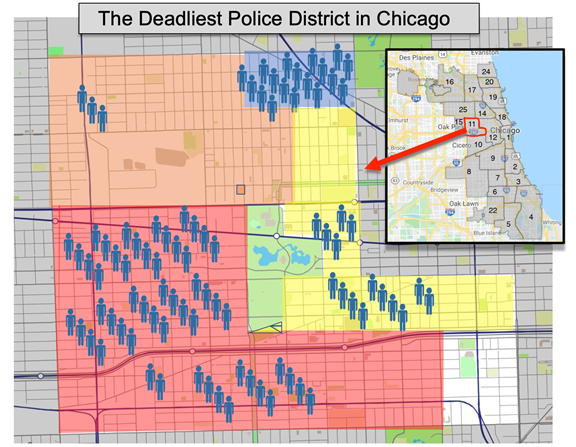
    Note that even within this one part Chicago, violence is strictly demarcated. Dramatically so. That, as they say, is a clue. The murders happen north of Chicago Ave, in a more hispanic area. South of Chicago Ave (orange and yellow, above) is almost 100% black. There are no murders there.

    Now even a dozen or active shooters among 5,000 residents is a lot. But we’re probably talking about just 20 or so men, 15-35, that are literally killing the neighborhood. They’ve all probably been arrested for violence before. So why not focus on those 20 men?

    The increase in shootings this year has happened only where there are shooters. That might sound obvious, but it matters. Programs that target cities, demographics, neighborhoods, and even parts of neighborhoods are too broad. Most people don’t kill. To reduce killings, focus on killers.

    Chicago Police, meanwhile, have been diverted from violent neighborhoods to protect the mayor’s house and also to act as scarecrows standing in The Loop and N. Michigan Ave. Should police be deployed like that? I don’t know. That’s a political decision. But people are dying.

    Of course it’s easier to say “focus” on the shooters than it is to actually focus. Your typical shooter is in his late 20s. After-school programs won’t much help prevent violence (which is not a reason not to do it, if it’s good on its own.)

    Arresting a killer after he’s killed is good. Clearance rates matter. But that involves incarceration. And racial disparities. And conviction isn’t easy. Nor does it bring back the dead.

    So you’re left with preventing violence. This nebulous but needed concept of pro-active policing. How do you “target” a killer? Well, you identify him. Because of past crimes. And then go after him for whatever you can.

    Going after illegal gun possession is good. But it needs to be prosecuted and punished. That seems harder to do, politically. Going after offenders for other crimes, drug dealing and minor offenses, can work, too. But now do you see the problem? These are “non violent” offenses.

    If you go after major players for minor offenses, well, when it comes to gun violence, it leads to racial disparity. Mind you, even when the disparity is consistent with the shooting population, it won’t be with the city’s general population.  And now the ACLU sues to stop it. Of course policing also affects the innocent. You want to minimize that, but innocent people will be stopped. As will targeted offenders on a drug corner who aren’t arrested. (I mention this because the ACLU counts them too as “innocent.”)

    It kind of comes down to this: if you’ve got somebody who is a known violent repeat offender, is that guy deserving special police attention? Or is that racist police harassment? Policing has trade offs. Is it worth it? Generally, I’d say yes. But I’d also say it’s not for me to decide. Why? Because—this is important—I don’t live there. So listen to those who do live there. And not just those “harassed” by police, but those afraid to leave their home.

    If residents want more policing, and I guarantee you most do, don’t listen to out-of-touch people who don’t live there clamoring for less policing in minority neighborhoods against the wishes of the residents.

    Of course it can’t be just policing. But policing plays an essential role. A service, even. But policing will never be perfect. It can be better, though. We need to minimize bad policing and promote good policing. But more policing is needed. And it will save lives.

    Imagine if this neighborhood had 18 covid deaths this year? If the area (because of demographics) has a COVID fatality rate 50% more than Cook County in general, which it might. And if there are 5,000 people (a big if), there would have been 13 COVID deaths this year. Now if we were talking about COVID, we would be talking about racial disparity, but we’d also be talking about doctors. Of course doctors don’t prevent COVID, but they’re an important part of saving lives.

    Permit me to compare COVID to shootings; masks and social distancing to social programs; doctors to police. Right now it’s popular to talk about how to reduce violence without police. That’s a great discussion. Sort of. And there are ways. But not in lieu of police. Public safety without police is like health care without doctors. Yes, preventive care is important. But doctors play a role in that, too. Can I _imagine_ a health care system of diet and exercise and no doctors? Sure. But why would I want to? And what if I have a tumor?

    There’s an element of police abolitionists that is a bit like anti-vaxxers. They’re so convinced they’re on to something. And yet so wrong. And so harmful to others. Though anti-vaxxers also put themselves at risk, whereas anti-policers usually theorize from very safe homes.

    For most people, a safe neighborhood without much policing is the life they live and see every day. It doesn’t mean everybody has that privilege. It would be like being healthy and telling a sick person, “You don’t need a doctor. Maybe you should try yoga and eating organic?”

    Yes, some neighborhoods need more policing that others. Some people need to be policed. And some more than others. Many more people need good policing around them. That is the world we have. And people who live with daily gunshots rightfully expect public agencies to respond.

    But that’s where we are with violence and police. There’s more violence and there’s less policing. You could say our health care has failed, as demonstrated by COVID. It doesn’t mean we should #defund hospitals. That’s where the academic discussion is right now with violence and policing. Anything but police. Sure I can “reimagine” public safety without police. But it will be less safe world. This doesn’t mean we can’t _also_ fund programs that don’t involve police. We absolutely should. But most won’t work well without safe streets.
  • What’s Up With Crime Being Down in Camden?

    What’s Up With Crime Being Down in Camden?

    Let me start by saying I don’t know much about Camden, New Jersey. So if you know more, help me figure things out.

    The city of Camden is just across the river from Philadelphia. It’s part of Camden County. The city has a declining population of about 75,000. Camden is about half black and half hispanic. It is, by any quantifiable measure, a “struggling” place. I wrote a post about violence in Camden back in 2015.

    In 2011 the city and police department were in crisis and announced plans to abolish the police department and start fresh, with a new police department. In May 2013, the city police department was abolished (in part to break the police union, which has since re-formed). Anybody that wanted to stay on had to re-apply for the job. Since then, the new Camden County Police Department covers Camden City (and only Camden City) while in Camden County, I guess some other agencies (I presume local agencies and/or the sheriff) do the work.

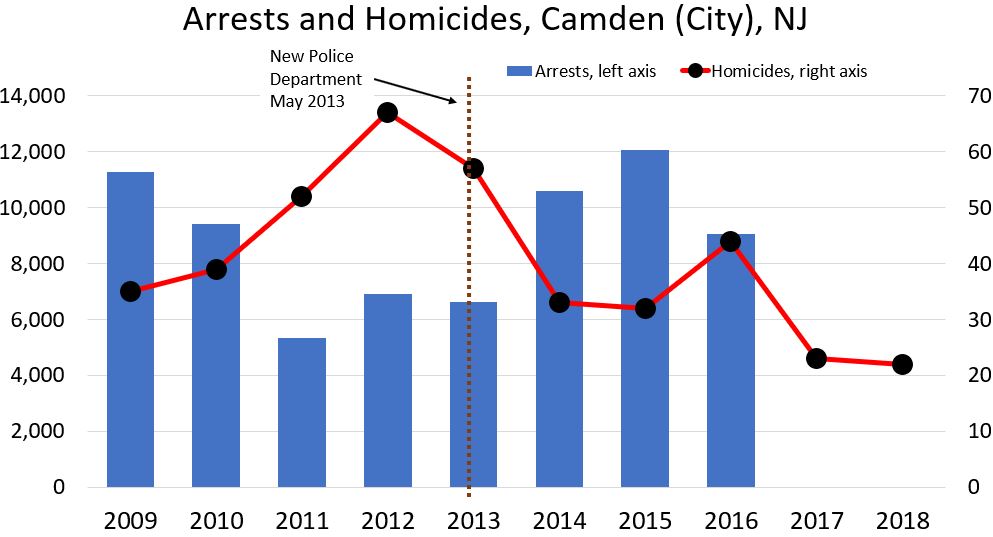
    This all makes data gathering a bit confusing. But I (painstakingly) went through the UCR’s arrest numbers for Camden City from 2009 to 2016 (the last available year).

    Nice chart, if I do say so myself.

    If history is a guide, and they say it is, when people blame an institution for human problems and tear it down and start new, after a few years you end up with pretty much the same situation and problems. Police are as much a product of their environment as anybody else. There are still occasional problems of corruption and brutality in Camden. Cops still get attacked. And Camden is still mired in poverty (a 37% poverty rate). But poverty is declining and money is being invested.”

    Meanwhile, across the river in Philadelphia, murders are up 25 percent (2016-2018). I do presume “underlying social conditions” haven’t gone that drastically in opposite directions in these neighboring cities just since 2016. So what if — crazy idea — police (and prosecution) actually matter. Maybe a lot. And even more than the so-called “root causes.”

    I mention this because the new Camden County Police, policing Camden City, have become the progressive reformers’ dream team (despite being founded, in part, in a fit of Republican union busting). Since 2013 there have been a lot of positive press, but here is one example that presses all the feel-good buttons like “strategic shift toward community policing” and “rebuilding trust between the community and their officers” and “being mentors in the community” and “a showroom for community policing techniques” and “nothing stops a bullet like a job.” OK, but all that sets off my BS alarm.

    In terms of crime, the proof is in the pudding. Give credit where credit is due. And here’s the thing: violence really is down. A lot!

    Last year there 22 murders and the year before 23, down from 67(!) in 2012. Shootings also been cut in half. Maybe police culture really did change for the better. Or training. Or technology. Or strategies. Or maybe police are now simply funded at the proper level they had not been. Or maybe we’re getting more for less. I don’t know.

    But I do know, despite what is often reported, it hasn’t been just kumbaya with carnivals and free ice cream. Those gimmicks can be part of building trust, but they’re not crime prevention strategies. Non-criminals need more positive casual interactions with police. Criminals need more interactions, too Perhaps not all so positive, but still professional and respectful. (The person you arrest today can be your source or even save your ass tomorrow.) As Chief Thomson says), “Nothing builds trust like human contact.”

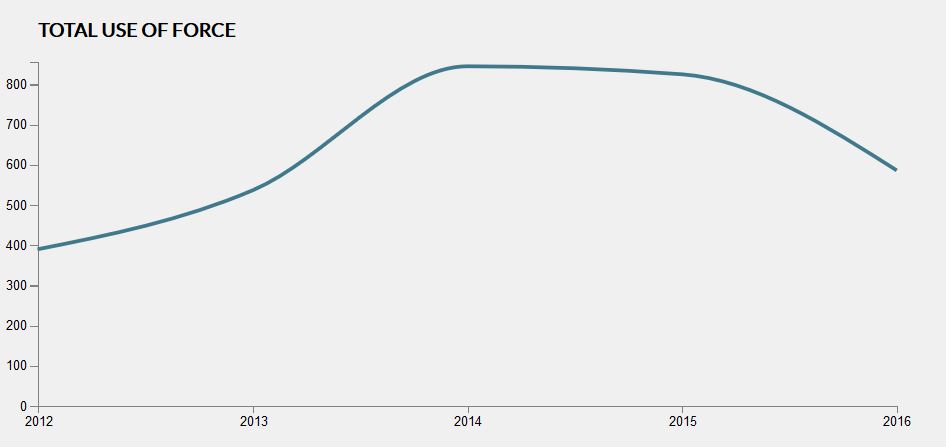
    And speaking of human contact, reported use-of-force — usually something reformers want to reduce — increased dramatically with the new police department. That could mean cops are now more brutal, but more likely cops are policing more, and some of that leads to justified use of force. Camden is being lauded by reformers for bringing down crime with exactly the form of pro-active policing loathed by the same reformers!

    http://force.nj.com/database/pd-dept/camden-camden

    Force went up. Arrests went up. Crime went down. But what about the idea, very popular among reformers who don’t live in high-crime neighborhoods, that arrests are bad, and people in dangerous neighborhoods hate police because police are arresting (or shooting) people of color for no good reason.

    If you decriminalize minor offenses, goes the hope, police “legitimacy” will increase, which along with leading to less incarceration means more solved crimes and many other wonderful things. It sounds good, especially if you think police are the problem and your neighbors aren’t.

    Based on UCR arrest numbers, arrests went up with the new police department. Camden cops are arresting more people, and crime is down. There may have also been better policing, but there was also just more policing. And the kind of arrests that increased — low-level discretionary arrests — would indicate that police focused on quality-of-life issues and Broken Windows. This is not the reformers’ party line.

    Caveat: I really hate using arrests as a metric for anything, much less good policing. But arrest data is available. And huge changes in arrest numbers tell you something is going on. Arrests can be a proxy for pro-active policing: cops stopping suspicious people, chasing and catching the bad guys, cops less afraid of making an honest mistake. My inquiry into Camden was inspired by thisarticle from March 2017 (that I just read) saying drug arrests were way down. Except that seems not to be true.

    In 2011, Camden cops may have lost a little of whatever go-getter spirit they still had. This was Camden’s Ferguson Effect (pre-Ferguson). Cops were told they were no good and their job was on the line. Arrested dropped 50 percent, from 11,000 in 2009 to 5,348 in 2011. Along with Camden, Baltimore and Chicago also saw similarly quick and drastic decreases in quantifiable policing. And in all three violence shot way up. Yes, correlation that is also causation [thunder clap]. At the start of 2012 Camden laid off 45 percent of the police force. Murders went up to 67 (which is a shocking number for a city of 75,000).

    Let’s compare 2012 and 2014 Camden, when murders went down from 67 to 33:

    • Drug arrests up 79% to 3,052.
    • Marijuana possession arrests in particular up 467% to 488.
    • Curfew and loitering violations up 34% to 1,128.
    • “All other offenses (not traffic)” up 50% to 3,352 (This most minor category is probably something catch-all like disorderly conduct, trespassing, loitering).
    • DUI arrests up 483% to 175 (an indicator of more policing).
    • Non-felony (ie: discretionary) assaults up 57% (to 754).
    • And murder arrests — because there were fewer or them — down 23% (to 20).

    Policing get “better,” but what does that mean? Maybe police officers have better manners. That matters. But what brings down crime is focusing on repeated violent offenders, usually young men, who commit the vast majority of violence crime.

    There’s irony here in that this little department so loved by progressives, has achieved success, in part, by arresting more minorities. And you know what kind of arrests increased the most? All the little ones that reformers want to stop in the name of social justice But those progressive reformers don’t live in Camden. If you do live in Camden, you probably support anything that works.

    For a small city, 9,000 arrests is a very large number. Scaled up to the population of New York City, for instance, this would be over one  million arrests a year (compared with the 240,000 arrests in NYC last year). One arrest for every 8 people is similar to the arrest rate that Baltimore had in the early 2000s (when I was there and violence was going down). This is the same arrest rate people (stupid people, mind you) blamed for Baltimore’s riots a decade later (arrests and crime in Baltimore dropped drastically from 2003 up until the riot of 2015).

    Now keep in mind arrests are not good on their own. It’s very important what the data do not reveal. How many times did cops change behavior without resorting to arrest? My guess is a lot. More good policing does often lead to more arrests, but it’s really important to put the horse before the cart. Policing is the goal. Not arrests. “More arrests” is never a good strategy.

    I’d like to know how many people were arrested in Camden in 2017 and 2018 when murder really dropped. In the ideal world, violence and arrests (and incarceration) all go down in sync. That’s the win-win(-win). But residents will always choose more arrests and less violence rather than the standard police reform package of less policing and more violence.

    One moral, and you see it time and again, is you don’t have to fix society’s problems to fix violence. Violence is not inevitable. But equally important is the corollary that you can’t fix society when violence is out of control. Most residents want more police. They want visible police who maintain order and treat people with respect. It’s not too much to ask for.

    Maybe what is going on in Camden is just slapping lipstick on a pig. But hey, it’s hard to argue with success. Don’t underestimate good PR and a progressive-sounding chief who both controls the narrative and won’t give in to anti-policing naysayers. And it’s likely that what the arrest numbers do not show — better hiring, training, culture, attitude, accountability, and leadership — is what makes effective aggressive policing possible, or at least palatable.

    Camden homicide numbers

    2018: 22

    2017: 23

    2016: 44

    2015: 32

    2014: 33

    2013: 57

    2012: 67

    2011: 52

    2010: 39

    2009: 35

    2008: 53

    2007: 45

    2006: 33

    2005: 35

    2004: 49

    2003: 41

    Non-fatal shootings

    2017: 95

    2016: 92

    2015: 109

    2014: 90

    2013: 143

    2012: 172

    Arrests

    2009: 11,280

    2010: 9,414

    2011: 5,348

    2012: 6,903

    2013: 6,613

    2014: 10,582

    2015: 12,049

    2016: 9,052

    Notes: In the data (for 2016, ISPSR 37056 and 37057) variable “offense” the value 18 is the total for drugs. Subtotals follow. Values 180 and 185 are again subtotals of what follow. This makes drug arrest numbers very easy to triple count, as I did at first.

    For 2009-2012, I’m assuming Camden City is the agency with the listed population of 77,665. I ignore the other Camden, which presumably is the rest of the county. After 2013 (unless I’m wrong) Camden City is the agency “Camden County Police Dpt” with a listed population of about 75,000.

    As always comments and corrections are welcome. Replications welcome; data available on request.

    Some sources: https://www.nj.com/camden/index.ssf/2018/01/camdens_2017_murder_rate_was_the_lowest_in_decades.html

    http://www.camconnect.org/resources/CrimeMaps.html

    https://camdencountypros.org/unit-list/homicide/#tabpanel22

    https://www.icpsr.umich.edu/icpsrweb/ICPSR/series/57

  • Every four or five years…

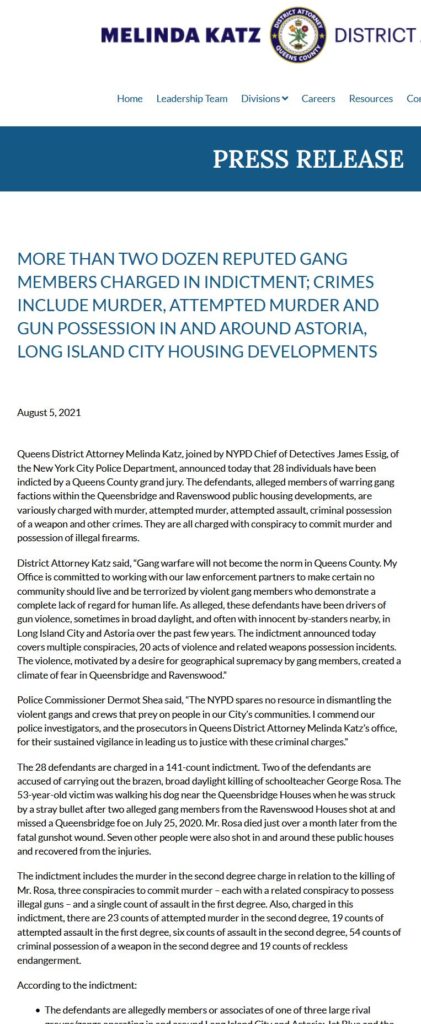
    Just a brief note to commemorate the semi-decennial NYPD drug sweep at the Queensbridge Houses.

    I keep track of these things. (I live nearby.) 9 raids. 22 arrests. 4 handguns.

    Last time this happened was 2013. And that was preceded by similar raids in 2009 and 2005. Sometimes police get disparaged for conducting wack-a-mole policing. (In fact, sometimes *I’ve* disparaged police for this reason.) But one of the reasons crime is so low in NYC is because police do wack those criminal moles (and have the resources to do so) when criminals pop their heads up. Illegal public drug-dealing, so linked to violence, is exactly what police need to focus on. And the residents of America’s largest public housing complex can be a little less afraid.

    There will be another similar raid in Queensbridge in 2023. Mark my words. But maybe that is exactly what is needed. Or maybe a little more continued presence now, rather than a few years, really could prevent the next crew from popping up.


    2021 Update: I was off by two years. https://queensda.org/more-than-two-dozen-reputed-gang-members-charged-in-indictment-crimes-include-murder-attempted-murder-and-gun-possession-in-and-around-astoria-long-island-city-housing-developments/


  • “You Get the Police You Ask For”

    Since I’ve been remiss at writing anything here recently, I’m going to link to a piece from Jim Glennon at Calibre Press:

    [Baltimore] Mayor Pugh then thanked federal officials for their assistance in the arrest of a man who murdered a three-year-old in 2014.

    The Mayor’s expectation that the FBI can assist in the day-to-day in Baltimore not only won’t happen, it can’t. The Feds, and I am not one to bash them, are great at what they do. But what they don’t do is don uniforms and walk a beat.

    The Baltimore cops may be undermanned but that isn’t the reason for the surge in crime. They have been understaffed before. What’s different in the past two years? An absence of proactive policing. The surge in crime began immediately after the cops pulled back. Though no division of the elite political class, few criminologists, no mainstream media outlets, and no legal activist groups like the ACLU will openly acknowledge this.

    Why? Because they are the ones who wanted proactive policing stopped in the first place.

    The anti-police pundits blather on about how the violence isn’t as bad as in the early 1990s. They’ll yammer about how the crime surge is only in about 75 of the country’s counties. They’ll wax poetically about economic issues, past history, immigration, lack of trust between the police and the community, and then they will go back to their security-controlled TV studios and gated communities, sip chardonnay and chitchat about law enforcement ills with like-minded peers.

    Meanwhile, real people are dying, and the FBI, the CIA, the DOJ, and the VIPs won’t be able to stop the carnage.

    So politicians, pundits, etc., you got what you asked for. The question is: Did the citizens ask for it?

  • Milwaukee Chief Flynn: “We can predict who’s going to get shot. We do. If we could only predict where and when, we’d be doing a great job. We can’t do that.”

    [See my previous post on Ed Flynn.]

    Flynn isn’t new at this.

    A few years back, Flynn was answering questions about a controversial police-involved shooting. At a community meeting, some criticized him for being “disrespectful,” because he was on his phone. His response is well worth watching.

    The cop involved in that shooting was later fired. Officers voted Flynn a nearly unanimous vote of no-confidence. Like I said, he gets it from all sides. He must be doing something right.

    But crime is up in Milwaukee, and here he is talking about police backing off (at 7:16).

    Later is that same interview he talks about deadly violence, and it’s worth quoting at length (at 8:28):

    We need to focus on the fact that it’s a finite group of people. There aren’t ten-thousand run-amok criminals out there. There’s a finite number of people who have prior arrests for weapons possession or other violent crimes overwhelmingly shooting people like them.

    And unfortunately the system doesn’t act like a system.

    There are a lot of other variables out there, and so far most of them have escaped accountability.

    No matter where you start looking at the co-location of victimization in this city or any city like us, every single negative social indicator is in the same place where the dead bodies are. There are a lot of moving pieces to the problem. Many of our most violent offenders have been identified at early times in their careers by both the juvenile justice system or even by the schools. We know the statistics: how many children exposed to violence end up replicating the violence; how many children that were the victims child abuse or physical abuse will replicate that behavior later on; how many of our most violent offenders committed their first violence when they were young juveniles.

    The data is there to focus resources on those with the most potential for violence. When we do network analysis we constantly find out that there’s 20 percent of our homicide victims in any given year have been witnesses or involved in other shootings and homicides. We can predict who’s going to get shot. We do. If we could only predict where and when, we’d be doing a great job. We can’t do that. We can do a network analysis, we give you the names of ten people in the next 18 months, at least six of them will be shot. The challenge is there’s no one to parse any of this information off to. Probation and parole are broken. Juvenile courts are broken. Nobody visits these folks at home except the police.

    So there are challenges out there. They are not simplistic. There are things that need to be done on the front end with young children that will pay dividends in years, and they need to start now. Same token, there’s more than most be done with young offenders. I’m not saying they all need to go to jail. But if they get neither services nor sanctions, why should their immature brains think something is going to happen to them when they turn 18 or 19? Time and again we see it. We keep grinding out the data. Other actors have to start stepping up. It’s going to cost money, but that’s what we pay taxes for.

    [Comments are open on my similarly themed previous post on Flynn.]

  • Milwaukee Police Chief Edward Flynn: “We’ve got to get beyond the finger pointing that does nothing except to depolice at risk communities”

    Milwaukee Police Chief Edward Flynn is smarter than your average flatfoot. Generally considered a progressive in the police world, he’s the type of chief who should at least be embraced by the political left. But Milwaukee is one of the latest police department to be sued by the ACLU for racially disparate policing. But Flynn refuses to de-police the city’s most violent streets. For this, Flynn gets heat from all sides: Republican senators, the anti-police crowd, and conservative Sheriff David Clarke (the Milwaukee County Sheriff better known for his Trump-loving cowboy-hat wearing general buffoonery).

    Most recently, Flynn didn’t take kindly to lawsuits from the ACLU making him and his police department out to be the bad guys. This is worth watching. “Disparity is not the same as bias,” Flynn says. That’s an important point that needs to be said loud and clear. If not, we abandon those most at risk. Here’s an edited six minutes of Flynn:

    [The full version is here.]

    Flynn understands the political equations. He frames the right questions. He give the right answers. And he can talk about “ellipses” of social problems, explicit and implicit biases, negative social indicators, evidence-based policing, and the history of racist policing in America. As my father always said, if you get criticized for all sides, you must be doing something right.

    [my next post on Flynn]

  • The best of times, the worst of times

    The best of times, the worst of times

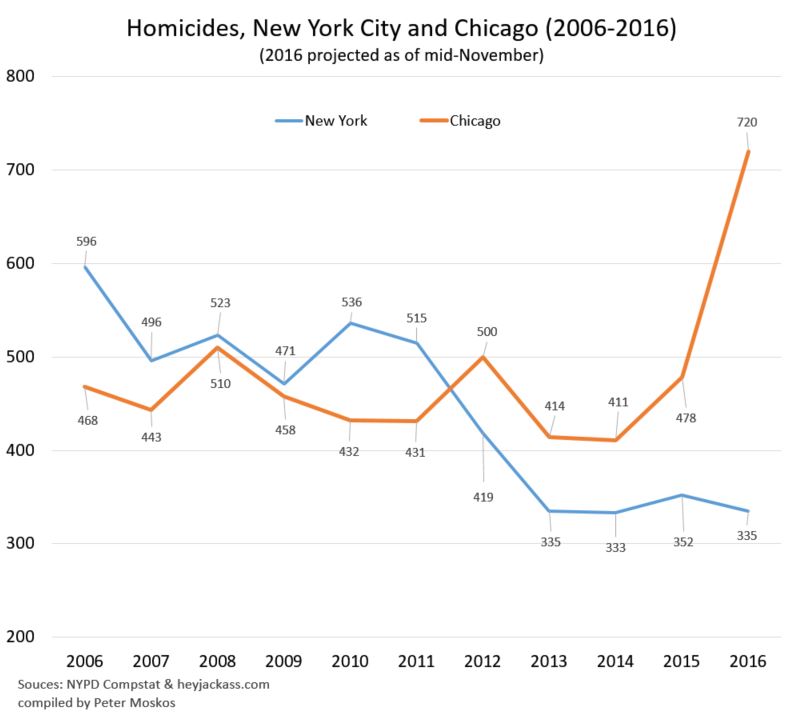
    Ah, the ol’ Tale of Two Cities trope. But the diverging homicidal paths of Chicago and New York City are striking. The New York Post has a surprisingly good (especially for the NY Post) article on homicide in Chicago and NYC.

    These are raw numbers and not a rate. Chicago is roughly one-third the size of New York City. [Notwithstanding rumors to the contrary, the national increase in murder would still be large, even without Chicago.]

    First observe NYC’s unheralded murder drop from 2011 to 2013. Police weren’t even willing to take credit! Why? Because it corresponded with the demise of stop and frisk. And then liberal Mayor de Blasio came on the scene in 2013. If you listened to cops, the city was going to immediately descend to some pre-Giuliani Orwellian hell. That did not happen.

    It turns out that quota-inspired stops and misdemeanor marijuana arrests are not good policing. Now we knew that (though even I’ll admit I was surprised that literally hundreds of thousands of stops didn’t have some measurable deterrent effect on gun violence.)

    In Chicago, stops also stopped, but unlike New York, it was not because cops stopped stopping people they didn’t want to stop. Cops in Chicago got the message to stop being proactive lest controversy ensues. Bowing to political and legal pressure, police in Chicago (and also Baltimore) became less proactive in response to the bad shooting of Laquan McDonald, excessive stop-related paperwork, the threat of personal lawsuits based on these same forms, and a mayor in crisis mode.

    Less proactive policing and less racially disparate policing is a stated goal of the ACLUand DOJ. See, if police legally stop and then frisk six guys loitering on a drug corner and (lucky day!) find a gun on one and drugs on another, the remaining four guys, at least according to some, are “innocent.” I beg to differ. (Though I should point out that in the real world, the “hit rate” never comes close to 20 percent.)

    And then there’s my beloved foot patrol. Policing is the interaction of police with the public. But there are no stats I know of to determine how many cops, at any given moment, are out and about and not sitting inside a car waiting for a call. From the Post:

    A high-ranking NYPD official credited the city’s increasing safety to the widespread, targeted deployment of cops on foot patrol.

    “Most cities only place foot posts in business districts. We put our foot posts in the most violent areas of the city, as well as our business district,” the source said.

    “It’s not a fun assignment, but it’s critical to keeping people safe.”

    Meanwhile in Chicago:

    Former Chicago Police Superintendent Garry McCarthy — who was fired last year amid controversy over the police shooting of an unarmed teen — said criticism of policing methods by local officials there had left cops “hamstrung.”

    “They’re not getting out of their cars and stopping people. That’s because of all the politics here,” said McCarthy, a former NYPD cop.

    “In Chicago, performance is less important than politics. It’s called ‘The Chicago Way,’ and the results are horrific.”

    My buddy Gene O’Donnell says:

    “The harsh reality in Chicago is that you have the collapse of the criminal justice system,” O’Donnell said.

    “The police aren’t even on the playing field anymore, and the police department is in a state of collapse.”

    O’Donnell, who was an NYPD cop during the 1980s, said that although “New York had a similar dynamic” during the height of the crack epidemic, “we had a transformation, because people realized you don’t have to tolerate that.”

    Guns are part of the mix:

    Veteran Democratic political consultant Hank Sheinkopf noted that Chicago “is much more porous to guns” than New York, with a “direct pipeline” leading there in “a straight line from Mississippi.”

    But that is more of an excuse than an explanation. Newark, New Jersey, just a PATH-train subway ride away from Manhattan, has more of a gun problem than New York City. Hard to imagine a subway and a few bridges plugs the gun pipeline.

    There are other differences between Chicago and New York in terms of poverty and segregation (greater in Chicago), commitment to public housing that actually works (greater in New York), and maybe even lower-crime foreign immigrants (greater in New York… but I say “maybe” because it’s still substantial in Chicago, with 22% foreign born).

    And then there’s this:

    Psychology professor Arthur Lurigio of Chicago’s Loyola University cited an “intergenerational” component to the mayhem, with sons following their fathers — and even grandfathers — into the city’s extensive and ingrained gang culture.

    “Chicago’s problem wasn’t a day in the making — it’s 60 years in the making,” he said.

    “Working at the jail as a staff psychologist, I’ve seen two, maybe three generations pass through.”

    I don’t mean to criticize an academic willing to highlight culture and the inter-generational transmission of violence, but I quibble with the line that Chicago’s problems are 60 years in the making. I mean, yes, it’s true…. But the explosion of homicide in the past two years is, well, a problem exactly two years in the making.

    Chicago may always have a higher homicide rate than New York because of history and structural issues. But the short-term solution is getting more cops out of their cars, back on beats, and supported when they legally confront violent people we pay police to confront.

    Violence-prevention depends, in part, on such confrontation. And since violence is racially disparate, this will mean racially disparate policing. Innocent people — disproportionately innocent black people — will get stopped. There’s no way to square this circle (though we can help sand down the rougher corners).

    The alternative to proactive policing is what is happening in Chicago. Police have responded to public and political (and legal) pressure: stops are down, arrests are down, and so are police-involved shootings and complaints against police. Police are staying out of trouble and letting society sort out the violence problem. How’s that working out?

  • “Do Not Shoot Anyone”: Policing J’Ouvert and the West Indian Day Parade

    “Do Not Shoot Anyone”: Policing J’Ouvert and the West Indian Day Parade

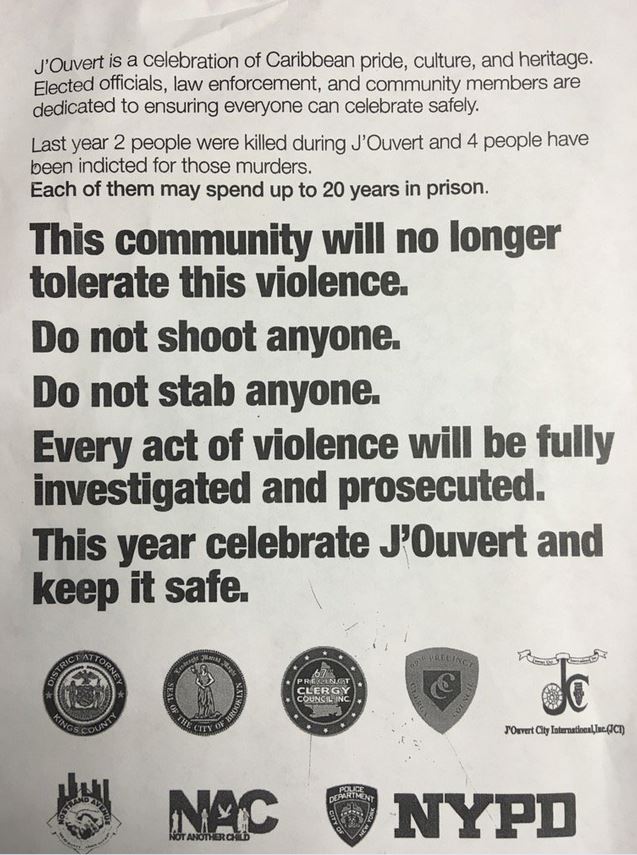
    Yes, the NYPD and others politely asked people to not shoot each other at J’Ouvert this year. The New York Postquotes a police source as saying, “I guess this is the de Blasio crime prevention program.”

    In Brooklyn, pre-lent pre-dawn J’Ouvert is followed by the massive (like one-million people massive) Caribbean Day Parade (which has also had a few unfortunate deathsover the years). The two events are organized separately and not related but by culture and heritage.

    It’s easy to mock a poster, but I don’t know if it was a bad idea. It’s never a bad idea to work collaboratively and ask politely. It’s not like the poster was the only thing police were doing. If nothing else, at least you can say, “At least we tried.”

    Last year an aide to Gov. Cuomo was shot and killedin the pre-dawn J’Ouvert hours.

    While onlyone bullet struck Gabay, some 20 or so people using some 27 firearms, mostly pistols, blasted off as many as three dozen rounds during the exchange.

    When the smoke cleared, three others were shot and two people were stabbed, one fatally.

    Last year organizers claimed the shootings happened during the parade, but not because of the parade. Just, you know, typical Brooklyn violence. Former cop and City Council Member Eric Adams saidthe reaction to the violence was “hysteria”: “We don’t stop celebrating the Fourth of July because some crazy breaks out a gun.” No, we don’t. But people don’t break out guns in most festivals.

    In 2014, “a gunman opened fire into a crowd of revelers, killing one man and wounding two others. In 2012, two people were stabbed to death and at least two were shot.”

    From the New York Times:

    Along with colorful costumes and dancing in the streets, there has been another constant: violence. Over the past decade, 21 shootings and other violent acts have been recorded at J’ouvert festivities, said Assistant Chief Steven Powers, the department’s Brooklyn South commander.

    At a news conference on Monday morning, Mayor Bill de Blasio said that the additional security measures “were exactly the right things to do,” but added, “We didn’t get the results we wanted.”

    Asked whether the parade should be moved or canceled, the mayor said only that “every option will be on the table.”

    He compared the J’ouvert festivities with other large New York City celebrations like the St. Patrick’s Day Parade and the Puerto Rican Day Parade, both of which were once far more raucous.

    “All of those previously violent events were brought under control,” Mr. de Blasio, a Democrat, said. “We will find a way to keep this one under control.”

    So yeah, you need to police J’Ouvert and the West Indian Day Parade differently than a million people listening to classical music in Central Park. And no, it’s not because the attendees at the former are mostly black and the latter mostly white.

    This year, rather than a scatter-shot police approach, for city decided to work with the organizers of J’Ouvert (the Caribbean Day Parade has always been much more legit). The city granted its first ever permit to J’Ouvert. There was a route, street closures, light towers, and an even greater police presence. The whole nine yards.

    Alas, it didn’t work. Two people were killed and last I heard at least three others were shot. A 17-year-old and 22-year-old were fatally shot a block from each other, at 4 and 4:30 AM, along the route of the official J’Ouvert parade.

    One of those shot, 73-year-old Margaraet Peters, said,

    The youths seem to want to ruin the West Indian parade. They’re smoking marijuana, carrying on, looking for fights with other groups…. The bystanders are always the ones getting hurt. It’s so sad – I could have died. I told my family the most important thing is I’m alive.

    For cops, this day is a no-win no-fun too-loud not-worth-the-mandatory-overtime hassle. I suspect Caribbean cops, and there are many in the NYPD, may beg to differ. But the few I know don’t want anything to do with policing this event either.

    Cops hate working these events because, like you, they want to be eating burgers with their families on Labor Day. Instead, they have to work a chaotic scene of literally a million people. And the 999,000 who aren’t causing trouble aren’t cops’ concern. Because at some point, especially pre-dawn, you know there will be fights and gunfire. And God forbid you actually stop somebody, cause then the New York Times will say you’re racist.

    For the often anti-cop Daily News, the story isn’t just violence but the cops complaining. Cops “crowing” over killings on “racist online message board,” screams the headline. Juicy! For example, right there in the first post, say the News:

    It’s 0644 on Mon. morning and already we have 4 SHOT with 2 DEAD (SHOT IN FACE) and we have 1 reported STABBING. Godless DeBlowsio was on his hands and knees PRAYING FOR THE STORM TO WASH OUT THE PARADE.

    Uh, actually, yeah. I bet de Blasio would have happily had the skies open up at 02:00 hours last night.

    [For the record Thee Rant often brings out the worst cops and the worst in cops. And yeah, some cops and retired cops are racist and know how to use the caps-lock key. But bitching about violence and the political sensitivities around working J’Ouvert makes you human, not racist.]

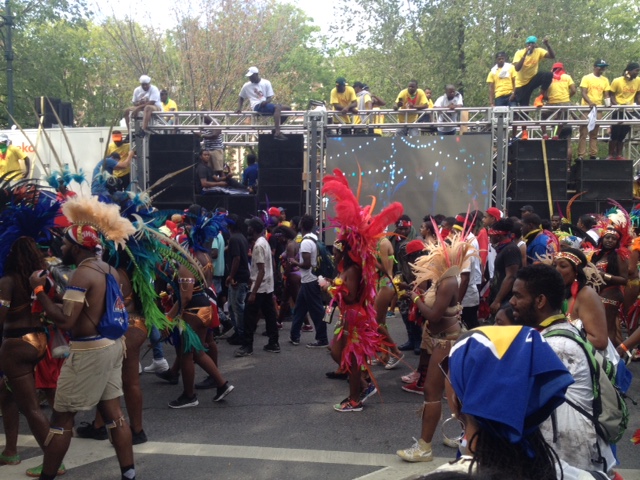
    But at least we tried. I guess you try again next year. It’s not like I’ve got the answer. I don’t think you could shut it down, even if you wanted to. And why would you want to? You really shouldn’t stop Carnival.

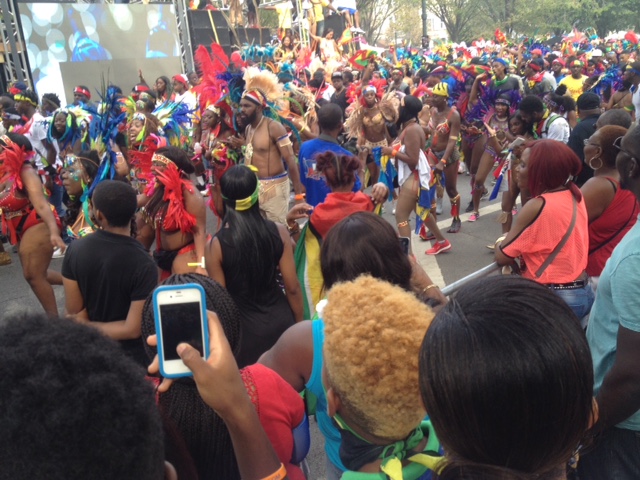
    I try and avoid massive crowds and police barriers, but my intrepid wife sent this report from the front line:

    Pretty freakin’ awesome, and made me sorry I’ve never gone before. Not terribly crowded. Insanely good fashion everywhere. Great-looking food. Only intermittently loud, as sound systems are pretty spread out in the parade. I did not find the girl I was trying to meet, but, oh well.

    Maybe next year I will go. I do look great in feathers.


    [Photos by Zora O’Neill]

  • “Policing is differentiated from other occupations by the use of coercion”

    My colleague Eugene O’Donnell, former cop and prosecutor, writes in The Crime Report about “The ‘Post-Policing Era’ in America: How Will We Cope?” I don’t actually think we are entering “a post-policing era,” but it’s certainly likely we’re going to see police responding to forces asking them to do much, much less of the coercive actions that justify the need for police in the first place:

    [Let us discount] the notion that if the police are nice to everyone the world will truly shine. In fact, when the police are doing the enforcement duties that differentiate them from other civilian occupations they are enmeshed in conflict, undertaking work that is adversarial and frequently leaves people smarting.

    It’s worth quoting this article by O’Donnell at length:

    “The policeman is denounced by the public, criticized by the preachers, ridiculed in the movies, berated by the newspapers, and unsupported by prosecuting officers and judges. He is shunned by the respectable, hated by criminals, deceived by everyone, kicked around like a football by brainless or crooked politicians.”

    —August Vollmer, police reformer and chief, Berkley, California, 1929.

    This is the dawn of the post-policing era in America, and the nation needs to come to grips with how to maintain safety and secure order with cops playing a dramatically reduced role. From coast to coast there is an acute shortage of men and women seeking to be police officers.

    Half a century ago, the Kerner Commission envisioned policing as a profession, with baccalaureate- carrying cops. But almost no police department in the county requires, or plans to require, a four-year degree for hiring. It is absurdly out of reach.

    In fact, departments with even the most minimal requirements struggle to recruit new officers.

    It is dawning on police officers and institutions that the police job is presently undoable in our far too violent and armed nation, and is rapidly becoming utterly impossible without a willingness to shoulder enormous physical and psychic risks and exposure to dire, possibly incarcerative consequences.

    To discharge the duties of a job that involves using force, even lethal force, on others in unscripted situations, while a camera records one’s improvised, clumsy and sometimes terrified decision-making for dissection by battalions of armchair second guessers makes this a career choice easily shunned.

    (Some reforms are overdue and necessary but cannot be reconciled with the need to find humans to do the work.)

    Once individuals have identified their political persuasions, than all issues are framed, and solutions filtered, through those orthodoxies. In fact, political philosophies are pretty useless when trying to accurately identify what a community’s problems are, and fashioning solutions.

    Thus, at present, an absurd partisan conversation about who is “pro-police” and who isn’t is a feature of this year’s presidential election. This team-police versus team-citizen approach avoids serious issues and the need to make choices. Only a political knave or a novice offers an affirmative blueprint for keeping the public safe from crime and terrorism: The rewards all flow to they who critique the best and express in the loudest voice the need for empathy and a view of humanity that is distinction free.

    Policing’s Hard Truths

    Policing is differentiated from other occupations by the use of coercion; thus it is fair to say policing is not infrequently lawfully brutal, but relatively rarely crosses the crime to criminally brutal. To say this in today’s environment is to utter words that are construed as almost hate speech, and subject the speaker to the loudest approbation.

    Policing is expected to be the one and only profession that can achieve a fairness that is elusive in every aspect of a market economy. Thus far in Chicago out of nearly 300 homicide victims, almost all are black and a handful, nine, are white. No fairness there. Some construct arguments about the police that omit these shockingly disparate facts, ignoring that these numbers are potent weapons in the hands of the most divisive figures in public life. (And it is worth looking at the faces of the lives snuffed out by this long-running genocide)

    The unstated idea that the police are no longer needed has become a mainstay, amongst many elites including those who pen editorials for the New York Times and the Washington Post. Enforcement and incarceration are regarded as evils per se. Last week’s Department of Justice report on the Baltimore police nowhere mentions the toxic implications of allowing shooters to shoot and remain free in their own communities.

    Community policing—which is ill defined and amorphous–is once again being offered up as an ameliorative in the midst of our current crisis. It is never quite clear what it is or how it works in a poor or high-crime community, but it advances the notion that if the police are nice to everyone the world will truly shine. In fact, when the police are doing the enforcement duties that differentiate them from other civilian occupations they are enmeshed in conflict, undertaking work that is adversarial and frequently leaves people smarting.

    The “police problem and criminal justice systems needs fixing” debate over the past few years has consumed a staggering amount of time, but precious little in the way of solutions that will take us forward into the future–a future where the police will play a much, much reduced role.

  • 10 shootings a day: This is the homicide problem

    10 shootings a day: This is the homicide problem

    The Chicago Tribune has an excellent articlethat starts on the West Side [2 miles from this house]:

    To understand Chicago’s violence, start at Kostner Avenue and Monroe Street and walk west up a one-way stretch of graystones and brick two-flats. There on a boarded-up front door you’ll see the red stain of gang graffiti. On the cracked sidewalk below lies an empty heroin baggie. Hardened young men sit on a porch.

    This single block on the West Side — part of the Harrison police district — has been the scene of at least six shootings so far this year

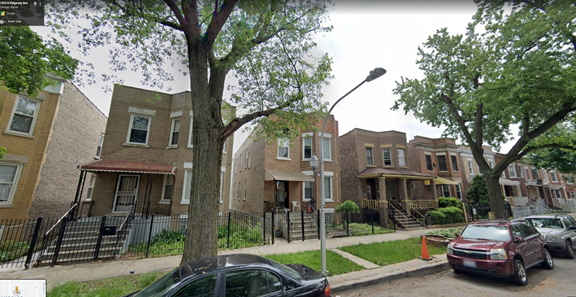
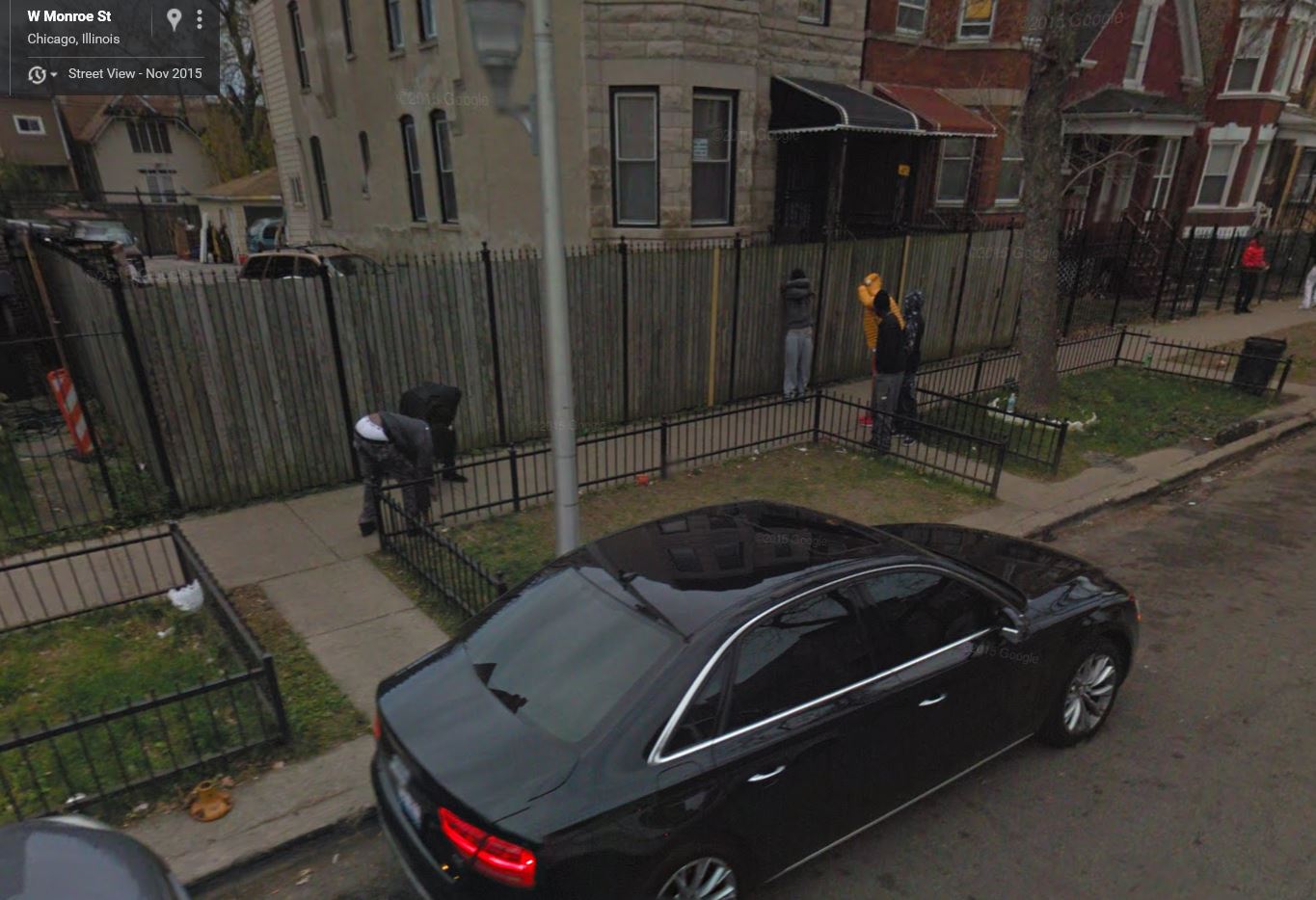
    My father grew up in this neighborhood, a mile away on North Avers Ave. The Greeks are long gone, of course. My father’s family moved to Albuquerque in 1947. I checked Google street view for that block of six shootings:

    These guys are totally not cool with the google car taking their picture.

    Think they’re up to no good?

    Kind of cracks me up.

    Here’s the thing. Those guys you see. Them. There. In that picture right there above. Those guys in front of that fence? They are the problem! Sometimes it really is that simple. Seriously. It’s not rocket science. There they are.

    And police officers know that. But now what?

    Chicago cops aren’t stopping these guys anymore because, well, why should they? The ACLU sues cops and the Chicago Police Departments for stopping six black guys who are just minding their own business:

    All this has led many officers to feel unsure about stopping anyone. Just this week, the president of the police union said many officers feel that “no one has their backs.” Other veteran officers agree that Chicago cops are dispirited and have slowed down on the kind of proactive policing that can remove a gun or criminal from the street.

    The makeup of Chicago’s gangs has changed dramatically over the years. They once were massive organizations with powerful leaders and hundreds of members who controlled large chunks of territory. Now small cliques battle for control over a few blocks.

    Experts also agree that personal disputes increasingly are playing a role in the violence. One veteran cop recalled with disbelief recently how a slaying he investigated boiled down to an insult over shoes.

    Police also said so-called net-banging on social media fuels conflicts. Gang members have been known to post menacing videos on YouTube, showing them furtively entering rival territory, waving guns and issuing threats.

    Ranking officers say reports from the field indicate more gang members are being caught carrying guns than in the past, a troubling trend that could explain in part the surge in shootings.

    Morale plummeted as officers expressed concern about their every move being captured on smartphone video, a Tribune story reported earlier this year. Some have suggested that officers became hesitant to make street stops and arrests for fear of backlash.

    Dean Angelo Sr., president of the Fraternal Order of Police, said street stops had plunged by 150,000 so far this year, but he blamed the more extensive paperwork that officers must fill out this year for every street stop.

    Another veteran cop said the forms are so complicated that they take as long as an hour to fill out, keeping officers from street duty and leading many to reconsider whether a stop is worth the effort. It’s affected the department’s ability to gather intelligence on gangs, he believes.

    The ACLU has disputed the notion that fewer street stops contribute to spikes in violence.

    Of course they have. But the ACLU is wrong. Dead wrong. Look, if you want to argue that these young men shouldn’t be stopped at all, fine. You agree with the ACLU (and don’t live on that block or hear the gunshots). And the ACLU is right in criticizing police who stop people for the sake of making a stop.

    As a cop you don’t (or shouldn’t) harass everybody walking down the block. You harass these guys on this block. And by “harass” I mean, within the law and constitution, make it little less fun for them to hang out in public and sell drugs. Yes, you as a cop give these guys a hard time. Is that fair? Yes. Because there have been six shootings on this block this year. Is it racist? No. Because these guys are the problem.

    If you’re a cop, you need to ask a bunch of questions 1) do you know these guy are slinging and shooting? 2) Should you stop these guys? 3) Are they committing a crime? 4) Are they a Broken Window? 5) What legal basis do you have to stop and frisk those guys?

    [The answers are 1) get out of your damn car and talk to them, or at least watch them disperse in your presence, 2) yes, 3) no, and 4) yes. 5) very little at first, but you can build it, ask for a consent search, or conduct a Terry Frisk.]

    You pull up to them. See what they do. You can crack down on this group by enforcing Broken Windows quality-of-life crimes. You get to know who they are. You can use your discretion and ticket them for something — drinking, smoking joints, jaywalking, littering, truancy, spitting — whatever it takes. You can arrest them when they can’t provide ID (they can’t, trust me). You can harass these criminals legally and within the bounds of the constitution. This is what police are supposed to do. It’s how homicides are prevented. It’s how some kids stay out of gangs. But if cops do their job, then we, society, need to support police officers against inevitable accusations of harassment, racism, and even discourteous behavior in their confrontations with these criminals.

    As a cop you will not win the war drugs, but as long as drugs are illegal you need to fight the fight against pubic drug dealing. But we’re telling cops not to do this. In Chicago cops are listening. And so are the criminals.