Tag: crime prevention

  • Murder in Baltimore

    With murdered doubled post-riot, you’d think more people would care. I don’t mean people in high-crime neighborhoods in Baltimore, they do care. It’s all those other people who so righteously saw police as the biggest problem in the hood. Where are they, now that the murder rate has doubled?

    Oh, and how did that “gang truce” work out? Well that hasn’t worked out so well. Legitimizing and empowering gangs is not the answer. It’s the Cloud Cuckoo Land idea, embraced by too many, that crime prevention can be purely collaborative and never confrontational. It’s also a strangely insulting concept, especially when it comes from outside white liberals, that criminals somehow represent the community more than the police.

    Yes, police can and should be more polite in their job. There’s no reason to be an asshole on the job (which is not to say that some people sometimes don’t need to get told off sometimes). But being a dick is not only wrong, it’s bad policing. It makes the job tougher for all police. Still, more polite and empathetic and understanding police — which can make non-criminals less anti-police (a more important than many cops want to admit) — will not stop criminals from killing each other.

    I think a lot of this comes down to the old sociology fallacies that A) police don’t deserve credit for preventing crime, B) culture doesn’t matter, and C) the only real causes of crime and what is perceived as bad culture are inequality, racism, and lack of opportunity. But the “root causes” did not magically change on April 27, when Baltimore burned.

    After the riots and horrible leadership from Baltimore’s mayor and police commissioner, proactive police patrol all but stopped. Why? Because all police work has the risk of going south. There’s long been the maxim in policing, “if you don’t work you can’t get in trouble.” I’m not a big fan of the thin-blue-line trope, and yet here you have a pretty clear cut case where police have done less and criminals have done more.

    Racism in America and violence in America are two separate problems. To walk up to an enemy and pull a trigger is something some people choose to do and others do not. Somehow, lots of poor people — even in Baltimore — manage to live decent and even joyous lives without killing somebody. Calling out racism and racists — a noble calling — isn’t going to save one black life in Baltimore. To see police as some kind of nexus between racism and violence is a tragic mistake. Baltimoreans aren’t being killed by racists. They’re being killed by each other (Freddie Gray being a notable exception).

    In parts of Baltimore we pay police to deal with those people who think murder is an acceptable problem-solving methods. Police deal with these criminals daily because these criminals are hanging out on the corner all day dealing drugs. Some neighbors have the gumption to not like this. So they call the police. And in come the police to clear the corner. And that’s what real police do.
  • Blacks against Black-on-Black Violence

    This isn’t really news. But some seem to think that blacks only care about black lives murder when it’s at the hands of police. (And certainly police-involved killings seems to be the only ones that get a lot of press). But when blacks do protest and act against violence in the black community, very few seem to notice.

    This happenedin Baltimore. The mayor said, “Some people have said the work we’re doing here is blaming black men. I refuse to ignore the crisis.” The sobering facts:

    This year, all but three of the city’s 44 homicide victims were black. Last year, 189 of the city’s 211 murder victims were black. And most were young. The largest group of victims — 54 — were age 25 to 29,

  • High security walls may increase violent crime.

    This is interesting, albeit about South Africa. But the basic idea is this:

    Walls are actually making things worse. “No one can see what is happening in
    your home so no one can help,” she told the [South African] Daily News.
    They keep people from being each other’s natural lookout. And they are an even bigger barrier to social cohesion, in a country that needs it a lot.

    Further, Marks told Quartz that high walls not only fail to curb crime, they attract criminals—once inside, the criminal is as isolated as the homeowner, free to do as they please.

  • Better Policing Equals Less Crime

    This is a no-brainer to many, but a lot of people — usually those who don’t like police — still deny or diminish it: cops matter. And national trends are the result not some crime-related miasma but of the collective work in individual cities and neighborhoods.

    Camden, NJ, is worth paying attention to. I haven’t been following it too closely, but what I do know (in part due to my colleague John DeCarlo) is very interesting. Then:

    In January 2011, the state slashed the budget for the city’s police department by nearly 23 percent. The police union was dissolved after half of the uniformed officers were let go. The department – criticized by some as incompetent and ineffective – was then reconstituted as a county-run enterprise. But until new recruits could be brought on, the city suffered under the draconian cuts. There were nights when only 12 officers patrolled the entire nine square miles of the city.

    And now:

    The city – frequently labeled “America’s Most Dangerous” – has recorded as of Friday the fewest homicides in a year going back to at least 2010.

    In addition, during the first six months of 2014, the number of gunshots in the city fell nearly 50 percent over the previous year….

    Despite two fatal shootings in quick succession this week, the number of killings is less than half of that two years ago. By Halloween 2012, Camden had buried 55 victims. This time last year, it had 43. As of Oct. 31, the city had seen 24. In 2010, at this point, there were 30.

    By civilianizing or outsourcing every job that does not require a gun or a badge, the county-run force bolstered the number of boots on the ground.

    Police walking beats are supplemented with “virtual patrols” by civilians, who monitor 120 surveillance cameras bolted to light poles. An additional 40 to 60 private security guards, sporting yellow-and-blue vests, roam the business district, calling in reports to the command center.

    Of course some people still complain, but haters are always gonna hate.

    Meanwhile…

    Vallejo [California] has struggled for years. Crippled by high pension costs and public-employee salaries, it filed for bankruptcy in 2008. Things didn’t get much better after the city emerged from Chapter 9 in 2011: Crime was bad and the city’s police department was perpetually short-staffed. There were 10 murders in 2010, 14 in 2012, and 24 in 2013.

    Obviously both cities cannot simply be reflective of some “national trend.”

  • Crime isn’t up

    Crime isn’t up

    Man, if you read the NY Post, you might think the city is going to hell. And all because a liberal is mayor and cops’ hands are tied: “The attack raised fears of a new wave of anti-cop violence — with a police union president blaming the assault on Mayor Bill de Blasio and his crackdown on stop-and-frisk.”

    I don’t want to minimize the danger of “air mail,” people throwing things from high above. It can indeed kill. But I doubt this potential murderer threw a bike at cops because police no longer make quota/productivity-goal based stops.

    I also don’t want to minimize the unfairness of potential lawsuits brought against individual police officers who are, in good faith, trying to do their jobs.

    Even my old sergeant from Baltimore couldn’t resist telling me how New York was not longer safe without all those stops, not to mention a liberal Sharpton-loving mayor in charge!

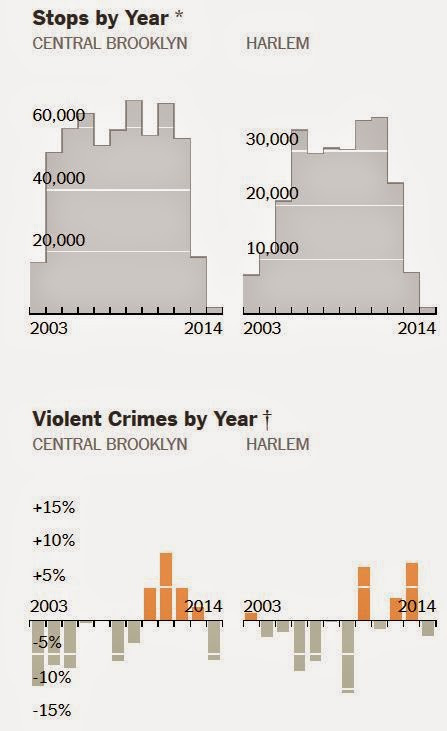
    But there’s one problem with crime-is-up-because-stops-are-down theory. Crime isn’t up! So until crime actually does increase, can we all just stop talking about the rise in crime so matter of factly?

    Here’s my theory: Cops have, are, and always will stop people when they have reasonable suspicion. Why? Because that’s what cops do! Call it doing your job or professional pride or whatever. Cops want to stop crime and catch criminals.

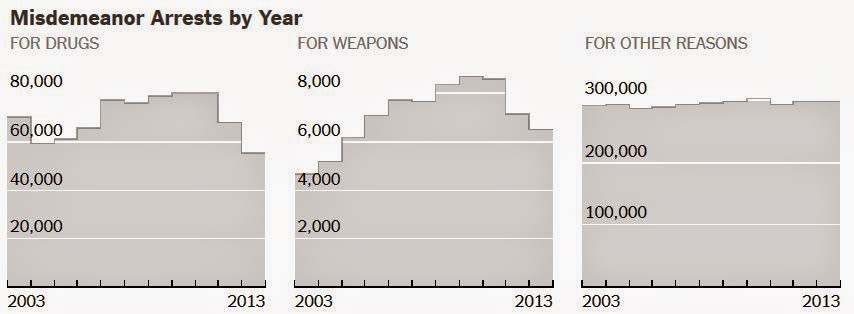
    But what cops are not doing much of making stops just to meet some perceived quota. This means that literally hundreds of thousands of guys a year are not being stopped because they’re wearing baggy pants in a high-crime neighborhood.

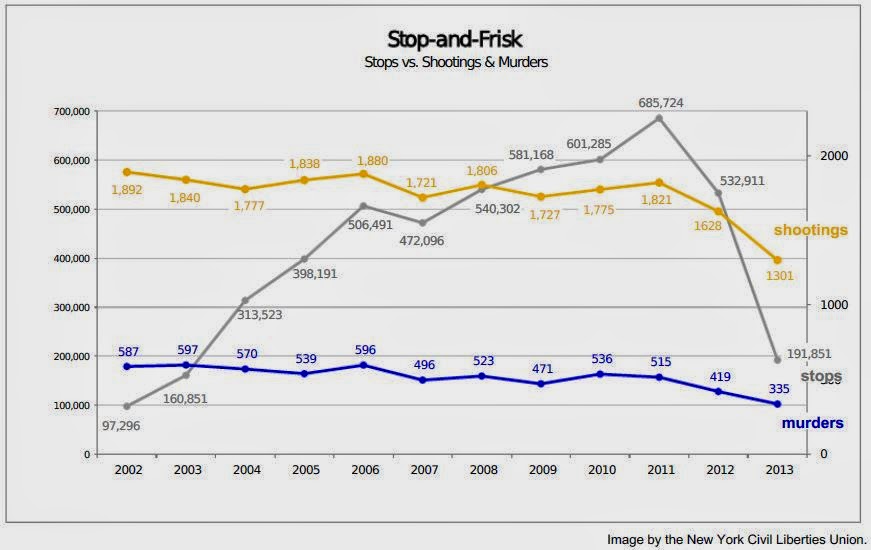
    I understand that logic of why massive stop-and-frisks could have a deterrent effect on crime. And yes, school is now out, the summer is hot, and stops have been way down for almost a year.

    Now this chart only goes to last year. This year stops are down, murders are down a bit, and shootings are up a bit. Overall, according to the stats, crime is basically unchanged (down 3%). But I make it habit not to rely on any crime numbers other than shootings and murders.

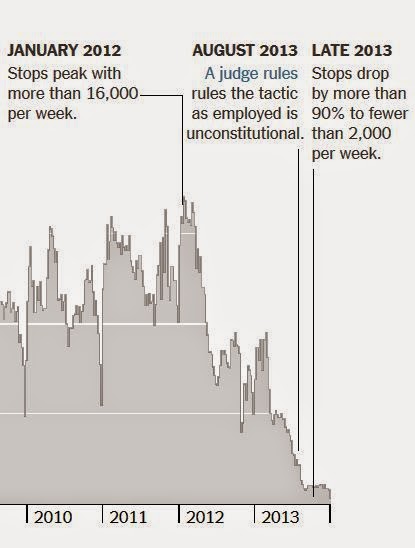
    So stops are down and crime is still down. Yes, crime is up in some places, but it’s down in other and overall constant. In the 75, stop are down 90% and shootings are up 30%. And leave it to a real news source to find local residents saying police need to start up those stops again!

    As somebody just put it (I forget where I just heard this), “what we have now isn’t a crime problem but a newspaper-selling problem.” I might also add there’s a bit of a problem with an ideology that believes the only effective policing is repressive policing.

    Is there a correlation there between police inaction and more shootings in East New York? Almost certainly. But we can deal with that without going back to blanket (and now illegal) police of massive stops and frisks.

    People feel safe when they see police and normal life functions. Police presence is key. Police getting out of their car is key. Police need to know the people — good and bad — in their area. Police need to stay in one area for a long time so that knowledge isn’t wasted. But 600,000 stops a year? That’s too many. And zero? That’s too few. But somewhere in between the two — and toward the lower end — it’s going to be just right.

  • High Crime Neighborhood + Cops on Bikes = Less Crime

    From the Chicago Tribune:

    The [Chicago] impact zones, established in February 2013 after a violent 2012, comprise just 3 percent of the city’s geographic area but account for one-fifth of its violent crime, according to the department.

    From the Sun Times:

    In March 2013, the department began assigning foot patrol offers to the high-crime areas. McCarthy said feedback from the communities has been positive, as have the results. Since Feb. 1, 2013, in the impact zones, murders are down nearly 50 percent, shootings are down 43 percent and overall crime is down 26 percent, doubling and outpacing citywide reductions, he said.

    How is the different than NYC? Hopefully, one would think, the cops in Chicago are doing something other than feeling quota pressure to write citations.

    In numbers, though, we’re not talking many cops. 360 officers in total. 140 on bike 220 on foot. That’s 18 cops per impact zone, which means about 4 or 5 on duty 16 hours a day. The zones seem rationallysized. The few I checked are about one-quarter to one-half square mile (or 30 to 55 blocks).

  • Crime in NYC is going to go up, unless it doesn’t

    I’ve never heard such uniformity in belief from police officers that crime is going to go up in New York City. Why with stop, question, and frisks down and a liberal mayor in charge, it’s almost like they want crime to go up just so they can say, “we told you so” and reminisce about the good ol’ days of Giuliani (when crime was, by the way — though going down rapidly — much higher).

    Perhaps a level of fear and oppression is lifting from parts of the city… I don’t know. Perhaps that is good. Perhaps it will lead to wilding and chaos. I don’t know. But until crime does go up… when the next Compstat report is publicly released it will show it was a bad week in NYC, with 9 murders. This will negate much of the year’s improvement over last year. And winter was indeed very cold.

    So it would be nice to get through a long hot summer before stating with confidence that crime isn’t going up. And if crime does go up in New York, let’s keep the focus on police tactics and police citizen interaction and not blame the usual gobbledygook of liberal “root causes.” (If the crime drop in the 1990s showed anything, it’s that crime can plummet independently of improved social and economic conditions. Poverty can make you miserable; it does not turn you into a mugger.).

    Regardless, right now crime is not going up. So until it does, it seems silly to run around like Chicken Little saying the sky is falling.

  • Good news from Chicago

    NBC Chicago Reports via Atlantic Cities:

    Chicago closed out the first 11 months of 2013 with 380 murders, a drop from 474 in the same period of 2012, according to police data. That’s the fewest for any year in Chicago since 1965, according to Adam Collins, the Chicago Police Department Director of News Affairs.

  • “You can’t stop me! You can’t do that no more! There are new rules!” says gun-toting idiot

    The Post reports (and some cops confirm) that word on the street is that cops can’t stop anybody anymore. Of course that’s not true. But it still make for some chilling anecdotes.

    “You can’t be stopping me, yo! The cops can’t be harassing us!”

    He was still frisked.

    And yet there is still no apparent increase in violence.

    [thanks to J.S.]