Tag: crime

  • And now you know… the rest of the story!

    Fatal stabbing suspect Cyan Brown, 16, was the aggressor in Christmas Eve New York subway fracas, police say.

    This happened in an area I go through a lot. The original reports said: poor girl “fondled” by group of bad men and stabbed one in self defense. The cop in me knew that wasn’t the whole story (when will reporters ever learn?). The truth is never (or almost never) that simple. Now the real story seems to be coming out.

    The account in the New York Daily News.

  • The family that robs together…

    Marc Perrusquia in the Memphis Commercial Appeal has a good story about the extensive criminal activities of one very criminal family.

    Over seven decades, Porterfield and several members of his extended family have been a violent, drug-peddling, thieving scourge on Shelby County. They’ve been involved in at least 14 shootings, four murders and countless break-ins and assaults.

    In all, 407 arrests.

    Breaking the cycle is a daunting, and costly, proposition. Yet, given the alternative — states are spending $50 billion a year to imprison offenders — it’s a challenge worth taking on, said Oregon social scientist J. Mark Eddy.

  • 18-Year-Old Charged With Murder in Death of Woman, 92

    “I don’t care about sob stories, bad background, poverty — none of that. As an adult, you know the difference between right and wrong. You have a choice and he made the wrong choice.”

    Well said. Too bad it’s from the daughter of an 82-year-old woman shot and killed.

  • “Help us get others”

    So says Chicago Police Supt. Jody Weiss. The Sun-Times reports. The police chief asking a bunch of high-school students to snitch? That’ll go over well.

    The sad part, at least to me, is that if it weren’t for the video, this would have been just another death in the hood. Another dead black kid, little reported and quickly forgotten. And some people, myself included, would have assumed that Derrion himself was partly to blame, getting himself into this mess.

  • Fight. Don’t Kill.

    Thinking about the street fight in Chicago makes me think Frank Zimring and Gordon Hawkins’ 1997 book, Crime is Not the Problem. They distinguish between crime and violence and argue convincingly that America’s problem is not crime but violence.

    Other nations have as much if not more crime, they say. They just don’t kill each as much. Zimring and Hawkins emphasize guns as part of our violence problem. But I think there’s something else. I’ve see some fights. Europe has their soccer hooligans. And a lot of drinking, too. And in Greece it seem like people are always yelling at each other. And there are even seasonal riots in Athens. But somehow it’s all controlled, almost ritualized. Maybe subconsciously. Somehow, in the heat of the moment, when the adrenaline is pumping, people in much of the world know to restrain from issuing that lethal blow. People let off steam, they save face, they vent, they even hurt. But by and large they don’t kill.

    And here, for no good reason I can understand, some kids pick up giant pieces of wood and wack each other, sucker punching others, and then stomping a man till he’s dead.

    I don’t buy the “it just don’t make sense” refrain. I mean, of course it don’t. But that’s not the answer. Is it something about American exceptionalism? Do we not understand how easy it is to kill someone? Do we not value human life as much as people in other countries? Do we have less self-control? Do we have no other means of having fun? All these may be true. But none of these seem to provide a satisfactory answer.

    How do you learn to enjoy stomping a defenseless guy for fun? I don’t know. Maybe you learned it from dad. More likely you never learned anything from dad because dad got locked up a long time ago himself. And your mom, who very well may be an idiot, tells you you gotta fight. Better to fight than get punked. That’s what you gotta do to be a mom.

    Maybe stomping a guy to death actually is fun. It’s easy to tsk-tsk others. Maybe there’s nothing better than hitting a guy upside the head with a two-by-four. Maybe that’s the dirty secret we who pass judgment from afar don’t want to consider. I don’t know. I’ve never tried.

    Update: Worth quoting T. Coates at some length here:

    I am aware of all the socio-economic forces at work they make black communities more subject to violence. I’m in all for trying to ameliorate those forces. In the meantime, I’m all for doing whatever it takes to protect the rest of us–particularly young black kids–from hooliganism.

    I can’t ever say this enough–there’s nothing inconsistent about trying to understand the broad societal forces, and still holding people responsible for individual action. Being black and poor sucks. But most poor black kids aren’t out smacking innocent bystanders with 2x4s.

    If all is as it appears for these kids who were arrested, then heaven help them, because we can not. Compassion–like all resources–has limits. It’s worth spending some time on what makes young boys do these sorts of things. It’s worth at least as much time to try and protect young boys who are just trying to live right. I know from personal experience that there are more of the latter than the former. Don’t ever forget that.

  • Nasty street fight in Chicago

    One 16-year-old high-school honors student student gets sucker-hit with a large piece of wood, then cold cocked, and finally stomped and beaten to death. All this caught on video in front of a large screaming (and sometimes cheering) crowd. Finally some nearby adults carry try and rescue him and carry him away, but it’s too late. Derrion Albert died.

    Foxhas video. The Sun Timesreports.

    The winner of the latest “Bad Parent Award”? The mother of one of the likely killer saying dismissively, “Gangbangers fight. That’s what they do!” Like it’s the natural order of things. Darrion, by all accounts, wasn’t a gangbanger.

    A few days later, in what seems like it could only come from a Monty Python skit:

    Some people stood nose-to-nose, arguing over whether the gathering [at the makeshift memorial] should be in memory of Derrion or a protest of the violence that killed him.

    Police responded.

  • Murder down in NYC

    Colleen Long has the story in the Washington Post.

    Homicides are down. They’re on pace for 457 this year, which would be lower than the many-decade low of 497 in 2007. Very impressive. Thank you, NYPD!

    This is all the more impressive since, as Patrick McGeehan reports in the New York Times, unemployment hit 10.3% in New York City, a 16-year high. Sixteen years ago, in 1993, there were 1,960 murders in the city. Take that, “root causes.”

  • A Mugging on Lake Street

    A Mugging on Lake Street

    A reader pointed out a good article in Chicago Magazine by John Conroy, “A Mugging on Lake Street.” It’s a bit heartbreaking to learn that John Conroy, whose name I recognize as a quality journalist, doesn’t have a regular gig. But at least he got this assignment. Too bad it all started with Conroy getting jumped while riding his bike home through the West Side of Chicago. (Actually Conroy was “banked” more than “jumped,” but only those in Baltimore will understand that subtle distinction.)

    The story that follows is all about crime and race and punishment. It’s worth a complete read.

    I was ambushed on the West Side last year, an attack that on its face made no sense. I’d never seen my assailant before; he’d never seen me; no words were exchanged; nothing was taken. Like many crime victims, I wanted the incident, which changed my life for the worse, to have some meaning. I’m white, he is black, and in time it was hard not to wonder if race had something to do with it.

    I stopped by the 15th District police station, at 5701 West Madison Street, hoping to thank the officers who’d helped me. Looking for help in finding them, I asked for an acquaintance, T. C. McCoy, an African American officer who lives in the district and has worked there for 24 years. When he heard my story, he said, “It’s a hate crime.”

    Conroy wants to meet his offender. He does. He wants to interview him. He doesn’t.

    But in the process Conroy learns what it’s like to be a victim in our f*cked-up criminal justice system. It’s not good and Conroy ends up being had. But read the whole article because I can’t do it justice in excerpts. And it’s far deeper than a simplistic tale of a naive liberal who got mugged (though there’s some of that, too. I wonder if he’ll becomes conservative, as the old cliche goes).

    His article hits home with me for many reasons.

    1) I was born in Chicago.

    2) I bike around cities in all neighborhoods at all times. I’ve never been the victim of violent crime (or been hit by a car), on or off a bike. I hope to keep it that way.

    3) My father grew up less than two miles from where Conroy was jumped. I drove through this area coming back from my father’s funeral last year. Before my father died he liked to say that his block on N. Avers Avenue (the eight or ten-hundred block?) looked basically the same as it did when he was a kid, except now everybody is Mexican and Puerto Rican.

    My in-depth knowledge of Chicago basically ends in 1989 when I went to college. I still call L lines by their destination and can’t get over the fact that yuppies live around Cabrini-Green. Cabrini-Green was a no-go area when I was a kid. So was the West Side.

    So my first thought when I saw Conroy’s piece was, “What the hell is a white boy doing biking down Lake St?” In my slightly dated mind, the map of Chicago turns to dragons and winds west of Greektown and Halsted Street. My how times have changed; Conroy was biking home.

    Of course sometimes sh*t just happens. But it usually takessh*ts to dosh*t. And most people choose to live as far as possible from sh*t.

    You could say that Conroy was just in the wrong place at the wrong time. But some neighborhoods have more wrong places and wrong times than others. The corner of Lake and Laramie is a wrong place. There’s a liquor store, a check cashing store, a phone store, a Chinese take-out, loitering people, and a vacant lot. Presumably it was the vacant lot from where Conroy was attacked.

    I learned that from google earth’s street view. You can learn a lot about a neighborhood from google earth. If you like google earth (and who doesn’t?), zoom in on the intersection of Chicago and Pulaski, north of Garfield Park in Chicago and cornering a big industrial zone.
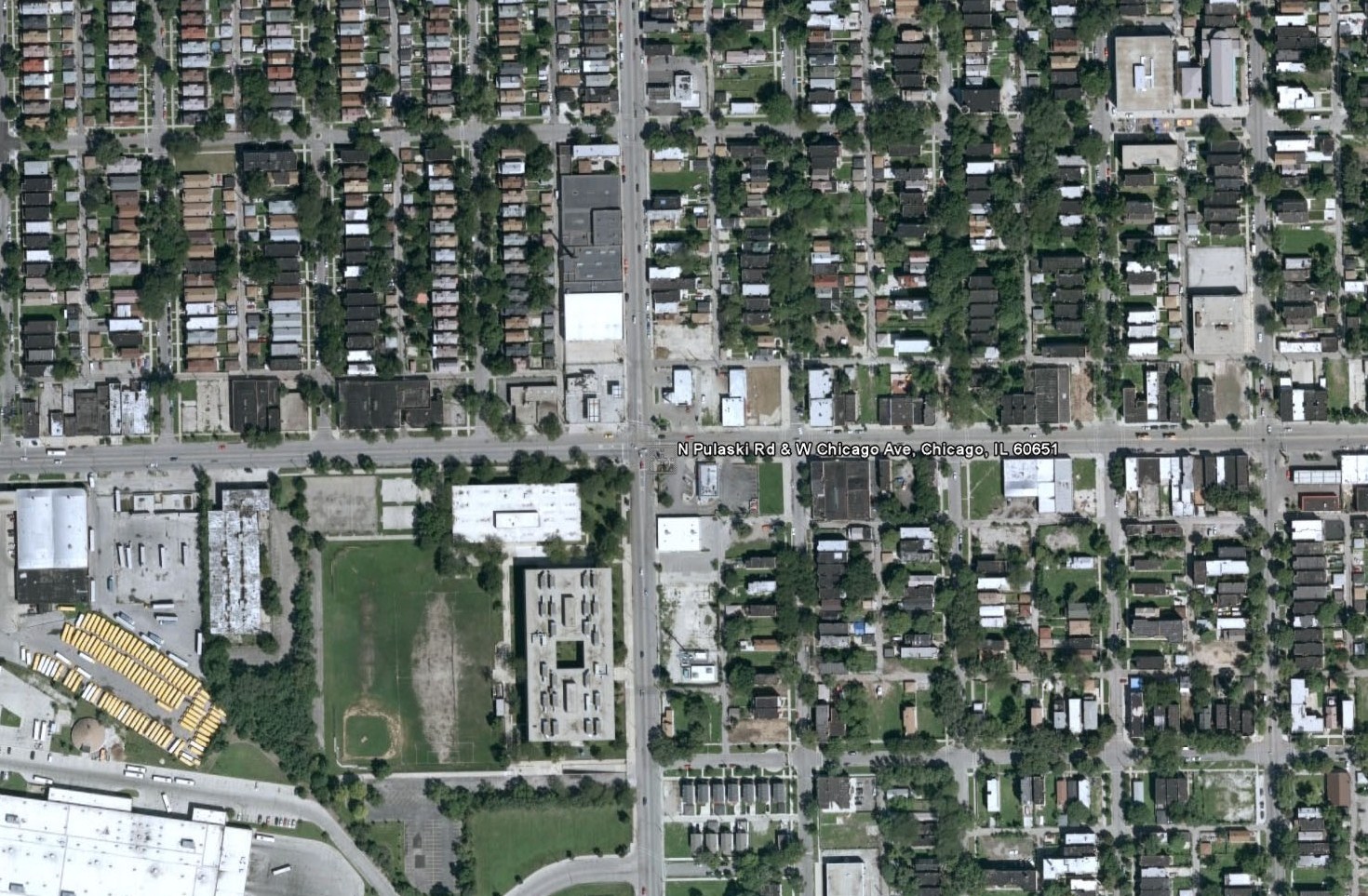

    To the northwest you get row upon neat row of Chicago bungalows. All’s well there. That’s probably what Conroy’s block looks like.

    To the northeast is where my father grew up. Things still look OK. You have homes and trees. But a few vacant lots are very worrisome. Still, you can even see nice block party / church festival being set up by Our Lady of Angels. That’s where my father went to school (before the horrible fire) until the family moved out to Albuquerque.

    But go south on Avers past Chicago and things start to git grim. Now you’re in the rough black West Side. From above, you can see fewer trees, more vacant lots, roofs in disrepair, trash in backyards, and abandoned cars littered to and fro. The street view shows boarded-up buildings next to well kept-up homes.

    It’s always the abandonment that strikes me. Entire city blocks empty. And just a short distance from where people pay half-a-million dollars for a “tear-down” lot. Crime, fear of crime, and race matter so much that in just miles property goes from being worth millions to being worthless and literally abandoned.

    Ta-Nehisi Coates comments on Conroy’s article here and here. As usual, he’s insightful, bold, and more often right than wrong (and who can resist the title, “The Logic Of The Bumrush”).

    I was struck by Conroy’s quest to find a deeper meaning in what happened to him. This may be more about me than him–but my sense of what always makes the hood so dangerous is the actual lack of real meaning, the random nature of violence, and how it pervades everything.

    Put bluntly, it’s not that they treated [Conroy] like a honky–it’s that they treated him like one of their own, like a nigger.

    And

    Eventually you tire of the whole dynamic. At least those of us who aren’t built like that, do. And make no mistake, most of us aren’t.

    One thing I learned policing in Baltimore is that I canhandle tough streets. I just don’t want to. Luckily for me, I don’t have to.
  • Do Not Murder

    Ta-Nehisi Coates has an interesting post about the death penalty and “innocent” people on death row. I assume it’s inspired by this storyin the New Yorker.

    I feel the need to highlight the case of Roger Keith Coleman, a man claimed innocence to the end, and whose case was murky enough that it garnered this cover story from TIME back in the 1992. Coleman was executed anyway.

    The DNA test came back and proved the state was right. Coleman had done it. You must understand what this meant. There were people who had devoted their lives to proving Coleman’s innocence, and they almost did. They were played by Coleman while he was alive, and he continued to play them from the grave.

    I bring this out to make something clear. I don’t have any doubts, first and foremost, about what, exactly, lies behind prison walls. There are evil people in this world. And there are, even more so, reckless people in this world who don’t much care about human life.

    I think there’s this presumption that people who are anti-death penalty get there out of some sympathy for criminals, or some wide-eye naivete. Maybe some people get there that way. I came up in an era where young boys thought nothing of killing each other over cheap Starter jackets. I don’t have any illusions about the criminal mind. I don’t believe in the essential goodness of man–which is exactly why I oppose the death penalty.

    I’d love a little followup on that last line. But it’s thought provoking.

  • Fed-up business people respond to robbery spree

    [He] was in the middle of a string of 17 robberies of city business in 22 days, police say.

    [In 2005] Lomax was sentenced to 21 years in prison, but the conviction was overturned on appeal. When the case came back to court on June 22, Baltimore Circuit Judge John Addison Howard gave Lomax 15 years, suspending all but five. The judge made the sentence retroactive to 2005, and Lomax was set free.

    Police say the latest crime spree began shortly thereafter

    The story by Justin Fenton in the Baltimore Sun.