Tag: crime

  • Tone it down

    I wrote thislast night for CNN, about the massacre in Dallas:

    Words have the power to inspire, inflame, provoke. Or else we wouldn’t say them. When words inspire others to kill, however deranged those others might be, we must see the consequences.

    When those on the political right speak against immigrants, Muslims or abortion, those on the left are quick and correct to observe that words inspire crimes of hate and violence. Similarly, when those on the left speak against police officers — not just bad ones, but all police officers — this, too, can have consequences.

    No matter one’s beliefs, we all need to call out extremism and hate, especially given American’s absurdly easy access to guns. No matter how many good people have guns, they cannot always stop a bad person with a gun. An armed society is clearly not always a polite society, so we need to tone it down.

    Police need to realize that some in their ranks make mistakes, both honestly and maliciously. This needs to be better acknowledged by those in law enforcement. But just as decent society does not hold every black, Muslim, or white Christian responsible for the murderous acts of a deranged few, it is a mistake to blame hundreds of thousands of police officers for the bad deeds of a few.

    In my call for common ground and more civility, I received nasty emails or tweets from some A) protesters, B) cops, C) blacks, D) whites, and E) gun nuts. So I must be doing something right.

  • “An Enduring Heroin Market Shapes an Enforcer’s Rise and Fall”

    The contrast between this well written piece about a murder victim in the Bronx and that BS pieceabout a murder in Baltimore is striking.

    Not surprisingly, Al Baker is on the byline of the good piece (Benjamin Meuller is first on the byline):

    Over nearly three decades, Mr. Perez held court on this block of East 157th Street off Melrose Avenue in the South Bronx. It was here that he climbed the rungs of the street heroin trade, wooed women, muscled out drug rivals from nearby public housing projects and, as he got closer to middle age, counseled young men to save themselves and to get honest work.

    By turns brutal and vain, comedic and exacting, Mr. Perez survived police raids, stickups, territorial incursions and a transformation of the city’s drug trade as it came to rely less than it once had on hand-to-hand street sales.

    When he was 13, his mother died from complications of H.I.V. His grandmother took him in, but then she died, too. He lived with an aunt until she moved away. A second aunt, Maddie’s mother, took over raising him; about a year later she also died from complications of H.I.V.

    As his crew’s muscle, Mr. Perez was targeted for robberies and beatings, friends said. Going to the police was akin to self-imposed exile. He built a reputation on responding with startling force.

    “In the streets you just don’t make money, and then get power and respect,” said a friend who worked with Mr. Perez, and who like many people interviewed for this article spoke on the condition of anonymity to avoid unwanted attention from rivals or the police. “Hell no. You’ve got to put in some type of work, meaning violence.”

    The police arrested dealers in buy-and-bust operations only to find most of them quickly back on the street, whisked through the revolving door of an overburdened court system.

    Arguably, Mr Perez shouldn’t be honored with a public memorial mural…

    It’s worth reading all these stories about murders this year in the 40 Precinct. So far there’s 1, 2, 3, 4, this one, #5.

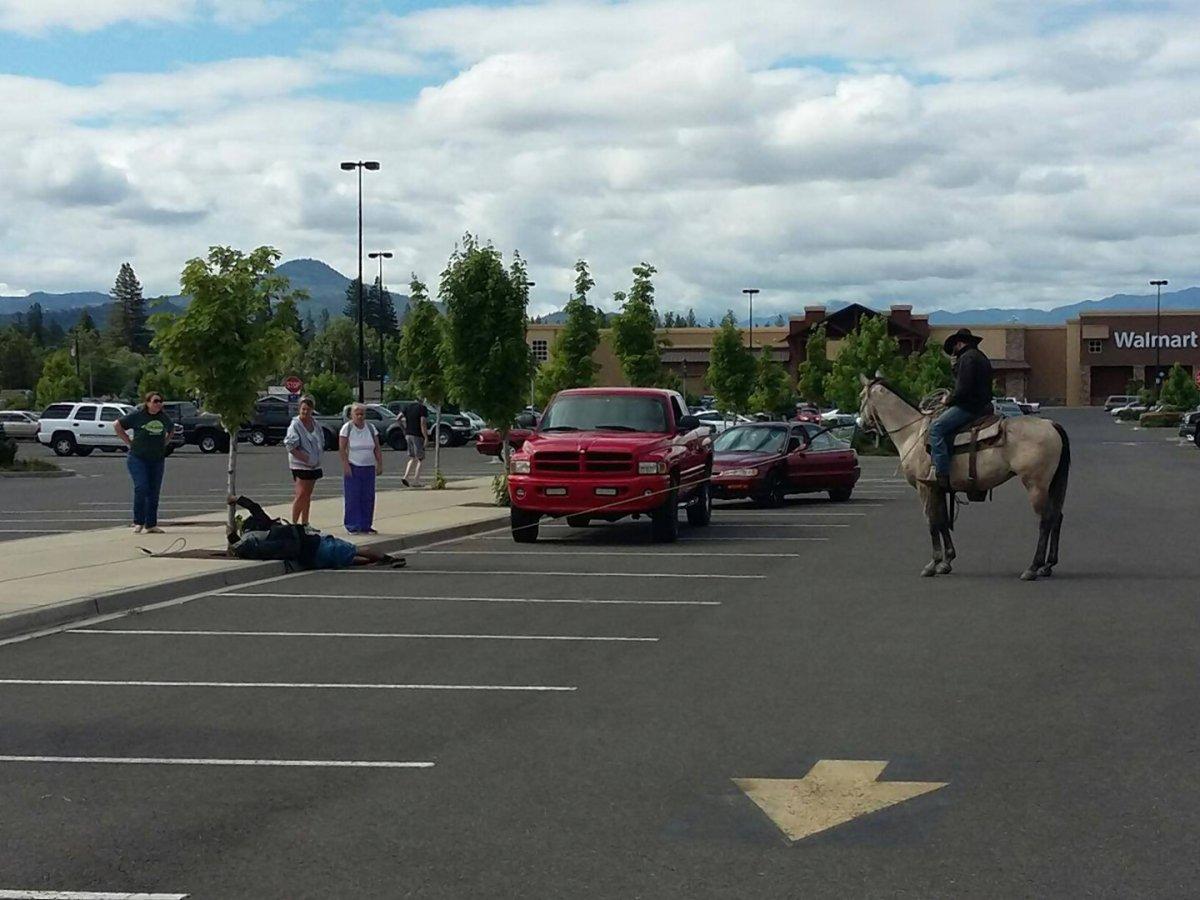
  • “Rancher on horseback lassos bike thief”

    “Rancher on horseback lassos bike thief”

    Too good of a headline to pass up. And nice picture, too. From the Daily News.

  • All in the Family (II): Another Nexus of Baltimore Violence

    All in the Family (II): Another Nexus of Baltimore Violence

    Forgive me for speaking ill of the dead, as I did a few days ago. But today the Baltimore Sun has a feature about a man who has had two sons murdered. Tragic. It really is. Nobody should have to deal with one child murdered, much less two.

    But being cynical and a former Baltimore cop, I’m thinking maybe this is a case of, “you play the game, you take your chances.” Zeus does not throw random thunderbolts. Lightning doesn’t strike twice in the same place. You get the idea? Did they “have it coming?”

    But read Colin Campbell’s sob story. These kids are presented as nothing but lost angels:

    “He was my best friend,” said [father] Nedrick Johnson, 38.

    The Johnson brothers played pickup sports and rode dirt bikes since they were 5 or 6 years old, their father said. “They used to sneak them out of the house and everything,” he said.

    Both were athletic: Darrian played quarterback, and Darrius power lifted competitively, he said. Darrius shot pool, could do a flip off a wall with a running start, and would sometimes ride his dirt bike with one hand — or none.

    Nedrick Johnson scrolled through photos of his sons on his cellphone: standing in front of the Christmas tree, sitting together at a family get-together, diving into a pool in tandem, popping wheelies on their dirt bikes.

    Darrian was caring, helpful, loyal, supportive and fiercely protective, his friends said.

    “He was the type to call you out of the blue,” she said. “‘You good?’ ‘I’m just checking on you.’ ‘You need anything?’”

    Homes said Darrian was a great cook and a lifelong friend.

    “He lived his life,” he said. “No matter if he died young, he lived his life to the fullest.”

    All that and a “great cook”? My God! Norman Rockwell couldn’t present such a dreamy All-American Family.

    But it made my Spidey-Sense tingle. Maybe you shouldn’t be “living life to the fullest” when you’re 19 years old. When I was 19 I was studying in college and waiting tables. But my first warning sign was “popping wheelies on their bikes.” Might seem wholesome to you. I love bicycles! Do you picture something like this?

    (This guy is not a Johnson brother)

    But in Baltimore we know what “dirt bike” means. (In a tweet, Colin confirmed “motor”.) “Dirt bikes” are horrible for quality-of-life. And they kill people (eight between 1997 and 2000, as I have in my notes, but more since. Update: this (dirt bike seriously hurts pedestrian, runs) and this (car hits dirtbike, driven get beaten), and even this. But by some bleeding-heart narrative I don’t understand, riding illegally and dangerously is just kids expressing themselves, even part of an uprising against racist cops.

    I respectfully beg to differ.

    First of all, good parents don’t let their under-10 kids “sneak out” with any bike, much less a motor bike. “Oh, that Junior. You turn your head for a second and next you know he’s doing wheelies on North Avenue!” Imagine the flack you’d get if you simply let your kid ride a bicycle without a helmet! You somehow it’s OK for other children — poor black kids in Baltimore — to do no-hand tricks on motorbikes while going the wrong way in traffic?!

    And, get this — pay attention because this is important — Baltimore police officers have gotten in trouble for trying to stop 7-year-olds from riding motorized ATVs in the streets. Why? I don’t know, but I suspect because when people read, “police removed a 7-year-old from his bike and detained his mom,” they’re thinking the kind of bike with cards in the spokes, so the cops must be assholes. It lead to media and public outrage against the police. And also a multi-year lawsuit from the boy’s mother (really from a lawyer who thought he could get a cut of the city payout.) The city actually fought the case and won.

    [Update: That kid on a bike story got mentioned in the DOJ’s 2016 report on the Baltimore Police Department as an example of how systemic problems are. No, not in Baltimore. But in the BPD. It makes no sense.]

    Here’s what I found from a brief search of Maryland’s online criminal records.

    Darrius Johnson — the brother killed in a double-shooting in 2015 — was born in October 1995 and had a moderate criminal record: assault, trespass, escape, burglary, assault, and trespass on school grounds. But keep in mind this record only covers the last two years of his life. Victims may beg to differ, but crimes don’t officially count until you’re an adult. (And there’s even a movement to raise the age.)

    Darrius’s brother, the one just killed, Darrian “Doddy” Johnson, seems to have stayed on the good side of the law with no criminal record. [Update: I originally posted incorrect information here that listed a Darrian Johnson with a different DOB and address. This was kindly corrected by a commenter. Corrections are always welcome.]

    But the real criminal seems to be their father. He’s no father of the year. For starters there’s the murder charge he faced when he was 15! (The disposition of the murder charge isn’t clear — hey, maybe he didn’t do it — but I suspect that when the case was booted up to circuit court, he got charged as a juvenile and the records were sealed.) There’s a first-degree rape charge at 18 (got null prossed, as ineffective prosecution could be seen as form of ghetto criminal entitlement). (There’s also the issue of some fraud case with the State Employees Credit Union that he lost for $34,000 plus court fees.)

    And then there’s the usual mélange of battery, assault, drugs possession with intent, more assault, drug dealing, more drugs, handgun violations, more drug dealings, assault, more handguns and drugs (not marijuana), armed robbery, and another handgun violation.

    The three sons mentions in the article may just be the kids he willingly took responsibility for. Paternity suits indicate at least two other sons (including a Nedrick Jr. already been convicted of a handgun violation). In fact, best I can tell (I may be wrong) Senior had three sons in two years! [Update: originally I had the time frame wrong.]

    Reading a fluff pieces like this in the papers, you might begin understand why cops hate “the media.” Neighbors call 911 and complain about shitty and violent public drug dealing neighbors over the years and over the generations. Police respond day after day after day to the crimes of this family. We pay and expect police to deal with the Johnsons.

    Let me say the taboo: Nedrick is a bad father and perhaps even a bad person. There. I’ve said it so cops don’t have to.

    Like the Antonios [sic] Addison and the Johnsons, some individual families are personally responsible for a disproportionate amount of violence and pain in Baltimore. Individual people on individual blocks actually are the problem. This isn’t some abstract theory of crime. This really is about “these people” not in the abstract offensive sense but in the literal sense of these people with these names who live in this house and commit these crimes.

    Police have to deal with the micro problems, the individuals, the Addisons and the Johnsons. Police don’t deal with the macro issues of social justice. And since nobody else (government, church, school, welfare, prosecutors) seems to be able to deal with these problems, we pay and pray that police do. And then if and when something goes wrong, we put the police on trial? I doesn’t make sense.

    Does this matter? I think it does. Because when you read about a poor father with two murdered sons, you may think think he deserves your sympathy. Hell, maybe he does. Like, despite all the father’s efforts, the mean streets of Baltimore done reached out and grabbed his children. But keep in mind it’s this very man that make the streets of Baltimore so mean.

    Who do you think shoots and kills and assaults people every year? The same criminals who sue police departments. Freddie Gray’s death was tragic; it may even be criminal, but that doesn’t mean he’s a role model on par with Martin Luther King, Jr. Keith Davis Jr. is an armed criminal who shot at and was shot by police. Even the out-to-prosecute-cops State’s Attorney agreed. That should be the end of the story. But it’s not.

    False narratives matter because we’re not being honest. When we portray criminals as innocent victims and give violent criminals the moral high ground, we perpetuate the violence.

  • Good News From NYC, Not-Bad News From Baltimore, Horrible News from Chicago

    In New York City, year to date, murders continue to be lower than last year (124 vs 140) and higher than record-low 2014 (112). Given the rise of homicide in so many other cities, this is great news.

    In Baltimore there were 26 murders in May. It’s hard to call this exactly “good news.” But last year, post riot, there were 42 murders in May. In previous years, May typically saw about 21 murders. Year to date (though May) 110 murders is not particularly good news. But it could be worse.

    In 2014 Chicago saw about 155 murders through May, last year there 173, and this year about 265 (just through May). Coinciding with this huge increase in murder is the fact that Chicago police are shooting far fewer people than ever! In 2014 CPD shot 45 people. This year they’re on pace for 15. The obvious conclusion is that police are less likely to proactively engage with violent criminals. This is great news for the police-are-racist-harassers-of-innocent-black-men camp. But not great news if you happen to be a young black man in Chicago getting shot.

    Yes, there might be a real trade-off between 30 people not shot by police and 1,400 more people shot by criminals. I’m not saying it’s direct cause-and-effect (it’s not like police were shooting all the bad guys) as much as mutual causation (police are interacting less with potential criminals).

    This certainly doesn’t fit the narrative from the left that police use-of-force is the paramount criminal justice issue of the day. But while the streets run red some people’s faces will go blue saying, “we don’t know why crime is up in Chicago!” What we do know is that no other standard factor has changed so much in Chicago in the past two years.

    If one happens to think, as I do, that most police-involved shootings are justified, this isn’t good news. Seems to me that police are not proactively engaging with potential murderers, and this matters. (And it matter more than, say, reducing the racial disparity in juvenile arrests based on population demographics.)

    I bet arrest numbers are down, too. [Well, I know they are, but why is it so hard to get Chicago arrest numbers?] Best I can find is this from 538.com.

  • The New York Times goes to the Hood

    I applaud any effort to focus on the victims of violence in America. Too often nobody knows or cares about this real carnage in this country.

    So over Memorial Day weekend the New York Times went to the bad parts of Chicago to sightsee:

    [We] dispatched a team of reporters, photographers and videographers to virtually all of the shooting scenes across the city. Working around the clock through the three-day weekend, The Times interviewed relatives, witnesses, police officers and others, and captured how much violence has become a part of the city’s fabric.

    After that self-congratulatory moment (wow, did they really work “around the clock” on a “three-day weekend”?!) I really did have high hopes for this 5,000-plus word article. But I was left feeling empty. Though I can’t quite put my finger on the problem, let me try.

    Murder victims should be humanized. You’re not just a homicide victim. You’re a real living human being with lives and stories and loves and problems. (And also, as cops know all too well, with soft flesh and blood and sometimes spattered brain matter.)

    This weekend, among the six killed are a father, Garvin Whitmore, who loved to travel but was scared of riding on roller coasters; and Mark Lindsey, whose outsize personality brought him his nickname, Lavish. The oldest person struck by a bullet is 57. The youngest person to die is Ms. Lopez, a high school student and former cheerleader.

    And so the logic of one Chicago mother, who watches another mother weep over her dead son in their South Side neighborhood, is this: She is glad her own son is in jail, because the alternative is unbearable.

    “He was bound to be shot this summer,” she says.

    That last part is powerful. Let’s be clear: a mother says she’s happy because her son is in jail, because otherwise he would probably be killed. As Yakov Smirnoff says, “what a country“!

    The Times reports that one victim was just watching the Newlywed Game on TV. Another has an “outsize personality.” (Though I’m not certain what that means, his nickname of “Lavish” raises my eyebrow. And how can you a “former cheerleader” at age 15? But maybe I protest too much….) I’m torn between my usual line, “damnit, these victims are Americans we should care about!” and “damnit, this is tear-jerking PC bullshit!”

    I quibble with this Times’ portrayal because most murder victims in Chicago (and other cities) are not just normal hard-working people with normal jobs who happen to be in the wrong place at the wrong time. Sure, sometimes the street draws in kids despite loving moms. Maybe mom is too busy working poorly paid jobs to keep an eye out on her child. But too many never had a loving parent when they needed to be brought up right.

    Cops see this all the time: living situations where little kids are growing up without any structure, much less electricity or a functional loving parent. Dad might be dead or in prison; mom might be turning tricks to support her addiction. Then what? What happens to the kids sleeping around mice and roaches, three to a bare mattress? Nobody talks to the kids, much less reads to them. Kids are simply ignored or neglected, ineffectively raised by siblings and cousins. What if you parents try to sell you for drug money? [Update: What if your dad shoots your grandfather at your uncle’s funeral?] How do you think you’re going to turn out?

    These things need be discussed, but the Times doesn’t want to go there. You might say I’m blaming the victim (because I am), but my point is not that “these people” deserve to get shot and killed (call me a pinko-lefty, but I’m firmly in the camp of those who believe that nobody deserves to be shot and killed). The problem is that if we don’t accurately address the real problem and characters involved — if we only romanticize victims and blame bad luck — we’re never going to get at effective solutions.

    This gets more at the truth:

    Sometimes only minutes after the gunshots end, a computer system takes a victim’s name and displays any arrests and gang ties — as well as whether the victim has a rating on the department’s list of people most likely to shoot someone or be shot.

    Police officials say most shootings involve a relatively small group of people with the worst ratings on the list. The police and social service workers have been going to some of their homes to warn that the authorities are watching them and offer job training and educational assistance as a way out of gangs.

    Of the 64 people shot over the weekend, 50 of them, or 78 percent, are included on the department’s list. At least seven of the people shot over the weekend have been shot before.

    For one man, only 23 years old, it is his third time being shot.

    As a cop, this makes me question the operational effectiveness of the “strategic subject list.” But as an editor, I would say this point needs to be more developed.

    You can’t say with certainty that an individual who is shot is also a shooter, but you can hazard a bet that a 23-year-old who has been shot on three separate occasions has also pulled the trigger a few times. On the front end of every murder is a murderer. Collectively the pool of murder victims is the pool of murderers. An exclusive focus on victims as victims glosses over the fact that many of the victims are the problem. They are murderers. (And, as the article points out, these murderers are not being arrested.)

    The Times quotes a Mr. Hallman:

    “Why did I gang bang?” asks Johnathan Hallman, 28, who lives on the South Side. “Just to be around something, like just to be a part of something, man. Because when you growing up, man, you see all these other people, older people that’s in the gang life or whatever. They making they little money and they doing they thing. You see the little ice, the car they driving. It’s just an inspiration, man.”

    Mr. Hallman says he joined a gang at a young age, but eventually decided it was not all he thought it would be. He got out, he says.

    Is he a good guy because he got out of the game? Hell if I know. But what about all the people who never got involved in the first place? Even in bad neighborhoods, it’s not normal to gang bang, shoot people, or be shot.

    Or take Mr. Roper, 24:

    who grew up in the Englewood neighborhood, says he had occasionally carried a gun to protect himself from being robbed, but never used it. “I have to have a gun to scare them off,” he says.

    Poor Mr. Roper. Personally I’m thinking that Mr. Roper is part of the problem. Does the Times really think Chicagoans should carry illegal guns for protection? Their editorial board has certainly preached to the contrary. Are young men who don’t carry guns irrational or somehow wrong? So what is the Times position on people’s needs to carry guns in Englewood?

    And then there’s Ashley Harrison, 26. She and her fiancée, Mr. Whitmore

    had been sitting in the car outside a liquor store, in a South Side neighborhood accustomed to gunfire, when, in broad daylight, shooting started. Mr. Whitmore was fatally shot in the head.

    “Broad daylight!” Like shooters don’t even have the common courtesy to kill at night. But it’s the intransitive almost-passive voice that kills me: “shooting started.” Like nobody actually shot a gun. Those guns, they just start shooting. And poor Mr. Whitmore got shot. And in “broad daylight”!

    So what would you do if you were with your fiancée in a car, and he gets shot? I suspect you wouldn’t be as bad-ass as Ms. Harrison, who grabbed her illegal gun, jumped out of the car, and popped off a few “warning shots” in return. (She has since been charged.)

    This is not the normal urbane behavior one might expect in a civilized society. But it goes unquestioned by the Times.

    By my count, the article talks about 12 of the 64 victims. What about the other 52? So far it doesn’t seem to be a random sample. Eight of the weekend’s 64 victims are 39 years or older. The Times mentioned four of them (out of the 12, total). The median age of the victims in the Times is 32. That’s more than 5 years older than the average murder victim over the weekend. Except for the 15-year-old “former cheerleader” — and to mention the youngest is pretty much obligatory — what about the other 21 victims under age 23?

    Who are these young black (and occasionally hispanic) men? The Times doesn’t tell us. I suspect this is because most of these young victims are less sympathetic than those who “love to travel but are afraid of roller coasters.”

    I don’t know if this is superficial reporting, a desire to avoid being “judgmental,” or something else. Is it because older victims are more sympathetic? Is it because younger victims would not talk to reporters? Is it because reporters couldn’t or were afraid to approach the younger victims and their friends? I don’t know.

    The Times mentions “52 of the shooting victims are black, 11 Hispanic and one white.” Just one white? Think of what that means for policing. The black/white disparity in shooting victims this weekend was 52(!)-to-1! And yet when police hassle/stop/arrest/shoot more blacks than whites, the Times and others scream bloody murder about racist policing and implicit bias. When I highlighted this racial disparity to explain/defend/justify racially disproportionate policing, I was called (by the Times no less) a “denier.”

    Jose Alvarez, 28 — AKA “Chi Rack Alvarez” (red flag!) — is mentioned. There’s a video of Chi Rack flashing signs disrespecting a gang. He was on the receiving end of 15 shots.

    The police describe Mr. Alvarez as a gang member and say he may have been the intended target of the shooting.

    You think?

    Mr. Alvarez insists that the police are wrong in labeling him part of a gang.

    Well, I bet the police are right. But who am I to judge?

    There’s Mark Lindsey (AKA Lavish), whom a friend calls, “one of the success stories.” “Lavish” was targeted in his car. (The last sentence on “Lavish” mentions, just barely, that he was arrested the previous day on domestic battery and released on bond. Hmmm, that is, as we say in the police business, “a clue.”)

    Or take Calvin Ward, 50. Two young men come up the street and fire is his direction six times. One bullet goes inside a home and hits his wife. Ward says he has no idea why people would shoot him, “I ain’t no gangbanger or nothing.” But Ward was “convicted several times of battery and aggravated unlawful use of a weapon.” I’m thinking that he may not be fully out of the game. But what do I know?

    If we want to reduce violence — and we do — police need to be more aggressive and focus on on the criminals who are linked to violence. When somebody gets killed there’s almost always a link to public drug dealing (even if the actual murder stems from some more mundane beef).

    If the goal of the Times is to show that murder victims are people too, great. That should be done. But most murder victims in Chicago are young black men who never realistically had a chance. They grew up with absent or bad parents (this point cannot be stressed enough). They dropped out of school (and you, gentle reader, have worked damn hard to make sure your precious little angels aren’t even in the same school buildingas them). These cast-offs are functionally illiterate. They have no mainstream social skills. They’ve never had a legal job. Nobody wants to hire them. They have no money. They hustle to get by. Then one day their luck runs out, and they’re slow on the draw. Rather than shooting someone, they get shot. This is reality that most of American and the Times still won’t touch.

    Statistical postscript: The Times also refers to a poll (an interesting poll by the way) in which 54 percent of blacks say calling the police will “make the situation worse or won’t make much difference.” That sounds damning. What do you think that means?

    The same poll also says — the same damn question! — that 84 percent of blacks say calling the police will “make the situation better or won’t make a difference.” Given those two statements (both are true because 42 percent say “calling police won’t make much difference”), how would you summarize the results?

    Their analysis is either statistical ignorance or intellectual dishonesty. Statistically and logically, it makes more sense to take out the middle (“won’t make a difference”) and observe that blacks are 3.5 times more likely to think police make the situation better than make than the situation worse (42 percent to 12 percent).

    This question isn’t a Likert scale, where a 3 is halfway between 1 (“strongly disagree”) and a 5 (“strongly agree”). These are three distinct non-linear answers. Hell, I called police in New Orleans even though it wouldn’t “make a difference” simply because because calling police is the right thing to do.

    The poll also has some interesting data that go beyond the scope of this post or their article, but they’re worth mentioning in light of the “progressive” context much police-related reporting.

    Compared to blacks, a greater percentage of whites have “had interactions with police officers in the past 6 months” (and this does not include close friends or family members). If this is true, what is going on? Given the level of violence in black Chicago, this is odd and even problematic.

    Thirty-seven percent of blacks (a plurality) say that “lack of strong family structures” plays the biggest role in Chicago’s high crime rate. The Times won’t touch this with a 10-foot pole. (Next on the list is “lack of good jobs.”)

    Also, even though 72 percent of blacks in Chicago consider themselves Democrats (compared to 53 percent of whites), blacks are just as likely to be “conservative” as “liberal” (compared to 17% conservative, 40% liberal breakdown for white Chicagoans. “Progressives” always seem to know what is best for other people, but they and their Bernie supporters doggedly refuse to acknowledge that collectively, blacks aren’t actually liberal like them. (Blacks are also much more likely than whites to be religious and go to church. And I never arrested any kid who went to church.)
  • Burgled in NOLA

    Burgled in NOLA

    We were burgled while out eating dinner in New Orleans.

    Not that I knew it then, but right before we left the home, somebody in the St. Roch League of Non-Aligned Residents reported:

    A 30ish black male about 5’6″ wearing a blue t shirt and gold shorts on a light colored bike (off white, I think) was hopping fences on N. Villere and Elysian checking out people’s back yards. I just saw him go down Marigny toward St. Claude. Thought I’d let y’all know.

    (Our neighbor, who was home, told me about this later.)

    Could be worse, thinking of all the things he didn’t steal and the greater mess he could have made (like, he didn’t leave a pile of shit on the floor). The only thing that seems to be gone is my (new but cheap) laptop.

    Could be better, too, needless to say.

    There’s always some irony when I’m on the other end of police services. And now, like any citizen, I can bitch that it’s been over three hours since I called 911. Some good research shows that a long response time doesn’t piss people off as much as waiting around not knowing if cops will ever show up. I can confirm that. I guess I’ll go to bed.

    This is probably all I’ll post till I’m back home next week.

    For the record, I would have liked police to stop this guy before he came in through our window.

    Update: After an 8(!)-hour wait, NOLA police service was most excellent. The officer was a thoughtful New Orleanian with 19 years on. We investigated. We waited for crime lab. We chatted about policing. We learned two neighbors also got hit. The officer read my op-ed in the Sun. In this house, crime lab got prints and DNA off a can of energy drink the burglar took from the fridge, drank half of, and left on the counter. And they also prints from the window that allowed entry. Another neighbor has a camera on this building, so there should be nice video of the guy coming in. All in all, were it not for the actual burglary, it was a very pleasant way to spend a couple hours.

    It’s amazing how much stuff wasn’t taken (Zora’s computer, camera, NYC house keys, power tools). And luckily, right before we left for dinner, I went back inside and locked our bikes together (my very expensive folding bike and Zora’s rental) saying, “well, this will make it harder for a burglar to walk away with these.”

    The only part that really bothers me is an 8-hour response time. I called 911 at 01:43, again at 03:24, and a cop showed up at 09:45. Seriously? I wouldn’t have minded if they told me when I called the first or second time, “an officer will be there between 9 and noon tomorrow.” No problem. I’ll go to bed. There’s something be said for waiting for light, anyway.

    But if you say an officer in “on the way,” a reasonable person might expect an officer to be, well, on the way. Are we supposed to wait up? I did, for far too long. Are we supposed to disturb the crime scene to go to bed? Eventually we did. Should I close the window in which he came? (I had to, after the world’s loudest morning mosquitoes wouldn’t let me sleep even after I gave up waiting.) There has got to be a better way.

    The other weird thing is the burglar riffled through the books. Burglars never do that.

    Update! They caught him.

  • “Man Seen Wheeling Body on Staten Island Is Arraigned in Wife’s Murder”

    It’s not so much the wheeling a dead body on a metal dollythat gets me. It’s the how do you get arrested 52 times by age 31?

  • Make misdemeanors great again!

    Shoplifting has gotten a boost in California. From the AP:

    Shoplifting reports to the Los Angeles Police Department jumped by a quarter in the first year, according to statistics the department compiled for The Associated Press. The ballot measure also lowered penalties for forgery, fraud, petty theft and drug possession.

    The increase in shoplifting reports set up a debate over how much criminals pay attention to penalties, and whether law enforcement is doing enough to adapt to the legal change.

    It’s so rare (but more common than many people admit) to see good direct cause and effect in criminal justice. My general belief is that people don’t give a damn a potential penalty and instead commit crimes when they think they won’t get caught. But I could be wrong.

    I remember a conversation on the street, back when I was a cop. From my notes:

    Had a weird talk with a guy who was suspected of pointing a gun out a car window. No gun was found. The guy said, “I don’t have a gun, I’m a convicted felon!” I asked him for details. He said he did strong armed robbery, no weapon involved other than hands, got four years.

    I said, you didn’t do that in Baltimore, cause you won’t get 4 years for yoking [unarmed robbery] in the city. Turned out it was in the county. He said the max was seven years. He was expecting 2 years for a four year crime: “I wouldn’t have done it if I knew it was seven years.”

    Let me get this right, you’re saying you weighed the severity of the punishment with the how-useful-is-the-crime?

    “I always weighed the punishment…. I was [also] copping for others, but they didn’t send me any commissary money. Fuck that, if they won’t look after me…. So now I’m trying to go straight.”

    Back in California:

    Prosecutors, police and retailers … say the problem is organized retail theft rings whose members are well aware of the reduced penalties.

    “The law didn’t account for that,” said Capt. John Romero, commander of the LAPD’s commercial crimes division. “It did not give an exception for organized retail theft, so we’re seeing these offenders benefiting and the retailers are paying the price.”

    On the other hand:

    Adam Gelb, director of the public safety performance project at The Pew Charitable Trusts, disputes those sorts of anecdotes.

    His organization recently reported finding no effect on property crimes and larceny rates in 23 states that increased the threshold to charge thefts as felonies instead of misdemeanors between 2001 and 2011. California raised its threshold from $400 in 2010.

    “It’s hard to see how raising the level to $950 in California would touch off a property crime wave when raising it to $2,000 in South Carolina six years ago hasn’t registered any impact at all,” Gelb said.

    My first thought is that seems like ideological wishful thinking. It might be hard to want see how… but you can try harder.

    But here’s what I don’t get. Why can’t police investigate serious misdemeanor? (Hell, in Baltimore they’re putting cops on trial for minor misdemeanors.)

    The article concludes:

    For his part, Lutz, the hobby shop owner, has provided police with surveillance videos, and even the license plate, make and model of the getaway vehicles.

    “They go, ‘Perry, our hands are tied because it’s a misdemeanor,’” Lutz said. “It’s not worth pursuing, it’s just a waste of manpower.”

    But why should a legal and semantic redefinition “tie police hands”? Police could investigate; they are choosing not to investigate because the crime — with the same dollar amount as last year — has been redefined a misdemeanor. That’s more a police choice. And maybe it’s not the right one.

    [Though in some states (I don’t know about California) the rules are different and many misdemeanor crimes need to be viewed by a cop for a cop to make an arrest. That said, shoplifting is an exception.]

    Leaving aside the specifics, I think more felonies should be misdemeanors. Misdemeanors are crimes, too. These days almost everything can be a felony, and that’s not right. Felonies are supposed to be life-changing citizen-disqualifying kinds of crime. Not run of the mill drugs or non-violent theft. Maybe sometimes people should get a year for a serious misdemeanor instead of a PB&J (probation before judgement).

    Of course the prosecutor plays a big role, too. If misdemeanors don’t get prosecuted, there’s little point in making an arrest. The problem isn’t that a serious crime is only a misdemeanor; the problem is we don’t take misdemeanor’s seriously.

  • You can’t make this sh*t up

    Hours after posting about the police-involved killing of robber Robert Howard, I read Justin Fenton’s amazing storyabout the robber: “Man fatally shot by off-duty officer was also shot by police 20 years earlier.” Are you effing serious?! What are the odds? I don’t think anybody in American history has ever been shot by cops in two separate incidents. I don’t know what that amazes me, but it does. Oh, Baltimore.

    But wait, there’s more. It’s deja vu all over again! Remember how in last week’s shooting, witnesses reported Howard was unarmed and running from cops? And they said that cops shot him in the back? If it weren’t for the video, many people (and a Baltimore City jury) would doubt the cops.

    How many “witnesses” come forward when the shooter isn’t a cop?

    Well back in 1996 Howard was again busy robbing. He pulled a gun on cops, fired on cops, and cops shot back. Cops could have kept shooting. But the police didn’t kill Howard because once Howard was no longer a threat, they stopped shooting. That’s what cops are supposed to do. Police arrested Howard, without further incident, after Howard tried to kill them. Job well done, right?

    Well in the 1996 shooting there was no video, and a jury acquitted Howard of all criminal charges. Howard’s attorney said officers planted a “drop gun” on Howard. One witness adamantly testified Howard did not have a gun. (Boy, if cop did have drop guns to plant, why are so many “unarmed” people shot by cops? Think Sean Bell, Diallo, Zongo, and Michael Brown.)

    As an outsider, this may seem like just a shame, understandable given years of oppression. Or maybe even true. But it’s not. And it happens all the time. It what frames cops’ worldview. And if you’re the cop involved? It’s life changing. And not for the better.

    Howard then (unsuccessfully) sued the officers for $12 million. He claimed he was unarmed and had his arms raised.

    When I was in Baltimore, Kevon Gavinwas killed after his car was deliberately struck by a criminal being chased by other cops. The killer was doing 80mph and rammed Gavin’s car, crushing it. The killer was arrested at the scene wearing a bulletproof vest and carrying a semi-automatic handgun. Later, in the jury trial, the killer was acquitted of all criminal charges. He walked free. (Even his lawyer admitted he was surprised at the verdict.)

    It’s happened before and it will happen again.

    So back in 1996, Stephen Cohen was one of the two cops that shot Howard:

    The fallout prompted Cohen to leave the agency: He said he was accused at the civil trial of being corrupt and racist.

    “The most upsetting thing about it was that he had the audacity to come after us, like we did something wrong,” Cohen says in a phone interview…. He pulls a gun, we shoot him, and now he’s accusing us, because he did nothing wrong and we’re the bad people.”

    “I saw the writing on the wall. I decided, I can’t live my life like this. This is not what I want for my life,” he said.

    Cohen said the civil case with Howard 20 years earlier caused him to lose faith in his role as a police officer.

    “This was life-changing. You’re a young white guy, being crucified by a whole community of black people saying the only reason you shot him is because he was black,” Cohen said.

    “At the end of the day, you can’t help people who don’t want your help, and can’t help themselves,” he said. “I was saying, ‘What am I doing in this picture? I can’t change anything. I’m going to end up miserable, bitter or dead in jail.”

    So he quit.

    Right now people are getting away with robbery and murder. This year alone there have been 67 homicides and 1,219 reported robberies in Baltimore. And yet when the story is reported, the only questionable characters are the cops.

    I wonder how many people Howard robbed in the past 20 years. You have to assume he didn’t die with a lifetime robbery record of 0 – 2.