Tag: Ferguson

  • Those pesky facts

    What if everything you thought about Michael Brown was wrong? Do you believe in evidence? Science? Evolution? Global warming? Can new evidence change your opinion? Is your conviction that a police officer killed an innocent surrendering black youth in Ferguson, Missouri, so strong that facts and evidence simply do not matter?

    Might you accept that there are racial injustices in the world in general — and perhaps in Ferguson in particular — while also understanding that perhaps the police officer in this case actually acted properly? Just maybe? The Atlantic says:

    A new report on Michael Brown’s official autopsy results appears to support Officer Darren Wilson’s version of the events on August 9, according to two medical experts.

    St. Louis medical examiner Dr. Michael Graham told the paper that the autopsy “does support that there was a significant altercation at the car.” The other expert, forensic pathologist Judy Melinek, went even further, saying that the wound on Brown’s hand “supports the fact that this guy is reaching for the gun” and adding that another shot, which went through Brown’s forearm, means Brown could not have facing Wilson with his hands up when he was shot, an apparent contradiction of the now iconic “hands up, don’t shoot” posture adopted by protesters in Ferguson.

    These recent leaks are meant to prime the public for an inevitable result: a grand jury investigation that ends with no charges being filed against Wilson.

    This is no way changes my belief that the police response to the protests was both tactically horrible and way over-the-top.
  • “Why we need to fix St. Louis County”

    Well said by Radley Balko in the Washington Post:

    When a local government’s very existence depends on its citizens breaking the law — when fines from ordinance violations are written into city budgets for the upcoming year as a primary or even the main expected source of revenue — the relationship between the government and the governed is not one of public officials serving their constituents, but of preying off of them.

    When the primary mission of a police department isn’t to protect citizens but to extract money from them, and when the cops themselves don’t look like, live near or have much in common with the people from whom they’re extracting that money, you get cops who start to see the people they’re supposed to be serving not as citizens with rights, but as potential sources of revenue, as lawbreakers to be caught. The residents of these towns then see cops not as public servants drawn from their own community to enforce the laws and keep the peace, but as outsiders brought in to harass them, whose salaries are drawn from that harassment. The same goes for the judges and prosecutors, who also rarely live in the towns that employ them.

    This isn’t as much about a police shooting as it is about the release of residual anger over an antagonistic system of governing that virtually requires its poorest citizens to live in misery and despair.

    If Bel-Ridge wasn’t collecting the equivalent of $450 in fines each year for each of the town’s residents, the town of Bel-Ridge probably wouldn’t exist.

    This is what St. Louis County government is built upon. And this is what needs to be changed.

    When I was a cop, I knew my ticket money went to the city. Hell, I was happy to help Baltimore. But I never felt that my job depended on me fining residents.

    New York City gets about $500 million annually from parking tickets, which is the biggest chunk of about $820 million overall in fines. New York’s overall budget is about $70 billion. So we’re talking one to two percent of the city’s budget coming from fines. I don’t know about court fees, but I doubt they’re a money maker for the city.

    I don’t think a big-city perspective really gets at what is going on in these small towns where government seems to exist for the sole purpose of taking money from residents: “Pine Lawn, with an embattled mayor facing federal charges of steering towing jobs to a particular company, brought in close to 70 percent through its courts last year. At least four other St. Louis County municipalities — Beverly Hills, Bella Villa, Calverton Park and Cool Valley — all took in more than half their general revenue that way, according to reports submitted to the state.” And “It’s illegal: “The city of Bourbon was breaking state law. Under Missouri law, a city is only supposed to make 30 percent of its revenue off tickets.”

    Thirty, 40, 70 percent of budgets comes from fines and court fees? Mandatory private garbage collection? Per person occupancy permits? It sounds like a straight-up criminal racket, and one enforced by police and the courts.

  • Race and justifiable police homicides (VII): hispanics

    Fact 7: What about hispanics? Hard to tell because many police departments don’t keep track. Half of all homicides (justifiable police homicides) have no “ethic origin” listed. When it is listed, 1/3 of those killed are hispanic, which strikes me as very high. Overall, including all the missing data, hispanics come out at 16 percent. So the real number of hispanics killed is somewhere between 16 and 33 percent. The census lists 17 percent of Americans as hispanic (which includes all races).

    That’s all I got for now. If you can think of any other question I can answer with the data I have, leave a comment, and I’ll do my best.

  • Race and justifiable police homicides (VI): black police shoot white people, too

    Fact 6: Black police officers do kill white people. This really isn’t surprising, but I mention it because I’ve seen a few people on twitter doubt this fact. Black officers (about 1 in 7 of all police) kill about 27 blacks and 9.4 whites per year. White police (of whom there are many more) kill an average of 81 blacks and 200 whites each year (both for the past 15 years).

    Like the previous fact, this doesn’t mean much without greater context. But it’s worth pointing out that there aren’t too many black officers working in high-crime white neighborhoods.

    The next and last fact concerns hispanics. Spoiler: the data isn’t good enough.

  • Race and justifiable police homicides (V): black police

    Fact 5: Black officers are disproportionately more likely than white police to kill black people. But this should come as little surprise since black officers are much more likely to work in black areas and in cities where there are more blacks. Again, given the bad data, take all this with a huge grain of salt, but according to the data we do have (UCR justified police-involved homicides 1998-2012), 73 percent of those killed by black police are black (which is kind of amazing). For white police officers, 28 percent of those killed are black.

    Put a different way, if you are black and shot by police, the odds are about 1 in 5 you’ll be shot by a black cop. If you’re white and shot by police, there’s less than a 1 in 20 chance your police-officer shooter will be black.

    In these 15 years, 547 black police officers killed 402 blacks and 141 whites. 4,388 white police killed 1,213 blacks and 2,998 whites.

    Also, the officer’s race is “unknown” 10 percent of the time. (n = 535)

    Next question: Do black police shoot and kill white people?

    Update: Additional data were added to this post in January, 2015.

  • Race and justifiable police homicides (IV): On the increase

    Race and justifiable police homicides (IV): On the increase

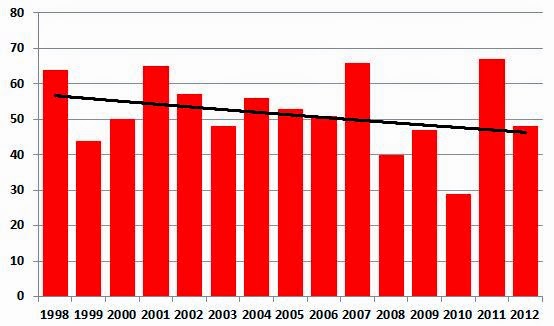
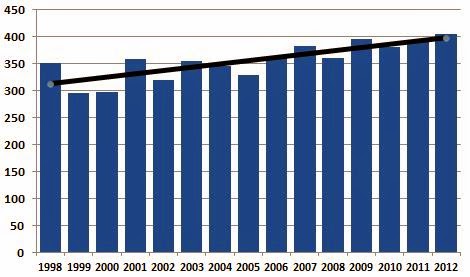
    Fact 4: Police-involved killings are going up. This one surprised me. Because police-involved shootings are generally correlated with overall homicides. But homicides are more or less steady right now, and down 10,000 since 1998 (14,000 in 1998, 13,000 in 2012).

    The trend is about five more killings a year, for the past 15 years. Keep in mind this is based on flawed data. So it could be indicative or something, or maybe it’s not.

    Meanwhile the trend is for fewer officers to get shot and killed. (If you go back further, like to the 1970s when more than 100 officers were shot and killed each year, the trend is way down.)

    So cops may just be quicker on the draw. Or perhaps too quick on the draw. Or some combination of the two.

    The next post examines if black police are more or less likely to kill people. What do you think?

    As a side note, justifiable killings by civilians have been increasing at an even greater rate over the past 15 years. From 191 in 1998 to 309 in 2012. I would assume (but do not know) that “stand your ground” laws have something to do with this. Also, (surprising to me) the race relationship of those killings have become even more intra-racial (and the greatest increase is seen in justified killings by black).

    [Data on police fatal shootings comes from the Officer Down Memorial Page.]

  • Race and justifiable police homicides (III): one a day

    [Update: Using better data, the number is more like three a day.]

    Fact 3: UCR data on justified police-homicides are notorious incomplete. These numbers are an undercount. But given the data we have, as reported (or not) to the DOJ by local police departments, police kill at least one person a day (426 in 2012, to be exact, 30 percent were black, 63 percent were white). Again, how you want to use or misuse that statistic is up to you. And you need to take it with a large grain of salt. Either at least one person a day needs to be shot to protect somebody from getting killed or seriously hurt. Well, either that or police are cold blooded murderers who fill a one-body-a-day quota in the murder department. I’m more partial to the former explanation…

    But it might be worth mentioning that the combined total for deaths from police shootings in Japan and Britain was… zero. Germany had eight.

    Now ask yourself this: are police-involved killings in the US going up or down. That’s tomorrow’s fact.

    And now, for the nerdy set, some numbers:

    In 2012, police killed a total of 426 people. Of those:

    white men: 267

    black men: 128

    white women: 6

    black women: 4

    “Asian or Pacific Islanders”: 9

    “American Indian or Alaskan Native”: 5

    The rates of justifiable police homicide, are roughly (per 100,000):

    black: 0.33

    Indian/Native American: 0.17

    white: 0.12

    Asian: 0.06

    To put these numbers in some perspective, there were 13,063 total homicides in 2012.

    white men: 4,332

    black men: 5,745

    white women: 1,651

    black women: 858

    Asian men: 160

    Asian women: 82

    Native/Indian men: 72

    Native/Indian women: 22

    The 2012 US homicide rates (per 100,000, and again, roughly):

    black: 16.5

    white: 2.7

    Asian: 1.6

    Indian/Native: 3.2

    One other interesting tidbit, if you’re still with me, is if one looks only at murders in which the killer is known to be a “stranger” (which is just 15 percent of all homicides… and this does not include the larger category of “relationship not determined”). Then the numbers plummet:

    white men: 912

    black men: 812

    white women: 112

    black women: 90

    Asian men: 45

    Asian women: 9

    Native/Indian men: 15

    Native/Indian women: 1

    I mention this because fear and public policy is built so much around the concept of people (I’ll say it: white women) being killed at home or in a robbery by some stranger (I’ll say it again: a black man). And yet there were just 32 such victims in 2012. And 2012 was a high year. 2011 saw just 25 white women killed by black strangers.

    The odds of being killed by a stranger, especially if you’re a woman, are almost infinitesimally small. Though to be fair, they’re still greater than the chance of being killed by lighting or attacked by a shark.

    [Rates are based on these population numbers (which are not cut and dried): white 224 million; black 40 million; Asian 15 million; Native/Indian 3 million. Homicides from the 2012 UCR homicide supplement.]

  • Race and justifiable police homicides (II): white and black

    Fact 2: Blacks are more likely than whites to be shot and killed by police, but probably less so than you’d suspect. 34 percent of those killed by police are African American. But put another way, 62 percent of those killed by police are white. (Actual numbers provided in next post.)

    What you want to make of these data probably depends on your ideological persuasion. While the percentage of blacks killed by police (1/3) is disproportionately high compared to the percentage of Americans who are black (about 13%), one-third is low compared to other indicators of violence, such as the percentage of homicide victims and offenders who are African American (about 50 percent, give or take).

    Since police-involved shootings correlate with gun violence in the population — and many black communities receive a disproportionate amount of police attention — one might expect the percentage of those killed by police to be closer to (or more than) 50 percent.

    Based on the data, it does not seem that police are particularly trigger-happy around blacks compared to whites. (Though once could still argue that police are too trigger-happy overall.)

    And keep in mind I make mistakes. If something seems fishy about my facts, let me know and I can double check.

    Question for tomorrow’s fact (#3): how many people (per year or per day) do police kill in the US?

    [The source for all police-involved homicides is self-compiled UCR homicide supplements from 1998 to 2012. I’ve selected the value of 81 (“felon killed by police”) for V29 (“Offender 1: circumstance”). I know that not all police departments report to the UCR, so the real numbers may be a bit more. But most police departments — certainly all the big ones — do report to the UCR. And the UCR covers “93.4 percent of the total population as established by the Bureau of Census.” The coverage for justifiable homicides, however, is less complete.]

  • Race and justifiable police homicides (I): Over time

    Back in 2008 I posted about what I called the “Al Sharpton effect”: cops shooting white people doesn’t generally make the news. That post has gotten a lot of hits recently (roughly 2,000 page views a day, when normally my whole blog gets about 700).

    So I’ve re-crunched these numbers, both to make them more current and to look at the past 15 years, from 1998 to 2012. This is fact 1 of 7 (give or take).

    Fact 1: The racial percentage of those killed by police hasn’t changed. In other words, police are not more (or less) likely to shoot and kill blacks than they were 15 years ago. (In more academic terms, there is no correlation between year and race, from 1998 to 2012, selecting for whites and blacks).

    Before I post the next fact, ask yourself this: what percentage of those killed by police do you think are black?

    I ask because because it’s good to know if your “facts” are actually based on reality And if the actual facts don’t coincide with what you think is true, then you need to reconsider your opinions based on lies. Too many people don’t do that.