Tag: foot patrol

  • Bicycle Patrol

    I love the idea of cops on bikes. Nothing beats the speed and stealth. But I haven’t really considered the benefits of paramedicson bikes. A couple of those saved a life in Chicago.

    The rescue might not have been possible if not for the paramedics’ bicycle team, which can weave in and out of crowded spaces like the Taste with life-saving defibrillators and other medical supplies in tow.

    “You can’t beat them. They’re just invaluable,” he said of the team, which is also used to patrol busy downtown areas.

    The whole story by Monifa Thomas in the Chicago Sun Times.

  • Bike Rapid Response

    Strange Queensday Attack in the Netherlands. In the BBC video, notice the first police officer on the scene rides a bicycle. Not a car. Not a man on foot. But a cop on a bike. If the goal is rapid response (at least for short and medium distances), we need more bikes.

  • Police History: Patrol

    This great historical tidbit is from the Edinburgh Review of July 1852. The original article, in pdf form, is here. The whole journal can be found on google books.

    I discovered this through Marjie Bloy’s excellent website on English history. She has a lot on Sir Robert Peel and early police (that’s how I found it).

    During the night they never cease patrolling the whole time they are on duty, being forbidden even to sit down. The police district is mapped out into divisions, these into sub-divisions, these into sections and these into beats, all being numbered and the limits carefully defined. To every beat certain constables are specifically assigned, and they are provided with little maps called beat-cards. The business of the constable on duty is to walk around his beat in a fixed time according to an appointed route. As soon as he has gone over it, he immediately begins his rounds again, so that the patrolling sergeant knows at any moment where the constable ought to be found unless something unusual has occurred. In this way every street, road, lane, alley and court within the Metropolitan Police District is visited constantly day and night by some of the police. The beats vary considerably in size. In those parts of the town that are open and occupied by the wealthier classes, an occasional visit is sufficient but where the character and density of the population is different, the throng and pressure of the traffic greater and the streets intricately designed the frequency of visits is increased. Within a circle of six miles from the centre of Kensington the beats are usually covered in periods varying from seven to twenty-five minutes and there are points which are never free from inspection.

    When anything occurs in the district worth communicating the intelligence is conveyed from one constable to another until it reaches the station house, thence, by an admirable arrangement of routes and messengers to the headquarters of the central office in Whitehall. Then it can be radiated along lines to each divisional station-house to every constable. This rapid transmission of intelligence is important as regards the detection of crime but especially as a means of preserving the city from riot. The effectiveness of this was proved with the disturbances of 1832 [the Reform Act riots]. In case of emergency the Commissioners could use this system to collect all 5,500 men in one place in two hours. There has therefore been no need to call upon troops. All crimes have been reduced but, because of this system, especially felonies, assaults and larcenies. Few people now dare carry weapons. Indeed many criminals have moved elsewhere for safety and easier work.

  • Foot Patrol

    Foot Patrol

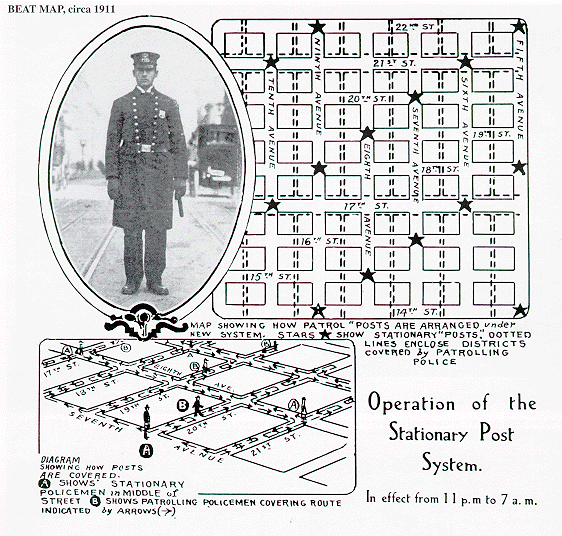
    Whenever people say there aren’t enough officers for foot patrol, I say, “hogwash” (or something with similar meaning). We used to have foot patrol. And we didn’t have more police. It’s a question of priorities, not resources. Here’s a interesting diagram from 1911.

    I don’t know if this was the theory, the practice, or a proposal. And perhaps standing in the middle of the intersection isn’t the best strategy. But it’s still very interesting to see. (Plus those old hand-drawn diagrams have style!)

    Basically foot patrol was replaced with making officers available to answer 911 calls. Too bad former is much better than the latter.

  • Two Legs Good; Four wheels Bad

    As a cost saving move, more foot patrol in Boston. Reported in the Boston Globe.

  • Foot Patrol

    Kind of like my idea, Policing Green. Officers turn to foot because of rising gas prices. Here’s the story from the New York Times. Thanks to Charlene, a former student of mine, for sending me the article.

  • In support of foot patrol

    I received this email last week.

    Finished the book a few weeks ago. I’ve got nine years on the job & it seems to track pretty well with my experience. Got some further thoughts (all good) but I’ll save that for another time. My reason for this little message was a piece I came across in the Atlanta Journal-Constitution about rookies being assigned to foot patrol.
    Interesting personal aside. I started out with the Metro Atlanta Rapid Transit Authority Police, where everybody walks a foot beat. There’s no substitute for the type of demands it makes on a new officer, most all of which are ultimately good. You learn very quickly and very well how to talk to people. A year of high-density foot patrol is equivalent to 8 to 10 years of motorized patrol experience when it comes to interacting with the public. If you’re paying attention & doing it right it definitely makes you a better officer.

    Sgt. [name withheld on request]

  • Is foot patrol right for you?

    Foot patrol may not be right for everyone. How do you know if foot patrol is right for you and your neighborhood? Ask your mailman. If your mail is delivered in a cart pushed by a walking mailman or woman, police should be on foot. If your mail is delivered by truck, foot patrol may not be right for you.

    Side effects of foot patrol include decreased fear, better quality of life, fewer broken windows, more fit police officers, greater interaction between police and neighborhood residents, and generally improved police/community relations.

  • Policing Green

    Cops want more money. Citizens want more foot patrol.

    We can have both. I call it “Policing Green.” Give cops the gas money for their shift if they agree to patrol without a car for that shift.

    The environmental link is mostly just a clever title to sell the idea, but it really would be green and save gas. At its core, though, it’s about policing.

    In an informal survey of my police officers students, every one of them would walk foot for their gas money. At least when it’s not raining.

    Police cars in the city probably go through about 6-8 gallons per shift. That’s $28-$32 right now. And even with giving this to police officers, departments would save money on cars upkeep in general. And as long as it’s the officers’ choice, everybody wins!

    Rather than asking what foot patrol does to improve matters (I believe it does, but it’s hard to prove), letting cops walk foot would shift the burden to asking what cars do to improve policing (and it’s been proven cars don’t improve patrol). Simply placing the burden on defending car patrol would be a huge and productive shift in police culture and patrol.

    Even better, you would let patrol officers determine the best way to police without cars. From the top down, it would never work. From the ground up, this could be effective.

    Here’s the system: at the start of the shift, officers either take the car keys or don’t. Anything else is up to them. They can grab their keys any time they want. But if they do, they don’t get the gas money for the day. They’re welcome to get a ride to their post. But they’re not allowed to team up with another officer in a car and split the gas money. That’s the only rule.

    Brilliant or crazy?
  • Car vs Foot Patrol

    There’s a good discussion I’ve been contributing to in the comments section from a post in marginal revolution.