Rarely to get exciting reading articles in academic journals (whether that says bad thing about me or the journals I leave to you), but this is exciting: “The Philadelphia Foot Patrol Experiment: A Randomized Controlled Trial Of Police Patrol Effectiveness In Violent Crime Hotspots.” It’s in the current issue of Criminology (like most academic journals, unavailable to the general public).
The Newark Foot Patrol Experiment was researched in the 1970s. And though it showed foot patrol in a more positive light than many people remember it for, it was hardly the unequivocal support for foot patrol I would have expected.
Now I know foot patrol works, but get a bunch of academics in a room and ask a simple question like, “Does foot patrol work?” and you’ll get a lot of “we don’t know” and “no” and “more research is needed.” Even in the police world, opinion is split.
Well finallysomebody has done a proper study of foot patrol. The bottom line? In high-crime areas, foot patrol decreased serious violent crime by 23 percent. This happened just after three months of foot patrol. No big difference was found in lower-crime areas, but then we fall back on the Newark Experiment and reduced public fear.
I bet you’ll never hear of a study showing the crime-reduction benefits of officers remaining “in service” to answer radio calls.
But seriously, both of us know that the answer to bad teaching is not job insecurity.
You go, Matt! While you’re watching the video, I’m going to be “assessing” papers from other people’s classes according to a “grading rubric” in which I must judge each paper on 1) Responsiveness to instructions, 2) Use of terms and concepts, 3) Organization, 4) Integration of different sources, 5) Using appropriate reference and citation, and 6) Conclusion. This is the type of shit teachers do during their so-called “vacation” time.
I don’t mention this to complain. I mention this to say that if you want me to teach well, let me teach. But pile on administrative B.S.? Give teachers make-work hoops to jump through? Take away time that could spend researching, writing, preparing for class, and grading papers? Analyze, assess, and prod me one too many times… and you’ll get what what pay for. But no more.
I didn’t go into this racket for the money. But without tenure, I neverwould have gone into teaching. Given my education, I could have made much more money as a consultant or investment banker or even a professor at a private university. But don’t we want more overqualified teachers at public schools? Besides, I like my job.
Some want teachers to exchange job security for “incentive-based” pay. Well I don’t know how you would “incentivise” me in my senior seminar. Some say pay should be based on student evaluations. Not a good idea. Granted I’ddo OK because I get very good student evaluations. But it’s still a bad idea. I do believe that bad evaluations are a sign of a bad teacher, I’m not so certain about the opposite. I like to think I get good student evaluations because I’m a good teacher. But I could also get good evaluations simply by being easy.
Pay me a fair wage (I make $74,000 a year in case you were wondering) and give me job security and enough time off, and I’ll put my heart into the job. Make teaching a game–especially a game refereed by administrators and other non-teachers–and I’ll play it like a game. Oh yes, I’d win that game! But my students wouldn’t.
Trying to weed out bad teachers is like trying to weed out corruption. It’s a noble goal and needs to be done, but you have to make sure the cure isn’t worse than the disease. When you place rules and regulations on everybody in order to catch a few, you make things worse for everybody.
Teacher unions aren’t perfect. But for teachers and students alike, they’re more good than bad. They’re also fighting on the front line against those who want to destroy unions and public education on ideological grounds.
Bad teachers need to be let go beforethey get tenure. And that would be easier if more good teachers were attracted to the profession. And that would be easier if there were not such teacher burnout, especially in schools most in need. Making the job less appealing is not the answer.
Matt Damon is right: Job insecurity would not make me work harder and MBA-style thinking is not the answer. A teacher wants to teach.
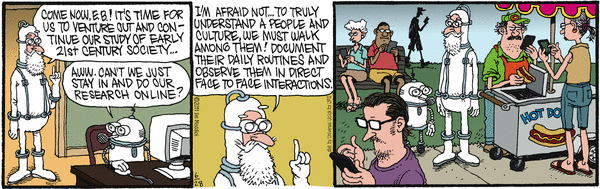
“Come now, E.B.! It’s time for us to venture out and continue our study of early 21st century society…”
“Aww. Can’t we just stay in and do our research online?”
“I’m afraid not… to truly understand a people and culture, we must walk among them! Document their daily routines and observe them in direct face to fact interactions.”
In the New York Timestoday, there’s an article extolling the benefits of introversion. I love reading pieces like this, which make it clear that introversion is a personality trait and not a medical problem that needs to be “cured” or treated with drugs.
My understanding of introversion began after I realized that being introverted is not the same as being shy. Rather, and more simply, introversion is simply the opposite of being an extrovert. This came to me in a great moment of self-realization after picking up a copy of Marti Laney’s The Introvert Advantage that was lying around the house (my wife is more introverted than I am). I am not shy and have no fear of public speaking, yet I positively dislike mingling with strangers at parties and usually find extroverts extremely tiring. It turns out I am in introvert. This was news to me. But then it all made sense.
So I got thinking about the nature of introversion (which is in itself a very introverted reaction) and decided (conveniently) that being an introvert is better for academic participant-observation research. Why? The Timesarticle puts it like this:
[Introverts] notice more things in general…. [and] tend to digest information thoroughly, stay on task, and work accurately … even though their I.Q. scores are no higher than those of extroverts.
My goal is to introduce the psychological concept of introversion into the sociological world.
…
The interpersonal nature of qualitative research and the perceived “action” of participant-observation research may perpetuate a belief that extroversion is a good quality for ethnographers. In fact, nothing is further from the truth.
…
If you’ve ever seen a group of ethnographers party, you may be struck by a general sense that we may not have been the most popular kids in high school. Despite what is often a very lively style of writing, ethnographers can be be soft-spoken and introverted. Now don’t get me wrong: As a group, we ethnographers are hardly the dorkiest in school (a few other academic disciplines spring to mind, but for politics’ sake I’ll refrain.).
Certainly qualitative researchers must have basic social skills, but let’s be honest, no prom king or queen ever went on to write an ethnography. As a group, almost by definition, academics are nerds. We like the library. We don’t mind being alone. We walk down the street reading. We thrive in small groups and intellectual conversations. And yet mingling and making small talk with strangers is tiresome at best or frightening at worst.
…
Without a clear function in a social setting, the introvert’s natural reaction is to withdraw and become silent. While this may be a problem at the annual Christmas party, it can come in handy for the researcher.
…
With a greater understanding of introversion, I hope sociologists can take advantage of psychological traits that come naturally to many already in the field.
Are you an introvert? You can take this self assessment for introverts. I scored 21 out of 29 (which makes me a moderate introvert).
I turned to academic papers because I wanted to do more than throw back a fleeting image.
But scholars are haunted by their own demons. I recently polled a few journalist friends, asking them how often they rely on academic research, and how useful and accessible they find that information. David Biello, environment editor at Scientific American, said he felt spoiled with information, particularly on the subject of climate change. But several others described being led astray by studies that turned out to be immaterial or steeped in opaque discourse. Adam Minter, a journalist covering the recycling trade who is writing the forthcoming Wasted: Inside the Multi-Billion Dollar Trade in American Trash, told me via e-mail that while there is a growing body of work on his topic, “The material is outdated, oriented toward creating new types of jargon totally irrelevant and indecipherable to the industry that I cover, and rarely concerned with primary source material.”
…
Beginning in the 1970s, academe became increasingly specialized. That, especially in the social sciences, the reward structure worked against accessibility: Tenure hung on publishing in peer-reviewed journals or with university presses, while more-popular work went largely uncompensated. …”To parody it, the fewer the number of people who could and would read your work, the more sophisticated it must be.”
James Q. Wilson writes some good stuff on crime in the Wall Street Journal. But this worries me:
Culture creates a problem for social scientists like me, however. We do not know how to study it in a way that produces hard numbers and testable theories. Culture is the realm of novelists and biographers, not of data-driven social scientists. But we can take some comfort, perhaps, in reflecting that identifying the likely causes of the crime decline is even more important than precisely measuring it.
Culture doesn’t create a problem for social scientists like me. If social scientists can’t deal with culture, who can? It’s time for sociologists to step up to the plate. And it’s time to take qualitative methods more seriously.
No doubt you, like most others, think the professorial life is all glamor, fame, leisure, wine, and women. That’s just what I wantyou to think with my frequent vacations and the fact there’s a good chance I might still be in my bathrobe at 3pm (working at home, mind you). Such perks do have their advantages.
Nevertheless, there’s nothing more mind-numbing than, at 1AM, correcting and editing writing assignments filled with basic grammar errors. I can’t help but wonder why my dear students didn’t learn sentence structure in high-school? Trying to teach basic writing skills–and taking the time to assign and correct writing assignments–may be the most important thing I do for my students. At least that’s what I tell myself. But it’s not what I thought I’d being doing when I got my PhD. Nor is it fun. Hour for hour, I’d prefer to be policing (does that bumper sticker exist?). So here’s to high-school English teachers… or at least the ones that teach good old-fashioned grammar.
And then, just when I start thinking of complaining, I think of what my dad always said about being a professor, “It beats real work!” And you can’t beat summers off.
I always feel like who am I to talk about grad school? I didn’t follow any of the standards Rules to Successful Completion. I liked school, but I wasn’t hanging around the department and I took nine years to finish. I might have been the only Harvard sociology student history to fail the “oral exam” (go ahead and snicker, I would. I know it sounds dirty, but it’s not). Most of my close friends, almost all of my employment (I was the sole worker in a very small library and was a TA to just one class during those nine years), and all of my social life were outside the sociology department. That’s how I stayed calm and sane. I also became a police officer. I recommend that for all grad students (kidding… sort of).
I just came across this in a comment to this article. It’s damn good advice if you’re in graduate school and anything like me. It’s also contrary to almost all “normal” advice you’ll hear. And don’ forget, “Friend, I don’t know what the hell you do for a living, but damn!” It’s the one time in your life you can spend all day in the library and reading books and consider it work:
7 Golden Rules for Grad School:
1. Never agree to live with someone in your program. Go home to someone who is either in a different program or who is a citizen of the “Real World.”
2. Always try and remember that MANY of your colleagues have the minimal level of social skills required for functioning outside of academia and many of them are feeling, after being star pupils and overachievers for most of their lives, deeply insecure. Knowing this will help alleviate a lot of your stress. So when they say something to you like, “You only got to teach X class because so-and-so/that professor/the department ________________.” Just quote Oprah and what one of my older colleagues said: “Don’t let them steal your joy!”
3. “Invest your ego somewhere else and find some support system that’s separate from this program—your family, your lover, or whoever.” Truer words were never spoken. Your friends and family are your reality check, your cheerleaders, and they’re the ones who are going to throw you a party post-defense. My best friend is always saying to me, “Friend, I don’t know what the hell you do for a living, but damn!” That’s all I need sometimes to get through a tough day.
4. “Be kind to yourself.” – one of my professors who I taught for last year.
5. A little anxiety never hurt anyone, but just be aware of that fine line between knowing that you’re just anxious and knowing that the lines on the bus’s brakes were cut and the bus is barreling towards you.
6. In the words of Baz Luhrmann: “Don’t waste your time on jealousy. Sometimes you’re ahead, sometimes you’re behind. The race is long and, in the end, it’s only with yourself.”
7. You’re there because someone, somewhere, on some admissions committee put all the pieces of you together and wanted you to come and earn a graduate degree with them. If you couldn’t do it, you never would’ve been recommended for admission by either your old professors or a bunch of professors who you’ve never even met before you set-foot in the door in August. You CAN do it.
The death of a Nassau County police officer got me thinking about cases of police officers shot by other cops. There’s the belief out there that black officers are much more at risk of being mistaken for suspects than are white officers. It’s also been said (by me?) that such accidental mistaken-identity shootings almost never happen to white officers. Officer Breitkopf is white.
So this afternoon I went to the Officer Down Memorial Page. I’ve found the data at Officer Down to be quite reliable and comprehensive. I looked at all deaths involving accidental police shooting of police officers. This does not include officers who were shot and lived. Or officers who didn’t meet Officer Down’s criteria for being killed on duty. But generally when officers get in any such situation, they’re considered on duty. And I wouldn’t expect including those data to change the basic findings.
I went back as far as 1960 and looked at the descriptions to determine which officers were killed after being mistaken for suspects (ie: not “friendly fire” or accidents–though I should point out that training grounds seem particularly prone to accidental lethal shooting). At least 47 officers have been killed in such split-second cases of mistaken identity. I then looked at the pictures of the deceased officer to judge race (they were all pretty clear cut). I then coded for the circumstances of the killings based on the description given. (So, what did you do this afternoon?) I ended up selected only those killed since 1976 because half of those between 1960-1976 didn’t have pictures. That brought the total number of officers number down to 28 (which was lower than I expected).
Here are the basic facts:
Since 1976, at least 28 officers have been shot and killed by other police who thought the police officer was a bad guy with a gun. (Or bad girl. Two officers killed were women, which surprised me.)
15 of these officers were white; 11 were black; 2 were hispanic. (I was surprised to find that so many white officers have been killed in such circumstances. Before yesterday, I knew of exactly two cases, and one of those was from 1972.)
3 officers were in uniform (all 3 of whom were white); 22 were in plainclothes. (And there were a few unknowns.)
19 were off duty before the incident started; 9 were on duty.
Racially, the only thing that jumps out is that 8 of 11 black officers were off dutyand 14 in 15 white officers who were on duty.
39% of officer shot and killed in cases of mistaken identity were African-American. But what does that mean? What’s the denominator? Should it be the percentage of black officers? Do we even know what percentage of police nationwide are black? I asked the kind people at the National Black Police Association if they could tell me. I got a quick reply saying they didn’t have such a number handy, but would guess around 10 percent (or 80,000 out of 800,000) of police nationwide are African-American.
Or perhaps the denominator should be the race of those working plainclothes? Or narcotics (about one-third of cases I could determine involved drug enforement)?
Or maybe we should look at the race of officers living in higher-crime districts? That seems to be the biggest contributing factor with regards to black officers getting involved in off-duty incidents.
Perhaps it’s more important to look at the demographics of the area in which the shooting took place? Or the race of the suspects in the incident? Or the race of the police officer who fired the lethal shot?
Of course most police officers officers are not black, so compared to white officers, black officers are disproportionately killed (about four times more likely) by other police mistaking them for suspects. Is this because police are much more likely to perceive any black man as a threat? Or are there simply more cases in which minority police officers end up in a situations where they’re out of uniform and holding a gun? I, for one, was surprised to see the issue isn’t so, well, black and white.
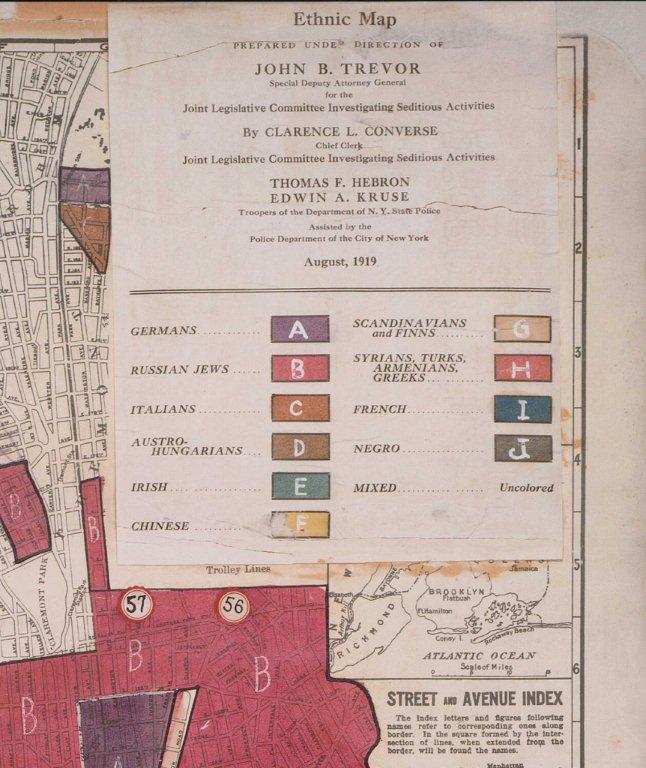
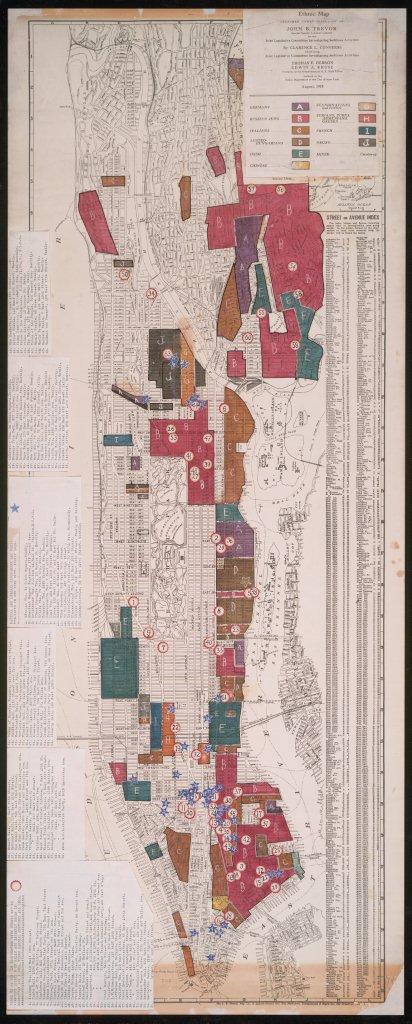
You know how “kids these days” think everything in the world is online and can be found with Google? Well, find this: John B. Trevor’s 1919 Ethnic Map of New York City.
I’ve wanted this map ever since I saw it.
Trevor, non-elected but politically powerful, was worried that immigrants (Jews in particular) were going to take over America. As a Nativist S.O.B., Trevor didn’t generally trust people who weren’t anglo-saxon, white, and Protestant.
Of course, to some extent, Trevor’s worst fears have come true: compared to 1919 America, immigrants havetaken over America (and, of course, vice versa)! Trevor was wrong because he thought such seditious people would surely take over through armed socialist revolution.
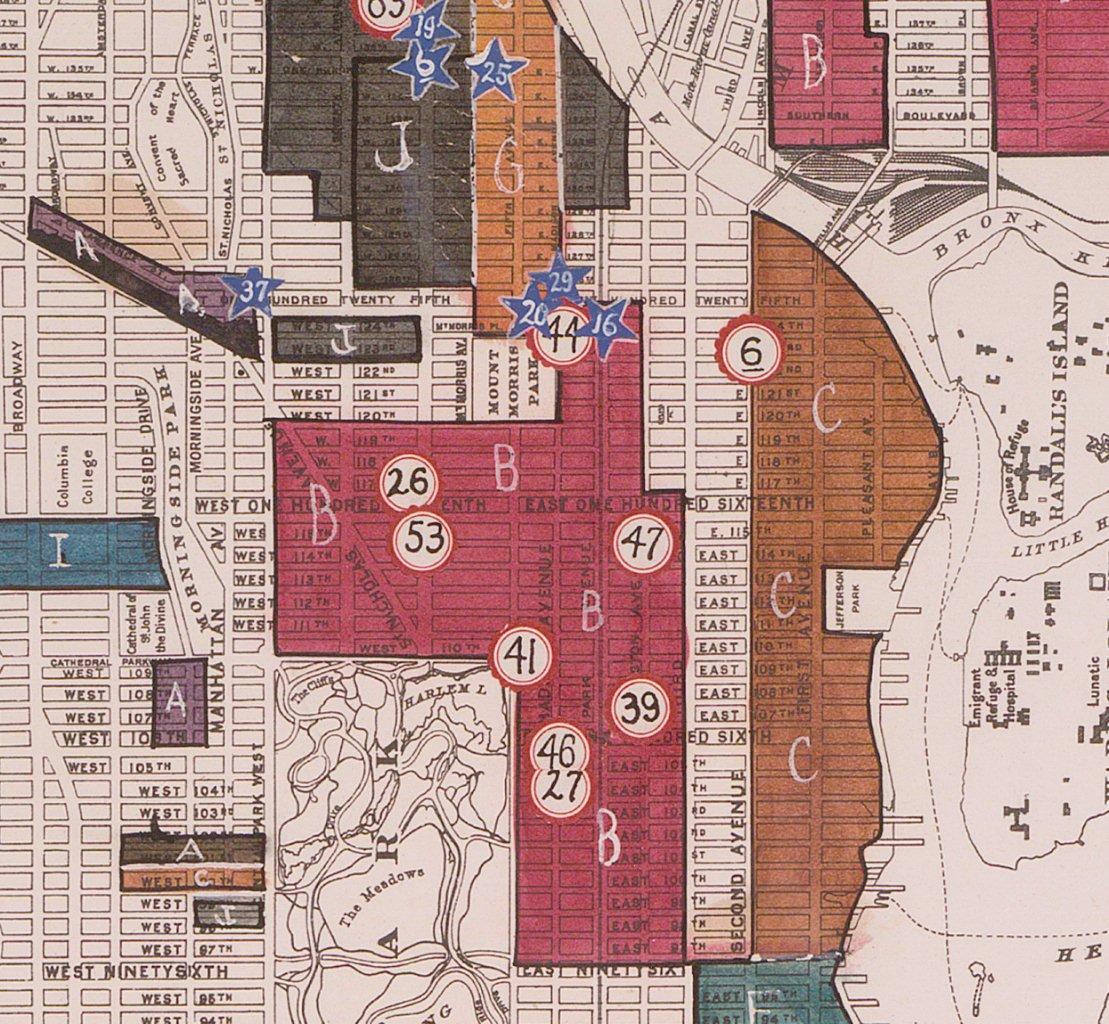
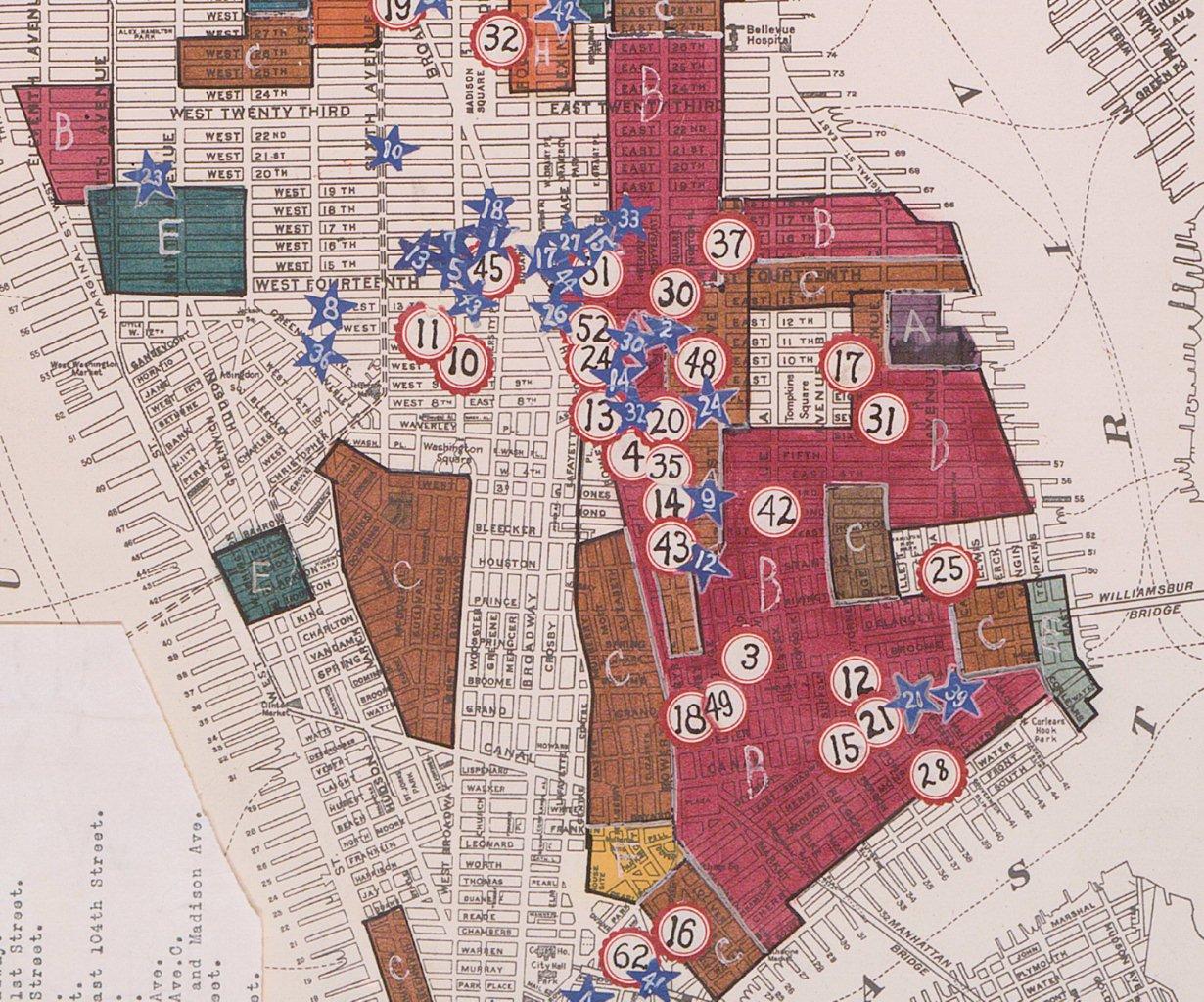
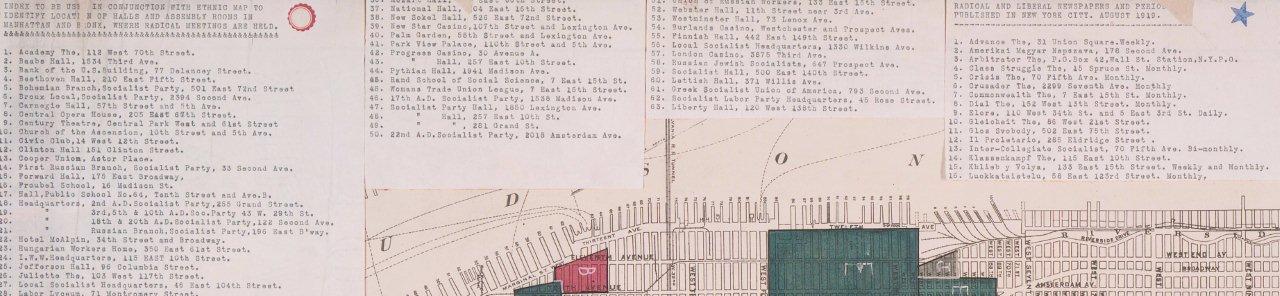
So ever the self-professed patriot, Trevor made a map of ethnic New York City, listing radical social clubs and liberal newspapers, to aid the police and national guard in the suppression of the revolt that never came.
Viva La Revolution!
Upper Manhattan / Harlem:
Lower Manhattan / Lower East Side:
Locations of “Radical Meetings” and “Liberal Newspapers”:
New here? Well, welcome! You’re probably interested in history and urban life. If so, you’ll love my book, Cop in the Hood (or maybe you just liked The Wire?).
Why not read the first chapter of Cop in the Hood. After that, you can shell out your hard-earned pennies — but only 1,241 of them — and buy it at Amazon.com. What a deal! Still need to be convinced? Read the reviews. Or just look at the rest of my blog. No shame in that. And it won’t cost you a cent.
 Fine advice from Jim Meddick’s excellent