Tag: ghetto culture

  • Reporter fired for politically incorrect editorializing

    With regards to the killing of Jersey City Police Officer Melvin Santiago, Fox News TV reporter Sean Bergin no longer has a job after editorializing on-air:

    It’s important to shine a light on this racist mentality that has so contaminated policing and America’s inner-cities. … The underlying cause for all of this, of course, is America’s racist criminal justice system that makes it impossible for young black men to succeed. It’s nearly impossible to cover the issue in-depth and accurately when surrounded by stark raving conservatives who masquerade as journalists.

    Just kidding.

    Bergin didn’t say that. And he didn’t work for Fox. The truth is, if he had said that, it’s very unlikely he would have been fired. He was fired for editorializing in a conservative manner, based on his what he’s seen as a reporter.

    What Bergin actually said on-air was:

    We were besieged, flooded with calls from police officers furious that we would give media coverage to the life of a cop killer. It’s understandable. We decided to air it because it’s important to shine a light on the anti-cop mentality that has so contaminated America’s inner cities. This same, sick, perverse line of thinking is evident from Jersey City, to Newark and Patterson to Trenton.

    It has made the police officer’s job impossible, and it has got to stop. The underlying cause for all of this, of course: young black men growing up without fathers. Unfortunately, no one in the news media has the courage to touch that subject.

    Do I agree with this? Not one-hundred percent, but he certainly brings up a fair issue. Is what he said overly simplistic? Of course. But let’s not set the bar too high for local TV news. This sure beats another cute animal video. And don’t give me that “reporters shouldn’t have an opinion” bit. Or “there’s a time a place for everything.” This was a great time and place to express his opinion on a major problem.

    Bergin later told The Blaze(and then it was picked up by the AP and other news sites):

    I broke the rules, but I broke the rules because I was doing the right thing. You can’t fix a problem if you don’t talk about the problem. The truth is, 73 percent of African-American children grow up without fathers. It’s a topic that needs to be handled delicately — and really, this situation could have been used as a way to explore that.

    Now that 73 percent figure isn’t true and a reporter should know better than to throw around misleading statistics. (There’s a big difference between not having legally married parents living together at time of birth and “growing up without a father.” Regardless, the comparable figure for whites is 29 percent.) But still, Bergin’s greater point is valid: there’s a problem here; we need to talk about it and get to the bottom of it.

    Bergin went on:

    “I’m in these housing projects all the time, and it’s all for the same thing: black men slaughtering each other in the streets. Why is this happening?” he continued, adding that it’s nearly impossible to cover the issue in-depth and accurately when surrounded by “stark raving liberals who masquerade as journalists.”

    OK, strike two again Bergin for using the phrase “stark-raving liberal.” But I’ll give him credit for this: his opinions come from actually visiting the homes and neighborhoods where the violence happens. He sees bad things happening and actually cares. Before you criticize him, ask yourself if you care. Think about the last time you’ve done anything in a high-crime neighborhood other than lock your car doors.

    As I wrote in Cop in the Hood:

    If you really want to learn about the ghetto, go there. There’s probably one near you. Visit a church; walk down the street; buy something from the corner store; have a beer; eat. But most importantly, talk to people. That’s how you learn. When the subject turns to drugs and crime, you’ll hear a common refrain: “It just don’t make sense.”

    Bergin did all this. Reality, as cops well know, isn’t always politically correct. And you don’t have to like what what he says to defend his right to say it.

  • Wife of Melvin Santiago’s killer wishes husband had killed more cops

    Wife of Melvin Santiago’s killer wishes husband had killed more cops

    Melvin Santiago, a rookie Jersey City cop was killed — ambushed while sill inside his police car — responding to a 4am call for an armed robbery.

    Sometimes, after a cop is killed, (just between you and me) I think, “man, that cop messed up” (knowing full well that we all mess up some time). Other times I think, “Man, maybe the cop shouldn’t have been so eager to search that car, fishing to find drugs. If it weren’t for the war on drugs, that officer would still be alive.”

    Other times, like in this case, I just get sad and think, “There but for the grace of God go I.”

    Officer Santiago gets a call at 4am for a robbery. What cop hasn’t? He responds to the scene and is immediately shot and killed.

    The killer, a suspect in a previous homicide and with many previous arrests, first cut and took a gun from an armed Walgreens’ security guard. Apparently he then tried to kill the guard (but was perhaps foiled by the gun’s safety). He said, “I killed your security guard” and told a customer to watch the news because he was “going to be famous.”

    So instead of leaving, he lingers for four very long minutes, waiting for the cops to show up. When the first police car pulls up, he shoots and kills Santiago: “Bullets flew through the cruiser’s windshield, 13 in all. The suspect was shot multiple times, and officers slapped handcuffs on him.”

    This horrible story has been well reported, so I had nothing to add.

    But now we’ve got the words of the killer’s horrible wife. See the problem, according to her, wasn’t that her husband is a cold-blooded killer. No. The problem is that he didn’t kill more cops. Because apparently, in her twisted world view, a man has a right to go out robbing and killing without society being all judgmental.

    She says, in what may be the most twisted attempt for sympathy ever:

    He should have took more with him. If they was going to stand over my husband and shoot him like a fucking dog, he should have took more with him. That’s how I feel.

    Sorry for the officer’s family. That’s you know. Whatever. But at the end of the day he got a family too. All they care about is the officer. All they care about is the officer.

    Meanwhile, the mother of the Santiago poignantly stated the obvious:

    [The killer] is a piece of shit. My son was 23 years old and he was a good boy, and he didn’t deserve to get a bullet in his head for no reason. For just doing his job. It was his dream and … he didn’t have to die like that. All because somebody wanted to be famous.

    [thanks to anon]

    [see later post as well]

  • Destructive Culture

    Najee Thomas, the 14-year-old son of Ronnie Thomas, was shot and killedin Cherry Hill (south Baltimore). You may better know Ronnie Thomas as Skinny Suge, he who 10-years ago created the semi-famous/infamous “Stop Snitching” DVD and is now in federal prison.

    Now I know it’s not popular in liberal circles to allow people to talk about “culture” — at least in any form except as related to mainstream dominant hetero-normative white male oppression. But social scientists can’t let conservatives co-opt and define the cultural perspective when talking about the ghetto.

    You don’t have to be a racist to note something is toxic about the culture of the Thomas family (see, for instance Stop Snitching parts one, two, three, and four). Not only are Skinny Suge’s life choices morally repugnant, they fail to succeed even by their own street-code values (unless these goals are to actually remain poor, in prison, or be killed).

    To blame America for America’s failings may be morally cathartic and even factually correct, but it does a great disservice to those who make better choices to ignore the culture of a community (and by “better,” yes, I’m using judgmental bourgeois standards of, like, holding a regular job and being a good parent.)

    Let me turn to one of my favorite takes on the matter, written back in 2006 by Harvard Sociologist Orlando Patterson (who was my PhD dissertation adviser). It’s well worth reading in its entirety, but here’s a bit in edited form:

    Why have academics been so allergic to cultural explanations?

    First is the pervasive idea that cultural explanations inherently blame the victim; that they focus on internal behavioral factors and, as such, hold people responsible for their poverty, rather than putting the onus on their deprived environment. (It hasn’t helped that many conservatives do actually put forth this view.)

    But this argument is utterly bogus. To hold someone responsible for his behavior is not to exclude any recognition of the environmental factors that may have induced the problematic behavior in the first place.

    Second, it is often assumed that cultural explanations are wholly deterministic, leaving no room for human agency. This, too, is nonsense…. Cultural patterns are often easier to change than the economic factors favored by policy analysts.

    Poor schools, per se, do not explain why after 10 years of education a young man remains illiterate.

    Nor have studies explained why, if someone cannot get a job, he turns to crime and drug abuse. One does not imply the other.

    And why, finally, do [so many young unemployed black men] murder each other at nine times the rate of white youths?

    Socioeconomic factors are of limited explanatory power.

    [When] the economy grew at a rapid pace, providing millions of new jobs at all levels[,] the jobless black youths simply did not turn up to take them. Instead, the opportunity was seized in large part by immigrants — including many blacks — mainly from Latin America and the Caribbean.

    One oft-repeated excuse for the failure of black Americans to take these jobs — that they did not offer a living wage — turned out to be irrelevant…. Such jobs offered an opportunity to the chronically unemployed to join the market and to acquire basic work skills that they later transferred to better jobs, but that the takers were predominantly immigrants.

    To understand self-destructive culture, one would be better served by disaggregated culture from its greater environmental causes rather than adopt, what is at its core, an old-fashioned functionalist and determinalist perspective.

    To say something is fucked up in ghetto culture is not to say that everybody in the ghetto is fucked up or even that everything ghetto culture is necessarily bad. Certainly people don’t have a choice as to where and to whom they are born. Certainly the criminal justice system contributes to the problem and can make it next-to impossible to succeed. And certainly people logically have survival skills to best suit their geographic and class-based-cultural environment. But the effed-up part of ghetto culture isn’t about survival, it’s about bad parenting, non-inevitable decisions, and poor life-style choices that are often distinctly counter-productive to actually surviving.

    Yes, oftentimes street behavior does make rational sense in street culture, but other times impulsive short-sighted street-behavior is just impulsive, short-sighted, and wrong.

    [Also, odds are nobody will ever do time for Najee Thomas’s murder. I can’t help but wonder how Skinny Suge feels about snitching when it comes to the guy who killed his baby boy.]

  • Ghetto Culture, Hockey Fights, or Stuff White People Like

    This may be the best argument for a residency requirement I’ve ever seen.

    You know what “ghetto” is? When two groups who are oh-so similar — really with everything in common, objectively, and perhaps a bit misunderstood by society — forgot their brotherhood and trade blows with each other because of some perceived slight.

    Or maybe it’s just in “their” nature to like a good scrap. And the spectators in said ghetto? Brother, sisters, wives, baby’s mommas and the like? They cheer on the fighters because they’re, I don’t know, “animals.”

    This was in Nassau County, but I haven’t seen such a good brawl since I was on 700 N. Port. Or the 1700 block of Crystal.

    Look, I love a hockey fight as much as the next guy. But this embarrassment was at a f*cking-charity-hockey-game! I only point this out because if this event were a basketball game with black folk fighting, countless people and The Blazewould be filled with racist comments about “their” culture.

    Idiots do in fact come in all races. But this hits home because I actually live on Long Island (geographically, at least) and these guys police my city.

    Oh well, fools fighting does make a great spectator sport! Too bad my taxes pay for their dental plan.

    Hell, the Finest and Bravest haven’t had such a good slug-fest since they were on the pile of the WTC together after Set 11th.

  • Why (some) good people don’t like cops

    Because (some) cops enforce non-existent laws and treat them like sh*t. Ta-Nehisi Coates writes about a recent encounter with police on the streets of Chicago:

    Catercorner to the volunteers of Safe Passage, two cops sat in an SUV, snug and warm. Our video team was shooting the conversation between our host and the kid. One of the cops rolled down his window and yelled, “Excuse me you need to take your cameras off this corner. It’s Safe Passage.”

    When the officer wanted us to move, there was a very easy way to handle the situation. You step our your car. You introduce yourself. You ask questions about what we’re doing. If we are breaking the law, you ask us to move. If we are not breaking the law and simply making your life hard, we are likely to move anyway. You are the power.

    The cop did not speak to us as though he were human. He spoke to us like a gangster, like he was protecting his block. He was solving no crime. He was protecting no lives. He was holding down his corner. He didn’t even bother with a change of uniform. An occupied SUV, parked at an intersection, announces its masters intentions.

  • "It's Torching" — A Traincrash of Speech

    There’s a a video on youtube of a guy and his friend (and baby, in babyseat in the back seat) driving toward a fire and then explosion of a train blowing up just outside Baltimore (don’t worry… according to authorities it’s just “toxic” but nothing to worry about).

    So I’m watching this video thinking, “These guys are likely candidates for The Darwin Award.”

    Regardless (and these guys seemed to survive just fine), I also couldn’t help but notice how these two were speaking to each other. They were speaking, well, the way these two African-American guys speak to each other while stupidly driving towards a cool fire (and subsequent explosion). I’m not here to judge. They’re probably very nice guys.

    The Baltimore Sun has about 12 videos of recordings and people describing what they saw. Many of them are worth watching just for the great Baltimore accents. I love Baltimore accents.

    But my point isn’t to make of accents or the way people speak. I couldn’t care less. I like when people talk like where they’re from. I think people should talk like where they’re from. (I wish I had more of a Chicago accent; but I’m from Evanston and my parents were too middle class, I suppose.) One time I asked a white guy in the police academy (who had a thick Bawl’mer accent) why he was making fun of how black people in our class talked. I thought it was ironic because to my ears his accent was more strange sounding than ghettoese (more politely known as African-American Vernacular English). 

    My point is this: there are about a dozen videos on the Baltimore Sun website. And this is the only one where the audio has been silenced. It’s the same one. These guys weren’t hamming it up for the camera. It wasn’t just that the “bad” words were bleeped (and by my count there 20 in two minutes, not including “damn”). The entire audio is just silenced. To rough for tender ears, I suppose.

    Or is it just too black?

    What does it say about our culture (or the media) that the way some Americans speak in casual private conversation–Americans whose ancestors have been in this country and speaking English longer than my family–still can’t be broadcast for public consumption?

  • When Cultures Clash

    Thug challenges Mayor Bloomberg to a fight, mano-a-mano.

    Nice to know the judge released him on his own recognizance since he seems like such a nice chap who will stay out of trouble.

  • Food Deserts: Quantitative Research at its Sketchiest

    Food Deserts: Quantitative Research at its Sketchiest

    The New York Times reports today on a RAND study (behind the Great Damned Elsevier Pay Wall) by Ruopeng An and Roland Sturm about the lack of “food deserts” in poor neighborhoods. Or more precisely about the lack of link between food deserts and obesity. More specifically, it questions the very notion of food deserts. From the Times:

    There is no relationship between the type of food being sold in a neighborhood and obesity among its children and adolescents.

    Within a couple of miles of almost any urban neighborhood, “you can get basically any type of food,” said Roland Sturm of the RAND Corporation, lead author of one of the studies. “Maybe we should call it a food swamp rather than a desert,” he said.

    Sure thing, Sturm. But I suspect you wouldn’t think certain neighborhoods are swamped with good food if you actually got out of your office and went to one of the neighborhoods. After all, what are going to believe: A nice data set or your lying eyes?

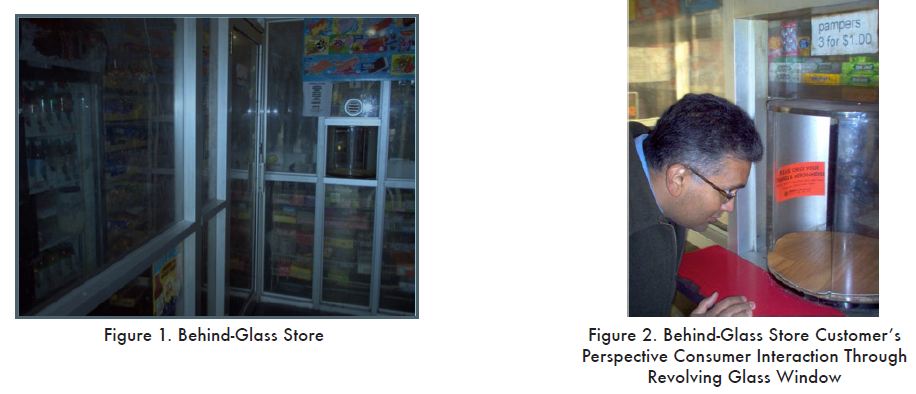
    “Food outlet data … are classifıed using the North American Industry Classifıcation System (NAICS)” (p. 130). Assuming validity and reliability of NAICS occupational categories is quite a red flag. It means that if something is coded “445110,” then — poof — it’s a grocery store! What could make for easier analysis? But your445110 may not be like my445110. Does your supermarket look like this:

    Well the NAICS says it does because they’re both coded 445. New York is filled with bodega “grocery stores” (probably coded 445120) that don’t sell groceries. You think this matters? It does. And the study even acknowledges as much, before simply plowing on like it doesn’t. A cigarette and lottery seller behind bullet-proof glass is not a purveyor of fine foodstuffs, and if your data doesn’t make that distinction, you need to do more than list it as a “limitation.” You need to stop and start over.

    Here’s one way to do it: a fine 2010 Johns Hopkins study edited by Stephen Haering and Manuel Franco. They actually care about their data. Read the first page in particular for the problems of food-store categorization. It matters. And notice the sections titled “residents personal reflections on their local food environment” and “food store owners’ attitudes regarding stocking healthy food.” What a concept for researchers to actually talk to people! (The picture above is from this study.)

    I find this so frustrating because so much quantitative analysis is so predictably problematic, over and over, again and again, in exactly the same way. Here’s the mandatory (and then ignored) disclaimer (p. 134, emphasis added):

    Possibly even more of a limitation is the quality of the … business listings, although this is a criticism that applies to all similar studies, including those reporting significant fındings…. More generally, categorizing food outlets by type tends to be insufficient to reflect the heterogeneity of outlets, and it is possible that more detailed measures, such as store inventories, ratings of food quality, and measuring shelf space, would be more predictive for health outcomes. Unfortunately, such data are very costly and time consuming to collectand may never exist on a national scale.

    So let me get this right, because “all similar studies” use this flawed data, it’s OK? And because getting good data may be “very costly and time consuming to collect,” we’ll simply settle for what we have at hand? Bullshit!

    You know, perhaps we never will have good data on a national level about what produce is sold in each and every store in America. I can live with that. But it is neither very costly nor time consuming to simply go into every store in any one neighborhood and see what is there. Do a spot check. Or at least read and learn from the John Hopkins study. I just found it on google without even trying. They managed just fine. And if a corner store sells three moldy heads of iceberg lettuce and some rotting root vegetables, it is not the same as Whole Foods simply because they’re both coded 445!*

    Ironically, An and Sturm may still be right about their conclusions, but more by accident than design. Maybe the focus on food deserts is barking up the wrong tree. Perhaps obesity is notcaused primarily by lack of access to good food. Maybe people do not want to eat healthy foods. Or maybe people simply don’t know how to cook. Maybe we need to bring back Home Ec. I don’t know. Certainly, I think we can agree, culture matters. But quantitative people don’t like looking at culture because it’s so hard to count. And who has the time to do time-consuming ethnographies when we’ve all got to get our name on as many co-authored quantitative peer-reviewed journal articles as possible?

    There actually is (or was?) an excellent produce store in Baltimore’s Eastern District, Leon’s Produce. Conveniently it was right by a busy drug corner. Talk about one-stop shopping! Seriously, as a cop, I could suppress the corner drug market and buy onions and carrots. And yet people would indeed pass up this local family-run store to buy a cheesesteak or yakomee.

    Maybe the problem is intense neighborhood isolation. Drawing a geographic circle around somebody and saying a grocery store is “close enough” may not matter if you’ve never left your neighborhood, don’t have access to a car, or are afraid to walk down the block. Speaking of cars, Sturm also uses CHIS data in which “Only 3% of households … report not having access to a car.”

    Well there’s another red flag.

    What does “access” mean? I suspect to some it is gathering $10 for a gypsy cab or knowing somebody who may let you borrow their car in an emergency.

    The authors acknowledge the limitations of CHIS data, and then go right on using it: “The response rate … remains low, and the current study sample has a large proportion of missing values” (30%, in fact!). If you’re looking at the problems of poverty in America and believe data that say 97% of people have access to a car, you’ve got your head up your ass.

    And if you have bad data, it doesn’t matter what fancy quantitative methods you use. It’s putting lipstick on the damn pig of correlation. Garbage in, garbage out:

    The primary dependent variables (i.e., counts of food consumption) are regressed on the explanatory variables using negative binomial regression models, a generalization of Poisson models that avoids the Poisson restriction on the mean-variance equality.

    Wow! Negative binomial Poisson regression models to avoid the mean-variance equality restriction. I (to my shame) no longer have any idea what that means, even though Poisson regressions were all the rage when I was in graduate-school. But I do remember the fatal flaw of non-random missing data.

    I’m not against quantitative methods. I’m against bad research.

    And I also believe you need to talk to the people you’re studying no matter what methods you use. I don’t trust your study on poverty if you’ve never talked to a poor person. I don’t trust your research on police if you’ve never talked to a cop. I don’t trust your research on crime if you’ve never talked to a criminal. Nor do I trust your research on obesity if you don’t talk to a fat person. And if you’re going to write about food deserts, you’d better talk to some people who live in one. If you’re not careful, you may learn something before it’s done. Once you quant-heads actually talk to the people you’re studying, then you can go ahead and run all the regressions they want.

    *Update (April 29): As one commenter pointed out, a Whole Foods is not coded the same as a corner store (because the Whole Foods is larger). Indeed. But you still get my point.


    And here’s a picture of a corner “deli-grocery” in Crown Heights, Brooklyn (NYC):

    It was in the Daily News because 14 were arrested for a running a drug ring from it. I strongly suspect it wasn’t a good place for quality groceries.

  • Not only in Baltimore

    Despite what some citizens of Baltimore think, kids zooming around on dirt bikes and 4-wheeled ATVs are nota natural rite of spring. But it turns out it’s not just Baltimore. It’s also all the rage in Philadelphia. And police are handcuffed to do anything about it. So it goes on. I’m quoted in this article by Dana DiFilippo.

  • “We have to be enraged at this point”

    So says, again and again, Detroit Mayor Dave Bing.

    I’m rarely shocked by murders. Nine-month-old shot and killed by a “stray” bullet? 12-year-old girl killed in similar (but separate) circumstances? 6-year-old critically injured after being shot by a 15-year-old with an AK47 in an attempted carjacking? (OK, that last one did make me do a bit of a double take).

    Horribly, it’s just the same-old same-old. The rest of American A) doesn’t care and/or B) can’t figure out what to do.

    But a 14-year-old (who was on the high-school swim team and in ROTC) killing his momfor not letting him hang out with losers? I’m actually shocked. From the same Detroit News:

    Tamiko Robinson, 36, who was fatally shot — relatives say by her teenage son — as she was sleeping about 3 a.m. Monday.

    Family members say Robinson’s 14-year-old son, who is in custody, shot his mother because he was mad she wouldn’t let him hang out with friends.

    “He just wanted to hang with the thugs,” said Robinson’s brother….

    “He said his mother won’t let him have friends; he said his mother won’t let him bring his girlfriends over; his mother won’t let him stay out until 11 o’clock at night,” Roberts said. “He’s 14 years old.”

    Meanwhile, investigators are trying to determine how two people died after their burning bodies were found early Monday on Detroit’s west side.

    Oy.

    Here’s a Fox TV clip where the victim’s brother says what happened.

    Mayor Bing said: “What we are living with today is totally unacceptable.”

    What is the answer?

    Update: Meanwhile I see we areenraged. When innocent white boys get killed. National front page headlines. And please don’t ask why I had to play the race card. Why do we care so much more when the victims are white? We either care about innocent shooting victims or we don’t.

    A lot of people (and a lot of cops) say, “well the black community doesn’t care about black-on-black crime.” Well they do. You just never hear them talk. I mean, have you ever heard of Mayor Bing? I hadn’t.

    I would mention guns. But what’s the point in talking about America’s gun culture and the lack of gun control? That battle is lost.

    As my favorite penguin says:

    Relax. Your paranoid political fantasies notwithstanding, no one’s going to take your guns away!

    Barring some seismic realignment in this country, the gun control debate is all but settled–and your side won. The occasional horrific civilian massacre is just the price the rest of us have to pay.

    Over and over again, apparently.