Tag: good press

  • Oh, Baltimore

    I always leave Baltimore loving it more than ever. This time was no exception. Except I was really wet. Man did it rain.

    A shame, considering the Book Fest was outdoors. Yeah, they had tents. But it was wet. Man did it rain.

    I got in on Friday night and went out drinking with my Palin-loving friends.

    Saturday I had lunch at Icarus (they make good crab cakes) and got to chat with Xenophone, whom I haven’t seen in years. Then I walked to the Highlandtown Library in the rain.

    Thanks to an influx of Mexicans and other from south of the border, Greektown and Highlandtown are very different than I remember. There are taquerias in Highlandtown! A lot of them. It’s hard to imagine. And property values are up. I’ll tell you what, Eastern Ave looks a lot better than it did when I left in 2001.

    The library talk went well. It was a small turnout, about 20 people, but a very good discussion. Some very good Greeks (and non Greeks) were there. I was actually quite deeply moved. Senator Sarbanes and the Maroudas family and John Gavrilis. If it weren’t for them, I never would have gone to Baltimore.

    Yes, Senator Paul Sarbanes and his wife were there. Sarbanes knew my father. Sarbanes is a very good man. He gives me faith in both politics and politicians. Seriously. He’s so low key. And so nice and caring. Nobody turns their head. But they all know who he is. I didn’t even recognize him at first. Like the Senator is always at the Enoch Pratt Free Library, Southeast Anchor branch. Maybe he is. I’m proud to have voted for him. Too bad I can’t vote for his son.

    Then I got a ride to the book fest and a nice little tour of the growth of Southeast Baltimore. But the book fest was basically a washout. I talked twice. And I thank anybody and everybody who showed up in the rain.

    Afterward, I went with friends to the Owl Bar in the Belvedere. Classy. I had never been there before. And then on the 10:45 train back to NYC.

    29 hours in Baltimore. Such a fine city. And I think it’s finally on the rebound. Too bad it rained. Man did it rain.
  • Baltimore appearances this weekend

    To everyone in Baltimore, I’m heading down there this weekend for a variety of on Saturday appearances. First at the Highlandtown Library, then at the Book Festival. For details, look at the “upcoming events” listed in the right column. Then come say hi.

  • Interview reschedule

    If any of you were planning on hearing me on the Phil Hendrie Show tonight, it’s been rescheduled for next Tuesday night, 1:30AM (eastern time). Something about breaking news. I bet it’s not the shootings in Harlem.

  • Cops and dealers (and The Wire)

    Dolan Cummings of Culture Wars has written the best review of my book. I don’t mean the most positive review (though I’m very glad he liked my book); I mean the best written review. They sure writes good with that there English language in England.

    Along with being the first to juxtapose me, Venkatesh, Homicide, and The Wire (which is a natural but he’s the first), I actually found myself learning more about my own book through this review. It’s outstanding writing (and it’s very rare to see a good use of “yadda yadda”).

    Read the whole review here. It’s a bit lengthy, and worth it.

  • “I do miss working with people willing to risk their lives for me”

    “I do miss working with people willing to risk their lives for me”

    There’s another profile of me, this time in the Financial Times of London.

    Like the Wall Street Journal, this is another big conservative economic paper I don’t read. Hopefully it will have some of the same impact as the Wall Street Journal review, which has been by far the best publicity to date.
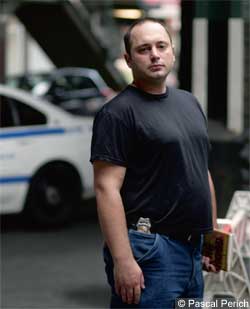
    It’s funny to read an “as told to” when I know I didn’t say things quite like that. I can’t imagine I said I thought long and hard about joining, because I didn’t. I thought it was a great opportunity and I didn’t have a choice, really. But who knows what I say? Sometime my mouth moves faster than my brain. While I may have said The Wire is a good show because “it doesn’t portray cops as always being good.” What I meant is the that The Wireis good show “because it doesn’t show cops and being always bad.” But I’m not complaining. This is great publicity. And the feel of the interview is correct. But let it be known I have never in my life said “learnt.”

    I do like the picture. It’s the “classic police shot.” The photographer, Pascal Perich, called me and I recommended going to the Ditmars elevated subway stop here is Astoria. That’s where where a good scene in the old movie Serpicowas filmed. They didn’t choose the shot from the alley of the shoot out, but this is from under the tracks. The photographer strongly requested I bring my old badge (it wasn’t my idea), my book, and “look intimidating.”

  • Prop Joe? He Dead.

    Prop Joe? He Dead.

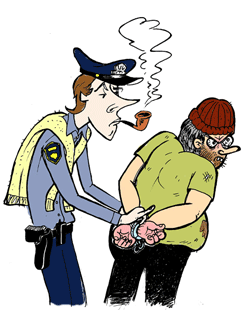
    That’s a Wirereference, if you don’t know. There’s a short Q & A about me in Vanity Fair titled “The Ivy Leaguer Who Took on Prop Joe.” The art cracks me up:
    While ace writer Jordan “slugger” Heller’s text makes me sound so rough and blue-collar, the art just captures my naturally effeminate and pompous persona perfectly.

    Hmmm, yes, indeed, I remember arresting that ruffian. It sure felt mahvalous to get that rapscallion and his dirty scowl off the street! I always carried a sweater just in case it got chilly or I needed to pat my high brow. In this arrest, I was just so thrilled that the scoundrel didn’t make me perspire (or even put out my pipe)! It was so nice to have that sketch artist capture the moment! What a dah-ling!

    When Harvard-trained sociologist Peter Moskos entered the Baltimore Police Academy, back in 1999, his objective was simple: observe up-close the methods and culture of an American police department. He never planned on actually becoming a cop. But one day after Moskos arrived, the police commissioner who’d approved his project left office, and the new regime was not so accommodating. “Why don’t you become a cop for real?” he was asked—or rather, dared—by the interim commissioner, who was threatening to throw him out on his Ivy League butt. Six months later, the Princeton/Harvard alum had a badge and a gun, and was patrolling the graveyard shift of Baltimore’s high-crime Eastern District, the same drug-riddled streets that served as a setting for HBO’sThe Wire. The result:Cop In the Hood: My Year Policing Baltimore’s Eastern District, Moskos’s book recounting his year in the ranks of the thin blue line.
    VF Daily: Your background is not typical for a police officer. Did you take much flak from your fellow cops?
    Peter Moskos: Actually, I found that I got surprisingly little flak from fellow cops about being a Harvard student. I got more shit from Harvard professors about being a cop.
    What were your professors worried about?
    Originally I wasn’t going to become a cop; traditional academics aren’t supposed to do that. [They’re supposed to observe, not participate.] So I think they felt I was pulling the bait and switch. But some of it I think was just class snobbery: “You’re a Harvard student, you’re not supposed to become a cop. That’s a blue-collar job.”
    The midnight shift in Baltimore’s Eastern District. That’s serious. Aside from the criminals you’d be dealing with, did you worry about encountering police corruption?
    [The Eastern District] could be perceived as the heart of darkness of police culture, so yeah, I was worried about it, but I didn’t see any corruption. What I did find, however, is that the average cop has more integrity than the average professor.

    There’s more. The whole Q & A can be found here.

  • CUNY Podcast

    Enjoy CUNY radio’s podcast interview of me. “Book Beat.” What a good name for a show that features a book about police.

    (CUNY, pronounced Quny, stands for the City University of New York, of which John Jay College is a part)

  • Good stuff!

    I received this email a while back from a Baltimore Cop who transferred elsewhere. I’m protected his identity (of course) by blocking out a few details with ****. (By the way, I think the “proper” spelling of “screet” is with a K, but that’s a minor issue.) This is good stuff. perhaps even better than my book:

    Much like a person’s upbringing in life influences some of their behavior and personality, my training, or “upbringing” as a cop, if you will, in Baltimore will continually influence how I police. I find myself very different from many of my current co-workers. I am more jaded and uncompassionate. I want every suspect to go to jail (which rarely happens here in ****).

    Thug life and the ghetto is another aspect of Baltimore I will never forget. Again, I grew up in **** and graduated with 5 or so African Americans out of 225. Not much contact. However, after 4 years in Baltimore, I am fluent in “ghettoese” (p62). “Peoples” “Hair-ron” “bounce” “up the screet” “on the corna” and “hoppers” are among my favorites.

    In regards to the ghetto, from my * years in Baltimore, I agree with the thought (p39) about not blaming poverty and racism for the ghetto life and wanting to “napalm the whole area” (I wish I had a dollar every time I heard that). It was hard as a white upper-middle class conservative male to feel sorry for African Americans there, but in the same light, I agree with the “hate everybody philosophy”(p40). My partner (white male) and I, knew when we saw a white junkie in the ghetto, they were getting locked up for something. Fair or not, that is how I played the game.

    One of the thoughts I am in agreement with many of the other officer’s in the book is the negative opinion of “junkies.” Drugs never had an impact on anyone in my family, any of my friends family growing up, or for that matter even in our community (it was unheard of). I took that with me to Baltimore. I was naive, but also cold and uncompassionate, and to this day I still am.

    My opinion of junkies (pp43-46) is that they are, “not even considered people … Who gives a flying fuck about a junkie!?” (My wife actually got mad at me during the reading of the book because I continually interjected my thoughts about this issue: “****, you are not in Baltimore anymore, let it go,” she says). It’s difficult to let it go, especially when you experience it firsthand and are so disgusted with it. I will never forget stopping a male junkie (Pennsylvania Avenue market, heroin shop), telling him to give me his tools, whereby he proceeded to bend over, spread his butt cheeks and show me a capped needle shoved into his anus. And people wonder how I got to be so bitter.

    Departmentally, I found your thoughts and opinions on point. Without a doubt, there is an unwritten quota at work. In flex it never bothered me because I locked a lot of people up, but regardless, we still heard about having to beat the other flex and bike squads in stats. During the latter part of my career in Baltimore, officers were temporarily transferred to other districts as punishment for poor stats. Yeah, that makes sense, send a poor producing officer to an unfamiliar district and ask them to produce. Command staff, you are genius!

    District and Circuit Court was a joke. Officer’s working until 3 or 4 am and then expected to be in court by 9am. And they wonder why officer’s FTA’d[failure to appear].I had court 5 days a week sometimes. I was never one for overtime; I wanted my free time. Talk about burnout. Court was one of the top reasons I wanted to leave Baltimore after my four years.

    I could write a lot more about the book, but I think it would be easier to just say I am in agreement with your thoughts about Baltimore policing, and leave it simply at that. I recommend this book to people curious about “real”(?) police work!

  • Ed Norris Show

    I’ll be on the Ed Norris show (via phone) tomorrow (Tuesday) 5pm. Listen in.

  • Incisive and intelligent account of police work “in the hood”

    Here’s an excellent review from Professor Arnold Ages published in the Jewish Post & Opinion.

    This is what the industry calls “a sleeper book.” There is no doubt that it will soon be auctioned off as a film script.

    Peter Moskos, a professor at the City University of New York, researched his Harvard Ph.D. dissertation in a most unusual way: He joined the Baltimore Police and after graduation from the Academy, was assigned to Baltimore’s toughest district, the Eastern.

    Moskos did not hide the purpose of his enrollment and for a year and a half he joined fellow police officers pursuing the bad guys and in so doing learned important things about the criminal justice system.

    His book, however, is not only a description of the daily activities of the men in blue but also a meditation of the Black underclass, the drug war and the ethics of his fellow officers. This reviewer has not read a more objective, incisive and intelligent account of police work.

    There is criticism galore in his essay—of the irrelevance of the police training academy, of the targeting of poor Blacks and of the misguided drug policies of the American government.

    With regard to those with whom he served, Moskos has high regard for their dedication and honesty and observes that few police officers would jeopardize their pension benefits by becoming “dirty,” the name for corrupt cops. He admits that there are some, but they are few in number.

    While violence is endemic in the area where Moskos served, few police officers, he says are victimized by gun violence: Most fatalities among the police occur as a result of auto accidents. The author himself lost a colleague in that way.

    One interesting element in this essay pivots on the arrest phenomenon. It is well known that police everywhere are expected to fill their arrest quotas. Baltimore is no different. But what is not known is that police officers receive overtime pay for court appearances and this can result in handsome monetary rewards.

    Moskos’s graphic descriptions of the drug culture in Baltimore’s Eastern District are the most detailed and analytical to be found anywhere. The author offers a comprehensive look at the “stoops” abandoned buildings, lookouts and benches where drug transactions occur. He also zeroes in on the personnel involved in the drug trade and provides ample details about the police’s efforts to inhibit that “business.” One of the surprising revelations that emerge from his reportage is that, except for the major bosses, street level entrepreneurs make relatively little money.

    Their clientele, the author notes, use a form of English language that is sui generis. “Bank” means to hit; “bounce” is to leave; “hoppers” are troublesome young people; “cousin” in a close friend; “fall out” is to faint; “zinc” is a sing. Mastering this linguistic tool is important for police officers because ignorance in this area can lead to misunderstandings when interrogating suspects. “Snitch” is another word popular in Baltimore’s Eastern District, and it is a despised term. In fact, the phrases “snitches get stitches,” more or less sums up the scorn in which such people are held.

    What distinguishes Moskos’s book from similar ones is the author’s plea for greater flexibility in addressing the rampant drug crisis. He characterizes the current ideology as prohibition—much like that which paralyzed the United States in the 1920s. Ultimately prohibition failed and Moskos feels that there are lessons to be learned from the experience.

    Citing the example of Holland, where addicts can the drugs they need, Moskos argues that de-criminalizing the illegal drug industry will no de-stabilize the American moral compass and that tax revenues from the legitimate purchase of hard drugs will fill the coffers of government.

    The reason the author is so passionate about his advocacy is because he has seen close hand what the alternative is in the microcosm of Baltimore’s Eastern District, where pandemonium reigns for its majority of poor Black inhabitants.