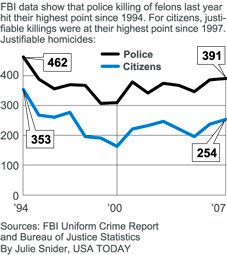
In the Kansas City Star by Tony Rizzo.
Tag: homicide
-
Bang bang, they hit the ground
Baltimore Crime turned me on to this:
Spotcrime maps every shooting in Baltimore (City and County) for 2008. Hit ‘start’ at the top left. Whether you want Turning of the sound to hear the bang bangs is up to you. At the time of this writing, I’m still only in October.I can’t tell if this is sick or genius. If I’m in doubt, I usually go for the latter.
-
Murder Factory
Now here’s some good investigating journalism from Tony Rizzo and the Kansas City Star. Local zip code 64130 is featured in a series called “Murder Factory.” These eight square miles were home to 101 convicted murderers incarcerated in Missouri prisons.
-
No Sh*t
The New Orleans Times-Picayune reports: “New Orleans breeds bold killers: half of murders occur in daytime.”
Duh. Three ace reporters have bylines on this story. Didn’t it occur to one of them to compare their stats with other cities?
They report: “About half of last year’s 179 murders in New Orleans occurred in daylight,” which is defined as between 6am and 8pm.
Now this isn’t real hard-core research, but sitting at my computer drinking my morning coffee, I can discover that in Oakland, 55% of homicides happen between 6am and 10pm.
In Australia (the whole country of 20 million, by the way, over a 13-year period ending in 2002, has an average of 316 homicides a year–that’s a homicide rate about 1/30th of Baltimore City)…In Australia, 61% of homicides happen between 6am and midnight.
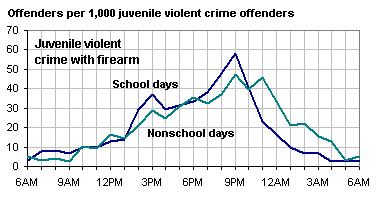
Here’s a table showing juvenile gun violence by time of day. I bet that homicides correlate pretty strongly with this chart.
That chart also reflects police call volume in high-crime areas pretty well. And thus (in part) why I liked working midnights.My point is that of course half of homicides happen during daylight hours because that’s when people are awake and out and about. And they increase throughout the day because that when problems develop and people get drunk. People don’t wait till dark before killing somebody. People kill when they’re pissed off and have the means and desire to do so. And when it’s bed time, the violence goes down. People go to sleep and have sweet dreams. Then, just like Groundhog Day, it starts over again. And generally, people who kill aren’t early risers.
So instead trying to find a grabbing headline or presenting this amazing fact as some deep pathology of criminals unique to New Orleans, perhaps the reporters should have just used the google.
[Note: In defense of the reporters (Laura Maggi, Brendan McCarthy and Brian Thevenot). Reporters don’t write their own headlines. The rest of the story is pretty good. The fault may lay with an editor trying to make a story and an attention-grabbing headline where there really is no story.]
-
Baltimore To End Year With Fewest Murders In Two Decades
Justin Fenton writes in the Sun.
This is great news. But one thing is very curious:
The city’s Western District, for example, where nearly 90 people were killed in 1992, recorded 23 homicides in 2008. It has not recorded fewer than 32 homicides in a year since at least 1970.
But the Western District is also emblematic of the past year’s uneven results: While it recorded the largest drop in homicides of any district, shootings rose and robberies increased by 37 percent.
That just don’t make sense. I can’t figure it out. I hope it doesn’t end up like in The Wire, with all the bodies found in vacants.
But in the meantime, kudos to the BPD.
-
Baltiore homicide by the numbers
Back in January, the Baltimore City Paper published a good simple analysis of homicide numbers in 2007. I was just looking at it again. As we all know, violence is not equally spread out in society. It may not be politically correct to talk about race and violence, but homicide in America is disproportionately a problem of black-on-black young male gun violence concentrated in poor communities with public drug dealing. It’s concentrated in places like the Eastern District. The question, of course, is what are we going to do about it?
There were 282 murder victims in Baltimore City.
261 (94%) were African-American (the city itself is 65% black).
258 (91%) were male.
233 (83%) were shot.
The youngest was 2.
The oldest was 82.
The Eastern District took the crown this year with 50 homicides. -
Homicides down in Baltimore
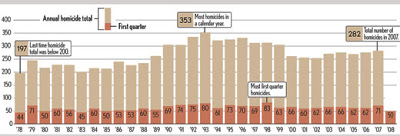
At least for the first three months of 2008. Hopefully it will last. Here’s the Sun’s story by John Fritze and Sara Neufeld.
There’s a nice Sun news graphic in the story.
It’s rarely mentioned that what looks like a steady decline in homicides in the 1990s correlates pretty well with the decline in the city’s population. So while the numbers dropped, the rate didn’t. -
Shooting in White and Black
The Sun has an excellent interactive graphic that can display all the year’s homicide victims. You can select for different variables, so it’s fun to play with (if you’re a nerdy academic).
One of the depressing things about homicide is the racial breakdown. Breaking violent crime down by race doesn’t get much press, probably because it treads on incredibly un-politically correct territory. But I’m not afraid of fact. According to today’s paper, the city’s homicide count rose to 277 (surpassing the 2006 total).
If you go to the interactive graphic, select for all of 2007 and white. You get 13 victims. Three of those by shooting. Keep shooting selected and then select for black victims. It’s very, very depressing. It’s mostly clustered in the Eastern, Western, and part of the Northwest.
Keep black and shooting and add “article, yes.” Look at those red dots disappear. Young black men shot and killed that you never even heard about. And that’s ifyou read the daily paper. Granted, most of the white victims didn’t make the paper either. But for whites in Baltimore, we’re talking maybe a dozen or so, not hundreds of lives a year!
Most of the deaths are caused by the issues related to the illegal drug market. If we regulated drug selling (and who is for unregulated drug selling?), lives would be saved.
When people ask me why things aren’t getting better, one of my stock answers is this: liberals refuse to talk about culture and conservatives are too greedy and don’t give a damn. Of course, that’s just my simplistic way to piss everybody off. So let me explain:
Liberals refuse to think of anything other than “root causes.” This usually comes down to money and racism. If anything is going to get better, it will cost money. But money isn’t everything. Rich drug dealers (though most are poor) have money. And they’re part of the problem. And most poor people struggle buy without ever killing anybody.
And racism matters. But if we wait till racism is over before moving forward, we’re going to be stuck a very long time.
And let’s talk culture. Part of ghetto culture is screwed-up. There are a lot of bad parents out there. I’m not going to divide parents into either “good” or “bad,” but some parents simply do a crappy job of raising (or not raising) their kids. I’m not blaming the victim. I think there are good reasons people are screwed up. But screwed up they are.
Just once I’d like to hear a liberal call anybody a “bad” parent. I’m not saying insulting parents is the answer, but sometimes a little truth is refreshing and helps clear the air (and may get conservatives to open their pocketbooks).
Conservatives, at least the good ones, do give a damn. But too often they are greedy or ideologically blinded. They don’t want to spend money. We need to change attitudes and shift priorities. But this can’t be done without money. We could make things better. If we had the will, we would find the money.
Say want you want about the risks of legalized and regulateddrug selling, but if we could save lives (and raise money), wouldn’t it be worth it? If you’re still for drug prohibition after all these failed years, ask yourself what is more important than saving the lives of poor young black men. If you have an answer, you need to look deep inside yourself. You may not like what you see.