I have a short article in the journal PoLAR: Political and Legal Anthropology Review. “Policing: A Sociologist’s Response to an Anthropological Account.” You can read the PDF here.
I love reading other people’s summary of my work. This is from the issue’s introduction:
In his commentary on Karpiak’s article, sociologist and criminologist Peter Moskos praises Karpiak for presenting an (in his view) unusually lucid example of anthropological writing. Moskos takes particular aim at the pressure in some sociological writing to conform to natural science models for research method and writing, which he feels take the enterprise off course. Instead, he advocates an interdisciplinary and combined-method approach in which qualitative and quantitative approaches can be brought together, in an effort to check the admittedly partial character of the knowledge produced by each method.
Is that what I’m saying?
My favorite part (and what will undoubtedly bring me into the glamorous party circuit of the high-rolling world of international poetry) is my haiku version of “Casey at the Bat.” It goes like this:
mighty casey swings
oh two two on down by two
no joy in Mudville
All kidding aside (not that I was kidding), I do believe that almost everything can (and should) be summarized in 17 syllables. Talk about cutting to the chase; it’s a useful skill. Recently, for my next book, I took my hand at Foucault. I was going to omit Foucault from the book on principle. But then I realized I couldn’t figure out what that principle was (except for me not liking Foucault’s writing). I also didn’t want people to think I didn’t read Foucault. Oh, no. I read Foucault. I thought about him long and hard. I just don’t like Foucault. And every time I read, “As Foucault said,” I reach for my gun. So to help make my point about the Frenchman’s needless verbosity, I attempted to summarize Discipline & Punish in 17 syllables.
I couldn’t do it.
It turns out that Foulcault’s classic treatise needs twohaikus:
society’s norms
more like prisons every day
resistance is futile
from body to mind
a new system of control
the Panopticon
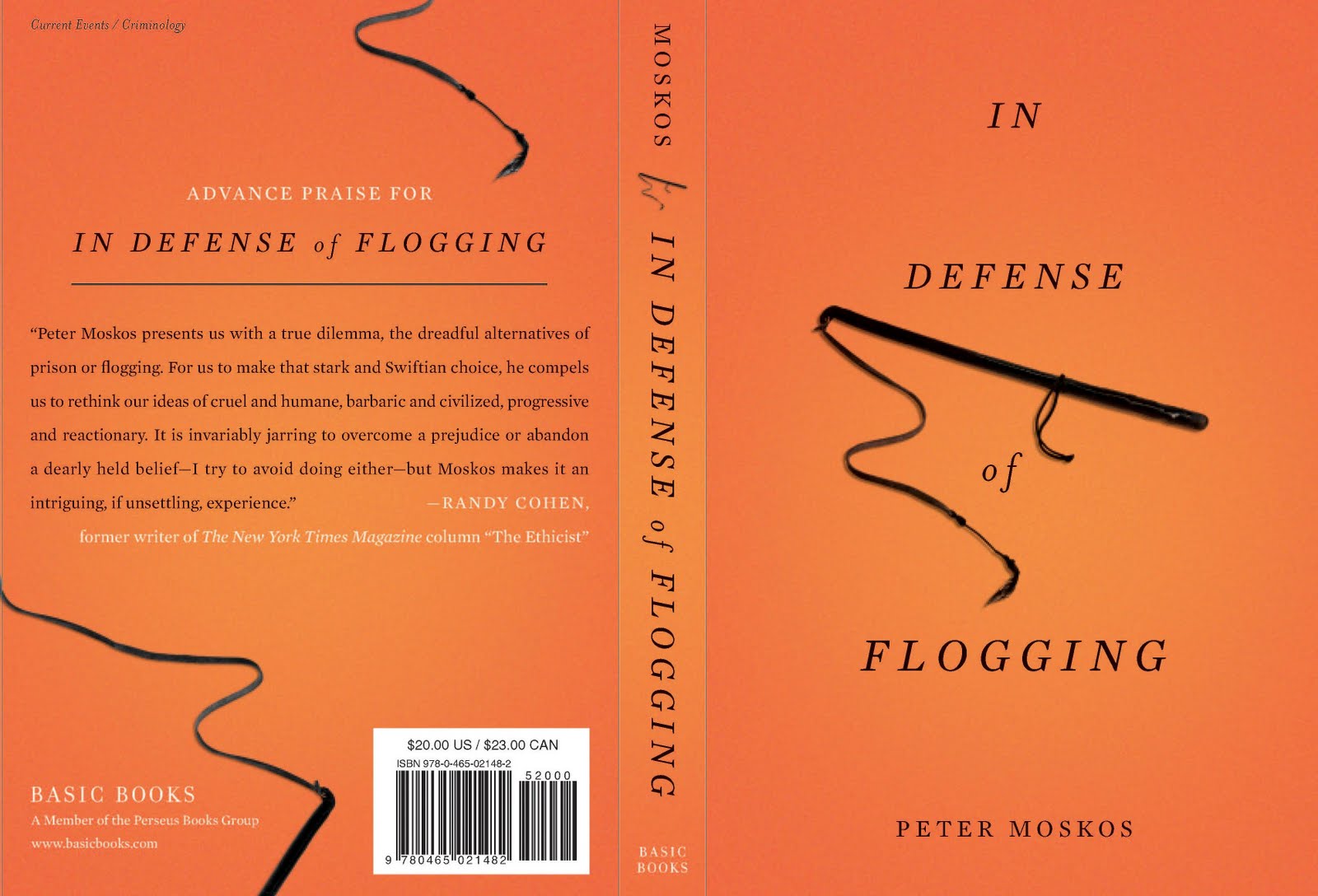
Speaking of my next book, here’s my 17-syllable summary of In Defense of Flogging:
punish with the lash
it’s much better than prison
why not give the choice?
That’s all you really need to know, but read the book anyway.
 Moskos, an assistant professor at John Jay College of Criminal Justice who specializes in police and criminal science, debates with the utmost seriousness the merits of flogging as an alternative to incarceration. Whether it’s called caning or lashing, he concludes flogging, which penetrates the flesh but is over quickly, is less cruel than depriving people of a chunk of their lives in “a barbaric, inhuman” institution where a record number of 2.3 million Americans endure insult and humiliation, with a high incidence of sexual aggression, rape, and a great risk of contracting a communicable disease. Moskos lists the long history of prison reforms in the U.S., but concludes that our penal system remains “an insidious marriage of entombment and torture.” Presenting the Singapore and Malaysian models of flogging, the author draws on interviews and recommendations to boost his “thought experiment.” Indeed, when Moskos mentions the possibility of electric shock as another option , readers will begin to wonder if the writer is poking outlandish fun and crafting a notion similar to Swift’s 1729 classic “A Modest Proposal,” using satire to call attention to the “shame” of our inhumane prison system.