Tag: incarceration

  • California Prison Release

    Off to bumpy start, says the LA Times:

    Many of the ex-criminals are not showing up for counseling appointments, some care centers are not being paid and county bureaucrats are scrambling to correct foul-ups that have caused delays.

    In the six months since, about a quarter of the probationers have been arrested for allegedly committing new crimes, which is below the previous state average for probationers.

    It’s kind of sad that one-quarter rearrested within six months is better than average. If any of you could figure out how to lower the recidivism rate, you’d be a hero. I have one answer: WPA-style make-work programs.

  • Spread those cheeks

    The Supreme Court upheld the constitutionality of strip searches for minor offenses. This isn’t a big surprise. The Court has always granted a lot of discretion to jails and prisons to run their own affairs, with regard to safety, broadly defined:

    Maintaining safety and order at detention centers requires the expertise of correctional officials, who must have substantial discretion to devise reasonable solutions to problems. A regulation impinging on an inmate’s constitutional rights must be upheld “if it is reasonably related to legitimate penological interests.”

    [C]orrectional officials must be permitted to devise reasonable search policies to detect and deter the possession of contraband in their facilities, and that “in the absence of substantial evidence in the record to indicate that the officials have exaggerated their response to these considerations courts should ordinarily defer to their expert judgment in such matters.”

    The four more liberal justices dissented.

    Leaving aside constitutional issues, I’ve always pointed out that you should welcome a strip search in jail not because of youmight be hiding or carrying, but because of everybody else you’ll be with. There are a lot of criminals in jail. If I’m in jail, I will sleep better knowing that everybody elsehas been thoroughly searched for weapons.

    Of course such logic does ignore the fact that most contraband gets into jail through visitors and correctional officers.

  • Procedural versus substantive justice

    There’s a great review of William Stuntz’s book, The Collapse of American Criminal Justice (which I have but have not read). Stuntz was conservative, just FYI. The review is by Leon Neyfakh in the Boston Globe. Stuntz’s point is that procedural justice is not the same is real justice. And the trend towards the former, encouraged by liberals, has actually screwed everything up. It’s quite convincing, at least in summary form. Neyfakh explains it well, particularly how well intentioned layers have helped screw everything up, with their misguided faith in the magic of procedure:

    At the heart of the book is Stuntz’s surprising argument about how we reached this point: that well-intentioned Supreme Court rulings meant to protect defendants from unfair and discriminatory police practices combined with the harsh laws passed in response to the crime wave of the 1960s and ’70s to produce a system that is merciless, destructive, and above all, unjust.

    Stuntz described it as a chain reaction, set off by the fact that the court had focused all its efforts on procedure, and had failed to impose any substantive limits on what legislators could criminalize and the punishments they could impose.

    In effect, those rights that the Warren Court gave defendants have become bargaining chips, to be traded away by defense attorneys in exchange for shorter sentences.

    The practical result, Stuntz writes, is that the criminal justice system is now anything but local, and mostly indifferent to the people whose lives are most directly affected by it. Poor minorities who live in the urban neighborhoods with the most crime are living under laws passed to please middle-class voters who live elsewhere, and processed by a system built to force a guilty plea rather than determine whether they actually deserve to go to prison.

    “It is the lawyer’s conceit to believe, on some level, that if you can get the procedure to be perfect, that will ensure that the results will be perfect,” said Joseph Hoffmann, a professor at the Indiana University Maurer School of Law, who has known Stuntz since the two of them clerked together on the Supreme Court. “It’s the way most lawyers look at the world….They would say procedural justice is how you get to substantive justice.”

    Alas, the real world doesn’t work that way.

  • A most fabulous correction

    From Salon.com, regarding an interview they did with me:

    The June 20, 2011, story “Could Flogging Solve Our Prison Crisis” initially stated that “the Corrections Corporation of America helped draft anti-immigration laws,” a reference to the draft legislation that later became Arizona SB 1070. CCA has brought it to our attention that although CCA did have a representative at the ALEC meeting where model legislation similar to 1070 was drafted, CCA was not involved in drafting the language. The story has been corrected. [Correction made 3/8/12]

    Of course. Their man sat quietly the whole time playing solitaire. I regret the error.

  • NYC marijuana and jail

    Two good posts from Zachary Goelman. One on the latest death caused by marijuana (prohibition). The other on the new jail in Brooklyn.

  • Couldn’t have said it better myself!

    Couldn’t have said it better myself!

    They say imitation is the sincerest form of flattery. I was flattered enough to send this letter to the New Yorker:

    To the Editor,

    As a long-time New Yorker subscriber, I was thrilled to see Adam Gopnik’s recent article, “The Caging of America.” I appreciate Mr. Gopnik bringing this important subject to the attention of the New Yorker’s readers (and I couldn’t agree more with his overall points).

    Incarceration is a theme I am quite interested in. So much so, in fact, that I wrote a book on the subject, In Defense of Flogging (Basic Books, 2011). Mr. Gopnik may have come across my book in the course of his research as it seems to me that he referenced my book numerous times in his article.

    Perhaps I am too familiar with the subject, but many of his phrases bear a uncomfortable resemblance to my own published work (examples follow). At the very least, it would have been nice to be acknowledged.

    Sincerely,
    Professor Peter Moskos
    John Jay College of Criminal Justice

    1) The US prison/Soviet gulag comparison.

    “The Caging of America”: Over all, there are now more people under “correctional supervision” in America—more than six million—than were in the Gulag Archipelago under Stalin at its height.
    In Defense of Flogging: Stalin, at the height of the Soviet gulag, had fewer prisoners than America.

    2) The US City of Incarceration.
    “The Caging of America”: That city of the confined and the controlled, Lockuptown, is now the second largest in the United States.
    In Defense of Flogging: If we condensed our nationwide penal system into a single city, it would be the fourth largest city in America, with a population more than Baltimore, Boston, and San Francisco combined.

    3) The baseball stadium analogy.

    “The Caging of America”: Every day, at least fifty thousand men—a full house at Yankee Stadium—wake in solitary confinement.
    In Defense of Flogging: At a sold-out baseball game in Chicago, forty-one thousand people can watch the Cubs at Wrigley Field. Two-point-three million is more than fifty-six sold-out ballgames.

    4) The bathroom.

    “The Caging of America”: (Lock yourself in your bathroom and then imagine you have to stay there for the next ten years, and you will have some sense of the experience.)

    In Defense of Flogging: Consider one California inmates account of prison life: “I live in a bathroom with another man, rarely see my loved ones, I’m surrounded by killers and thieves.”

    5) Rape as comic fodder.

    “The Caging of America”: More than seventy thousand prisoners are raped each year—that it is routinely held out as a threat, part of the punishment to be expected. The subject is standard fodder for comedy.

    In Defense of Flogging: Approximately one in twenty prison inmates say they’ve been sexually assaulted by other inmates or staff in the past year…. And yet we still joke about prison rape. … comedian Chris Rock popularized an account.

    6) Prisoners as disappeared.

    “The Caging of America”:We lock men up and forget about their existence.

    In Defense of Flogging: Troublesome people are out of sight and out of mind—picked up off the street and all but disappeared.

    7) Marion prison lockdown.

    “The Caging of America”: Then, in 1983, inmates at the maximum-security federal prison in Marion, Illinois, murdered two guards. Inmates had been (very occasionally) killing guards for a long time, but the timing of the murders, and the fact that they took place in a climate already prepared to believe that even ordinary humanity was wasted on the criminal classes, meant that the entire prison was put on permanent lockdown. A century and a half after absolute solitary first appeared in American prisons, it was reintroduced.

    In Defense of Flogging: Things changed, however, in 1983, when inmates in Marion Prison killed two guards in two separate incidents on the same day. Marion immediately went on lockdown and remained there—for the next twenty-three years…. Reincarnated after nearly a century’s absence, the concept of near-total isolation spread from Marion, Illinois, to the world.

    8) Drug offenders to embezzlers.

    “The Caging of America”:Neither the streets nor the society is made safer by having marijuana users or peddlers locked up, let alone with the horrific sentences now dispensed so easily. For that matter, no social good is served by having the embezzler or the Ponzi schemer locked in a cage for the rest of his life, rather than having him bankrupt and doing community service in the South Bronx for the next decade or two.

    In Defense of Flogging: Certainly mere drug offenders should not be kept in prison, nor should white-collar criminals. Bernard Madoff, famously convicted in 2009 for running a massive Ponzi scheme, is being incarcerated and costing the public even more money. Why? He’s no threat to society.

    9) “Natural rate of incarceration”

    “The Caging of America”: The natural rate of incarceration seems to hover right around a hundred men per hundred thousand people.

    In Defense of Flogging: We might consider 100 per 100,000 a somewhat “natural” rate of incarceration. [A phrase I believe I coined.]

    And in case you’re wondering, this image has been blatantly stolen from Gawker.

     

    Follow up post

  • “Beware of the Risen People”

    “Beware of the Risen People”

    In Dublin, these neighborhoods with their uniform rowhomes remind me of Baltimore.

    The grittiness of Dublin was a bit of a refreshing shock after the pastoral beauty of rural Hampshire. Even though I have nothing but nice things to say about the English, in Ireland I felt like I was back on home ground. From where I’m from (Chicago, Boston…) England feels more like a foreign country.

    My friend in Dublin lives next to Aubourn Prison.

    “Holds pedophile priest,” she assured me (but not, I should note, from the Greek church next door).

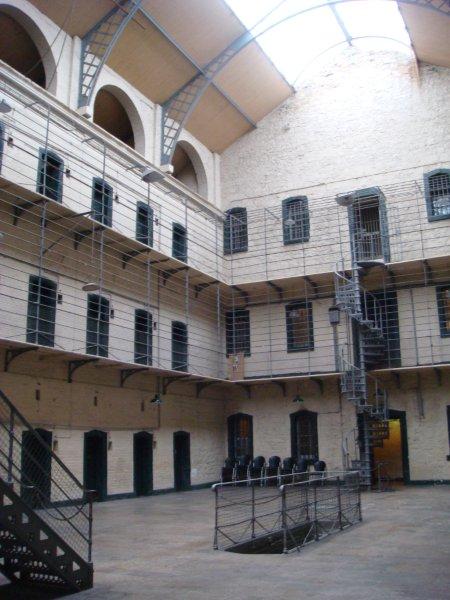
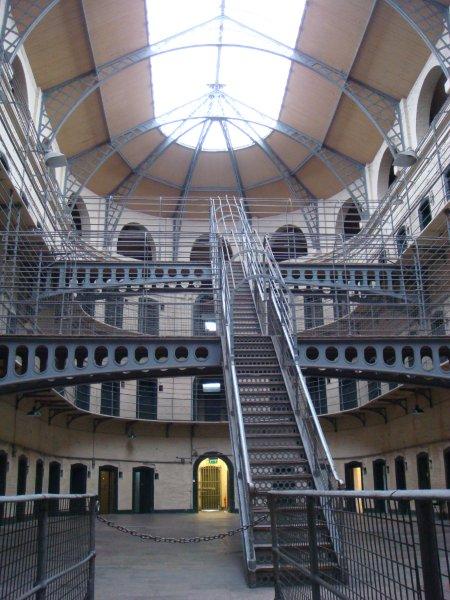
    A short walk past leads to the old Kilmainham Jail. It closed in the 1920s and stands today as a museum, but less to prisons than to the “Heroes of 1918” and Irish independence. Suffice it to say my knowledge of Irish history is a bit thin up top. 1918? Revolution? Civil War? Indeeeeed…

    But I was keen to go to this prison because it claims to feature a Panopticon.

    Actually it’s not a Panopticon because it’s not, well, round with a centrally located guard post designed to provide constant potential surveillance inside each prison cell….

    But Kilmainham Gaolwas, with its multi-tiered layout, inspired by Bentham’s evil concept. And the architecture is cool.

    Typical of early prisons, starvation was used as a tool in place of corporal punishment. More humane, said the Progressive thinking of the time. In 1884 C.S. Parnelltestified at the Royal Commission on Prisons in Ireland:

    One thing that struck me in Kilmainham was the semi-starved aspect which all the convicted prisoners presented. They seemed to be utterly dejected and weak, and unable to undergo any amount of physical fatigue…. I do not think that we are entitled to enfeeble the bodies of prisoners in order to reform their minds, or with a view of maintaining discipline amongst them.

    Unlike contemporaneous American penitentiaries like Auburn and Sing Sing (which, unlike Kilmainham, are still operational), Kilmainham’s cells didn’t have plumbing. So prisoners in Ireland had to “slop out.” Even more amazing, today, in 2011, the practice of slopping out is still practiced in at least one Irish prison.

    Meanwhile, from the museum at Kilmainham, I’m always a sucker for revolutionary propaganda.

    Johnny-come-lately lately Republicans:

    I didn’t see ye out there fightin’ in 1921, now did I?

    And Irish Mothers, Do You Want Your Children Kidnapped?:

    “Beware of the Police”The highlight of the trip, however, unrelated to prison, must have been hearing Travelers sing while we were “on the Batter.”

    Beware of the Risen People.

  • “I’m expressin’ with my full capabilities…”

    The Timesand a grim read about a boy with mental problems, gone bad. It’s interesting but in all-too-many ways nothing new.

    But what struck me was this great example of doublespeak:

    Mr. Clergeau was discharged … with the expectation that he would be imprisoned. Hospital authorities told the state police that he was “not a psych patient,” which appears to reflect a medical opinion that he belonged in a correctional setting.

    Okay… So once we give up on you, once we determine you are cannot be helped with treatment, when it’s all over and we simply lock you up because we’re afraid your going to hurt somebody… … that’s when we put you in a “correctional” setting. Got it? Now try explaining that to the Martians when they land.

  • The California Prisoner Hunger Strike…

    …enters it’s second week. From the S.F. Weekly:

    Activists and inmates say the strike is meant to call attention to inhumane conditions in Pelican Bay’s Security Housing Unit (SHU), where dangerous prisoners are lodged in small, windowless cells, often without access to other people or open space for extended periods. Critics of the SHU say that solitary confinement is equivalent to psychological torture, a position that is buttressed by recent scientific research.

    Here’s a more current update from The Nation.

    Or, as Johann Koehler relates it to In Defense of Flogging in a thoughtful blog post:

    The question of whether you’d prefer flogging instead of prison is nowhere near as grotesque as whether you’d prefer to starve yourself to raise awareness than tolerate another day of institutionally sanctioned torture. One is a fanciful thought experiment. It’s fiction. For 400 people, the other is acutely real.