Tag: militarization of police

  • Why police need big guns

    My man Eugene O’Donnell wrote this in the Daily News. It’s worth reading, given general opposition (including some from me) to the militarization of police:

    At present only a handful of police departments have the capacity to intimidate would-be terrorists and, if need be, wage sustained combat against them in the streets of America. This is a weakness to correct, not a condition to celebrate.

  • Well done, hon!

    Well done, hon!

    Things went well in Baltimore last night. So far, knock on wood, nobody else has gotten seriously hurt.

    Compare this with police tactics in Ferguson. But Baltimore is better than Ferguson. And the BPD is better than the FPD. What we have not seen are flash-bang grenades. No tear gas. No gun shots (except for the “normal” Baltimore homicides). No riots. No fires. No looting.

    Nothing is easy. But a bit of police restraint has gone a long way to keeping the peace. So kudos to all the brave Baltimore City police officers for a job well done.

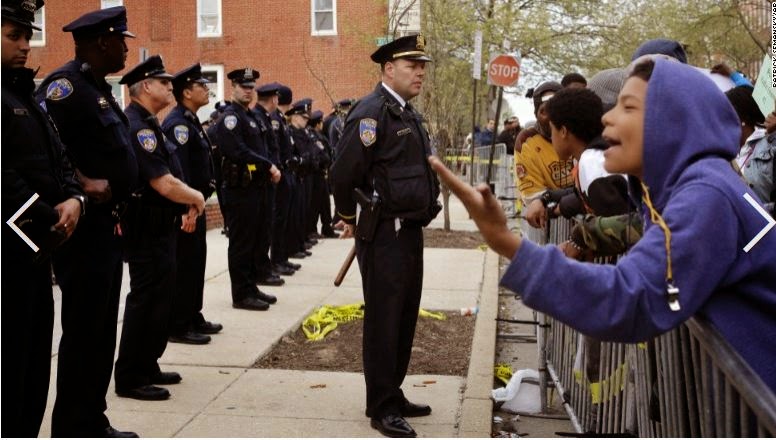
    Seeing all those cops lined up last night at the Western District WITHOUT riot gear — looking like human beings, not being provocative, taking shit (and a few bottles), looking bored, and being professional about it — it made me proud to have been a Baltimore cop.

    [photo from CNN]

    The whole no riot gear thing is interesting. I heard former commissioner Hammsay on CNN that he he didn’t like that, tactically. “Somebody may get hurt.” He was right. But in this case it worked. Yes, it was just luck. I’m saying this in hindsight. But luck matters.

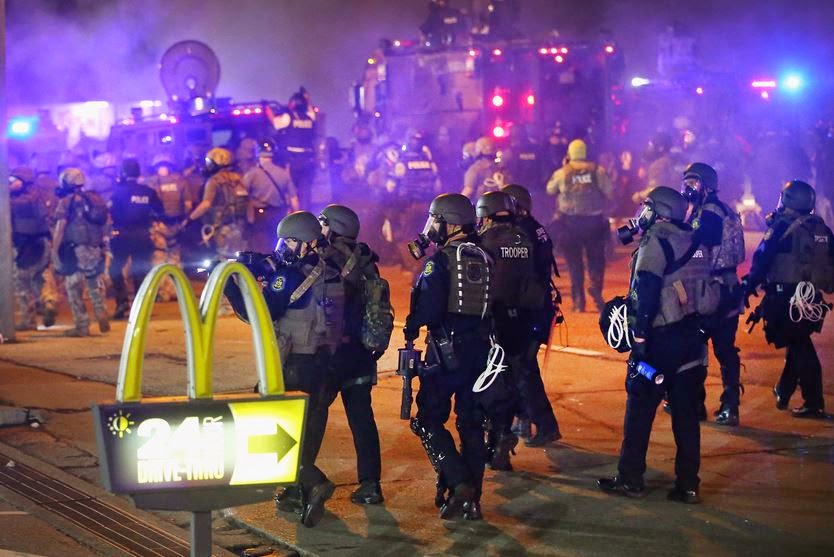
    So what if police had been decked out in riot gear?Sure shields and helmets give you needed protection against rocks and bottles. They also dehumanize police officers and provide a target for people throwing things. What if some SWAT-like team was there, looking bad-ass? (Is it still “QRT” or have they have they been rebranded?) Throw in an armored personnel carrier with a turreted machine parked right out front. Well, think of the message that would send! Now we’ve got a party!

    [not Baltimore]

    And then somebody throws a bottle. Or maybe lights a fire. And police respond with tear gas, rubber bullets, and flash grenades (the latter makes no sense at all, but anyway)? And then there’s a baton charge. What if in that melee police get hurt? Seriously hurt. Well then those injuries would justify the military-like action.

    But that’s not what happened. Give credit where credit is due. And the Baltimore police last night deserve credit. Everybody went home. This didn’t “just happen.” These are choices made.

    Look, it’s not easy to say, “Men, women, go out there and stand there like targets. If anybody throws anything at you, duck and dodge. Pray for the best.” But sometimes that is the job of police. Sometimes that is what you have to do to make sure nobody else, officers include, get seriously hurt. Also, ranking officers were there. That matters. (I did not see the mayor. Where was she? Was she at a more pressing meeting?)

    Police exercised restraint. Police respected the right of people to protest. The police were professional and brave. Nobody knew how this was going to turn out. Imagine kissing your family goodbye that night before going to work, to stand in a line, in front of a police station, facing angry protesters throwing things at you. Shit is going down. “See you later, honey”! [smooch] It’s not just another day at the office.

    I didn’t post this last night because I didn’t want to sound foolish if the Western burnt down and people were killed. One guy with a gun even a rock and good aim could have changed (and still could change) everything. But so far so good.

  • “Just the world we live in”

    “Just the world we live in”

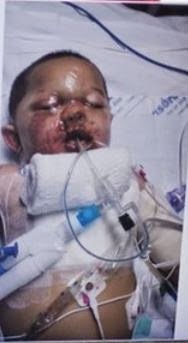
    A stun grenade exploded in a baby’s face. According to the BBC:

    The Swat officers had used a stun grenade, called a flash bang, as they entered the residence. The device, which creates bright bursts of light and noise to temporarily disorient its targets, landed in 19-month-old Bounkham “Bou Bou” Phonesavanh’s playpen, where it burned the child’s face and created a gash on his chest deep enough to expose his ribs.

    OK. I mean it may be standard to use SWAT teams and flash grenades, but that isn’t supposed to happen. But mistakes do happen. So I bet the chief is pretty apologetic.

    But not in Habersham County, Georgia. According to Sheriff Joey Terrell:

    Our team went by the book. Given the same scenario, we’ll do the same thing again. I stand behind what our team did…. Bad things can happen. That’s just the world we live in. Bad things happen to good people…. The baby didn’t deserve this.

    I’m sorry, but that’s not good enough.

    I mean look, I know this is just another example of our idiotic war on ourselves, I mean drugs. That’s nothing new. And bad things do happen to good people. But that doesn’t mean bad things should happen to good people at the hands of police. And when they do, as they inevitably will sometimes, you say you’re sorry, figure out what you did wrong so it doesn’t happen again, and probably shell out some dough to the victim.

    When “the book” results in innocent babies being maimed by police, then rewrite the fucking book, you brainless fool! What you don’t do is say no mistakes were made, and you would do the same thing again. See, if you did the same thing again in the same situation, then the same thing would happen again. And if you’re OK with that, then you’re a dick.

    From the BBC:

    Meanwhile, Bou Bou Phonesavanh is no longer in a coma, but he is still undergoing hospital-based rehabilitation. His long-term prognosis has yet to be determined.

    Wanis Thonetheva, the original target of the raid, was eventually located and arrested for drug possession. As the Guardian’s Pilkington notes, police officers knocked on his door, and he went with them without resistance.

    That’s worth repeating: “Police officers knocked on his door, and he went with them without resistance.” Wow, so you mean the whole SWAT team / flash-grenade thing was unnecessary? Why… yes.

    Anyhow… with Thonetheva off the streets, I’m sure it must now be impossible to get meth in Habersham County.

    Update: It’s worth noting, and it’s taken me a while to realize this, that this is the same jurisdiction and sheriff that were involved with the killing of innocent Rev. Jonathan Ayers in 2009. It’s amazing to me that such multiple instances of gross incompetence in law enforcement could come out of the same small place.

  • Guarding the “Pumpkin Festival and other dangerous situations”

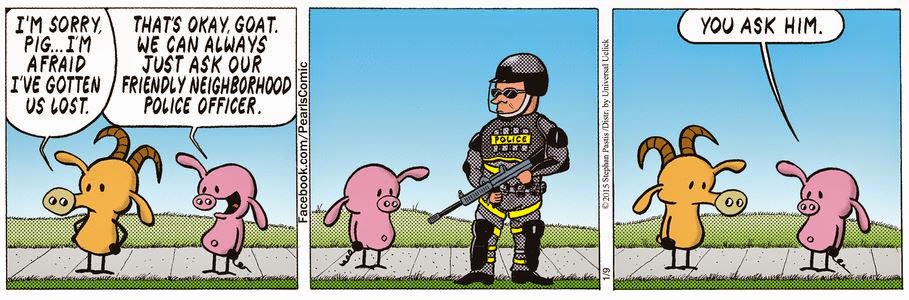
    The Economist’s takeon the militarization of police. Or, why does Keene, New Hampshire, need a $286,000 armored personnel-carrier?

  • Lockdown Nation: How military-style policing became America’s new normal

    Lockdown Nation: How military-style policing became America’s new normal

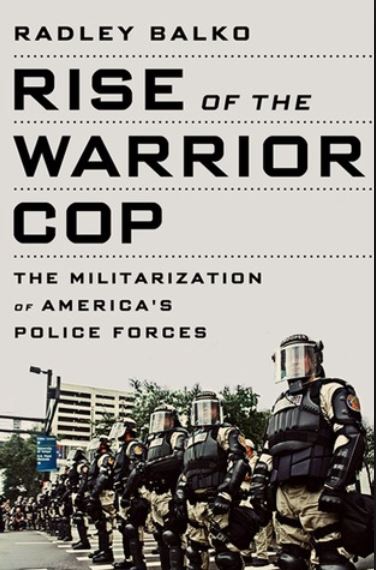
    If you care about the militarization of police, and Radley Balko makes a strong case you should, read his “fascinating and sometimes terrifying” Rise of the Warrior Cop: The Militarization of America’s Police Forces. That quote is mine. And you can find them in the July/August issue of Pacific Standard, a great new (to me) magazine coming from California.

    Here’s an excerpt of my review:

    Journalist Radley Balko traces the changes in American policing from colonial times to the present. His focus, though, is law enforcement’s increased reliance on military hardware and strategy in the last 45 years.

    Paramilitary policing quickly spread across the country. Today there are more than 1,000 U.S. police forces with SWAT or SWAT-type units. In 1980, nationwide, they carried out an average of eight paramilitary raids a day; now there are well over 100. Balko attempts to explain why this happened, and why it matters.

    Paramilitary police tactics were designed, Balko writes, “to stop snipers and rioters-people already committing violent crimes.” Today, however, SWAT teams are used mostly “to serve warrants on people suspected of nonviolent crimes.” Paramilitary raids on American homes, which just four decades ago seemed extraordinary, have become common, as has legal forgiveness for any “collateral damage.” The Supreme Court has by and large acquiesced, creating a string of drug-related exceptions to the Fourth Amendment.

    Balko carefully prefaces his argument by noting that it isn’t, at its core, “anti-cop.” I suspect this is because he hopes to convince as many people as possible. As a former police officer, I have my doubts. Balko asserts that most police officers regularly commit felonious perjury. Lying, he writes, is “routine,” “expected,” and “part of the job.” He supplies little evidence for this claim – an absence that is particularly notable because the rest of his book is so meticulously researched and thoroughly footnoted. “Bad cops are the product of bad policy,” he warns us. But this is too glib. Bad policy creates bad policing. Bad police, however many there may be, are a separate problem.

    Even if SWAT raids don’t pose an existential threat to American liberty – and Balko makes a strong case that they do – Rise of the Warrior Cop persuasively demonstrates that they’re simply unnecessary. The problem has little to do with the Constitution, and solving it doesn’t require some radical innovation in police practice. Most warrants are served just fine the old-fashioned way: by knocking on someone’s front door. In tactically tricky situations, police can wait for their suspect to walk to the corner store. The relevant question is political: Having given our police broad access to military weapons and tactics, will we ever choose to take them away?

    _______________________________________________

    PS: I feel compelled to mention the great experience I had writing this book review for Pacific Standard. I worked with editor Peter Baker once before when he was with Washington Monthly. I’ve actually had good luck with editors over the years, but other writers crook their eyebrows and then get jealous when I mention such positive experiences. Perhaps I have been very lucky, but it’s a shame it’s even noteworthy to work with a collaborative and helpful hands-on editor. Speaking of all too rare in publishing today, kudos also go to Pacific Standard  for paying good money for a writer’s labor. And paying promptly. Thanks!

  • Because one life isn’t enough: The Militarization of Police

    I’ll be gracing the ever-mysterious world of Second Life again tonight. It’s a nice long-form discussion. And you can listen in in your first life as well. Virtually Speaking with Jay Ackroyd. Tonight at 9pm, New York time. It’s about the militarization of police.

  • UC-Davis Pepper Spray

    From Jack Stripling in The Chronicle of Higher Education:

    The pepper spraying of student protesters at the University of California at Davis in November, an incident that provoked international outrage, constituted an unjustifiable use of force in an operation that was bungled by failures of leadership and communication at nearly every level, an investigative report issued on Wednesday asserts.

    The damning report, which was commissioned by the university system’s president at the request of the campus’s chancellor, highlights a series of missteps that culminated in what it calls a “critically flawed” and unauthorized police action.

    The report’s major findings include [Still quoting the Chronicle but I’ve added the numbers]:

    1) The use of pepper spray “does not appear to have been an objectively reasonable use of force.”

    2) Davis campus police officers used a type of pepper-spray weapon they were not authorized to use, were not trained to use, and did not correctly use.

    3) Davis’s chancellor, Linda P.B. Katehi, failed to communicate that police officers should avoid using physical force.

    4) The command and leadership of the Davis police force is “very dysfunctional.”

    5) There is little evidence that protesters attempted violence against the police and weak factual basis to support the officers’ contention that they felt trapped by a “hostile mob.”

    6) Davis should develop accepted rules for regulating campus protests and commission an outside review of police protocols.

    To that I say: 1) yes, 2) don’t know, 3) rings true, 4) ditto, 5) ditto, 6) sounds good, probably bullshit.

    I have two other posts on this incident. You can find them 1) here, and 2) here.

    You know, one thing I learned at NPIA, Bramshill (the excellent UK police college where I was last semester) was a better way to handle crisis situations. The Brits do it with “Gold,” “Silver,” and “Bronze” positions of leadership. I don’t know if it’s the best way. It’s probably not the only way. But it’s a damn good way to know who is in charge and who is doing what. Now I have not risen through the ranks of a US police department. And I had the wonderful honor of taking part in an international police leadership class in the UK (a very expensive class at that). I was pretty impressed at the UK way. For instance, if you get promoted to a high rank, you go to (and live at) Bramshill and take a 10-week class. That’s leadership training.

    Because here’s the thing… I have the sneaking suspicion that most US police departments have noleadership training. From my experience, it was first officer on scene and then anybody else could pull rank. That is not a plan. That is not leadership.

    And yes, as always, please do comment and correct me if I’m wrong.

  • Don’t say you were not warned

    In Indiana, you can now “stand your ground” against police. It would be ironic if this marked the end of police busting down people’s doors to find some drugs. Then the NRA might actually be defending liberty. But I suspect it’s just going to escalate matters. Yes, at least in Indiana, you can kill a cop… but only as long as you reasonably believe you’re in the right. Call me old fashioned, but I’m against this.

    By the Force Science Institute and PoliceOne:

    You may have heard of the bill passed recently by the Indiana General Assembly that gives citizens the right to physically resist — even with deadly force — any LEO they “reasonably believe” is unlawfully entering their dwelling or is about to cause them injury.

    Last week, Gov. Mitch Daniels signed the bill, meaning its now law in the state of Indiana.

    “It will mean basically open season on police officers,” predicts Tim Downs, president of the state FOP, which campaigned vigorously although unsuccessfully against the bill. “Law enforcement officers are definitely going to be put in harm’s way.”

    The bill specifies that even deadly force can be justified in resisting the police if a citizen “reasonably believes” an officer is “acting unlawfully” and “the force is reasonably necessary to prevent serious bodily injury to the person or a third person.” In other words, Downs states, “There is no limit on the resistance that can be used.”

    Force Science News: Are there any subtleties in this law that make it less crazy than it seems?

    Downs: No, it’s insane.

    FSN: Who was the driving force behind this legislation?

    Downs: Well, one group that sticks out and that surprised me was the National Rifle Assn.

    Doesn’t surprise me. The NRA always chooses guns over cops. I wish more cops would realize that.

  • More on UC Davis Pepper Spray

    You can watch the 45 minute version here. This may not be thedefinitive version, but if you care about this issue, you owe it to yourself to at least take 45 minutes from your busy life and watch a version of the whole thing.

    Some have said the cops are surrounded. That is after-the-fact rationalization (at best). Perhaps it was true in a technical sense, though I’m not even certain of that. The police seemed to be able to walk freely over the students. The police were certainly not acting as if there were surrounded; they made no effort, even after macing some of the students, of breaking out. I do not believe that police used force because of any perceived threat to their physical safety. And if there was a threat (I wasn’t there), it wasn’t coming from the people who were maced.

    If you think police acted out of necessity here — as opposed to legal, justified, or even acceptable behavior — if you real believe it was tactically necessary for the safety of the officers to mace the people sitting down, you probably can’t ever conceive of a situation where police did the wrong thing. That’s your right, but… well… you’ve got nothing to add to any talk of bettering police.

    Here’s my take:

    Except for the use of mace, it all seemed to be handled pretty well. Seriously — and I know it’s a bit like saying, “other than that Mrs. Lincoln, how did you enjoy the show?” — most police officers and most protesters deserve a star for staying cool in a potentially hot situation. This includes the initial police arrests.

    Now whether the students needed to be dispersed and/or arrested is an issue I’m going to pass over because it’s not relevant to analyzing the behavior of the officers on scene following lawful orders. There were no students being clubbed. There were no bottles lobbed at police. There was no vindictive pepper-spraying of students on the way out. There was no riot. This was not Kent State. All that is good.

    Everything was just fine until somebody made a bad (not illegal, mind you) decision to use O.C. spray against passively resisting non-threatening students.

    In the end, the police retreated and the students chanted “you can go.” And police did.

    It gets me thinking, people have been upset about the militarization of police for years. Seems like nobody listens or cares until a few college students get maced by cops in riot gear. I guess better late than never. But the smell of mace in the morning is so minor compared to what is going on elsewhere in this country. For instance, innocent people continue to get killed in drug raids.

    People are actually fighting and dying for real freedom in other countries (Egypt comes to mind). I’m happy our standards are higher. But we should all be a bit thankful for the (mostly) civil society in which we Americans live. I can write this. You can disagree. And nobody is going to knock on our doors and arrest us. God bless America.

    Finally, a few minor points:

    Am I the only one, but chanting crowds always bug me. Something about the mindlessness of chanting always rugs me the wrong way. Is there not a certain dignity to silence?

    And since when did college students start referring to themselves as “children”? What ever happened to “I am a man”?

    And before some huffy cop corrects me, I know that police do not technically “mace” people. Police use O.C. (Oleoresin Capsicum) spray, which is a related to hot peppers (hence the “capsicum” of O.C.). I think mace is actually another chemical. But many people, including myself, always use mace as a generic term for anything that comes out of spray can and hurts like hell. Besides “stop or I’ll administer a chemical O.C. spray” does not have the same ring to it.

    Finally, on the lighter side of pepper spray, of course there’s a tumblr blog.