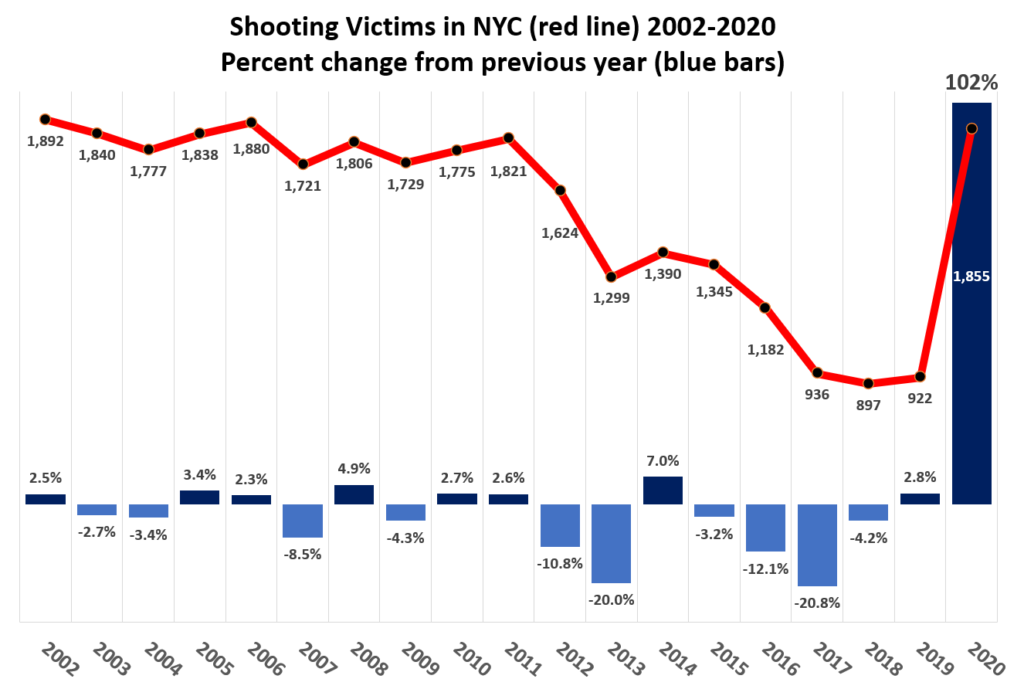
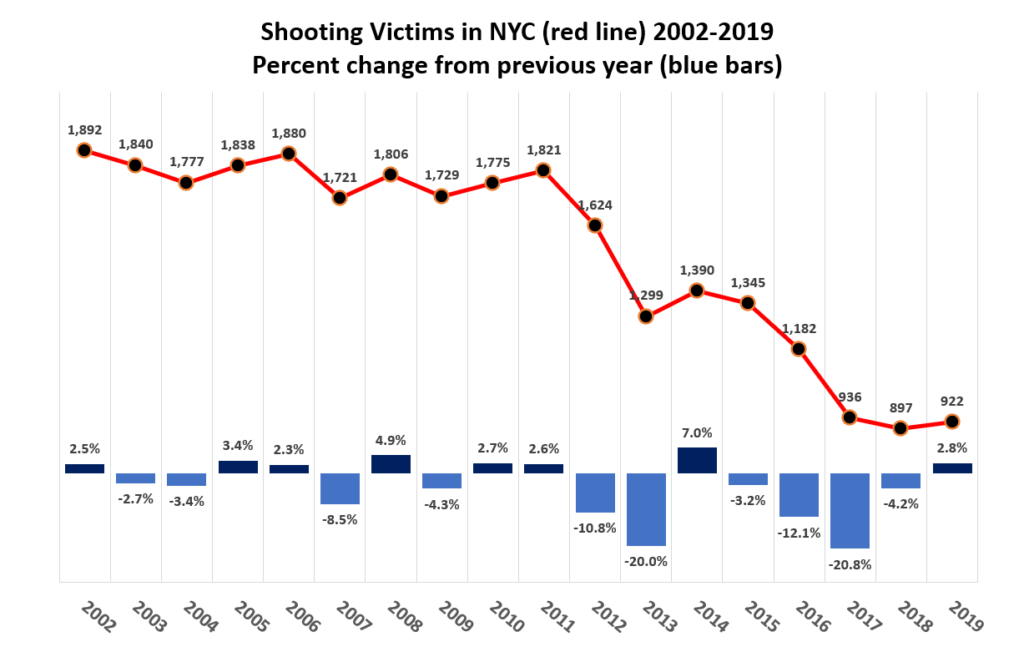
I’m just playing with charts and data presentation. If I graphed the number of people shot in NYC and the percent change on the previous year, it’s a challenge when a number that is between -20 and +7 suddenly goes to 100best I can come up with is something like this.
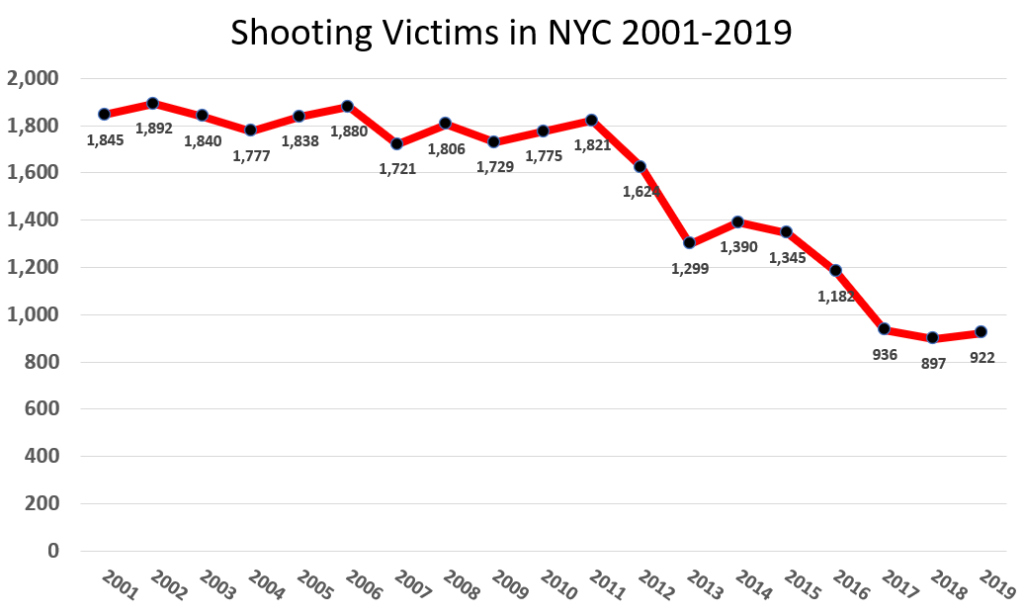
Without 2020 it’s much easier to do.
Though without knowing about 2020, I’d probably use a more traditional format and not even include percentage change. (Plus I could go back one more year, to as far back as I this data.)
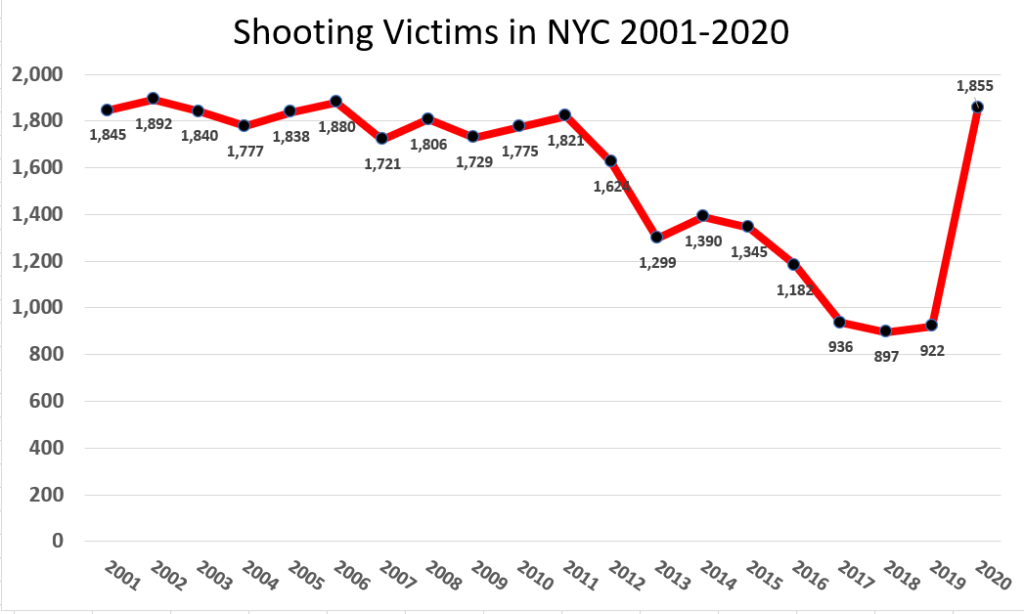
Add 2020 to the simple chart and you get this. But I think it’s important to show just how absolutely absurd the percentage increase in shootings was last year. The last time there was even a 10% increase in shootings was probably 1990. My NYC shooting data only goes back to 2001. Though I read somewhere reliable that 5,866 people were shot in 1993.
Jill Lepore has an article in the New Yorker about the invention of police that somehow manages to sidestep every thing I know about the history of police. I know a little about the history police history. Much more, I suspect, than Jill Lepore.
I discussed a key problem of Lepore’s perspective in my last post. She writes through a lens, a worldview, in which she believes that two-thirds of people aged 15-34 who go to the Emergency Room are there because they were beaten by police or security.
It’s crazy talk. And it makes me question everything else she writes on the subject.
Her article has so many errors. But rather than refute her point by point (though there’s some of that), I’m just going to present my own history of the invention of police. Now this is just one version of police history (albeit a pretty mainstream one). I’ve got no grand narrative here. It’s what I consider “objective.” That used to be goal. Now? I don’t know. If you want to put your spin on this to apply it to current events, feel free. But that’s on you. And yes, of course this is over-simplified. But here’s my brief history of the invention of police in America, from 2050BC to 1870AD, from a New York City perspective.
Hammurabi did it in stone
Long before there were police, society and governments and communities maintained order. That’s important to keep in mind.
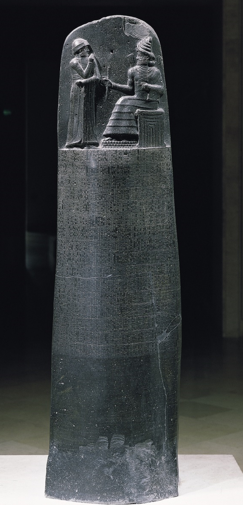
1800 BC, 3,800 years ago, Hammurabi invents the “rule of law.” Or at least he was smart enough to carve it in stone, so we give him credit whether he deserves it or not.
The Old Testament (Exodus 21:24) talks about an “eye for an eye, tooth for tooth.” Harsh? Maybe. But much softer than Hammurabi! Justice in the Judaeo-Christian world changes when Jesus says, “go and sin so more” (John 8:11). Retribution vs restorative justice? Deep.
Not too much innovation in the west from then until the Anglo-Saxon “kings peace” concept that all crimes are crimes against the king, and the state will keep a monopoly and prosecution and punishment, thank you very much.
James Watt’s steam engine comes along in 1780 and you got your Industrial Revolution. And with it, urbanization, disorder, gin, and the growth of crime and disorder in London. America was a few decades behind.
Very long story very short: Sir Robert Peel invents and implements the concept of modern police in 1829 London, the Bobbie. It’s to maintain order and prevent crime, he says. It’s so not an army we’ll put them in blue instead of red.
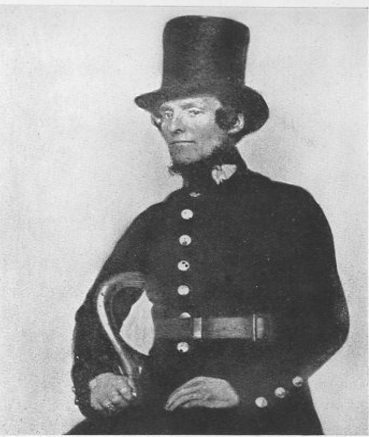
The word “police” isn’t new. What has changed is the concept of “policing.” There had been watchmen since forever, and America certainly had bounty hunters and slave catchers long before 1829. Britain had frankenpledge and tithing. Before that the Romans had the “urban cohort,” Vigeles, public servants who did some of the things associated with police today. But we define “police” as full-time public employees, most in uniform (originally blue, with hat, rattle, and baton) whose purpose is to prevent crime and disorder, and who also have the power and obligation to arrest criminal offenders. What Peel did was combine a lot of public functions into one, and center it around the idea that police should be public servants whose primary (almost exclusive) purpose was to “maintain order and prevent crime.” He was pretty clear about this (though note he never wrote his famous “principles“). I’ll also give Peel credit for inventing foot patrol. That’s kind of big deal in the policing context. Public patrol is very different from “guard this property.” I’d say it defines policing.
Peel’s policing idea was adopted in New York City in 1845. It quickly spreads from New York to other American cities. But I’m going to focus on New York.
Unlike police in London, American police (at first) don’t wear uniforms, but more important, police in New York are under local (ward aldermanic) political control. They also carry guns.
In the South, police remains a slave catching / bounty hunting proposition until Reconstruction. During Reconstruction, Southern cities had a pretty clear divide between antebellum slave catchers and the post war “modern” policing imposed by northern occupation. But Reconstruction ended up being too brief, police in the south reverted to their racist role as enforcers of slavery-based Jim Crow.
One of Peel’s Bobbies
I try to cover that in my first class in an hour. It’s not easy. In my second class I turn to Kelling and Moore’s Three Eras and Williams and Murphy’s Minority View. I add some August Vollmer (and shame on Lepore for making him sound like some cracker), Civil Rights, the LA Riots, and the NYC crime drop, and pretty soon you’ve got a decent foundation for me to get on with whatever the class is supposed to about.
It is often said that Britain created the police, and the United States copied it. One could argue that the reverse is true.
You could argue that, but you’d be wrong. And Lepore is not very convincing, at least to anybody with any knowledge of police history.
Lepore stresses Patrick Colquhoun. But not because of his contributions his dockside “River Police” (usually the “Bow Street Runners” get more credit, but both were, still, in essence, bounty-hunting operations), and less for his 1800 treatise on police that talked about the “new science” is which police should “prevent and detect crime” (this no doubt this influenced Robert Peel), but because [gasp] Colquhoun had spent years in Colonial Virginia and owned shares in a sugar plantation in Jamaica. Ergo, through Colqohoun, American police are rooted in slavery. Though Lepore admits that not much came of Colquhoun’s idea for another generation, until the London police started by Robert Peel, to whom she gives two sentences.
Why does that matter? Because one could either see the invention of police as good, as a noble concept, as a way in which society tried to defend the community and protect those most vulnerable. I actually believe that. But even if I didn’t, I don’t see why I wouldn’t want to believe it. Or you see American police as rooted in slavery and doing little more than serving White Supremacy. I certainly know the dark side of police history as well as anybody. It’s real. But that’s not and never has been the ideal. It’s not what American policing is rooted in. American policing doesn’t come from slavery. And it’s certainly not why American police expanded.
Lepore says:
It is also often said that modern American urban policing began in 1838, when the Massachusetts legislature authorized the hiring of police officers in Boston.
Actually, no. Nobody outside Boston ever say that.
For what it’s worth, in Baltimore you’ll sometimes hear Baltimoreans say they had the first police (established 1784). And a Glaswegian might tell you modern policing started with the Glasgow Police Act of 1800 (which has more merit). This is like rah-rah boosterism. Not real history.
I mean, even in Boston the Boston Police department doesn’t claim American urban policing began in 1838 Boston. The Boston police were established in 1854, a date Lepore somewhat sloppily references later in her article.
To be generous, if this isn’t your field, one basic source of confusion is that the word “police” is an old word. And sometimes people were paid to “police.” What changed is the meaning of the word. To be a a police officer didn’t mean what we think it means until Peel’s Bobbies hit the street of London in late 1829. Peel’s model is the one that worked, the one that lasted, and the model that was copied in America (and is given credit in every policing textbook).
From 1829 London, the idea of “preventative police” spread. (And the successful implementation of policing in London is great story, well worth reading about. It was not an easy lift.) In 1838 the New York Morning Heraldwrote: “The new police system of England is to be introduced into South Australia, and two London officers have been sent out.”
Our citizens are all agreed that a thorough, radical Reform is needed. Such are the general features of the Plan proposed. It seems eminently simple and well calculated to effect the great object for which any Police is needed – the prevention of crime.
Because we already had detectives and people running around to catch thieves for profit. Here’s a letter to the editor of the Daily Tribune:
I fully agree with you that a Police is wanted to take the place of the present Watchmen, Constables, &c. I saw, during some years’ residence in London, the effect of the new Police established by Sir Robert Peel; and I think one of that plan for this city would not be far from the best. The necessity of keeping them on duty at all hours is unquestionable.
And this is not too long after the War on 1812. Revolutionary War veterans were still alive. It wasn’t like “it’s British” was a great selling point. But there was no mistaking what the “new police plan” was modeled on. This isn’t controversial.
The first (abortive) New York police superintendent was mocked, according to the New York Herald, because he gave he copied a long speech, “word for word from a manual of instructions to the Liverpool police, published some half dozen year ago.”
There’s no reference to slavery. Nothing about Boston. But a whole lot about preservation of the peace and good order, which is straight from England. New Yorkers weren’t looking back to slavery, they were looking across the Pond to Peel.
From David R. Johnson’s (1981) American Law Enforcement: A History:
The reform of the London police attracted favorable attention in America shortly after the bobbies began patrolling their beats. … In an era when an attempt to collect accurate crime statistics had not even been made, it is extremely difficult to determine whether crime was actually increasing. We can say, however, that concern over property offenses had become widespread. Citizens arming themselves to defend their homes and persons was only one indication of this growing fear. Such measures had been unthinkable prior to the 1830s. Fear about this kind of crime, combined with dismay over the decay of social order, therefore made a powerful argument for police reform. … New York was the first American city to adopt a lasting version of a preventive police.
American policing — preventive police, a “new police” — started with the New-York Police Bill, written in 1844, but not passed until 1845. Objections came from Nativists (anti-immigrant) opposition to what they saw (correctly) saw as an immigrant dominated police force. This speech was given outside City Hall:
They … are now about to pass an odious and base police bill to bind us down. (Cries of shame, shame.) They will then appoint persons to office, and those men will not be native born citizens. (Cries of shame). We have had to encounter much opposition from these foreigners. In the ward were I reside the Greeks and the Hessians deposited their ballots, and when I asked them were they resided, the inspector said he would challenge every one at our side. It was not enough for them to have the privilege of voting: no, for when they found they were cut down at the polls, they then had their Greeks and their Dutchmen to kick up a row. and when we claimed to have the men arrested we were then struck down (cries of shame). I saw a state convict let loose from Blackwell’s Island by the Governor, to pollute our polls by his presence. I saw him parading in our streets at the head of bands of blood-thirsty ruffians, banded for the purpose of preventing the native citizens from giving their votes. Old Tammany Hall must die. (Cheers). It is already tumbling, and for ever let it be damned and lost, and the Native American party rise and extend its influence. [Mr. Whitney concluded by exhorting his party to rally round the glorious banner, and] conquer the Greeks and Germans, and all other foes of reform. (Great applause).
But the the New York Police Bill passed the next year and took effect in June, 1845. George Matsell was appointed commissioner on June 17, 1845 and would serve for 13 years (plus 2 years for a second term later on). The main points:
Article 1 §1 The watch department, as at present organized, is hereby abolished, together with the offices of marshals, street inspectors, health wardens, tire wardens, dock masters, lamp lights, bell ringers, day police officers, Sunday officers, inspector of pawn brokers and junk shots, and of the officers to attend the poll at the several election districts of the city and county of New York. … §2 In lieu of the watch department and the various officers mentioned in the foregoing section, there shall be established a day and night police of not to exceed seven hundred and fifty men, including captains, assistant captains and policemen. … §5 Each ward of the city of New York shall be a patrol district. … §12 It shall be the duty of the policemen to render every assistance and facility to ministers and officers of justice, and to report to the captain all suspicious persons, all bawdy houses, receiving shops, pawnbrokers’ shops, junkshops, second hand dealers, gaming-houses, and all places were idlers, tipplers, gamblers, and other disorderly and suspicious persons may congregate; to caution strangers and others against going into such places, and against pickpockets, watch-stuffers, droppers, mock-auctioneers, burners, and all other vicious persons; to direct strangers and others the nearest and safest way to their places of destination, and, when necessary, to cause them be be accompanied to their destination by one of the police. … Article IV Compensation of officers §2 No fees or compensation shall be charged or received by any officer for the arrest of any prisoner… [or] the issuing of any warrant, subpoena, or other process. Any magistrate or officer violating the provision of this section shall be guilty of a misdemeanor, and shall be subject to the pains and penalties for such an offence. §10 No member of the police department shall receive any present or reward for services rendered or to be rendered.
The new police were called the “new police” because they were, in fact, not just an evolution of the old. The old system was abolished and at least 12 municipal functions were absorbed into one “new police.”
But anti-immigrant sentiment was strong. The pro-new-police and not particularly Nativist Herald wrote in June 1845:
The Organization of the New Police is proceeding rapidly under the new Superintendent, Major Matsell. About five hundred men have passed the ordeal, and some two or three hundred incompetent candidates been rejected. … The nominations are made by the Aldermen of the Wards, and in some instances they have been so silly as to nominate men who could neither read nor write; some of these candidates being Irishmen, who have all, of course, been rejected, although nothing like “native” feeling exists in the selection. Adopted citizens, if competent, are just as eligible as any others.
But, unlike the Bobbies, these “new police” weren’t in uniform. This was a big issue for a while. The New York Herald emphasized the goal of “public safety” and made a plea for uniforms in early July:
We sincerely wish they had been more proscriptive in this particular, and made a uniform as essential feature in the police organization…. Let us have a uniform–we are no admirers of hogs in armor, but by all means let our police dress as policemen.
[Could this be the first ever reference to cops as pigs?]
There was a great fire in New York in July, 1845. Three hundred buildings burned and lives were lost. Troops were sent to prevent looting. The ever supportive Herald noted:
The police along Broad, Pearl, Stone, and William streets, was most energetic, at the same time civil and firm. The Value of the new body was spoken of by all in the highest terms, and have doubtless been the means of preventing the plundering of some thousands of dollars worth of property.
Two days later, still discussing the terrible fire, it was noteworthy enough to mention:
The Police wore large metal stars on their coats on which are the city arms, and the word, “Police.”
And the “new police” were often referred to as the “star police.” Both expressions seem to have died out by about 1850.
The New York new police lost the support of the Herald in late 1847, which noted that crime was up, and around 20% of the force had resigned or been fired. This was probably true, but paper’s objection may have been politics and the election of Mayor Brady (anti-Tammany). Or maybe there was a new editor at the Herald? But just a year earlier the paper was lauding the New Police for their “judicious use of authority” and usefulness in “the prevention of crime.” In May 1847 Mayor Andre Mickle (Tammany) went so far as to advocate for the complete abolition of the police system and a return to a system of night watchmen:
It has been in operation a sufficient time to enable us to form a just estimate of its worth, and I regret the necessity which compels me thus officially to state, that so far as my own observation extends, it has failed to meet the just expectations of the community.
It’s hard to follow all the local politics. But they matter. The Herald also highlighted the problem of corruption in policemen serving at the will of local ward aldermen:
Let a policeman make a descent on one of the lottery or policy shops in Broadway, and the changes are against his holding officer another year. The owner of the such shop possesses political influence, which he will exert against that policeman. And he will be backed by all his associates in the same business, in running and hunting down the faithful officer who has dared to fulfill his duty by enforcing the law
The paper seems to become pro-police again three months later, with the swearing in of Mayor Havermeyer. I could go on. But, to paraphrase Tip O’Neill, all policing is local. In a few very short years, other cities copied the New York “new police” model. And with the notably exception of the enforcement of the extremely unpopular (in the North) federal Fugitive Slave Law, the era of for-profit bounty hunting and policing for profit (at least legal profit) ended.
The New York model spread across America. Johnson:
Police reformers in other cities did not adopt every feature of New York’s plan. But there were enough similarities to say that New York served as a kind of model for the campaigns to establish preventive policing elsewhere. New Orleans and Cincinnati adopted plans for a new police in 1852. Boston and Philadelphia did so in 1854, Chicago in 1855, and Baltimore in 1857. by the 1860s, preventive policing had been accepted in principle, properly modified to meet American conditions, in every large city and in several smaller ones. This was an important achievement.
Let me just quickly get up to the start of today’s NYPD before ending. The NYPD actually does not descend from the “new police” of 1845! There were the Astor Place Riots of 1849. And in 1853 power to hire policemen was taken from local ward aldermen and given the mayor (Mayor Westervelt). This was progress, probably. Also in the early 1850s the size of the New York Municipal Police Department increased, cops were finally forced to put on a uniform, and police received military-like drill training (including baton training). And technology is always improving! The “magnetic telegraph” connected all the various stations. The telegraph actually precedes the police whistle, which won’t be invited until 1884. Want backup to deal with ruffians? Bang your night stick on the ground or fire off a few rounds into the air. “Service pistols” didn’t because standardized until Teddy Roosevelt required them as police commissioner sometime around 1895 (before that cops carried whatever gun they wanted to).
All this leads to New York State’s abolition of the Municipal Police in 1857. Corruption this; brutality that; nepotism this. But it was about power and politics and anti-immigrant sentiment. The state abolished the Municipals. The state established (and controlled) the new New York City Metropolitan Police. For a while there were two police departments as the Municipals sued in court against the legal power play. They wouldn’t turn over their property (and lose their jobs) to the upstart police. When the New York Appeals court ruled the legal shenanigans constitutional, the Metropolitans had the law on their side. It was all over but the shouting. Except…
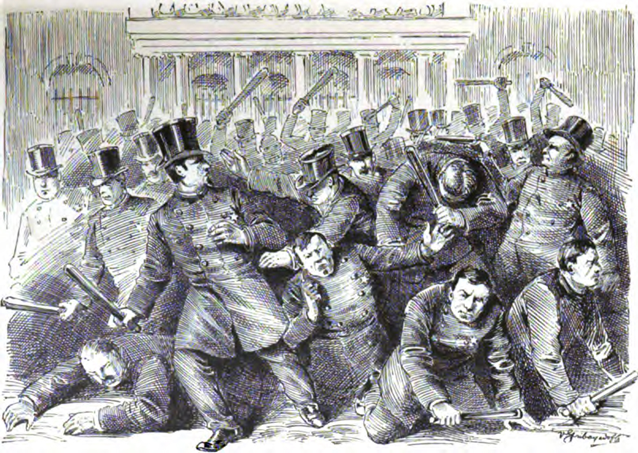
The Municipals didn’t go down with a fight, literally. On the steps of City Hall! I can’t believe there’s no book dedicated to this: a City Hall battle between two New York City police departments. Mayor Wood barricaded himself in his office. The siege ended only when Wood faced the possibility of an artillery bombardment! Just so happens an army regiment was passing by, so the Metropolitans borrowed a piece or artillery and turned toward City Hall. And so begins the NYPD, established 1857. Everything changed and nothing changed. The state returned control of the police department to the city in 1870.
Just last month, I swear I told my class, “People won’t talk about crime until a cute white girl gets murdered.” Tessa Majors, unfortunately, is that woman. Would her murder be getting as much press if she had been black? I doubt it. But who knows? Turns out not a lot college students of any race get robbed and killed. But that’s not what I’m going to write about.
Nor am I going to write about that the murder weapon seems to have been a 4-inch folding knife. Why do I point this out? Because this is the exact kind of knife that was made legal just last year, against the advice of law enforcement, and heralded by some as a “heroic” and “a massive victory for justice in New York.” Bravo.
Nor will I go into what Majors might have been doing in the park. Nor the shameful conduct of the SBA (union) President, Ed Mullins, in publicly releasing details of an in-progress investigation to make political hay.
Nor will I touch on the fact that the apparent robbers and murders are but kids, aged 13 and 14. “What can you do?” cops say, “Our hands our tied. They’re kids and weed isn’t enforceable anymore.” That’s bullshit, of course. They seem to have been causing trouble for quite a while. Cops could at least ask, “What are doing and where the hell is your guardian?” and take it from there. That’s where the attention and proactive help needs to be focused. The problem is coming from inside the house. I guarantee it. But if nobody else dares go there, why should I?
Cops, at least in theory, might have prevented this murder with proactive policing. But in doing so they might have become a media sensation. And not in a good way. If you were a police officer and you suspected these kids of previous crimes, would you risk
stopping them on reasonable suspicion? In a park? God forbid the kid is uncooperative and runs. Or puts up a fight. With indignant Columbia students pulling out their phones and calling you racist?
For police, at least in terms of public relations — and this is a current and real problem — it’s probably better to have a poor woman murdered that risk the public indignant public and political pushback from stopping a 13-year-old black kid on suspicion of criminal activity.
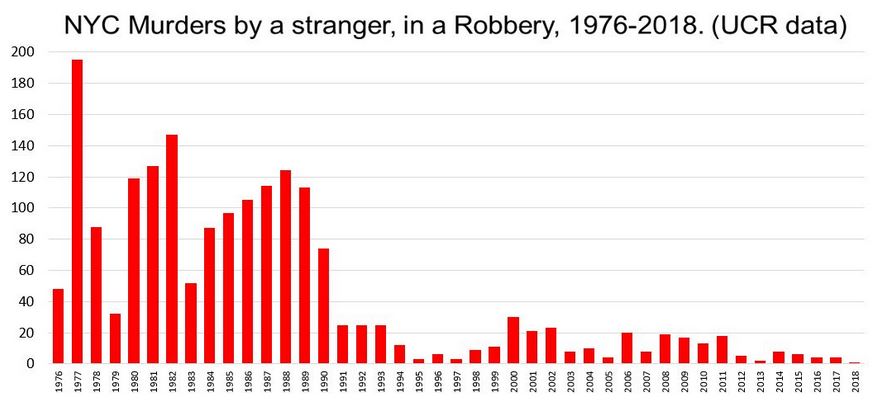
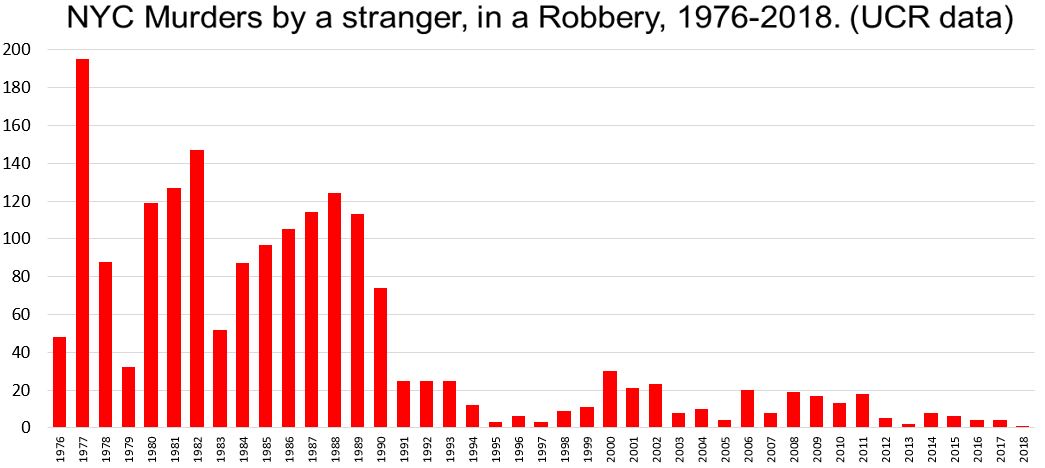
I’m not going to talk about any of that. Here’s where I do want to go: the numbers. I like data. And when I looked at them in New York City, I see these kinds of robbery/murders are rare. Really rare. Particularly for women. And then for white women? It basically doesn’t happen. But it did. and I guess that’s the definition of news.
I took the UCR murder numbers [FBI Uniform Crime Reports] for New York City. I excluded “unknowns” for all the variables I’m looking at. That is not a moderate cut, particularly with regards to “offender 1 circumstance” and “victim 1 relation to offender 1.” How much it matters? I don’t know. But it does matter. But perhaps not so much to my main point, which is that this type of crime really is rare.
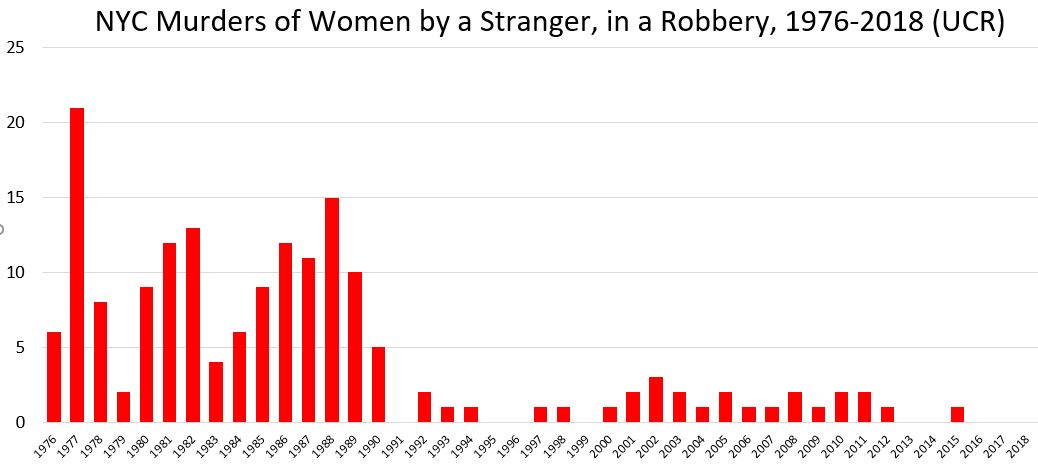
In the past 20 years — since 2000 — only 2(!) women under 20 have been murdered by strangers in a robbery. It’s the not young who are at risk, but the old. Most women victims are over 50. Five of the 20 women victims were over 80 years old, which seems particularly bad. The last time a white woman of any age was killed by a stranger in robbery was 2015. Before that was 2011 and 2009. All three of the victims were senior citizens. The robber/killers were all in the 30s. One was white, one was black, one was hispanic.
Since 2012, there have been but 30 people murdered by strangers in robberies in New York City. Total. Last year just one person in New York was murdered in a robbery by a stranger. One. A 66-year-old Asian man. In 2017? Four. All men. Same in 2016. There haven’t been more than 10 such murders a year in nearly a decade and not more than 20 such murders in a year since 2002. But in 1988, there there were 124 such victims! It really was a different city.
Since 1992 — arguably when New York City started becoming safe — there have been 28 murders of women (and 287 of men) by strangers in robberies. Yes. Total. Since 1992. In 8 different years since 1990, the number of women killed in robbery has been zero.
As to race, it seems that Asians are disproportionately targeted and victimized. But with that notable exception, victims or robbery/murders seem to reflect the demographics of New York City, at least generally. Offenders are disproportionately (but not exclusively) black men. For the women victims since 1992, 17 were white, 8 black, 2 Asian (1 unknown). Of their robber/killers, 17 were black, 10 white (1 unknown). Two women were murdered by women.
Note the scale of the y-axis is much more magnified on the second picture.
My point is that this type of crime — a woman being killed by stranger in a robbery — is rare in New York City. No, not just for white women. And not just for women. So when something like this does happen, it should be news. No, not cause for alarm and the ever-feared (at least in criminal justice circles) “over reaction.” But no, this shouldn’t be swept under the rug. Because we don’t want to go back to the days when the public lived in fear and people were literally being murdered by strangers in robberies gone wrong on a near daily basis.
Brian Mulkeen was a Fordham grad and worked at Merrill Lynch till he quit his job and joined the NYPD. Apparently Mulkeen was killed by “friendly fire” while wrestling with an armed suspect.
There’s a nice 1 minute video on twitter. I was mostly just sad and dry eyed till “Country Roads” kicked in. Because he’s not just a cop; he’s a person. RIP, Brian Mulkeen.
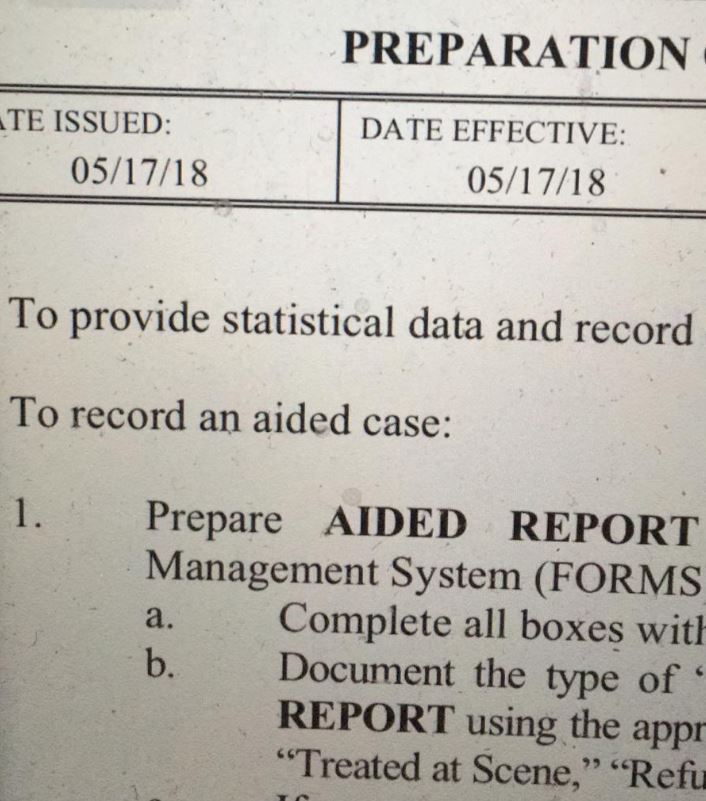
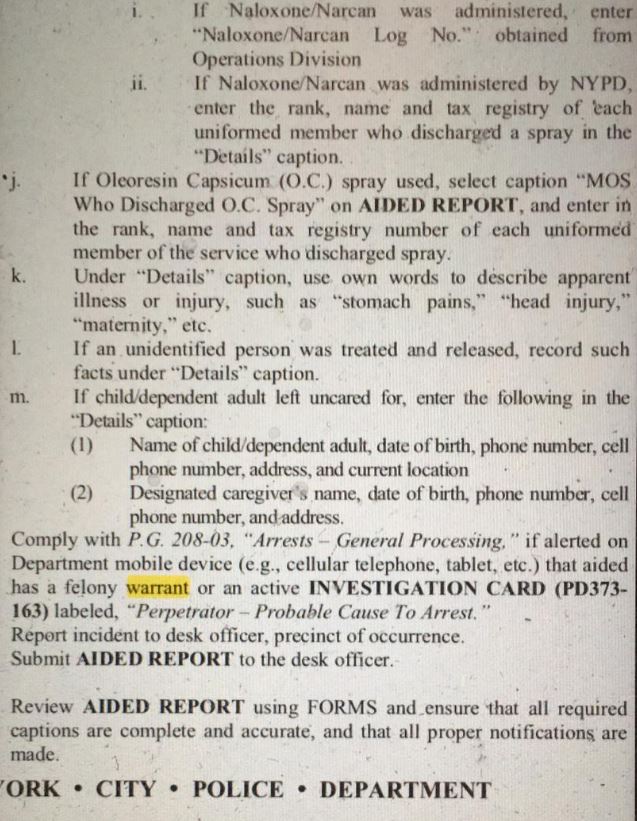
May 17 of last year the NYPD issued an obscure order concerning “aided reports” — that’s when a cop responds to a 911 call for a sick person waiting for an ambulance (a “bus,” as they say here) — requiring the officer to enter the person’s information into their phone. This looks all technical and boring.
When you put the “aided card” into the phone, it automatically goes
and queries the warrant system. This means that if Uncle Pedro has a
heart attack and he or you is wanted, cops will take you away
(after medical treatment, but still). Thanks, technology! That’ll teach
you to call 911!
Say your Uncle Pedro has chest pains. Or is ODing. Should you call 911? Of course! Right? But what if you don’t know if he’s wanted? What if you don’t know if you’re wanted? Should you still call 911? You know cops might also respond because, well, why not? Maybe cops can do some good
before the ambulance arrives. (Though generally, as a former cop, when it comes to medical care, are you serious?)
Or keep the peace. But should you be debating all this before deciding to call 911? While you’re discussing the pros and cons, Uncle Pedro just stopped breathing.
The NYPD has spent time and dollars trying to build relations with all communities. We want people to call for help. The goal has always been to bring people into the system, not make them afraid of it. The Neighborhood Coordination Officer (NCO) philosophy is just the latest serious effort. All this will be for naught if people are afraid to call 911 or 311 even for non-police matters.
We don’t need people thinking EMS are the bad guys. And we for sure don’t need people fighting unarmed EMTs because they’re worried that they the EMTs and paramedics are going to call the police and get them arrested. That’s not good public policy.
Cops do not have discretion when somebody comes back wanted. A
warrant is a warrant. And arguably for good reason. A judge hath spoken.
But there are wanted people out there, and an entire undocumented
population, for instance, whom we still want to call 911 when A) there’s
a fire, B) they witness a crime C) they victims of a crime, and D) when
they need medical care. Needless to say, this is not an inclusive list.
Perhaps for minor violations, when you know the person’s name and addresses, just give the guy something like a “must appear notice,” like the one he never got because it was mailed to his address from three years ago. Then bounce it to a detective for follow up. A surprisingly large percentage of people who have warrants simply do not know they are wanted. Give them 60 days or something. Why is the only part of the criminal justice system that moves quickly the one in which somebody wanted is taken in?
It’s in everybody’s best interests to have people turn themselves in at a more convenient time. This can be the difference between staying employed or being fired. Most warrants are not over urgent matters. And often staying employed can make all the difference in the world.
Could it become common in NYC hospitals (and not the hospitals serving rich white people) for police to run the names of visitors and patients while they are waiting around? For some, their injury or presence might constitute grounds for a probation or parole violation. This is exactly what Alice Goffman said was happening in Philadelphia. (It’s not clear it actually was happening, but people thought it was, and that’s bad enough.)
New York City has an estimated undocumented population (aka illegal immigrant) population of 560,000. Even in a sanctuary city, people — more than half a million New Yorkers — are afraid. Currently NYPD doesn’t share this information with ICE. But that could change overnight. Recently I had an immigrant student whose boyfriend was hit by a car. He was hurt. The driver stopped, but the boyfriend didn’t want to exchange information. A guy hit by a car through no fault of his own was afraid to get the driver’s information or go to the hospital. This is not good.
What problem is this solution supposed to fix? “We want the cops to put an aided card into the phone on the scene and it to automatically query the warrant system.” It is bad policy to routinely run warrant checks on people seeking medical care.
I know it’s not in the public’s interest to have wanted people running around. It’s one thing for police to run somebody because they have suspicion. It’s another to do so because they called for help. It’s not in the public’s interest to have people afraid to seek medical care or see EMTs and paramedics and the FDNY as part of law enforcement. Let’s base a policy decision based on evidence rather than, “hey, cops now have smart phones linked to the warrant system!”
One interesting (at least to me) thing I learned in talking to somebody about this, cops in New York did not routinely run (check for warrants) every time they 250d (stopped) somebody. In Baltimore, we ran basically everybody we stopped. This is a big difference in police behavior, and I’ve never heard anybody discuss or even be aware of this. But even in Baltimore we didn’t routinely run people on medical calls. In part we didn’t want to know. Because if the person is wanted and going to the hospital, guess who gets to babysit the patient until they’re released? Not a good use of patrol resources. And the next shift will really hate you, too.
Maybe we ran more people in Baltimore than they did in NYC because more people were wanted. But it probably had more to do with an unrelated technological issue. One radio channel in Baltimore covers one district (aka precinct) with 1 dispatcher for 15 (often fewer) patrol units. One radio channel in New York covers multiple precincts and has perhaps 10(?) times as many officers. It takes precious air time to run a 10-29 (Balto code for, check warrants). And air time in New York is more precious. Many stops, even car stops, weren’t called in. That’s not safe or good policy. Something as simple as how many units are on one radio channel, can change police culture more than any formal debate or informed policy. Maybe it shouldn’t be that way.
And if it is good policy to check people in medical crisis for warrants, and I don’t think it is, they hey, why not go all-out and front-end it to the 911 and 311 operators. Let them be part of the system, too. At least it would be honest. “Thank for calling 911. This call is being recorded and you are being checked for any felony warrants. Now, what is your emergency?”
When ever corruption scandals breaks, I always notice two things:
1) The “blue was of silence” is more fiction than fact. Sure, cops in collusion won’t talk, at first. But that’s hardly a blue wall. I mean, given people’s natural inclination not to snitch on their friends and family, cops snitch on other cops quite regularly. Probably more so than other occupations. Why? A) cops don’t like bad cops, B) when push comes to shove, people CYA and say “I’m not going to risk my pension for that dirty cop I never liked anyway.”
2) The dollar amount some cops are willing to screw up their lives, their reputations, and their valuable pension. It’s chump change. Lazy cops retire. Bad cops retire. But dirty cops rarely retire because being able to rat out a dirty cop is a great get-out-of-jail-free card. And that card is something other crooks find very useful. I mean, just put in 20 to 25 years and they pay you for the rest of life! And you screw it all for $100 here and $200 there?
But here we go, as reported in the Times: “One detective was allowed to pay $20 for an encounter with a prostitute that would normally cost $40.” A cop gave his all for $20 off a blow job.
This was a “multi-year NYPD investigation” started by a top from a cop. But a multi-year NYPD investigation means there are a lot of well crossed T’s and beautifully dotted I’s.
Last I heard, 7 cops and about 20 civilians were arrested.
It’s also interesting when internal PD investigation brings down dirty cops. Cops are like, “Great, system finally worked! Stupid dirty cops got what they had coming.” Cop-sceptics are like, “Blue Wall of Silence is proof police are irrevocable corrupt!”
Also, for police and sex-workers alike, prostitution should be regulated and legal.
I keep track of these things. (I live nearby.) 9 raids. 22 arrests. 4 handguns.
Last time this happened was 2013. And that was preceded by similar raids in 2009 and 2005. Sometimes police get disparaged for conducting wack-a-mole policing. (In fact, sometimes *I’ve* disparaged police for this reason.) But one of the reasons crime is so low in NYC is because police do wack those criminal moles (and have the resources to do so) when criminals pop their heads up. Illegal public drug-dealing, so linked to violence, is exactly what police need to focus on. And the residents of America’s largest public housing complex can be a little less afraid.
There will be another similar raid in Queensbridge in 2023. Mark my words. But maybe that is exactly what is needed. Or maybe a little more continued presence now, rather than a few years, really could prevent the next crew from popping up.
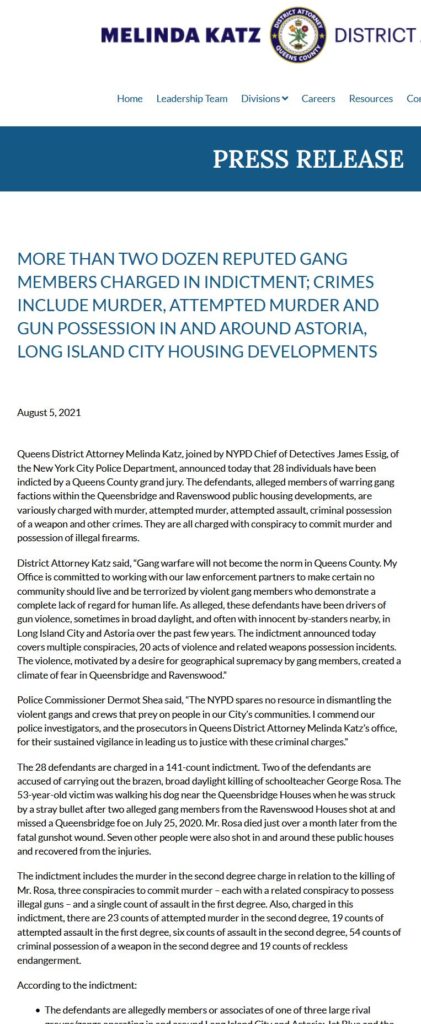
2021 Update: I was off by two years. https://queensda.org/more-than-two-dozen-reputed-gang-members-charged-in-indictment-crimes-include-murder-attempted-murder-and-gun-possession-in-and-around-astoria-long-island-city-housing-developments/
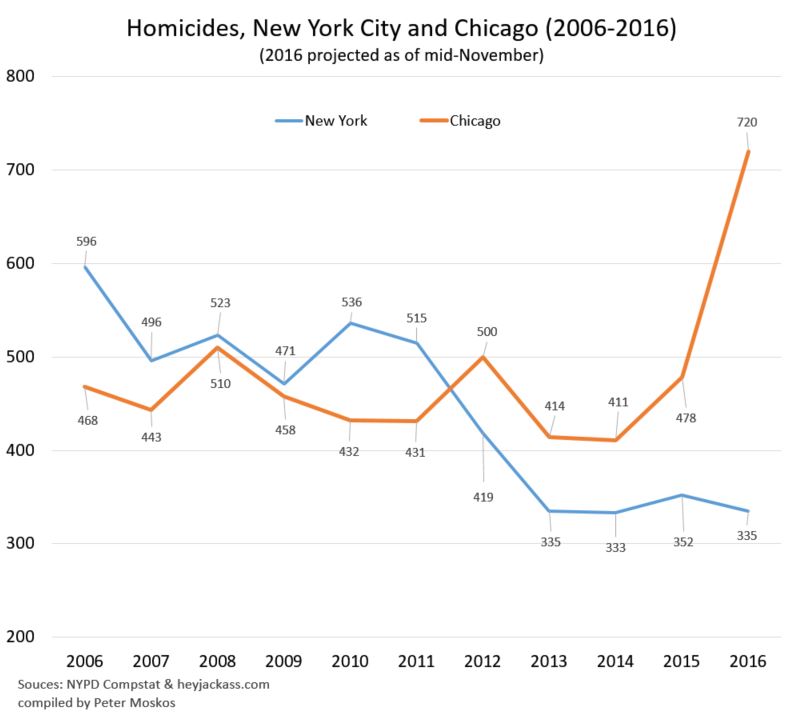
Ah, the ol’ Tale of Two Cities trope. But the diverging homicidal paths of Chicago and New York City are striking. The New York Post has a surprisingly good (especially for the NY Post) article on homicide in Chicago and NYC.
These are raw numbers and not a rate. Chicago is roughly one-third the size of New York City. [Notwithstanding rumors to the contrary, the national increase in murder would still be large, even without Chicago.]
First observe NYC’s unheralded murder drop from 2011 to 2013. Police weren’t even willing to take credit! Why? Because it corresponded with the demise of stop and frisk. And then liberal Mayor de Blasio came on the scene in 2013. If you listened to cops, the city was going to immediately descend to some pre-Giuliani Orwellian hell. That did not happen.
It turns out that quota-inspired stops and misdemeanor marijuana arrests are not good policing. Now we knew that (though even I’ll admit I was surprised that literally hundreds of thousands of stops didn’t have some measurable deterrent effect on gun violence.)
In Chicago, stops also stopped, but unlike New York, it was not because cops stopped stopping people they didn’t want to stop. Cops in Chicago got the message to stop being proactive lest controversy ensues. Bowing to political and legal pressure, police in Chicago (and also Baltimore) became less proactive in response to the bad shooting of Laquan McDonald, excessive stop-related paperwork, the threat of personal lawsuits based on these same forms, and a mayor in crisis mode.
Less proactive policing and less racially disparate policing is a stated goal of the ACLUand DOJ. See, if police legally stop and then frisk six guys loitering on a drug corner and (lucky day!) find a gun on one and drugs on another, the remaining four guys, at least according to some, are “innocent.” I beg to differ. (Though I should point out that in the real world, the “hit rate” never comes close to 20 percent.)
And then there’s my beloved foot patrol. Policing is the interaction of police with the public. But there are no stats I know of to determine how many cops, at any given moment, are out and about and not sitting inside a car waiting for a call. From the Post:
A high-ranking NYPD official credited the city’s increasing safety to the widespread, targeted deployment of cops on foot patrol.
“Most cities only place foot posts in business districts. We put our foot posts in the most violent areas of the city, as well as our business district,” the source said.
“It’s not a fun assignment, but it’s critical to keeping people safe.”
Meanwhile in Chicago:
Former Chicago Police Superintendent Garry McCarthy — who was fired last year amid controversy over the police shooting of an unarmed teen — said criticism of policing methods by local officials there had left cops “hamstrung.”
“They’re not getting out of their cars and stopping people. That’s because of all the politics here,” said McCarthy, a former NYPD cop.
“In Chicago, performance is less important than politics. It’s called ‘The Chicago Way,’ and the results are horrific.”
My buddy Gene O’Donnell says:
“The harsh reality in Chicago is that you have the collapse of the criminal justice system,” O’Donnell said.
“The police aren’t even on the playing field anymore, and the police department is in a state of collapse.”
O’Donnell, who was an NYPD cop during the 1980s, said that although “New York had a similar dynamic” during the height of the crack epidemic, “we had a transformation, because people realized you don’t have to tolerate that.”
Guns are part of the mix:
Veteran Democratic political consultant Hank Sheinkopf noted that Chicago “is much more porous to guns” than New York, with a “direct pipeline” leading there in “a straight line from Mississippi.”
But that is more of an excuse than an explanation. Newark, New Jersey, just a PATH-train subway ride away from Manhattan, has more of a gun problem than New York City. Hard to imagine a subway and a few bridges plugs the gun pipeline.
There are other differences between Chicago and New York in terms of poverty and segregation (greater in Chicago), commitment to public housing that actually works (greater in New York), and maybe even lower-crime foreign immigrants (greater in New York… but I say “maybe” because it’s still substantial in Chicago, with 22% foreign born).
And then there’s this:
Psychology professor Arthur Lurigio of Chicago’s Loyola University cited an “intergenerational” component to the mayhem, with sons following their fathers — and even grandfathers — into the city’s extensive and ingrained gang culture.
“Chicago’s problem wasn’t a day in the making — it’s 60 years in the making,” he said.
“Working at the jail as a staff psychologist, I’ve seen two, maybe three generations pass through.”
I don’t mean to criticize an academic willing to highlight culture and the inter-generational transmission of violence, but I quibble with the line that Chicago’s problems are 60 years in the making. I mean, yes, it’s true…. But the explosion of homicide in the past two years is, well, a problem exactly two years in the making.
Chicago may always have a higher homicide rate than New York because of history and structural issues. But the short-term solution is getting more cops out of their cars, back on beats, and supported when they legally confront violent people we pay police to confront.
Violence-prevention depends, in part, on such confrontation. And since violence is racially disparate, this will mean racially disparate policing. Innocent people — disproportionately innocent black people — will get stopped. There’s no way to square this circle (though we can help sand down the rougher corners).
The alternative to proactive policing is what is happening in Chicago. Police have responded to public and political (and legal) pressure: stops are down, arrests are down, and so are police-involved shootings and complaints against police. Police are staying out of trouble and letting society sort out the violence problem. How’s that working out?
The funeral for Sergeant Tuozzolo just happened. My friend Ari Maas posted this on facebook after his death:
For the second time this week, the law enforcement community suffered a great loss. NYPD Sgt. Paul Tuozzolo was shot in the head while attempting to arrest a very bad man. That bad man had 17 prior arrests and had just committed a home invasion in the Bronx at the home of his estranged wife.
That bad man had a gun, a gun he used to take Paul’s life and attempted to take many others. Luckily a rookie officer, who was still in police academy field training, was able to put an end to that bad man’s rampage. But not before that bad man destroyed Paul’s family, leaving his wife a widow and his two children fatherless.
I didn’t know Paul. We were both veterans of the 26th Precinct, but Paul was promoted just a few months before I was transferred from East Harlem to West Harlem. However, I see on my Facebook feed from my 26 family who worked with and were friends with Paul, that he was a great man, father, husband, and police officer. He had 19 years of service. 19 years of putting on that uniform every day to make New York City a better place. 19 years of working midnights, holidays, weekends and being away from his family. 19 years of selfless service.
And even if I didn’t know Paul, I knew Paul. Paul was just like every one of us who puts on the uniform every day not knowing what to expect, but knowing we do what we do because we make a difference. Because we are sworn to protect those that can’t protect themselves. Because we have given so much and far too many of us, have given our all, in order to make the world even a little better place.
Every time a cop gets killed, I change my profile picture to a badge with a mourning band on it, and I write a post. I do this not so much for myself or the other cops on my friends list, but rather, so that my friends from my other diverse groups can understand that we are human, we feel pain, and all we want is to do our job, make a difference, and go home to our families. And all of us are willing to pay the ultimate sacrifice to make this world better.
But, I have come to realize that the Michael Marks, a Marine Corps veteran quote, “And maybe just remind the few, if ill of us they speak,that we are all that stands between The Monsters And The Weak” isn’t something we have to do. Because for anyone that has ever worn a uniform to work, not knowing what that day of work will bring (our Armed Forces, police, fire and EMS and others), it doesn’t really matter if people understand the evil we protect them from. What matters is that we can look at ourselves in the mirror every day, honor our lost brothers and sisters, and continue on, in their memory, in making this world a better place.
Sgt. Paul Tuozzolo, Blessed is the True Judge. May your family, friends, the NYPD and the entire City of New York find comfort during these trying times. We will carry on your watch from here.
Rosales’ 50-year-old mother-in-law had called 911 when the man, who had 17 prior arrests in Suffolk County, forced his way into the apartment she shared with his estranged 29-year old wife and their 3-year-old son, minutes before the police chase ensued, O’Neill and sources said.
Sgt Kwo and a rookie, three days out of the academy, returned fire. Kwo was shot and wounded. The cop killer was killed.