Tag: NYPD

  • NYPD Aims Better in 2012

    It’s being reportedthat fatal NYPD police-involved shootings were way up in 2012. They are, but it’s a non-story. Indeed, fatal police-involved shootings increased from 9 to 16, but better aim and luck were probably the reasons why. Police-involved shootings were only up by 2, to 30. (And this even though the average distance from which officers shot was further away in 2012.)

    The real story (though you should always be leery basing a story on what might be a statistical one-year fluke) is that the number of NYPD officers shot went up from 4 in 2011 to 13 in 2012. Luckily none of those 13 was killed. 13 officers shot is the most since 1998. In 1997 27 officer were shot, 4 fatally.

    30 police-involved shootings is an incredible low number for a city as big as New York. It is also part of a long-tern downward trend (that correlates, not surprisingly, with the crime rate). In 1990 there 111 police-involved shootings. Going back even further, in 1972 there were 211 people shot by cops!

    To put this in comparison, Baltimore, with a fraction of New York’s population and about 3,000 officers, had 22 police-involved shootings in 2009 (the last year I have numbers for).

    Here’s the NYPD report.

    Update: Houston police, with 5,300 officers has shot an average of 24 people a year (10 of them fatally) for the past five years. Many were unarmed.

  • “You can’t stop me! You can’t do that no more! There are new rules!” says gun-toting idiot

    The Post reports (and some cops confirm) that word on the street is that cops can’t stop anybody anymore. Of course that’s not true. But it still make for some chilling anecdotes.

    “You can’t be stopping me, yo! The cops can’t be harassing us!”

    He was still frisked.

    And yet there is still no apparent increase in violence.

    [thanks to J.S.]

  • Five charts Ray Kelly Doesn’t want you to see!

    Five charts Ray Kelly Doesn’t want you to see!

    (Can you guess I was just on buzzfeed? A better headline would be “Murders way down in NYC. And so are stop and frisks. And nobody seems to care.” But what kind of clickbaite would that be?)

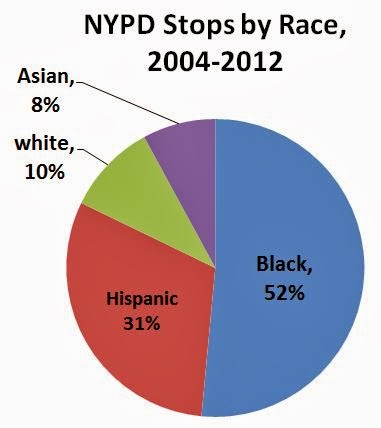
    1) Breakdown of NYC stops by race.

    Indeed, as often reported, 83% of stops have happened to black and hispanic people.

    2) Breakdown of NYC homicide victims by race.

    But ninety-one percent of homicide victims were black or hispanic. Wow. Actually, this is the chart Ray Kelly wants you to see. Critics of stop and frisk generally don’t like talking about this issue (as if the racial disparity in violent crime will just go away if we ignore it). But it is relevant. It may not excuse the racial bias of stop and frisk, but it goes a long to explaining it. Cops are where the violent crime is. Cops stop people where cops are assigned. Ergo cops stop black and hispanics disproportionately. “Racism without racists,” it’s sometimes called. It’s not that individual cops are racists in their day-to-day work, but the end result of a stop-and-frisk policy can still racist.

    3) Hit rate for stops of black people.

    (this and then next figure are taken from Mother Jonesand the data from the Center for Constitutional Rights)

    One in 143 stops of blacks yields guns, drugs, or other contraband. Compare this to the rate for whites who are stopped.

    4) Hit rate for tops of white people.

    One in 27 stops of white people yields guns, drugs, or other contraband. Same yield with 19 percent of the stops.

    Wow.

    One way to interpret these data is that white people must be 5.4 times as likely as blacks to be packing heat or drugs! Of course that’s unlikely. So why is contraband 5.4 times as likely to be found on white people? Because white people are more likely to be stopped based on actual suspicion (there is much less pressure to produce stats in low-crime neighborhoods). Black people are being stopped because Compstat and “productivity” pressure in high-crime neighborhoods mean some officers stop people simply because the feel they need to stop people to fill out the UF-250s (the stop, questions, and frisk form).

    So how about this for a goal: get the “hit rate” for blacks up to the same level for whites. Not only would this be fair, it would be good policing. It would also go a long way to mitigating the problem of excessive stop and frisks. And it’s not hard to do. Make smart stops, not more stops.

    5) Stops and homicides are both down!

    For years Bloomberg and Kelly were basically saying that every one of the five, six, and seven-hundred-thousand stops was necessary to keep the city from exploding in crime. An inevitable part of the crime drop in New York City.

    And yet stops have plummeting in the past two years (2013 figures are estimated year-end totals based on latest available data). In part this is from pressure from the top and in more recent part instructions from the PBA.

    And homicide? Must be way up, right? Because Bloomberg and Kelly have insisted we need all these stops to keep homicide down. And yet we’re on track from just over 300 homicides for the year in NYC. (Again, estimated year end total).

    What did I just say New York City is on track to have just 318 homicides this year?! That’s amazing. Why is this not front-page news? This 22 percent reduction is not from a crack-fueled high of the late 1980s but from the record low year of 2012! The 2013 homicide numbers are an amazing accomplished. (I mean Baltimore City used to top 300 homicides with just 650,000 residents.)

    Homicides in New York City are down 22 percent this year and nobody seems to want to take credit! Attackers of stop and frisk never like to highlight any evidence that might be used to imply stop and frisks are effective. But defenders of stop and frisk can’t reconcile a huge crime drop that correlates with an even larger decline in stop and frisks. In two years stops have been cut in half and homicides are down by one-third. (Of course there might be a delayed link between the end of stop and frisk and a rise in crime, but I think the past year or two should be enough time to see such a lag effect).

    So for crying out loud, give the NYPD some credit! Just last year academics, once again, were saying crime had bottomed out; crime won’t go down; crime can’t go down any more. And yet, once again, it did. This was not inevitable. This is not irreversible. But as Bill Bratton likes to say, “Cops count and police matter.”

    So give the NYPD credit for a record low number of murders, but remind them that this amazing reduction in homicide has happened without unnecessarily stopping and bothering another 350,000 innocent black and hispanic New Yorkers this year. That matters.

    We now know that all these stops were not needed. Throw out that bathwater! But be careful, because there is baby somewhere in that murky water. Surely some of these stop are needed. You know, the stops based on officers’ reasonable and honest suspicion.

    The crime reduction can continue at the same time unnecessary stop and frisks and ended. One goal should be to raise the hit rate for blacks stopped to the same level as found for whites who are stopped. This alone could reduce the total number of stops (and misdemeanor marijuana possession arrests) more than 80% from the 2011 high. The good news is we’re already half way there.

  • Shira Scheindlin Stop & Frisk Smackdown

    I’m in beautiful Sydney. Spring is in the air and the birds make funny sounds just to remind me that I’m on the other side of the planet. Despite my focus on the Festival of Dangerous Ideas, I couldn’t help but notice that everything Judge Scheindlin decided regarding stop and frisk has been put on hold! The New York Times reports:

    A federal appeals court on Thursday halted a sweeping set of changes to
    the New York Police Department’s policy of stopping and frisking people
    on the street, and, in strikingly personal terms, criticized the trial
    judge’s conduct in the litigation and removed her from the case.

    “In taking these actions, we intimate no view on the substance or merits
    of the pending appeals,” the two-page order stated.

    In its ruling, the panel … criticiz[ed] the judge for improperly applying a
    “related-case rule” to bring the stop-and-frisk case under her purview.  

    This is a fair smackdown of the judge. For a judge with a strong opinion on a case to make sure she gets a case so that her decision becomes law of the land makes a mockery of the concept of an independent judiciary. I mean, we all knew how she was going to rule.

    In an age of political cynicism, I’m actually thrilled to see that such shenanigans are not the way the system is supposed to work. And the system self corrected. (though it seems like this should have been decided before she heard the whole case.)

    I might be the only person in the world who agrees with this reprimand and (most of) her original decision. (And I still hope the cameras on cops pilot program proceeds.)

  • The Intellegence of the NYPD’s Demographics Unit

    The Intellegence of the NYPD’s Demographics Unit

    I am a day late and a dollar short on this, because these AP reportson the NYPD Intelligence Division “Demographics Unit” came out in 2011 and 2012 (mostly when I was out of the country). The reports are from 2006, but only now am I fully appreciating them. Here’s New York Magazine’s more recent take on the whole operation. Of course the NYPD has a long tradition of mapping “seditious ethnic groups,” so it’s not exactly earth-shattering news. (Less traditional is spying on student organization at my school.)

    The NYPD went out and collected (very basic) information on groups of Muslim immigrants. Here are the reports on those from Egypt, Syria, and Albania. Some, myself included, might say that the NYPD should know where different groups hang out. Indeed, at a very basic level this should be considered very basic police knowledge. Too bad they get it wrong.

    Any actual beat officer would know this information. Just as people who live in the neighborhood do. But apparently the NYPD lacks day-to-day knowledge of the communities they serve and protect, so they have to rely on undercover officers to “rake” the community. This is wrong. As is much of the information the NYPD gathered.

    I could have told the NYPD information about the locations in my neighborhood (including a place near me they missed because it’s a few blocks away from where “they” usually hang out).

    The report expressly says it excluded Egyptian Christians from surveillance. So it’s explicitly a religious witch hunt, but the dumb “intel” officers include a lot of Christian places by mistake. Apparently the “rakers” who are supposed to keep us safe from Muslim extremists can’t tell the difference between Christians and Muslims. They all look Arab, I suppose.

    And the facts about the country in question are so mindlessly copied from the web that we get to read about the “richness of the annual Nile river flood.” I’m surprised there wasn’t clip art of the pyramids.

    Naturally the first place I looked up was the place I know best: Kabab Cafe. The owner, Ali, is a friend of mine.
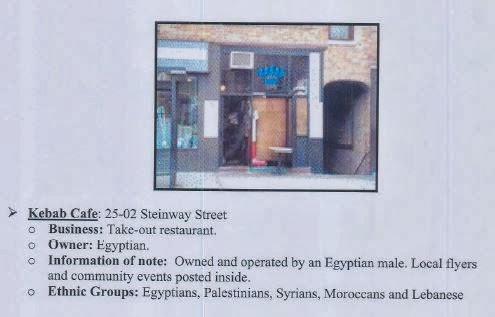
    I can tell you a lot about Kabab Cafe, but I’m not a trained and active “intel” officer. So what did the NYPD’s Demographics Unit come up with? For starters, they misspelled the name of the restaurant. It’s Kabab with two A’s. And they got the address wrong. It’s located at 25-12 Steinway. Good work, guys. Maybe next time check out a Zagat Guide.

    The “ethnic groups” that might be found at said location of interest? “Egyptian, Palestinians, Syrians, Moroccans, and Lebanese.” That’s also wrong. Ali does draw a diverse crowd, but his place is not an Arab hangout. Truth be told, at $30 to $50 per person, this place is kind of pricey for Queens. If I had to categorize, I’d say those who dine at Kabab Cafe are predominantly “hipsters” and “Jews.”

    And the “local flyers and community events posted inside”? No. Not there. Unless you think that’s what the anti-Mubarak poster is.

    The NYPD lists my friend as an “Egyptian male.” That’s arguably correct, even though he’s non-religious and has been an American citizen longer than I’ve been alive.

    It’s amazing that so much incorrect information can be packed into just 35 words of “intel”!

    But that’s not all. The business is listed as a “take-out restaurant,” which happens to be wrong. If you ask politely Ali will do take-out, but it’s not really his gig.

    You’d learn a lot more reading about his restaurant in the New York Times or New York Magazine. Or perhaps you saw Ali on TV, as he was featured in Anthony Bourdain and Andrew Zimmern’s TV show. He also starred in an episode of Jammie Oliver’s American Road Trip (an episode that also features my wife, just braggin’).

    Across Steinway Street is another place, listed as “Egyptian Cafe.” My wife tells me that’s not the name of the place, which is clearly written in Arabic. But my wife reads Arabic, which apparently the “rakers” didn’t (though maybe they did, in which case they’re just really really stupid). Also, this Queens location is listed as being in Brooklyn.

    Why is Kabab Cafe a “location of interest”? Naturally, “detectives gravitated toward the best food.” I would. New York reported:

    It nagged [Lieutenant] Berdecia to see his talented detectives sitting around eating kebabs and buying pastries, hoping to stumble onto something. If it was worth writing up a report, it was worth conducting an investigation. “It irritated me to send a lot of second-grade detectives and first-grade detectives to sit in coffee shops with nothing going on. If we hear something, then let’s do more proactive police work. Let’s run plates. Let’s follow guys.” But as the years passed under Berdecia’s supervision, the Demographics Unit never built a single case. “It was a bunch of bullshit,” Berdecia said.

    Now of course my friend isn’t a terrorist, and he’s got nothing to hide. So no harm done, right? Except the information gathered by the NYPD is completely and comically wrong. And that is potentially harmful.

    So I don’t know what bothers me more, that the NYPD spies on people solely on their perceived religion and nothing else, or that the NYPD has done so with such complete and total incompetence. I mean, how can I focus on the morality and constitutionality of the Demographics Unit if they can’t even spell the names right and write down the correct address?!

    But short of some fact checking (have they heard of google?), this police work should not be done undercover. No police work should be done undercover unless it has to be. Not only does does a uniform or badge make the difference between honest police work and a secret state security apparatus, but undercover officers are less effective. If you want basic information, you need a beat cop (or a resident) who has an eye, an ear, and half a brain.

    But how, you might say, would police discover terrorist plots while walking the beat in uniform? Good question. First, good people might actually talk to police, if only they saw police to talk to. This is how the NYPD foiled the 1997 subway bombing that wasn’t. People snitch. This is how most big arrests are made. And it’s a bit harder to feel the love if you’re being spied on, which is what you call secret police work based on no actual suspicion of criminal wrong doing.

    Second, the secret Demographic Unit didn’t uncover any plots. The latter point is important — perhaps not a moral and constitutional level — but certainly an operational and police level.

    The only actual “intel” from this report seems to be which of these places believed to be run by or cater to Muslims watch Arabic-language Al-Jezeera news on TV. Well, I hate to break it to you Fox News believers, but Al-Jezeerais an actual news channel. And truth be told, it’s a pretty good one.

    Just because Al-Jezeera has an Arabic name does not mean it is a terrorist organization. That might be the real take-home lesson.
  • This is a big deal

    This is far more radical than anything Judge Scheindlin ruled in her well publicized stop and frisk decision.

    In a 3-2 decision (People v. Johnson is not long and worth reading in its entirety) the court managed to rule the following unconstitutional:

    In a New York City Housing Authority building, which the testifying officer characterized as a “drug-prone” location, the officer observed defendant descending the stairs to the lobby. Upon seeing the police, defendant “froze,” “jerked back,” and appeared “as if he was going to go back up the stairs,” although he never retreated up the stairs. The officer asked defendant to come downstairs, and defendant complied. The officer inquired whether defendant lived in the building, and defendant replied in the affirmative, whereupon the officer asked defendant to produce identification. Defendant immediately clarified that he was visiting his girlfriend, who lived in the building, and informed the officer that his identification was located in his pocket. As defendant moved his hands to retrieve it, the officer’s partner grabbed defendant’s left arm and pulled his hand behind his back, revealing a handgun inside defendant’s coat pocket. The officer seized the gun and placed defendant under arrest.

    Seems like good policing to me. This is from the dissent:

    Defendant initially told the officers that he lived there. However, when asked for identification, he began to stutter, and changed his story to say that he was visiting his girlfriend. Although defendant stated that he had his identification in his pocket, he began moving his hands “all over the place, especially around his chest area,” which the officers interpreted to be threatening and indicative of possession of a weapon. To “take control of the situation” before it could “get out of hand,” an officer grabbed defendant’s left arm and brought it behind defendant’s back, which caused defendant’s open jacket to open up further and reveal a silver pistol in the netted interior coat pocket. One officer removed the pistol from the pocket, and another handcuffed defendant.

    You can also read the New York Times article.

    What are police officers now allowed to do? Where exactly in this arrest did police overstep their bounds? I don’t get it. The court said it had a problem not with subsequent stop and frisk, but with the initial questioning!? I cannot fathom (maybe somebody can explain to me) why this isn’t covered under what is known as the “common-law right of inquiry.” See, for instance, People v. Moore, which limited but defined that right.

    I don’t see how to downplay this decision and say it’s no big deal (which is my usual reaction). If you were trying to get police to stop policing, telling officers they don’t have the right to question suspicious (and, in the end, armed) suspects seems like the ideal way to do so.

  • “Police work is a thinking person’s game”

    It’s worth highlighting this excellent comment to a previous post, from a anonymous police officer. You can file this under “if you don’t work, you can’t get in trouble.”

    What I’ve learned over my career, and what has frustrated me as a life-long progressively inclined citizen, is that despite all common sense and evidence to the contrary, well-meaning liberal types are stubbornly attached to this outdated narrative of white officers maliciously and illegally harassing innocent black men “doing nothing.” As you just articulated, police work is a thinking person’s game. Unfortunately the critics are often so blinded by ideology that to educate themselves on very basic police procedures which may illustrate, like you stated, that for professionals it’s not all about race.

    The real harm from this refusal to engage maturely with the subject matter is the effect this political pressure has on departments, and by extension the most vulnerable communities. I see officers putting blinders on and avoiding perfectly justified stops (not even grey area sophisticated, I’m talking straight probably cause) for fear of allegations of racism. It’s more trouble to deal with the subsequent complaints that now accompanies meaningful proactive police work than to do the bare minimum. And of course, the crime rate sky rockets because the suspects are emboldened by de-policing and ideological cover. So once again, it’s folks in the poor and predominately black neighborhoods, where the well-meaning liberal types don’t have to live, that suffer.

    It’s too easy to be for “police accountability,” whatever that means. Good intentions aren’t enough. Hell, even I’m for police accountability at some very large level. But any “accountability” needs to result in better, not worse, policing. That may sound obvious, but it’s not.

    I’m curious to see how things are going to work out in NYC with potentially two new levels of “accountability” that will just happen to coincide with a new mayor and new police chief who will have to reap what Bloomberg and Kelly sowed. It is not inevitable that crime will go up! But next year the NYPD will have to choose to do right and continue to improve and police (and stop stops for stops’ sake!) or curl-up into a ball and disengage.

    If you create a system where an officer can get banged or sued for doing his or her job, don’t be surprised when officers say, “I want to get promoted. I want to keep my pension. I’m not getting out of this car unless someone calls 911.” Individual actors still act rationally in irrational systems. So-called accountability can all too easily lead to bureaucratic paralysis (for exactly how, see “the Anticorruption Project and the Pathologies of Bureaucracy” in Chapters 10 and 11 of Anechiarico and Jacobs’s The Pursuit of Absolute Integrity.)

  • “Council Overrules Bloomberg on Police Monitor and Profiling Suits”

    So reports the Times. I would not have voted for this because it’s perceived as anti-police, but once again, I say that Ray Kelly get what they had coming. You do work for the city, and you’ve shown nothing but scorn for those who try and make the NYPD better. The chickens coming home to roost and all that.

    If the NYPD weren’t so goddamned tone-def and oblivious — not just oblivious but actively hostile to any constructive criticism and to the non-criminal residents (and academic researchers) of they city they work for — this never would have happened.

    For instance, quotas are illegal. They have been and continue to be. So the police brass invented the term “productivity goals” to hide a quota by any other name. But the rank-and-file officers aren’t dumb. They know a quota when they get f*cked by one. Instead of being semantically clever the NYPD could have simply stopped using UF-250s as signs of “productivity.”

    I do hope this doesn’t mark the turning point to the rise in crime. The shame is that if crime does go up, those who debated this law won’t look changes in police practice but rather focus on all so-called “root causes” that have less to do with crime than any sociologists wants to admit.

    If police stop policing, it would be horrible. And Ray Kelly will be out, so he won’t be around to take the blame for the consequences of his actions. There’s nothing in this law that lessons effective policing. It wasn’t easy to get more police to start being real police in the 1990s. I suspect it will be much easier to get cops to stop working next year.

    Of course crime doesn’t have to go up. It’s not inevitable. Stops can go down and crime can stay down. It happened last year (the NYPD gets kind of schizo explaining this seeming contradiction) because the stops that weren’t made last year were probably not the ones based on honest police-honed suspicion.

    If the NYPD weren’t so damned closed to the city around them — if the NYPD had simply stopped making so many stops and marijuana arrests before the shit hit the fan — this never would happened. The NYPD can blame liberals in the city council. But really, they had it coming.

  • Stop & Frisk: They Had It Coming

    Stop & Frisk: They Had It Coming

    A (cop) friend in Baltimore asked me with regard to stop and frisk: “What the hell is going on?” I emailed back:

    You know, leaving aside the decision was entirely predicable based on the judge not exactly being a friend of police, her decision is actually kind of mild. All she f*cking asks is for cops to stop making illegal stops. It’s really not too much to ask for.

    The idea that cops can stop and search (because we both know how frisks can turn into searches) somebody and not even have/be able to articulate reasonable suspicion is absurd (because we both know how easy it is to articulate reasonable suspicion). They have these stupid forms in NYC (called UF-250s) and all the officer has to do is check a box — no writing required, because the forms were made to be idiot proof, which helps turn some cops into idiots — saying “furtive gesture” or something. It is a little absurd.

    A few months ago she instructed politely, and the police department ignored her. The NYPD got what they were asking for. They refuse to rational engage/debate even with people who don’t hate cops. So now they get some smart-ass judge telling them what to do. Kelly had it coming.

    I think the NYPD could reduce stop and frisks by 75% without any impact on crime — because probably 75% are quota driven and not based on valid suspicion, but instead are based on the end of the work period, not having 5 UF-250s that month, and worried that the sgt will chew you a new asshole. So you stop the first young guy in baggy jeans that walks by (who happens to be black).

    What worries me is what will happen if the cops stop doing that last 25%, the stop and frisks that are actually based on reasonable suspicion. Then shootings will go up.

    I still haven’t gotten my head around the federal monitor, however. And I’m kind of excited about the pilot camera program. I can’t imagine it will work well, but if it does it should help police tremendously, despite what police fear. Ten years ago I was against cameras (I think), but technology has moved forward. Cameras are there whether cops like or not. So it’s good to have a camera with a police POV.

    [Update: this is worth reading, by John Timoney. On the plus side (though he presents it as a negative) look at all the overtime cops are likely to get!]

    Related, there’s an excellent piece in Salon by Brian Beutler, “What I learned from getting shot.” Walking down the street in D.C., Beutler was held up by two black guys in hoodies and then shot three times. He was very lucky to live:

    I didn’t buy a gun, though several well-wishers seemed to think that night would’ve ended better if I’d been armed and had initiated a saloon-style shootout in the middle of the street. Other well-wishers wondered — let’s not sugarcoat it — if the experience had turned me into a racist.

    Those emails were easy to respond to.

    [Kal] Penn got in trouble for touting the supposed merits of New York’s stop-and-frisk policy. To the objection that the policy disproportionately targets blacks and Latinos, he responded, “And who, sadly, commits & are victims of the most crimes?”

    But that’s a non sequitur. A false rationale. Take people’s fear out of the equation and the logical artifice collapses. Canadians are highly overrepresented in the field of professional ice hockey, but it would be ridiculous for anyone to walk around Alberta presumptively asking strangers on the street for autographs. When you treat everyone as a suspect, you get a lot of false positives. That’s why above and beyond the obvious injustice of it, stop and frisk isn’t wise policy. Minorities might commit most of the crime in U.S. cities, and be the likeliest victims of it, and that’s a problem with a lot of causes that should be addressed in a lot of ways. But crime is pretty rare. Not rare like being a professional hockey player is rare. But rare. Most people, white or minority, don’t do it at all.

    Everyone who’s ever shot me was black and wearing a hoodie. There just aren’t any reasonable inferences to draw from that fact.

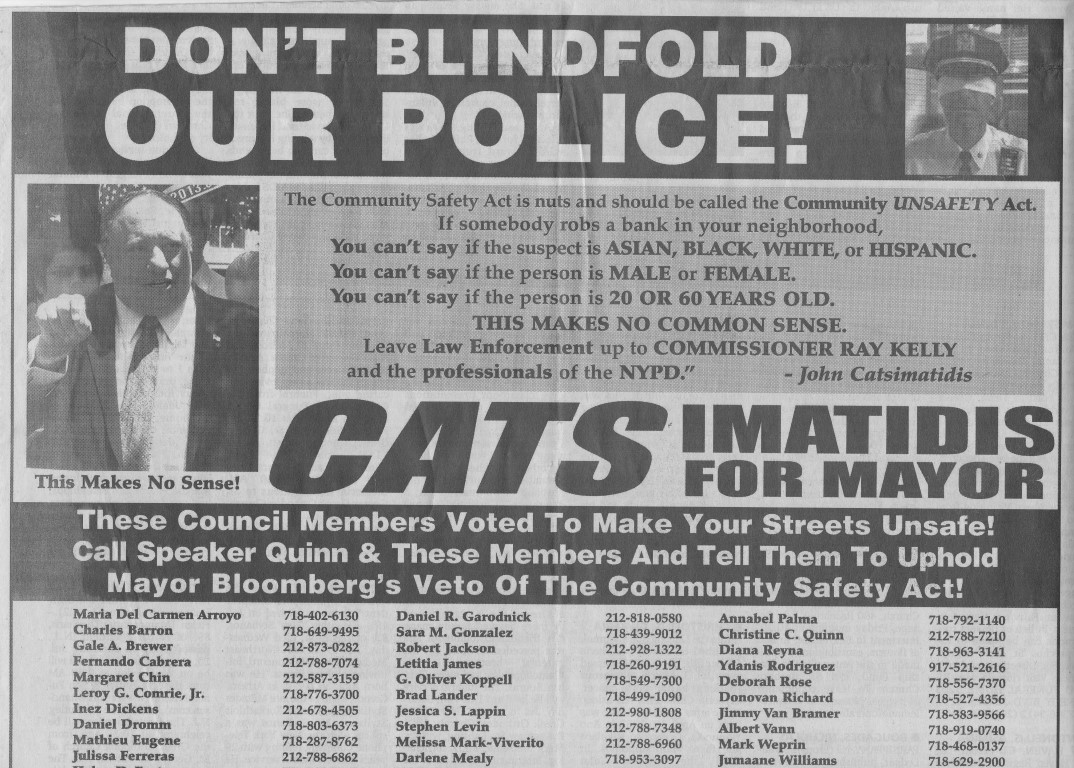
    And file this under Right Wing Lies (VIII). There’s an ad in the Greek-American paper, the National Herald, for John Catsimatidis. He’s a Republican running for mayor. The ad shouts: “DON’T BLINDFOLD OUR POLICE!” And there’s even a picture of a ranking officer violating rules by mis-wearing a uniform for a political ad (those are two separate violations). The ad is about The Community Safety Act, a not very significant anti-profiling bill passed by the New York City Council. Catsimatidis says, and it’s presented as a quote:

    The Community Safety Act is nuts

    and should be called the Community UNSAFETY Act.

    If somebody robs a bank in your neighborhood,

    You can’t say if the suspect is ASIAN, BLACK, WHITE, or HISPANIC.

    You can’t say if the person is MALE or FEMALE.

    You can’t say if the person is 20 OR 60 YEARS OLD.

    THIS MAKES NO COMMON SENSE.

    Leave Law Enforcement up to COMMISSIONER RAY KELLY

    and the professionals of the NYPD

    The problem, and I bet you can see where I’m going with this, is that those statements are bald-faced lies. The law is about police profiling. Of course you can describe a suspect. Shame on Cats, the lying Greek.

    But I can picture Greek grandmother in my neighborhood. She always suspected those Democrats loved crime and supported criminals. And now she knows it to be true because she read Yannis say it in the Herald.

  • Tic-Toc Like Clockwork

    Jeanmarie Evelly of DNAInfo.com writes about a “massive drug sweep” in the Queensbridge* and Ravenswood Homes in Astoria/Long Island City. 28 people indicted; 23 others arrested for selling drugs to undercover cops on “hundreds of separate occasions over an eight month span from 2012-2013.”

    Well, slap my back and declare victory.

    Just like we I wrote about in 2009.

    And happened before in 2005.

    If drugs were so bad, one might logically wonder why police didn’t simply arrest those who sold them drugs back in 2012 before they could peddle their addictive wears to other innocent people. The answer, of course, is you need to shut down the whole operation. Get the kingpin. And, you know, make the projects drug free. Just like we did four and eight years ago. In the war on drugs, we’re always behind enemy lines. The depressing part is that the goal of the drug war isn’t even to win. It’s to keep fighting in perpetuity.

    We can win a battle or two every four years. But I suspect today some other “entrepreneur” is already gleefully taking the place of those arrested. And he’ll get paid and live large till he’s arrested four years from now. And then we’ll all pay to lock him up for five or twenty years.

    Ask yourself, do you think one addict can’t get drugs today because of this operation? If you think the answer is yes, you’re very very naive. People want to get high. The only question is how. There are certainly more and less harmful drugs as well as more and less harmful ways of distributing them (liquor stores seem to work pretty well). So you then might wonder, couldn’t there perhaps be a better way of reducing use and the harms of public drug markets than swooping down every four years and imprisoning “many vicious characters”*(at a cost of $30,000-$70,000 per man per year)?

    Of course there is. We could reduce drug use (the US has the highest rate of illegal drug consumption in the world). We could drastically reduce the violence and effed-up culture that goes along with illegal selling. We could regulate the drug trade. But that won’t happen with a prohibitionist mindset.

    Meanwhile, I’m marking my calendar for 2017. Because this will happen all over again.

    *Here’s a nice video about the Queensbridge Homes. It’s the largest public housing project left standing in America. And it’s not as bad as you might think.

    **New York Police Superintendent Pillsbury, in a 1859 quarterly report. Pillsbury wrote about “[Youthful immigrants,] many vicious characters, and a still larger number of needy and ignorant persons, who, under the influence of over ten thousand grog-shops become recruits to the army of law-breakers.” In 1859, 84% of arrests were drug related (alcohol). (And 80% of those arrested were foreign born.)