Using tech and smart phones to help police. This is great, right? I can’t think of downside. Am I missing something? Kudos to the NYPD.
Tag: NYPD
-
NYC Shootings and Homicides
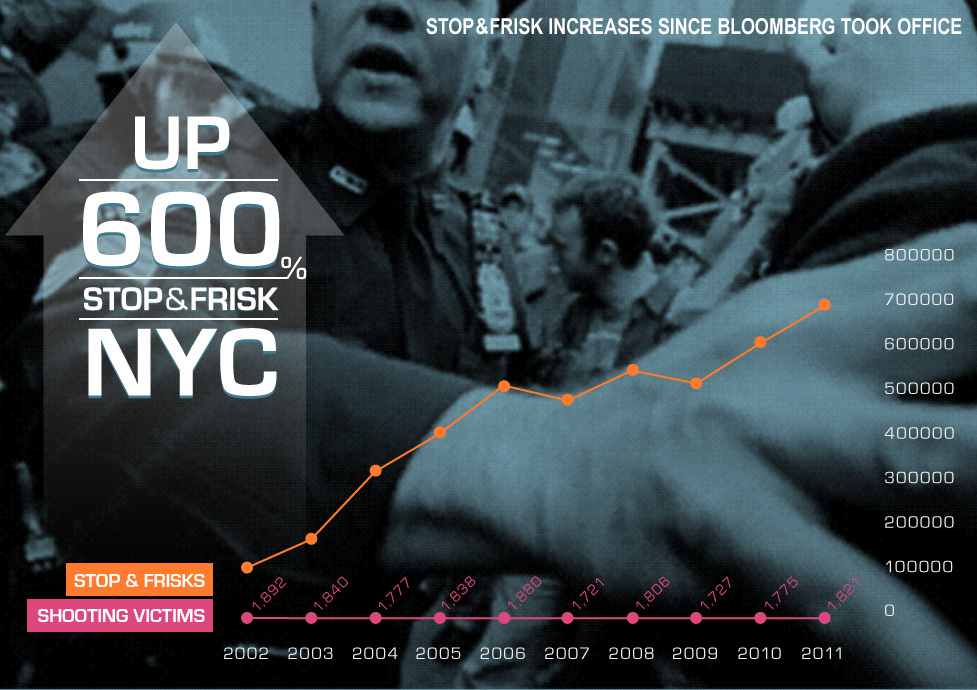
A short while back I was hit with this little picture:
You may look at the stop-and-frisk trend. But what I found more interesting are the shooting numbers. You don’t often see those numbers. Homicides are well tallied by police departments and the Uniform Crime Reports. Shootings less so. I’ve always used homicides as my standard indicator for crime. Homicides are reliable and valid, right?
But here’s what threw me for a loop: are shootings in NYC really not down? 1,892 in 2002 and 1,821 in 2011. During that time, homicides went from 587 to 515.
So here’s the problem: using homicides as a bellwether indicator for crime rests on the assumption that 1) there is a direct and consistent correlation between violent crime and shootings and 2) between shootings and homicides. So if homicides are down and shootings are not, it doesn’t work. Something else other than police work is probably responsible for the drop in homicide. Paramedics, nurses, and doctors jump to mind. The Wall Street Journal reported on this a few months ago (but the story is behind a paywall).
The problem with the chart on shooting victims from dnainfo (which is a horrible name for a great news source) is that it draws a flat line. And 2012 was a good year for the NYPD: shootings dropped to 1,625 and homicides to 419. So if you punch the numbers into SPSS and get a trendline, you get this:
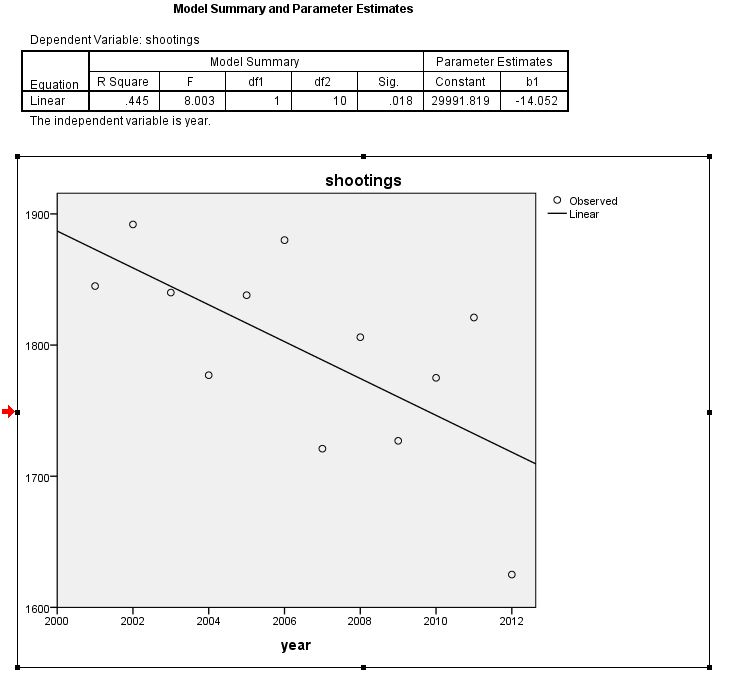
It’s an average reduction of about 12 shootings per year over the past 13 years. It’s not huge, but it’s not insubstantial (and it is statistically significant). Shootings are down about 12 percent since 2001; homicides are down one-third (I haven’t broken down the homicides by weapon, but roughly 70 percent of homicides in NYC are shootings).
One could reasonable infer that about 2/3 of the decline in homicides in NYC has nothing to do with police (because shootings are a better indicator of crime than are homicides). But still, a long-term (since 2001) 10-to-15 percent decline in New York City shootings (and, I would infer, crime) is noteworthy, if not exactly headline grabbing.
Last year, 2012, recorded stop and frisks were down 22 percent, to 533,000 (compared with 685,700 in 2011. Homicides and shootings in 2012 were also down. (So clearly, if nothing else, last year tells us there’s no direct inverse linear relation between stop-and-frisks and homicides.)
I’ve long argued that some some stop-and-frisks are necessary. You know, the ones based on reasonable suspicion that a suspect is armed. It’s the ones that are nothing more than stat fluffers that bother me.
-
Stop and Frisk
A federal judge ruled that some of the ways the NYPD conducts their “Trespass Affidavit Program” are unconstitutional. The NYT reports, “The judge ordered the police ‘to cease performing trespass stops’ outside the private buildings in the program unless officers have reasonable suspicion, a legal standard that requires officers to be acting on more than just a hunch.”
So the judge basically ordered the NYPD to follow the law and the constitution. You’d think that would go without saying, but apparently somebody had to say it. The ruling is well stated and actually pretty mild. It doesn’t ban the program or stop and frisks. It bans illegal stop and frisks (which, of course, were already technically illegal).
Of particular note, the judge criticized the check-the-box system in which officers tic, “furtive movements” as a basis for the stop. The NYPD set up this system to make the forms idiot proof. But most cops aren’t idiots. And maybe those that are shouldn’t be on the street.
It is likely that the NYPD will have to go back to what is generally accepted standard practice everywhere else: articulating in words their reasonable suspicion for a stop. That’s the way it should be.
I find it curious that the NYPD defends the system by saying this is what landlords want. It would be a lot better of the program was conducted at the behest of the residents. I don’t think most tenants, particularly poor tenants, see their landlords as looking out for the best interests. Landlords own buildings to make money, not to serve the best interests of their tenants.
As a side note, and quite worrisome assuming it’s true:
The judge expressed concern over a department training video that she said incorrectly characterized what constituted an actual police stop. In the video, a uniformed narrator states “Usually just verbal commands such as ‘Stop! Police!’ will not constitute a seizure.”
The narrator explains that the encounter usually qualifies as an actual stop only if the officer takes further steps such as physically subduing a suspect, pointing a gun at him, or blocking his path. “This misstates the law,” Judge Scheindlin said of the video, which has been shown to most of the patrol force.
To say only that this “misstates the law” is quite generous. That the NYPD would incorrectly educate its officers on such a basic issue… well I’d like to think it simply ain’t so, Joe.
A “stop” (for which reasonable suspicion of crime is needed) occurs when a person cannot or reasonably believes he or she cannot leave. Because it is illegal to disobey a lawful order, reasonable suspicion kicks in the second a cop says “stop” or “come here.”
This decision could be a win-win for the police and the community if the NYPD rises to the challenge by discouraging illegal quota-based stops based on “hunches” while continuing to encourages and support officers who perform legal stops. The risk (I think it’s a small risk) is that NYPD will know throw up its hands and stop policing. But nothing in this decision bans legal and effective policing.
-
Bang Bang, My Baby Shot Me Down
More murders in Chicago. Fewer in NYC. Clearly something is going on. But generally you’ll hear nothing but crickets (or winter winds) blow through the ivory towers. It’s a real shame. These days, most academics will (almost reluctantly) concede that effective policing may play a roll in reducing homicide. And yet still very few academics would dare consider the hypothesis that aggressive — yes sometimes even unpleasant — policing may actually prevent homicides. (And, yes, you can and should be polite and respect the law and state and federal Constitutions at the same time as policing effectively and aggressively. Police work is harder and more dangerous when police go out of the their way to piss off people).
As some academics may be afraid of digging deeper because they’re afraid of what they’ll uncover. Better to round up the usual suspects of poverty, gangs, racism, drugs, etc. But the NYPD does itself no favors by not giving a damn what people think: “Everything is under control. No need to look here. Keep moving.” But academics and the NYPD need each other. Certainly they do if any lessons are to be learned from the NYPD and applied elsewhere.
You can’t just “do it like they do in New York” because we don’t know what about what they do in New York works. Is it Compstat? Stop and frisk? Broken Windows? Foot patrol? Zero Tolerance? College-educated police officers? Community policing (whatever that means)? Hot spots (actually, we do know that this works)? Better public housing? Mandatory prison time for illegal gun possession? Decreased incarceration? More immigrants? More eyes on the street? Getting rid of lead? Who knows? But let’s say that one thing the NYPD does pretty well these days in keep homicide numbers low. Well one thing academics do pretty very well is test theories and break things down into parts. There’s a lot going on here. It would be nice to systematically figure out what works. We need to understand these parts so that effective police tactics and strategies can spread to other cities.
In the meantime, it’s like we’re swinging at a piñata, blindfolded. We took a few swings and feel some contact. But in the end all we see is candy in the floor. So we scoop some up and forget about what we actually did.
-
Bang Bang, That Awful Sound
Chicago’s 2012 murder total was 532. NYC’s total number for 2012 was 417. Even in absolute numbers this is significantly lower than Chicago! Amazing. The comparable homicide rates for NYC and Chicago are 5 and 20 per 100,000.
Homicides in New York City declined 19 percent from 2011 (just to remember: in 1990 2,245 people were killed in NYC). To get such a substantial drop on such a low (by US standards) homicide number needs some explaining. Chicago saw a 23 percent increase from 2011.
Had the New York numbers gone up and the Chicago numbers gone down, you’d hear sage mumblings from chin stroking academics about regression to the mean (which, of course, assumes there is a mean (average) homicide rate toward which to regress… but I digress). I’ll tell you what the answer isn’t: people in New York just loved each other more; while clearly hate was on the rise in Chicago.
[More tomorrow]
-
Cop Does Good, paper reports
An all too rare reporting of a cop doing a good deed.
Of course the cynic in me worries that he will get in trouble for 1) being off post, 2) shopping while on duty, and 3) accepting a police discount. That’s they way cops think because that’s the way the departments can f*ck you, when they want to. Only the good press might save him.
Why do we let police work in a system where they can get in trouble for buying shoes for a barefoot homeless guy?
[Update: The homeless guy was found barefoot again by the New York Times. He said the shoes were in a safe place because they were worth a lot of money.]
-
What a news day!
If Cannibal Cop is a minus point or two (you just don’t see headlines like this too often)… there’s “hero cop” to counterbalance the bad (or, as one of my students said while watching the video of him holding his bullet wound while shooting the criminal: “Damn, he’s going O.G.!”)
I guess, for the NYPD, that makes the day kind of a wash.
-
Judge Rules Against NYPD in Brooklyn Bridge Arrests
From the Times:
A federal judge ruled Thursday that the police did not sufficiently
warn Occupy Wall Street protesters against walking on the roadway of the
Brooklyn Bridge before arresting about 700 of them in October.The ruling, by Judge Jed S. Rakoff of the Federal District Court in Manhattan, allows a class-action suit filed by protesters
to proceed against police officers and other police officials involved
in the arrests. But the ruling dismissed the mayor, the police
commissioner and the City of New York as defendants in the suit, saying
that there was insufficient evidence that those parties were responsible
for any misconduct by the police.This may be one of those cases were both sides are right: The police did warn; the protesters couldn’t hear. The burden is (and should be) higher on the police.
-
911 is a very costly joke!
There’s a much delayed and controversial report listing the flaws of New York’s “new and improved” 911 phone system. There are many flaws I won’t get into here, but I would like to point out just the cost. The project has cost $2 billion. The entire annual budget of the NYPD is about $4.5 billion (NYPD and NYFD is about $6.1 billion). It’s bad enough that half the average police department is, in effect, sitting in a car waiting for the phone to ring. It’s even worse when the system costs as much as the officer.
-
Happy May Day?
Destruction in Seattle. Destruction in Oakland. All pretty peaceful in New York, more or less. Kudos to all who kept the peace.
And I like the one cop in this video who doesn’t even flinch when a guy kicks out the window of a squad car right next to him.
Bad ass.
Respect.