Tag: NYPD

  • “Stop arresting people for weed” is 5 words long

    You’d think it would be easy to tell cops to stop arresting people for small scale possession of marijuana. But not a police department.

    Every now and then I try to write about paperwork, because it’s such an integral part of the job and such a key negative motivator of police officers and good police work. But who the hell wants to read about paperwork?

    Well, anyway, it’s my blog, damnit! And to understand police you need to understand police paperwork. Here is the Order that tells cops to not arrest people for marijuana. It is 21 steps, 5 pages, and 1,652 words long. And yes, this is typical. And yes, there are literally thousands of others. And yes, they come out about once per week. And indeed, they are all not followed because nobody knows them all. And yes, if you fail to follow them correctly, it could be your ass in the jackpot. Also, believe it or not, this order is designed to reduce the amount of paperwork and time police officers have to spend on the matter.

    Figure out a legal and efficient way to reduce paperwork in police
    departments and the police will beat a path to your door… er… but in
    a good way!

    OPERATIONS ORDER

    SUBJECT: ENFORCEMENT OF CRIMINAL POSSESSION MARIJUANA, FIFTH DEGREE, SUBDIVISION ONE

    DATE ISSUED: 11-11-14

    NUMBER: 43

               1. This Order allows for the issuance of a Criminal Court summons, in lieu of arrest, to people found in possession of a small amount of marijuana – defined as 25 grams or less – in a public place and open to public view. Eligible, properly identified people will be issued a Criminal Court summons for Unlawful Possession of Marihuana, a violation, rather than arrested for Criminal Possession of Marihuana, a misdemeanor. The Criminal Court summons will be issued for the lesser included offense of Unlawful Possession of Marihuana (Penal Law 221.05).

               2. This Order will apply only to people found in possession of a small amount of marijuana open to public view, in a public place, that is consistent with personal use. A person found in possession of marijuana burning in a public place will be arrested and charged with Criminal Possession of Marihuana in the Fifth Degree, subdivision one (Penal Law 221.10 (1)), a misdemeanor. Additionally, a person found in possession of marijuana in public view in a manner that is inconsistent with personal use will be arrested and charged with the appropriate degree of Criminal Possession of Marihuana.

               3. Therefore, effective November 19, 2014, at 0001 hours, members of the service will adhere to the following procedure when they apprehend people for violating Penal Law section 221.10 (1), Criminal Possession of Marihuana in the Fifth Degree, subdivision one – possession in public view only:

    PURPOSE: To provide for the issuance of a Criminal Court summons (C-summons) in lieu of an arrest for eligible people apprehended for violating Penal Law section 221.10 (1), Criminal Possession of Marihuana in the Fifth Degree, subdivision one – possession in public view only.

    PROCEDURE: When a person is found in possession of 25 grams or less of marijuana in a public place and open to public view that is not burning and is consistent with personal use:

    UNIFORMED MEMBER OF THE SERVICE CONCERNED

    1. Confiscate contraband for subsequent testing and invoicing as per Patrol Guide Procedure 218-08 “Field Testing of Marijuana by Selected Uniformed Members of the Service within the Patrol Services and Housing Bureaus.”

    2. Determine if there is probable cause to believe that the person committed any other fingerprintable offense beyond the mere possession of marijuana in public view.     

    3. Inform person that he/she may be issued a C-Summons, if qualified.

               a. Disqualifying factors for a C-Summons issued in conformance with Patrol Guide Procedure 209-01, “Conditions of Service,” for Criminal Possession of Marihuana in the Fifth Degree, subdivision one – public view only are:

                          (1) Person has an active warrant

                          (2) Person is wanted in connection with an active INVESTIGATION CARD (PD373-163) labeled Perpetrator – probable cause to arrest

                          (3) Person is charged with other fingerprintable offenses

                          (4) Person is not properly identified.

    4. Establish person’s identity through observation of valid identification documents.

               a. For the purposes of this procedure, valid documents include:

                          (1) Valid Photo Driver’ License (From New York State, another state, or another country)

                          (2) Valid passport

                          (3) Citizenship or naturalization papers

                          (4) New York State Non-Driver’s Permit

                          (5) New York State Driver’s Permit

                          (6) Other government photo identification

                          (7) School identification card issued by high school, community college, college or university

                          (8) Birth certificate

                          (9) New York State Benefit Identification card

                          (10) NYC Department of Consumer Affairs Vendor Licenses

                          (11) A City, State, or Federal employee identification card

                          (12) Utility bill dated within the last three month, listing person’s name and current address.

               b. Members should note that these are general guidelines, and other forms of identification may be acceptable.

    5. Determine if the person has an active warrant or an active INVESTIGATION CARD labeled Perpetrator – probable cause to arrest by requesting a check through Communications Section, the local precinct, and/or through the use of a mobile device.

    NOTE: A person should be issued a summons in the field unless further investigation is needed or conditions warrant processing at a Department facility.

    IF THE PERSON IS ISSUED A CRIMINAL COURT SUMMONS IN THE FIELD

    UNIFORMED MEMBER OF THE SERVICE CONCERNED

    6. Issue the person a summons for the lesser included offense of P.L. 221.05 “Unlawful Possession of Marihuana,” as per Patrol Guide Procedure 209-09, “Personal Service of Summonses Returnable to Traffic Violations Bureau or Criminal Court.”

    7. Deliver marijuana to Desk Officer, precinct of occurrence

    DESK OFFICER

    8. Have marijuana invoiced as per Patrol Guide Procedure 218-08, “Field Testing Marijuana by Selected Uniformed Members of the Service within the Patrol Services and Housing Bureaus.”

    9. Ensure testing member prepares the MARIJUANA SUPPORTING DEPOSITION/ FIELD TEST REPORT (PD381-145) in accordance with P.G. 209-09, “Personal Service of Summonses Returnable to Traffic Violations Bureau or Criminal Court.”

    IF THE PERSON IS TO BE REMOVED TO THE COMMAND

    UNIFORMED MEMBER OF THE SERVICE CONCERNED

    10. Comply with appropriate arrest processing guidelines and remove person to precinct of arrest or a designated arrest facility and advise desk officer of facts.

    a. Determine whether the person should be issued a C-summons or processed as an online arrest.

    b. Include in Command Log entry that the circumstances of the summons or arrest were in conformance with the standards set forth in this Order.

    DESK OFFICER

    11. Question officer regarding circumstances that led to the apprehension of the person and the seizure of the marijuana.

               a. Determine whether the person should be issued a C-summons or arrested.

               b. Include in Command Log entry the circumstances of the summons or arrest.

    12. Allow person to contact a third party in order to obtain appropriate identification, when such identification is necessary for the issuance of a summons or Desk Appearance Ticket (DAT).

               a. Delay arrest processing a reasonable amount of time to allow the delivery of such  document(s).

    13. Determine whether the person’s identity has been verified. Determine whether the person has an active warrant or INVESTIGATION CARD.        

    14. Direct issuance of C-summons if appropriate.

    IF PERSON QUALIFIES FOR A CRIMINAL COURT SUMMONS AT THE STATION HOUSE

    UNIFORMED MEMBER OF THE SERVICE CONCERNED

    15. Issue the person a C-summons for violation of P.L. 221.05 “Unlawful Possession of Marihuana,” as per Patrol Guide Procedure 209-09,“Personal Service of Summonses Returnable  to Traffic Violations Bureau or Criminal Court.”

    DESK OFFICER

    16. Release person after C-summons has been issued.

    17. Make Command Log entry and process summons as per Patrol Guide procedure 209-09, “Personal Service of Summonses Returnable to Traffic Violations Bureau or Criminal Court.”

    18. Ensure marijuana is invoiced as per Patrol Guide Procedure 218-08, “Field Testing Marijuana by Selected Uniformed Members of the Service within the Patrol Services and Housing Bureaus.”

               a. Once a decision is made to issue a C-summons, do not delay the release of the person in order to field test the marijuana.

    19. Ensure testing member prepares the MARIJUANA SUPPORTING DEPOSITION/ FIELD TEST REPORT (PD381-145) in accordance with P.G. 209-09, “Personal Service of Summonses Returnable to Traffic Violations Bureau or Criminal Court.”

    IF PERSON DOES NOT QUALIFY FOR A CRIMINAL COURT SUMMONS AT THE STATION HOUSE

    DESK OFFICER

    20. Direct issuance of Desk Appearance Ticket (DAT) if person is properly identified and eligible.

               a. Disqualifying factors for a DAT for the charge of Criminal Possession of Marihuana in the Fifth Degree are:

                          i. Person refuses to sign the DAT

                          ii. Person has an active warrant

                          iii. Person is under the influence of drugs/alcohol to the degree that he may endanger himself or others

                          iv. Person owes DNA.

               b. If person has an active INVESTIGATION CARD labeled Perpetrator – probable cause to arrest:

                          i. Notify the Criminal Intelligence Section, Regional Intelligence Support Center (RISC) of active INVESTIGATION CARD

                          ii. Continue with DAT process and release person to responding detective

                          iii. Do not release person with an active probable cause INVESTIGATION CARD if no detective is available to re-arrest person. In this situation deny the DAT and process online.

    21. If person is not eligible for a C-summons or DAT ensure that the arrest is processed online as per existing Department procedures.

    ADDITIONAL DATA

    A GROUP OF PEOPLE SMOKING MARIJUANA

    If a group of people are observed smoking and passing a burning marijuana cigarette in public, all persons observed in possession of the burning marijuana may be arrested for Criminal Possession of Marijuana in the Fifth Degree, subdivision one (Penal Law 221.10(1)), a misdemeanor. Additionally, this type of incident does not constitute a sale or intent to sell under this Order. None of the people should be arrested and charged with selling marijuana.

    MARIJUANA IN A VEHICLE If marijuana is observed inside a vehicle with multiple occupants, every attempt should be made to identify the person in custody and control of the marijuana. Only that person should be issued a C-summons or be arrested for the possession of the

    marijuana. Normally the operator of a private vehicle would be considered in custody and control of any items in the vehicle, unless it is found on the person of a passenger or in such a manner that would lead an officer to believe that a passenger has custody and control of the item.

    PERSONS EXTINGUISHING MARIJUANA IMMEDIATELY PRIOR TO APPREHENSION

    An officer does not have to personally observe a person in possession of marijuana burning in public. If there is probable cause to believe that a person was in possession of burning marijuana in public (i.e., the unique smell of burning marijuana), yet the officer only observed the person in possession of an extinguished marijuana cigarette, that person may be arrested and charged with Criminal Possession of Marihuana in the Fifth Degree, subdivision one (Penal Law

    221.10(1)), a misdemeanor.

    4. Operations Order 49, series 2011, is hereby REVOKED.

    5. Operations Order 13, series 2013, is hereby REVOKED.

    6. Commanding officers will ensure that the contents of this Order are immediately brought to the attention of members of their commands.

    BY DIRECTION OF THE POLICE COMMISSIONER DISTRIBUTION

    All Commands
  • Quote of the Day

    As more and more states legalize marijuana, New York City still leads the world for arrests for possession of the evil weed. You might wonder who actually thinks it’s a good idea to arrest people for a decriminalized amount of marijuana. Sergeants Benevolent Association president Ed Mullins: “If the current practice of making arrests for both possession and sale of marijuana is, in fact, abandoned, then this is clearly the beginning of the breakdown of a civilized society.”

    Dude, get some perspective. Mullins continued, “If we’re not making marijuana arrests, then we may not pop someone who has a warrant on them or who committed felony crimes…. If the department doesn’t want us to make marijuana arrests, they should introduce legislation to change the law.” Seems fair enough, but there are a few problems here. First, you can run somebody and see if their wanted. If not, you don’t need to arrest them misdemeanor marijuana.

    Second, small scale possession of marijuana is just a violation (not an arrestable offense) until the marijuana is in “public view.” And I don’t want to imply anything, but how the marijuana gets into public view is open to debate. But I think it’s safe to say most of the tens of thousands of people arrested aren’t walking around holding dime bags in their hands.

    Finally, and this is important to policing, back in the old days, hell, even the days I policed, real police would be ashamed to come in with such a crappy arrest. Off the street for hours for what?! If you come across weed, you can throw it in a sewer. Or hell, you could even hand it back. (It’s happened.) There are lots of minor violations that do not deserve zero-tolerance. In the absence of other crimes, in the absence of a person being wanted a warrant, you can warn, you can admonish, or you could even turn a blind eye. Police have a lot of discretion. Use it. If anything will lead to the “breakdown of civilized society,” it won’t be police officers doing their job and using their brain.

  • Brrrr… it’s cold outside

    I can’t help but notice — now that another long hot summer is done and a commie mayor and Al Sharpton are running the show and the police have been thrown under the bus and Obama is president and the ACLU stopped letting police stop criminals and there’s no more stop question and frisk and there’s independent oversight and body cameras are coming and it’s open season on cops and people don’t show any respect and society going to hell — but crime *still* isn’t up (-4% by stats I don’t trust. But what I *do* trust is 249 homicides to date compared to 262 in last year’s record low. Shootings are up 6%). I know it’s in good part because of the hard work of the men and women of the NYPD, but I’d still like just one Republican, one conservative cop (or maybe somebody like Heather MacDonald) to admit he (or she) was wrong. It’s all very strange to me.

    Or maybe the only thing keeping New York City from become The Warriors are all the marijuana arrests or the bike ticketing blitz in Crown Heights? Nobody really believes that, right?

  • Why Hassaum McFarlan Matters (or what liberals don’t understand)

    Why Hassaum McFarlan Matters (or what liberals don’t understand)

    Imagine you’re a New York City Police Officer. You take pride in your job and serving the city. You work hard. You play by the rules. You also feel you don’t get enough respect for what you do. And that disrespect comes right from the top.

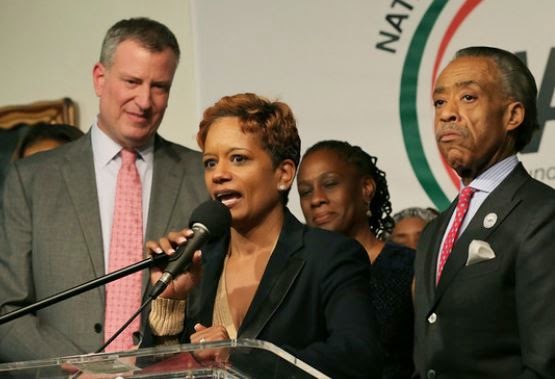
    De Blasio gets elected mayor. You believe, perhaps correctly, that the mayor neither understands nor appreciates what you do. Suddenly police bugaboo Al Sharpton becomes a trusted aide. Whatever you think of the reality of Sharpton, the symbolism of giving him a major say in police policy is painful to most police officers. The New York Timessays: “Mr. Sharpton… is now a highly influential figure at City Hall.”

    Anyway, you do like your job. You love the people you work with. But anti-police liberals — those who have no understanding of your job and seem to criticize everything you do or don’t do — piss you off.

    If you’re a cop, you’re not getting rich. You get by on $45,000 to $70,000 (perhaps $10,000 more with overtime). NYPD Captains (a rank above sergeant and lieutenant) make less than Noerdlinger. Captains can have hundreds of disgruntled officers and 100,000 concerned citizens to manage and keep satisfied. And these are people you can neither fire nor deport. On top of that, you’ve also got the top brass breathing down your neck, busting your chops at compstat. The chief of patrol makes about $200,000, I think (correct me if I’m wrong). For what it’s worth, my salary as an associate professor (10 years on the job) is about $85,000.

    And do keep in mind this is a city where apartments rent for $2,000 to $3,000 and the average (median) home sells for over $1,000,000. It’s not a cheap place to live. But this really isn’t mostly about money. It’s about job professionalism and integrity. It’s about messages from the top.

    The mayor hires Rachel Noerdlinger to serve as chief of staff to his wife, Chirlane McCray. You even noticed that one because Noerdlinger was formerly Sharpton’s spokesperson. But it became news recently when Noerdlinger became the story became of her boyfriend .

    Noerdlinger lives in Jersey (she got a waiver for that). Noerdlinger also gets paid $170,000. That would pay for two college professor, two police officers, or 1.5 sanitation workers (you can pick whichever you think is most needed).

    Here’s the first part of the problem. Noerdlinger’s live-in boyfriend, Hassaun McFarlan, was convicted of manslaughter as a teenager and does not like cops, to put it mildly. He also doesn’t seem to speak well of women, either. From the Times: “The mayor has defended Ms. Noerdlinger, saying she should not be judged by the behavior of a companion.” OK. Fair enough. Maybe we shouldn’t judge. But sometimes you need to: “two of McFarlan’s five arrests on charges ranging from driving on a suspended license to drug trafficking took place while he was dating Rachel Noerdlinger.”

    Let’s get real. This isn’t a civil service or union job. This isn’t a question of free speech. This is a question of bad judgement by a woman in a powerful discretionary patronage job. Standards should be higher, not lower. Messages from the top do matter. What if McFarlan wrote about Jews like he wrote about cops? What if McFarlan stereotyped women like he actually did stereotype, er, women? (Actually, that he’s getting a pass on that is kind of surprising). If it were almost anybody but cops complaining, Noerdlinger would be out. There were be platitudes about the tapestry of New York City. You’d hear about there being no place for hate in this beautiful diverse city. Now you may have no problem with all this being considered no big deal by the administration, but please understand why cops do.

    I would argue that a trusted aide should be trusted to have, if nothing else, good judgement, it’s not just a question of what her boyfriend said or said. It’s also that Noerdlinger herself didn’t mention her living arrangement, as required in the hiring process:

    She had failed to disclose on a background questionnaire that she lived with a boyfriend, Hassaun McFarlan, who had an extensive criminal record. False or misleading statements on such a form can result in termination or prosecution.

    …Still, it remained unclear why Ms. Noerdlinger had chosen to inform the mayor’s aides of her living arrangement, but not officials at the city’s Department of Investigation, which conducts formal reviews of high-ranking City Hall appointees.

    But apparently the administration sees no problem here Nordlinger didn’t “intend to deceive” the mayor about her domestic status. Or do honesty and ethical inquiries not apply at the top (is that a silly question to even ask)? You can be damned sure a cop in controversy would be thrown under a bus for such a violation. And perhaps rightfully so.

    Patrick Lynch, PBA president, quite rightly said:

    The standards that apply to hiring police officers should apply equally to hiring high ranking, influential staff members. If it is found that she committed a lie of omission during the investigation, then she should be fired.

    If you want to read more, you could read this and this.

  • CRIME (not) SKYROCKETING

    The real headline of course, the one you don’t see very often, is that crime is down.

    So says the BJS. Though I’m skeptical of the NCVS, since it reported a 40 percent increase in the previous two years, which, quite frankly, as I wrote, I do not believe. (The UCR showed an every-so-slight drop during the same time). So this “drop” in crime may be a bit of a statistical correction.

    Still, “crime isn’t up” is always nice news, since people always assume the world is always going to hell in a handcart (which seems like an awfully slow and old-fashioned way to get somewhere, these days).

    Meanwhile, in New York City, despite the claims, or should I say desire, nay, let’s go all out and say despite the knowledge, dreams, and aspirations of police unions and many police officers, crime in New York is basically steady.

    Yes, shootings are up 6 to 7 percent. Homicides are down. Other crimes are basically steady. (Now PBA and SBA, please stop, as you’ve so often done in the past, trying to harm the city that most of you don’t live in).

    Oh, how it must pain conservative ideologues to see that even without strong conservative leadership, crime isn’t going through the roof. Now let’s not forget that in the 1990s liberals knew that crime couldn’t go down. It did. Now conservatives have been certain for about two years now that crime would go up. But it hasn’t. At least not dramatically and definitively. (And we’re now through the second summer after the demise of stop and frisk, which was what I was waiting for.)

    Imagine this: the city is still safe even with a commie mayor, Al Sharpton as police adviser, extra and probably unneeded police oversight, unfair accusations of murder when criminals die resisting arrest, and unnecessary stop and frisks all-but stopped.

    See it’s not about ideology. It’s about hard work. It’s about an intelligent police department and intelligent police officers using discretion and doing their job. I know haters (on both sides) are gonna hate, but instead of seeing impending doom, why not take credit for a job well done?

  • Good use of Taser

    NYPD subdue armed mentally disturbed man. Nobody seriously hurt.

    That’s the headline you should read every now and then. But you rarely do.

    I’m not a big fan of the Taser, but this seems to me exactly what it is designed for.

    What’s odd, at least to me, is that here is a perfect use of the Taser. A crazy gets zapped. Nobody gets seriously hurt. And yet at least one media source seems to imply something bad happened.

    Also, does the NYPD really respond to 100,000 EDPs a year? Seems awfully high to me. And what the hell does, “routinely result in injuries or death” mean. I seriously doubt there the NYPD responds to 275 EPD calls per day. But if that is the case, and people are “routinely” injured, does “routinely” mean say, half the time? So there are 6 EDPs injured by the NYPD every hour? Now that would be a real story… except it’s not true. I’m not quite certain what the story here is, except for a job well done by the NYPD.

    Anyway, “cops do good job” indeed isn’t much of a headline. Nor is “violent crazy man committed to hospital, everybody goes home” a great lede. Still, it seems appropriate to give the police credit when it is due. I mean this is what Tasers are for.

    [hat tip to Sgt B]

  • “Excited Delirium” is not a real medical condition

    Best I can figure, it was invented (or at least inspired by) the Taser corporation (correct me if I’m wrong here).

    But it’s not a real cause of death. That being said, it’s usually used to get cops off the hood when someone dies after being Tased.

    But now some high guy dies and the police officer might (but probably will not) get in trouble? If there’s any crime here, it sure wasn’t committed by the police.

    The story from the New York Times.

    And I’ve never heard of this pseudo bullshit medical condition being used in a situation that wasn’t Taser related. Again, correct me if I’m wrong.

    And since when did the NYC M.E. buy into the concept of “Excited Delirium”?

  • The chokehold that wasn’t?

    Not surprisingly, the preliminary autopsy report in the death of Eric Garner shows, showsthat the “deadly encounter Thursday did not damage his windpipe or neck bones.”

    Why is the not surprising? Because I’m still not convinced there was any chokehold at all. It certainly did not happen when Mr. Garner was taken down. There may have been a chokehold later, but as I have said, and without 100 percent certainly, I don’t think there was. But seeing how Garner apparently didn’t suffer any damage from a chokehold, can we at least stop saying a chokehold killed him?

    The Daily News, which has been the most harsh of all the NYC newspapers, has repeated mentioned “chokehold” as a matter of fact, even though it may not be. “Chokehold” is mentioned around eight times in a webpagethat ends with, “Sources told the Daily News that a preliminary report found no signs of neck trauma, such as a crushed windpipe.”

    There’s something very strange about people who are screaming about “police killing a man with an illegal chokehold” who then don’t care that there perhaps there wasn’t a chokehold. Don’t facts matter? Of course it doesn’t help that Commissioner Bratton himself has called it a chokehold, which seems to sort of settle the matter, at least in the media.

    Of course Garner is dead, so it’s fair to ask, “does it matter?” Well, yes. It does. Because (as I’ve said before) there’s a big difference between police killing a man and having a man die of a heart attack in the course of resisting arrest. It matters because the former is a crime and the latter is a tragedy. The guy seems to have died from physical exertion while resisting arrest. Is that the fault of police?

    Meanwhile a police officer has been tried in the court of public opinion and found guilty. He very well may be tried in a criminal court — and then there will be further shock and uproar when he is acquitted.

    Except for some of the more extreme cops, who believe everybody resisting police should die, most decent people can agree that something went wrong. A man shouldn’t be dead after a minor police encounter over a non-violent crime. That should be a starting point for discussion. But if you start by saying police killed a man — even if it’s not true — it’s hard to have any sort of reasonable or productive discussion.

    This ideological anti-police bias is a left-wing lie similar to the right-wing lies I prefer to write about. It’s like Larmondo “Flair” Allen, the drug dealer who, according to a right-wing email being sent around, was receiving $13,500 a month in welfare before he was murdered. “An outrage!” people scream while blaming Obama (“Flair” died in 2004). When I corrected this fact — the real figure would have been more like $550 a month — most people who so outraged by the $13,500 figure didn’t seem to give a damn that it wasn’t true. They want to be outraged! Facts be damned! “Well,” they say, “maybe those numbers are wrong, but that doesn’t change my opinion.” Well… then you’re a fool. If your opinion is based on beliefs that are not true, shouldn’t you perhaps change your opinion? Or at least get your facts right?

    Maybe in my next post I’ll try and break down the Garner encounter situation and point out various points where something could have been done differently. Choices, had they been taken, where Mr. Garner wouldn’t end up dead. Certainly things went wrong; a man is dead. But that doesn’t mean the officers on scene killed a man.

    [Update: I defer to the medical examiner, who says otherwise.]

  • If you can say, “I can’t breath”…

    If you can say, “I can’t breath”…

    The first thing that jumps to mind in the death of Eric Garneris that somebody who is repeatedly saying “I can’t breath” is, in fact, breathing. It’s a basic rules of choking, first aid, and well, the way we speak. [Update: Seems I’m probably very wrong about this.]

    Also, I’m no expert in chokeholds (because most departments forbid them), but what I do know is that a chokehold can either block the windpipe (which won’t kill you, since suffocation takes a while after you pass out) or block the carotid(?) arteries in the neck (which technically isn’t a chokehold but a strangle-hold). The former is done with the arm flat on the windpipe. The latter is more a vice grip, and you’ll go out pretty quickly. It’s pretty lethal. If you’re on the giving end, you have to let go as soon as the person drops if you don’t want the person on the receiving end to die.

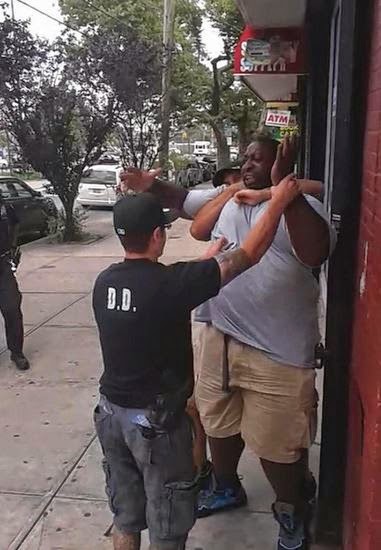
    I don’t see either of those being a factor here… though it doesn’t look good for the officer in green, Agent 99, who did grab Mr. Garner’s neck, since chokeholds are forbidden. That officer also may have rushed the decision to put Mr. Garner in custody. Generally I’m for a hand-on approach to physically controlling a guy. And it’s not easy to control a man as large as Mr. Garner. I’d be more critical if Mr. Garner died after being Tased.

    But this is not a chokehold (though it’s possible one was used later).

    And yet the Daily News caption in an article about chokeholds says “Eric Garner was put in a chokehold as Staten Island police tried to subdue him Thursday.” The officer (Agent 99) is using a half nelson and pulling on the guy’s neck for leverage to bring him down and to the right, which he does. He’s not near the windpipe, and this does not seem to be an attempt to choke the guy. So it’s not a chokehold. Does that distinction matter if the guy is dead? Well, yes. Because chokeholds are forbidden, and the guy is dead.

    But there’s an important difference between saying “the cops killed him with a forbidden chokehold for resisting” (as I’ve heard people say) and “he died while resisting.” Once you decide the guy is under arrest, what would you do? Mayor DiBlasio said he watched the video like family. Well, I watched it like a cop. And it’s not easy to get cuffs and a large resisting man. Just because he died, which is a tragedy, doesn’t mean he was killed, which is homicide. Certainly it will matter what the autopsy shows.

    What you have is a very large and presumably out-of-shape asthmatic man resisting arrest, perhaps because he didn’t deserve to be arrested. (I don’t know, I wasn’t there.) There do seem to be multiple witnesses (actually at the scene, I might add, which isn’t a given when it comes to “witnesses”) saying the same thing: Mr. Garner was a peacemaker trying to break up a fight. [But the officers seem to be arresting Mr. Garner for something else entirely: selling a cigarette.]

    Mr. Garner, apparently, has been arrested 30-some times. And that very well may be why police focused on him.

    But best I can tell (and again, I may be wrong), Mr. Garner seems to be little more than a repeat offender for the criminal offense of… selling loosie cigarettes! Now of all the idiot war-on-drugs nonsense… illegal cigarette selling should be low on the list of law-enforcement priorities. The guy died for selling loosies? And if he was selling them for 75 cents each (I don’t know the going price for loosies), then they’re cheaper than buying them legally by the pack. If he’s selling them for a dollar, then he’s making a good profit!

    Why are about half of all the cigarettes sold in New York illegal? Because the tax is too high, and that has created a very large black market. The thing about legal regulated drug selling is it needs to make sense.

    High taxes on cigarettes — $5.85 a pack ($4.35 New York State plus another $1.50 for New York City — were politically popular under Bloomberg, but probably do more harm than good in New York. That, just as much as any chokehold, contributed to the death of Eric Garner.

    Selling loosies shouldn’t be a crime.

    [The post has been updated. And see this as well, dispelling the idea that if you can talk, you can’t be not able to breathe.]