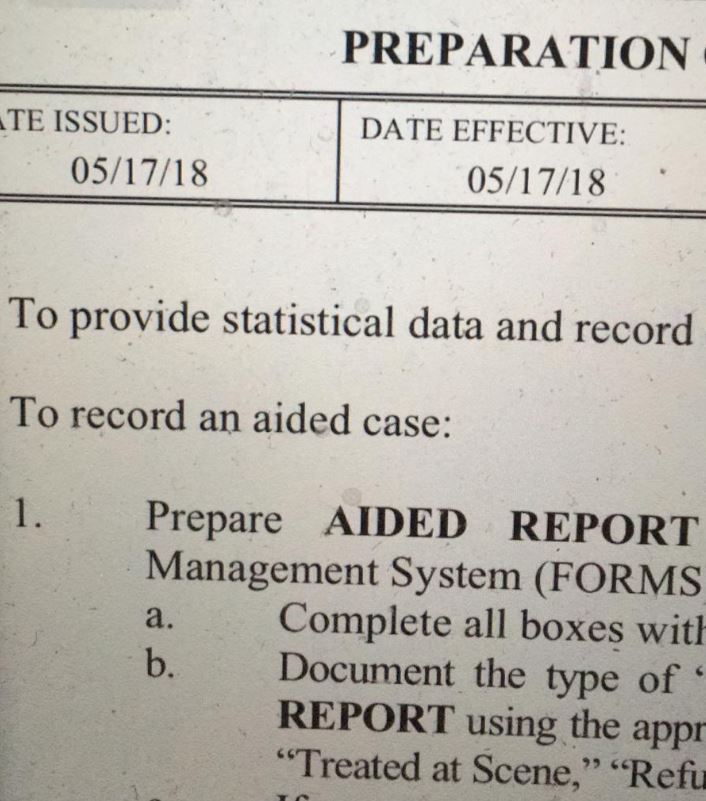
May 17 of last year the NYPD issued an obscure order concerning “aided reports” — that’s when a cop responds to a 911 call for a sick person waiting for an ambulance (a “bus,” as they say here) — requiring the officer to enter the person’s information into their phone. This looks all technical and boring.
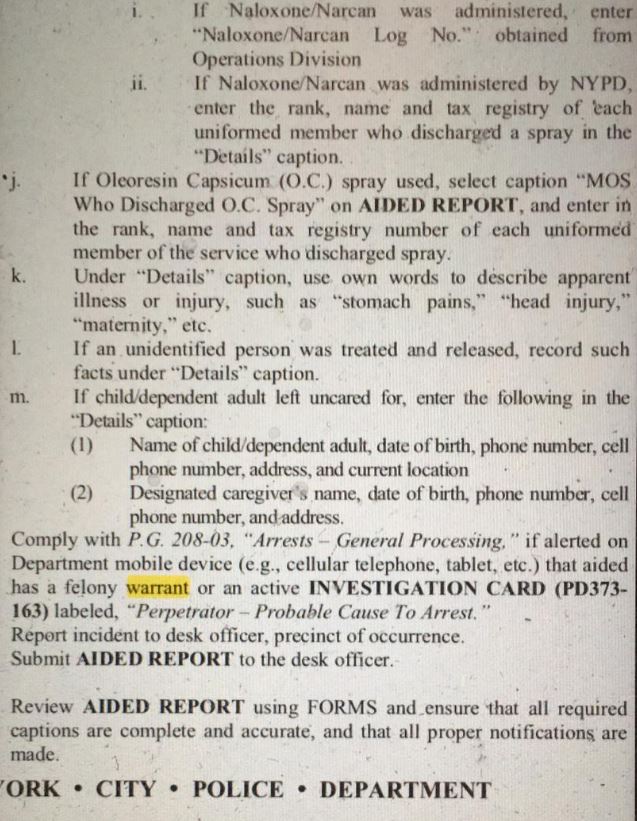
When you put the “aided card” into the phone, it automatically goes
and queries the warrant system. This means that if Uncle Pedro has a
heart attack and he or you is wanted, cops will take you away
(after medical treatment, but still). Thanks, technology! That’ll teach
you to call 911!
Say your Uncle Pedro has chest pains. Or is ODing. Should you call 911? Of course! Right? But what if you don’t know if he’s wanted? What if you don’t know if you’re wanted? Should you still call 911? You know cops might also respond because, well, why not? Maybe cops can do some good
before the ambulance arrives. (Though generally, as a former cop, when it comes to medical care, are you serious?)
Or keep the peace. But should you be debating all this before deciding to call 911? While you’re discussing the pros and cons, Uncle Pedro just stopped breathing.
The NYPD has spent time and dollars trying to build relations with all communities. We want people to call for help. The goal has always been to bring people into the system, not make them afraid of it. The Neighborhood Coordination Officer (NCO) philosophy is just the latest serious effort. All this will be for naught if people are afraid to call 911 or 311 even for non-police matters.
We don’t need people thinking EMS are the bad guys. And we for sure don’t need people fighting unarmed EMTs because they’re worried that they the EMTs and paramedics are going to call the police and get them arrested. That’s not good public policy.
Cops do not have discretion when somebody comes back wanted. A
warrant is a warrant. And arguably for good reason. A judge hath spoken.
But there are wanted people out there, and an entire undocumented
population, for instance, whom we still want to call 911 when A) there’s
a fire, B) they witness a crime C) they victims of a crime, and D) when
they need medical care. Needless to say, this is not an inclusive list.
Perhaps for minor violations, when you know the person’s name and addresses, just give the guy something like a “must appear notice,” like the one he never got because it was mailed to his address from three years ago. Then bounce it to a detective for follow up. A surprisingly large percentage of people who have warrants simply do not know they are wanted. Give them 60 days or something. Why is the only part of the criminal justice system that moves quickly the one in which somebody wanted is taken in?
It’s in everybody’s best interests to have people turn themselves in at a more convenient time. This can be the difference between staying employed or being fired. Most warrants are not over urgent matters. And often staying employed can make all the difference in the world.
Could it become common in NYC hospitals (and not the hospitals serving rich white people) for police to run the names of visitors and patients while they are waiting around? For some, their injury or presence might constitute grounds for a probation or parole violation. This is exactly what Alice Goffman said was happening in Philadelphia. (It’s not clear it actually was happening, but people thought it was, and that’s bad enough.)
New York City has an estimated undocumented population (aka illegal immigrant) population of 560,000. Even in a sanctuary city, people — more than half a million New Yorkers — are afraid. Currently NYPD doesn’t share this information with ICE. But that could change overnight. Recently I had an immigrant student whose boyfriend was hit by a car. He was hurt. The driver stopped, but the boyfriend didn’t want to exchange information. A guy hit by a car through no fault of his own was afraid to get the driver’s information or go to the hospital. This is not good.
What problem is this solution supposed to fix? “We want the cops to put an aided card into the phone on the scene and it to automatically query the warrant system.” It is bad policy to routinely run warrant checks on people seeking medical care.
I know it’s not in the public’s interest to have wanted people running around. It’s one thing for police to run somebody because they have suspicion. It’s another to do so because they called for help. It’s not in the public’s interest to have people afraid to seek medical care or see EMTs and paramedics and the FDNY as part of law enforcement. Let’s base a policy decision based on evidence rather than, “hey, cops now have smart phones linked to the warrant system!”
One interesting (at least to me) thing I learned in talking to somebody about this, cops in New York did not routinely run (check for warrants) every time they 250d (stopped) somebody. In Baltimore, we ran basically everybody we stopped. This is a big difference in police behavior, and I’ve never heard anybody discuss or even be aware of this. But even in Baltimore we didn’t routinely run people on medical calls. In part we didn’t want to know. Because if the person is wanted and going to the hospital, guess who gets to babysit the patient until they’re released? Not a good use of patrol resources. And the next shift will really hate you, too.
Maybe we ran more people in Baltimore than they did in NYC because more people were wanted. But it probably had more to do with an unrelated technological issue. One radio channel in Baltimore covers one district (aka precinct) with 1 dispatcher for 15 (often fewer) patrol units. One radio channel in New York covers multiple precincts and has perhaps 10(?) times as many officers. It takes precious air time to run a 10-29 (Balto code for, check warrants). And air time in New York is more precious. Many stops, even car stops, weren’t called in. That’s not safe or good policy. Something as simple as how many units are on one radio channel, can change police culture more than any formal debate or informed policy. Maybe it shouldn’t be that way.
And if it is good policy to check people in medical crisis for warrants, and I don’t think it is, they hey, why not go all-out and front-end it to the 911 and 311 operators. Let them be part of the system, too. At least it would be honest. “Thank for calling 911. This call is being recorded and you are being checked for any felony warrants. Now, what is your emergency?”