Tag: police culture

  • How to arrest a very large man who doesn’t want to go

    Telling officers what not to do doesn’t tell them what they should do. And it’s never going to look pretty. That doesn’t make it wrong.

    Here’s my op-ed in today’s New York Daily News:

    If you’re a cop, how do you cuff a 6-foot-tall, 350-pound man who doesn’t want to go to jail?

    Most arrests happen without a problem. Police order a guy to put his hands behind his back. The cuffs click or zip, and that’s that. But sometimes people make it clear that they don’t want to go. Then what?

    Read the whole thing here.

  • How to change occupational culture

    New York City just paid $2.75 million to settle a lawsuit from a prisoner who killed in Rikers. As a taxpayer, I worry about a million here and a million there. Pretty soon, as they say, we’re talking about real money. To the tune of $100 million each yearfor New York City. And indeed it does not grow on trees.

    Everybody who has ever been a jail — guard, police officer, prisoner, lawyer — knows some bad stuff happens in there. If you want to find brutality, stop looking at police and start looking at C.O.s. (Of course, it’s a lot easier to film police than to film what goes on in jails and prisons.)

    But those big settlements don’t cost the agencies where it happened one penny. The Department of Corrections or NYPD budget doesn’t pay for the lawsuits they brought about. The city pays. It’s a lot easier to be irresponsible when somebody else picks up the tab. It’s like you’re playing baseball and break a neighbor’s window. You’ll probably break fewer windows if you have to pay for the replacement. But as long as mom and dad pick up the tab, play on.

    If some or all of that money came from the agencies that were responsible, I guarantee you those agencies would find a way to change the behavior and working culture that leads to lawsuits. Instead, the culture stays the same, and every now and then an officer gets thrown under the bus.

    [Update: Jim Dwyer has a July 22 story with a similar themein the NYT.]

  • Crime isn’t up

    Crime isn’t up

    Man, if you read the NY Post, you might think the city is going to hell. And all because a liberal is mayor and cops’ hands are tied: “The attack raised fears of a new wave of anti-cop violence — with a police union president blaming the assault on Mayor Bill de Blasio and his crackdown on stop-and-frisk.”

    I don’t want to minimize the danger of “air mail,” people throwing things from high above. It can indeed kill. But I doubt this potential murderer threw a bike at cops because police no longer make quota/productivity-goal based stops.

    I also don’t want to minimize the unfairness of potential lawsuits brought against individual police officers who are, in good faith, trying to do their jobs.

    Even my old sergeant from Baltimore couldn’t resist telling me how New York was not longer safe without all those stops, not to mention a liberal Sharpton-loving mayor in charge!

    But there’s one problem with crime-is-up-because-stops-are-down theory. Crime isn’t up! So until crime actually does increase, can we all just stop talking about the rise in crime so matter of factly?

    Here’s my theory: Cops have, are, and always will stop people when they have reasonable suspicion. Why? Because that’s what cops do! Call it doing your job or professional pride or whatever. Cops want to stop crime and catch criminals.

    But what cops are not doing much of making stops just to meet some perceived quota. This means that literally hundreds of thousands of guys a year are not being stopped because they’re wearing baggy pants in a high-crime neighborhood.

    I understand that logic of why massive stop-and-frisks could have a deterrent effect on crime. And yes, school is now out, the summer is hot, and stops have been way down for almost a year.

    Now this chart only goes to last year. This year stops are down, murders are down a bit, and shootings are up a bit. Overall, according to the stats, crime is basically unchanged (down 3%). But I make it habit not to rely on any crime numbers other than shootings and murders.
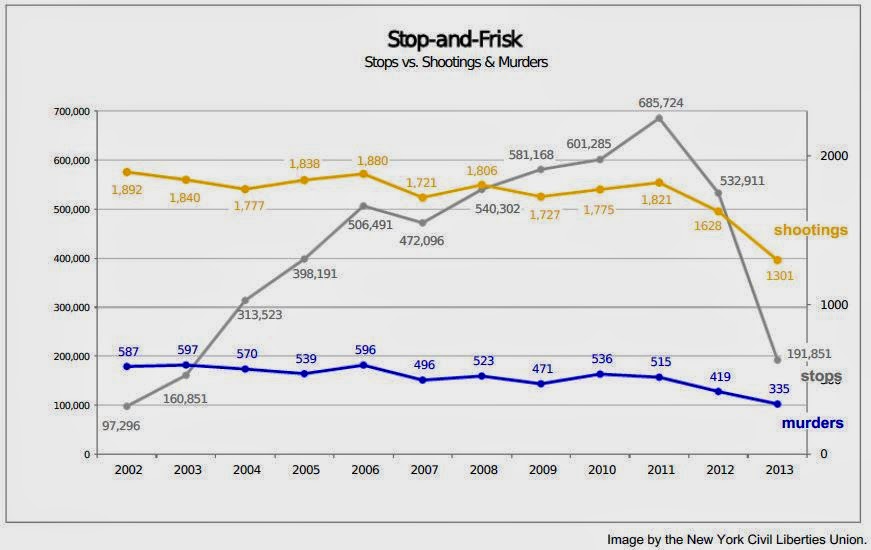
    So stops are down and crime is still down. Yes, crime is up in some places, but it’s down in other and overall constant. In the 75, stop are down 90% and shootings are up 30%. And leave it to a real news source to find local residents saying police need to start up those stops again!

    As somebody just put it (I forget where I just heard this), “what we have now isn’t a crime problem but a newspaper-selling problem.” I might also add there’s a bit of a problem with an ideology that believes the only effective policing is repressive policing.

    Is there a correlation there between police inaction and more shootings in East New York? Almost certainly. But we can deal with that without going back to blanket (and now illegal) police of massive stops and frisks.

    People feel safe when they see police and normal life functions. Police presence is key. Police getting out of their car is key. Police need to know the people — good and bad — in their area. Police need to stay in one area for a long time so that knowledge isn’t wasted. But 600,000 stops a year? That’s too many. And zero? That’s too few. But somewhere in between the two — and toward the lower end — it’s going to be just right.
  • Thomas Frazier directs the Oakland Police Department to comply

    I was just spell checking Thomas Frazier’s last name for something I’m writing and learned, though the wonders of google, that Frazier is now running the Oakland Police Department. And he’s running it in a way I’ve never heard of:

    The former Baltimore police commissioner, who rose up the ranks in San Jose, is accountable only to the federal judge who last week appointed him to ram through reforms that Oakland police were supposed to have completed five years ago.

    Despite the modest title of compliance director, Frazier, 68, will have authority to overrule top commanders, spend city funds and even oust Chief Howard Jordan and demote his deputies if he determines they are obstacles to the decade-old reform drive.

    Damn…

    Frazier is the guy who originally approved my Baltimore research, though he was gone before I got there. He and Kurt Schmoke were universally disliked by the time I got to Baltimore in late 1999. Among the rank-and-file, Frazier was never able to live down his line about police being “social workers with guns.”

    “He won’t be intimidated by any outcry from the rank-and-file or the public,” said Gary McLhinney, the former head of Baltimore’s police union and a staunch Frazier critic. “When he gets an idea in his head, he’ll run with it. He doesn’t care if it’s popular.”

    “Academics loved Tom; rank-and-file cops despised him” McLhinney said. “Tom was into the community policing model really to the extreme. He wasn’t really interested in locking up bad guys. That wasn’t his focus.”

    Between 1995 and 2000, murders in Baltimore dropped from 325 to 261.

    There’s some irony that Frazier is now trying to clean up the mess in Oakland that Anthony Batts, now the Baltimore police commissioner, couldn’t fix.

  • 3-Adam-22

    3-Adam-22

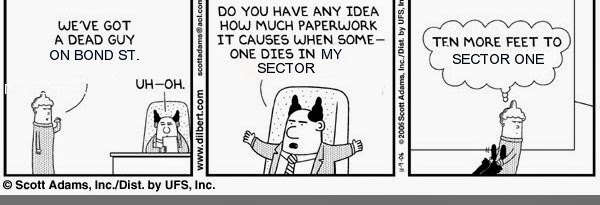
    I just found this photoshopped file in an old folder on my computer. I honestly have no idea who made it or how I got it. (Needless to say, it is not a original comic and has nothing to do with creator of the comic.)

  • “Anybody want to try the spread?…”

    “Anybody want to try the spread?…”

    “…The spaghetti with brains is mind blowing.”

    Sure, it’s not the funniest quip ever, but I said something like that while guarding the crime scene of a 12-person shooting back in 2001. What else are you going to do? Have a moment of silence?

    I miss the laughs from the job. Non-cops may not understand cop humor, which is often a desperate attempt to make people laugh at precisely the most inopportune time. Granted it may not look good to be laughing over a dead body (especially if the victim’s relatives are nearby…) but hey, you gotta have fun.

    Well, now it’s official. Or at least peer-reviewed (“Is humor the best medicine? The buffering effect of coping humor on traumatic stressors in firefighters.” Sliter, Michael; Kale, Aron; Yuan, Zhenyu. Journal of Organizational Behavior vol. 35 issue 2 February 2014. p. 257-272).

    Cops don’t crack such jokes because they’re evil people. Quite the contrary! Cops (or at least firefighters) laugh at the misfortune of others because it keeps them sane. Humor, shocker of shockers, is good for you.

    That shooting on E. North Avenue was at an “RIP party” for a guy who went by the name of “Bone.” (“RIP party?” I remember one of my partners saying with disgust, “We already have a word for that. It’s called a wake.”)

    Just now I discovered that one of the “Hot Boys” shooters, stuck with the unfortunate nom de guerre “stink,” did 10 years. “Stink” was undoubtedly minding his own business just a few months ago, last December, when he was shot and killed. Oh well. I wonder what they’re serving at the wake?

    Also, I like how the Baltimore Sun says, “The block party shooting was one of the highest profile crimes at the time.” And yet at the time, the Sun didn’t even put the mass shooting on the front page.

  • Cliven Bundy and the Law

    Cliven Bundy and the Law

    There is justifiable liberal outrage over Cliven Bundy’s land-rights claim, his refusal to recognize the federal government, and his kookie armed supporters who forced the government to back down. And by kookie, I mean men who say they’re going to use woman and children as human shields (in other contexts we blame terrorists for that).

    It is also indeed true that were the group armed non-whites (or even unarmed liberals) who broke the law (or not) the government would be much less likely to back down.

    But that’s not the take-home lesson here.

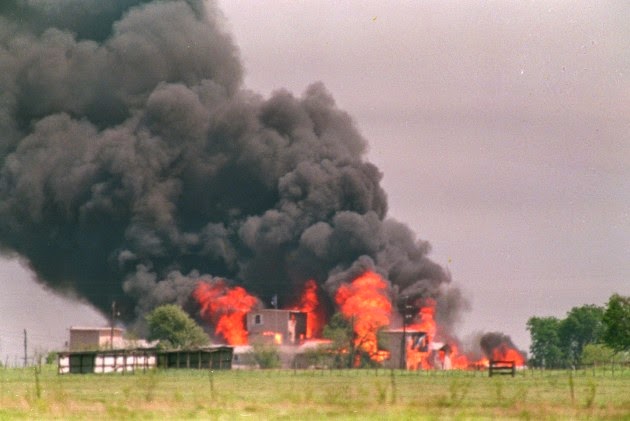
    And in fact, law enforcement has gone after armed whites before. In places like Ruby Ridge. And Waco. It didn’t end well.

    Janet Reno never apologized for the Waco killings. And liberals were shamefully silent (or downright supportive) about these events because, well, there was schadenfreude at seeing guns turned on them, for a change. But that didn’t make it right. You don’t have to like somebody to think they shouldn’t be assaulted (or assassinated) by the government!

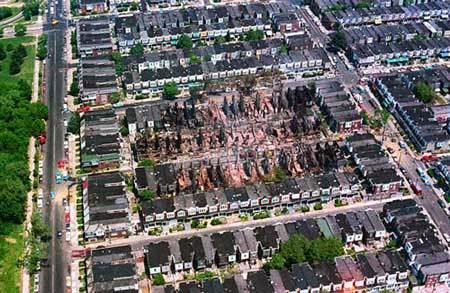
    And then there was MOVE. They were bad neighbors (and not white conservatives). And the law didn’t back down. How did that end up for the neighborhood?

    In the case of Cliven Bundy and his seditious friends, it’s fabulous the government backed down!

    What we saw here was law enforcement avoid a violent confrontation that was a lose-lose situation.

    Why? Because the alternative would have been bloodshed. Sure, it would have been their fault and their blood. But so what? (Though I imagine there is nothing more than some lefties might like to see more that cops and right-wing kooks killing each other — personally, I’d just settle for an interesting Venn diagram of those categories).

    But does it really take Bill O’Reilly to speak common sense and grill a Bundy supporter as to why his movement is any different than Occupy? Of course the right does a disservice to Occupy by comparing the two movements (For the record, Occupy has does much morein the public’s servicethan Bundy, and Bundy is destroying property), but there are similarities. Does it really take Glenn Beck to provide a voice of reason?:

    I don’t know who these people are. They all might be great. But here they are, they’re acting, they’re enraged, they’re enraged. And they’re confronting the federal government officials. I get that. But this is not the way to win…. I want to be clear, 100 percent clean on one thing all of us should agree on, and unfortunately, I don’t believe we do, both left and right. And that is, we need to agree on, we condemn those who use violence. Inciting violence doesn’t solve anything. I vehemently denounce anyone who even hints at such tactics.

    I suspect the law hasn’t given up on Bundy, it’s just some wise person saw a road leading to death and decided to take a different path. I suspect that Bundy will be prevent from trooping his cows over federal land in the not-too-distant future (at least I hope so). At the very least the government can put a lien on his land and take it when when he dies (hey, what’s the rush?). There are better ways of getting him to follow the law than starting a gunfight and making him, as required by his state’s constitution, pledge allegiance to the federal government.

    There’s this belief, too common in the conservative law enforcement community, that you can never back down. Sometimes a tactical retreat is just what is order. Live to fight another day. All the above (except maybe the MOVE situation) could have been resolved peacefully. Johhnie Law doesn’t have to get in a my-dick-in-bigger-than-your-dick pissing contest with every person who disrespects authority.

    The Bureau of Land Management and other involved law enforcement agencies should be applauded for their common sense and willingness to not make a bad situation worse. Rather then provoke a fight, they focused on preserving life and a goal-oriented style of policing. That is the take home lesson. Well done, Feds!

  • Laments of the Qualitative Researcher

    I don’t apply for many grants, in part because they’re so hard for a qualitative researcher to get. Ethnographic work and qualitative research isn’t taken seriously in a generally quantitative field. My research doesn’t follow the standard “theory, hypothesis, experiment, verify” model of hard science. Nor should it. But it’s hard to get grants or get published in Criminology if you don’t. (The quantitative/qualitative ratio leading journals is roughly a depressing 90%/10%.) So why is this work not valued in research grants and journal publications? I do my research the old-fashioned way: I talk to people. Perhaps it’s worthless research, but professors do assign my books to students. But why is the worth of qualitative research only recognized after the fact?

    [If you look at Amazon’s list of “best sociology,” you have to get to number seventy-six before you find one written by an actual sociologist! I would see this is a crisis of the field (even given issues with how Amazon classifies sociology).]

    So here’s my next book idea: I’m going to research and write an oral history of the Great New York City Crime Drop. Why? Because crime went down more than anybody thought possible, and there is still no academic consensus about what actually happened. It’s one thing to talk about Broken Windows and Compstat in theory. But I want to explain the crime drop from the perspective of the NYPD officers who were actually there. What police have to say may be profound. And nobody ever talks to the lowly beat cop. At least what they have to say will be revealing. And if nothing else, it should be a very good read.

    The grant rejections (I wanted money to pay for transcribers) were check-the-box, so I don’t want to read too much into specifics. And the single most important reason may be: “Proposal needs stronger organization or writing.” Had they just left it at that, I would said, gosh, maybe they’re right. That’s a good reason for rejection. I could have spent more time writing it. (But then, in a catch-22, I didn’t want to waste more than a few days writing a grant application that would probably be rejected…)

    It’s the other specific reasons that I have issues with, such as:

    • Proposal does not clearly state a testable hypothesis, goal or aesthetic vision

    Well of course there’s no clearly stated testable hypothesis because I’m not testing a hypothesis. It’s called Grounded Theory, if you want to get fancy (I don’t). I’m going to talk to people to listen to them and try and understand what they have to say. There’s no shame in that (nor, apparently, grant money).

    • Research methodology is underdeveloped

    I’m going to interview a lot of cops who worked the streets from the late 1980s to the mid 1990s. And then I’m going to write a book about it. Just because you don’t like that plan doesn’t mean it’s underdeveloped.

    • Proposal fails to convince reviewers of scholarly significance

    Murders in NYC decreased eighty-some percent and we, the so-called “experts” in the field, still can’t agree on a theory that has any practical use. If explaining the crime drop doesn’t have scholarly significance, I don’t know what does!

    • Proposal does not demonstrate sufficient understanding of the state of the discipline or field

    Really? This is my field, and I don’t think I’m an idiot. I guess we’ll just have to agree to disagree.

    I’ve done some pretty good research in my day. I’ve written good books and social science. But because I choose not to follow the hard-science model of methods and writing, I still feel like an idiot when my grant applications are rejected. It’s not so much the rejection that hurts (don’t “poor baby” me; I have thick skin). This wasn’t a large grant. And I’m good at research on the cheap. Still, it’s the stated reasons for rejection that make me throw up my hands in frustration.

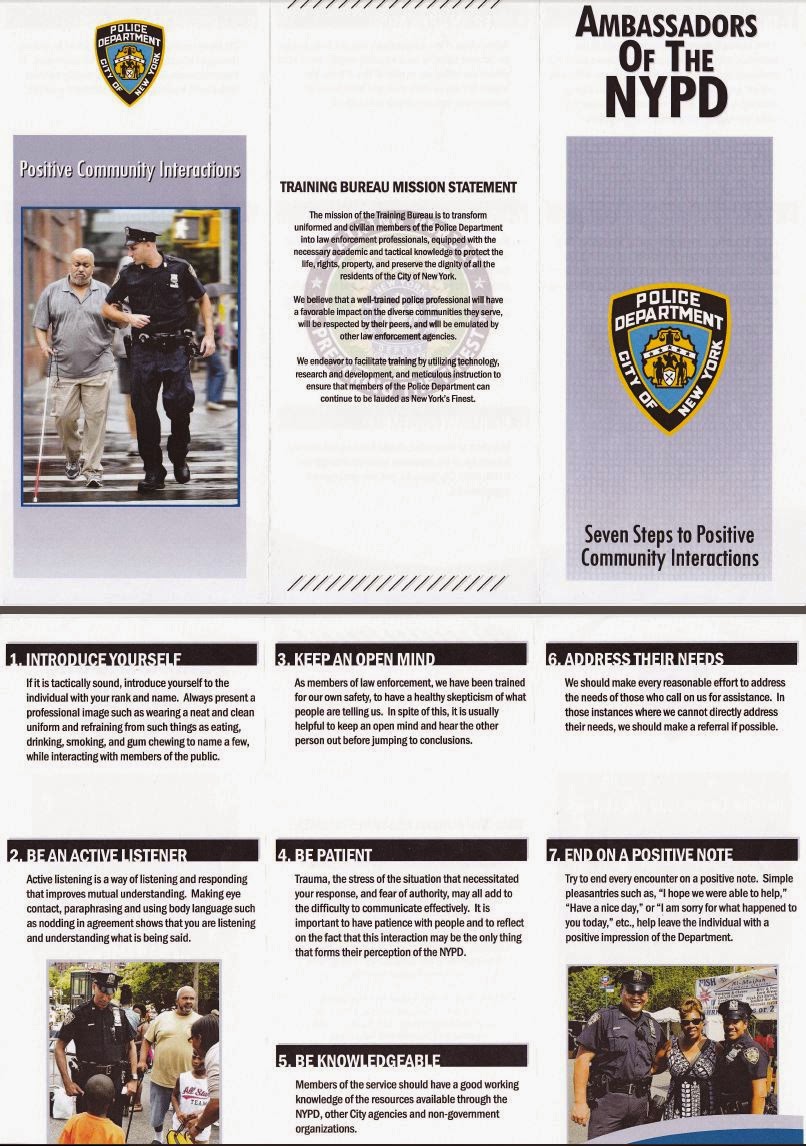
  • “Ambassadors of the NYPD”

    “Ambassadors of the NYPD”

    “OK, academy class, pay attention. Today we are going to learn the ‘seven steps to positive community interactions.’ OK? And, um, even though Number Seven says ‘end on a positive note’ — stop snickering in the back — you should not say ‘have a nice day’ after cuffing somebody.”