Tag: police culture

  • The DOJ is Right (4): The actual department is a mess (3/3)

    Update: The links have changed (oops!) since these were first published. Here are links to all my August 2016 posts on the DOJ report on the BPD.
    1 https://copinthehood.com/initial-thoughts-on-doj-report-on-2/
    2 https://copinthehood.com/the-doj-is-wrong-1-2/
    3 https://copinthehood.com/the-dojs-war-on-broken-window-2/
    4 https://copinthehood.com/cant-you-take-joke-2/
    5 https://copinthehood.com/the-doj-is-wrong-2-n-word-2/
    6 https://copinthehood.com/the-doj-is-wrong-3-that-damn-kid-on-2/
    7 https://copinthehood.com/the-doj-is-wrong-4-on-diggs-dig-2/
    8 https://copinthehood.com/the-doj-is-right-1-2/
    9 https://copinthehood.com/the-doj-is-right-2-actual-department-is-2/
    10 https://copinthehood.com/the-doj-is-right-3-actual-department-is-2/
    11 https://copinthehood.com/the-doj-is-right-4-actual-department-is-2/

    F) And then there’s the problem of recruitment and retention:

    It appears BPD’s staffing shortage will not be resolved in the short term. We heard from officers, supervisors, and command staff that many officers join BPD to gain experience in a high-activity environment, and after three to five years, leave the Department for less-demanding and higher-paid positions with neighboring agencies…. This is a significant drain on the Department’s resources, as these experienced officers, if they remained, would be the future leaders of the Department, and critical to the success of the Department’s law enforcement efforts. The Department also appears to be confronting challenges in recruiting qualified officers — it has only met a fraction of its goals for the 2016 Academy class. At least one of the Department’s background check processes — its psychological testing — has been investigated for allegedly rushing those evaluations, sometimes conducting psychological evaluations for aspiring officers in as little as fifteen minutes.

    I totally aced that test. I still remember my doctor’s name was “Doctor Outlaw,” which I still think is a cool name for a doctor interviewing cops.

    G) And equipment issues are more key than outsiders may suspect:

    Officers suffer from being supplied with outdated, broken, or in some cases, no equipment. As one officer noted to the Fraternal Order of Police in a focus group, “How am I supposed to pull someone over for having a taillight out when my car has two?”

    Officers have no computers in their cars, forcing them to return to the district station to type reports, and even those computers are often not working…. Taking officers off the street to type reports at the district takes away from time that could be spent on law enforcement or community building activities. It also creates inefficiencies for officers who often must write reports on paper in the field while their memories of incidents are fresh, and then type the same information into computer databases after arriving at the district station at the end of their shift.

    H) There’s good news and bad news about how easily some of these things can be solved:

    Despite its budgetary issues, the City of Baltimore will need to make an investment in its public safety facilities and resources to ensure that officers have the tools necessary to properly serve the residents and businesses of the City.

    The answer is money. Baltimore doesn’t have too much of it.

    Here’s the thing. Cops work in a shitty environment. They know that. But accountability ends above the civil-service ranks. Why is that? Where is the leadership and accountability on high? Nobody blames the bosses — the mayor and police commissioner in particular — for the dysfunction of the department they control. This does so much to lower morale. It matters. Low morale is so much of the reason some cops become burnt-out assholes on the street. Where does the buck stop? Certainly not with the lowly patrol officer.

    Now if your job were that shitty, you’d walk off. But police can’t. The show must go on. No matter how bad things get, police have to go out there and make the best of it. Radios die, car transmissions don’t work, your car gets a flat and there’s no spare, computers are down, your uniform splits at the seams, and now body cameras are another can of things that can break. Despite all of that, one thing is certain: cops will go and answer the next call.

    You can’t fight City Hall. Cops get blamed for bureaucratic nightmares that not only do they have no control over. This dysfunction screws good cops and there’s nothing they can do about it. You think cops like working with (the very small minority of really) bad cops? Hell, no. But the system has no way to get rid of them. So you make do. You have to. And then you get pissed off when one bad cop who should have never made it out of the academy, should have been fired, should not have been promoted — this guy? He actually admits his racist crimes, and somehow people consider him the good guy and blames everybody else who was forced to work through his misdeeds.

    I defend most police officers because I’ve been there. I’ve had to drive shifts with a car that couldn’t go faster than 20 MPH. I’ve had to fill out forms. I’ve had to deal with citizens calling 911 to lie about me, I’ve had to work with cops I wouldn’t trust as far as I can throw.

    So fix it, dammit. Good cops want to, but they can’t. They’re tools in this system. And yet every day they get up from their bad dreams and go to work. It doesn’t matter how bad things get, police will do their job, most of them professionally. If one thing is true is for police, it’s that cliche: “the show must go on.”

    Maybe this DOB report will improve the department despite itself. Though I might be wrong, I doubt it. I suspect people will ignore this key section and just focus on eliminating discretionary proactive policing that saves lives. If policing taught me nothing else, it’s that things can always get worse. Or, as has been said: “I have never seen a situation so dismal that a policeman couldn’t make it worse.”
  • The DOJ is Right (3): The actual department is a mess (2/3)

    Update: The links have changed (oops!) since these were first published. Here are links to all my August 2016 posts on the DOJ report on the BPD.
    1 https://copinthehood.com/initial-thoughts-on-doj-report-on-2/
    2 https://copinthehood.com/the-doj-is-wrong-1-2/
    3 https://copinthehood.com/the-dojs-war-on-broken-window-2/
    4 https://copinthehood.com/cant-you-take-joke-2/
    5 https://copinthehood.com/the-doj-is-wrong-2-n-word-2/
    6 https://copinthehood.com/the-doj-is-wrong-3-that-damn-kid-on-2/
    7 https://copinthehood.com/the-doj-is-wrong-4-on-diggs-dig-2/
    8 https://copinthehood.com/the-doj-is-right-1-2/
    9 https://copinthehood.com/the-doj-is-right-2-actual-department-is-2/
    10 https://copinthehood.com/the-doj-is-right-3-actual-department-is-2/
    11 https://copinthehood.com/the-doj-is-right-4-actual-department-is-2/

    C) It’s not like most police don’t want to make things better. They can’t. A lot this is systemic to any large bureaucracy in a poor city. But it’s not like cops haven’t tried to improve things. People care. But nothing seems to get better. The organization is dysfunctional:

    Individuals throughout the Department have highlighted that the Department needs to significantly improve its training program. For example, in 2012, the Fraternal Order of Police’s Blueprint for Improved Policing in Baltimore includes an entire section focused on training issues and recommendations. See FOP Blueprint for Improved Policing (July 11, 2012), at 6–8. More recently, BPD’s July 2015 Training Academy Needs Assessment provides a program analysis, describing major issues in personnel, curriculum, equipment and structures, and budgeting. It also notes that the Academy has been working to address some of these issues.

    And we don’t know what is happening because:

    Serious deficiencies in BPD’s supervision of its enforcement activities, including through data collection and analysis, contribute to the Department’s failure to identify and correct unconstitutional policing.

    D) And then we get to a failed discipline process:

    The system has several key deficiencies. First, BPD sets thresholds of activity that trigger “alerts” to supervisors about potentially problematic conduct that are too high. Because of these high thresholds, BPD supervisors often are not made aware of troubling behavioral patterns until after officers commit egregious misconduct. Second, even where alerts are triggered, we found that BPD supervisors do not consistently take appropriate action to counsel the officer, consider additional training, or otherwise intervene in a way that will correct the behavior before an adverse event occurs. Third, critical information is omitted or expunged from the EIS that could help address officer training or support needs or help prevent future misconduct.

    It is clear that the Department has been unable to interrupt serious patterns of misconduct. Our investigation found that numerous officers had recurring patterns of misconduct that were not adequately addressed. Similarly, we note that, in the past five years, 25 BPD officers were separately sued four or more times for Fourth Amendment violations.

    You might call that a red flag.

    E) Officers feel and are unsupported:

    BPD fails to support its officers through effective strategies for recruitment, retention, and staffing patterns, and does not provide them with appropriate technology and equipment.

    Specifically:

    First, BPD does not have a Department-wide plan to address staffing shortages in patrol; instead, each district deals with its own shortages independently. Districts address their staffing shortages by “drafting,” or requiring, officers to work additional hours after their regular ten-hour shift. Officers are “drafted” to work up to an additional ten hours after their regular shift, making for, potentially, a twenty-hour day.

    Officers we spoke with consistently informed us of the serious negative impact that drafting has on their morale. Additionally, the potential negative impact that drafting has on officers’ decision-making skills after working for up to twenty hours is equally troubling.

    This policy contributed to the death of my friend, who was killed in a traffic accident after many months of mandatory overtime and 12-hour shifts.

  • The DOJ is Right (2): The actual department is a mess (1/3)

    Update: The links have changed (oops!) since these were first published. Here are links to all my August 2016 posts on the DOJ report on the BPD.
    1 https://copinthehood.com/initial-thoughts-on-doj-report-on-2/
    2 https://copinthehood.com/the-doj-is-wrong-1-2/
    3 https://copinthehood.com/the-dojs-war-on-broken-window-2/
    4 https://copinthehood.com/cant-you-take-joke-2/
    5 https://copinthehood.com/the-doj-is-wrong-2-n-word-2/
    6 https://copinthehood.com/the-doj-is-wrong-3-that-damn-kid-on-2/
    7 https://copinthehood.com/the-doj-is-wrong-4-on-diggs-dig-2/
    8 https://copinthehood.com/the-doj-is-right-1-2/
    9 https://copinthehood.com/the-doj-is-right-2-actual-department-is-2/
    10 https://copinthehood.com/the-doj-is-right-3-actual-department-is-2/
    11 https://copinthehood.com/the-doj-is-right-4-actual-department-is-2/

    Mixed in with questionable methodology, intentions, and anecdotes, there’s some of God’s awful truth in this DOJ report. Yes, the department is a dysfunctional organization that keeps going only because of the dedication of rank-and-file who do their best, despite it all. (pp.128-139)

    A) Here’s how they describe the rule book, policies, or the book of General Orders I’ve already tried to describe. To say G.O.’s doesn’t follow “best practices” (pdf link) is an understatement:

    We found systemic problems with BPD’s method of drafting, distributing, and implementing policies that has made it difficult for officers to understand proper procedures and adapt to changing rules.

    This led the criminal prosecution (and acquittal) of officers.

    And there’s this (I know you might want to skim over this eye-numbing paragraph, but really read it to let it sink in):

    The Department has historically developed and published policies and amendments in a manner that officers find to be confusing and opaque. As many officers told us, the numbering system alone is a source of confusion. Generally, BPD policies have been organized with titles that included letters and numbers. During one period, however, the letter-and-number system was replaced with a system that included numbers alone. The new system only applied to newly implemented policies, however, and the majority of policies were still classified by letter-and-number. Policies from different eras are written in different formats, and often modified by annexes, memoranda, amendments, and rescissions, instead of replacing the old policy completely, making it difficult for officers to be confident that they had the current, complete policy.

    And this:

    While the policy manual has a table of contents [ed note: with no friggin page numbers; there are no page numbers! (Stab self in eye)], there is no index, and new additions and revisions can quickly make older manuals difficult to navigate. In fact, during our investigation, BPD was unable to locate one of its own amendments to disclose to us.

    And of course there’s a lack of any input from the rank and file:

    BPD likewise fails to provide officers the opportunity to provide input on the policy as it is developed. We spoke with many officers, including supervisors and others in positions of authority, who were frustrated by the lack of input they were able to have on policy development, including the policies developed in 2016. With nearly 3,000 sworn officers and another 1,000 personnel, BPD will likely receive conflicting input in addition to the helpful ideas generated if it seeks input from officers. Without seeking this input, however, BPD fails to learn critical lessons from the field, and, as importantly, it risks alienating its officers and undermining adherence to the policies it develops.

    B) And then there’s training:

    Indeed, BPD’s former director of the Training Academy released a needs assessment in 2015 that highlighted an “internal culture of placing training second,” “expectations for ‘rushed’ training,” and “outside pressure to condense training programs” as threats to the current program. See Baltimore Police Department Training Academy Needs Assessment (July 2015), at 5. Unfortunately, after the training director sent the needs assessment to BPD leadership, he did not receive a response for months. He also organized three different meetings with patrol commanders to begin making changes based on the needs assessment, but no commanders attended the meetings.

    Officers who had furthered their training did so because of their own personal interest or ambition, often using private funds and overcoming obstacles posed by supervisors or work schedules. Rather than encouraging additional training, supervisors view training as a peripheral activity that is consistently superseded by the need to keep officers on the street.

    And consider this about the BPD academy:

    The program lost about two-thirds of its staff over the past three years: training staff fell from approximately 60 in 2013 to 20 currently. During the course of our investigation, thirty classes had no primary instructor. Multiple training units, including the ones responsible for supervisor training for new sergeants and lieutenants, were entirely vacant with no personnel staffing them.

    The Fraternal Order of Police has also highlighted this concern, noting that class sizes for new recruit training have averaged 35–50 officers.

    BPD training facilities are in a similarly troubling state. During the course of our investigation, we were informed that BPD has only 17 computers available to train its nearly 4,000 personnel. The buildings themselves are in disrepair: water cannot be consumed from the faucets, and the buildings often lack workable air conditioning and heating. According to the Academy’s recent needs assessment:

    “The decrepit state of the academy itself gives the impression of a lackadaisical and uncommitted attitude towards the necessities of training the modern police officer. Recruits, sworn personnel, visiting law-enforcement experts, and civilians get the impression that they are party to a fly-by-night, poverty-stricken department when they find themselves in a crumbling, drafty building.”

    [Ed Note: And this is the “new” academy! No different in the “old” academy I attended on Guilford St. But at least in the old days we could drink the water.]

    You’d think the DOJ might have mentioned that a trainee was shot in the academy. I mean, it really doesn’t get worse than that. At the time the academy was on its seventh head of training in the last 19 months.

    [to be continued in posts 2 and 3]

  • On Felony Running

    [From pp.58-59 of Cop in the Hood]

    To meet the standards needed for a formal prosecution, one must follow the informal rules imposed by the state’s attorney. Rule number one is don’t take your eyes off the drugs. Drug charges against a suspect will not be prosecuted in Baltimore City if an officer fails to maintain constant sight of the drugs. A suspect fleeing from police will throw down drugs while running. An officer in foot pursuit must then choose between catching a suspect with no drugs and retrieving the drugs with no suspect. Officers generally will choose to follow the suspect over the drugs because— along with a personal desire to catch a fleeing suspect—arrests are a police statistic used to judge performance. Found drugs are not.

    After catching the suspect, the officer will return to retrieve the drugs and charge the suspect with possession, knowing full well that the charges will be dropped if the report is written honestly. But officers are rewarded for arrests, not convictions. If the drugs can’t be found–lost in weeds, scooped up by a bystander, or never there to begin with–the officer is in a bit of a bind, left with the noncrime of “felony running.” You can’t lock somebody up for drug possession without drugs. And after a chase, even loitering doesn’t apply. But the officer will find some crime, however minor If you run and get caught, you’re probably not sleeping in your own bed that night.

    [This is why Freddie Gray was arrested for a barely illegal knife].

  • Initial thoughts on the DOJ Report on policing in Baltimore

    Update: The links have changed (oops!) since these were first published. Here are links to all my August 2016 posts on the DOJ report on the BPD.
    1 https://copinthehood.com/initial-thoughts-on-doj-report-on-2/
    2 https://copinthehood.com/the-doj-is-wrong-1-2/
    3 https://copinthehood.com/the-dojs-war-on-broken-window-2/
    4 https://copinthehood.com/cant-you-take-joke-2/
    5 https://copinthehood.com/the-doj-is-wrong-2-n-word-2/
    6 https://copinthehood.com/the-doj-is-wrong-3-that-damn-kid-on-2/
    7 https://copinthehood.com/the-doj-is-wrong-4-on-diggs-dig-2/
    8 https://copinthehood.com/the-doj-is-right-1-2/
    9 https://copinthehood.com/the-doj-is-right-2-actual-department-is-2/
    10 https://copinthehood.com/the-doj-is-right-3-actual-department-is-2/
    11 https://copinthehood.com/the-doj-is-right-4-actual-department-is-2/

    My take away is that the report is 1/3 spot on, particularly in describing some of the dysfunction in the department (e.g. pp. 128-137) and some (but not all) of the abuses of Terry, 1/3 crazy and wrong (that goddamn 2007 kid on a motorbike is brought up as racist evil policing), and 1/3 bullshit and errors of commission (like the black power structure and majority-minority status of the city and police department).

    The optimist in me hopes it will be hammer that improves the department and the lives of police officers and Baltimoreans. The report brings up problems I’ve spent over a decade bitching about. So good. Cops don’t want to work in a dysfunctional police department. Maybe this will change that. (One can dream…)

    And I hate zero-tolerance policing. But today’s politicians are trying to pass the buck to the past for present failures. Stop blaming “the early 2000’s” for what is going on today. And those horrible O’Malley days when I was a cop? Crime and homicide were lower; and there were no riots. That should count for something.

    Too many of the examples of bad policing are A) good policing or B) completely misinterpreted/misunderstand on a situational and legal basis. And it bothers me because this isn’t an undergraduate paper I can correct. It’s the friggin Department of Justice! Of course some anecdotes are examples of bad policing. But take that that damn dragging a seven-year-old kid off his bike incident from 2007. That was an example of bad parenting (and bad reporting), not bad policing. If that’s used against police, I don’t know which anecdotes I can believe. Too many Terry Stops do become illegal searches. I know that. And too many cops are rude to people. I know that, too. Preach on and spread The Word. But is every damn complaint lodged against police God’s unalterable truth? Get real.

    I’ll write more later, but for now I’m going to cut and paste (with permission) from my good friend Leon Taylor. He grew up in the Eastern. We were exchanging emails last night as we were both reading the report until I finished and went to bed under the glow of rosy-fingered dawn.

    Police are a crime fighting entity, not a cost effective social outreach unit. Teach every officer that they police communities. Stop hiring white police who feel they’re some sort of heroes, and whose friends laud them for working in a “war zone.” Stop hiring Black Police who don’t understand that they’ll be disciplined more harshly than White Police.

    Will somebody please own up to the fact that the same politicians who criticize Police are responsible for bettering the communities that Police serve?

    The report only pays lip service to the real problem of socioeconomic disparity. People think of “The Police” as a faceless, soulless entity, when in fact, the “Police” experience more of the human condition than most scholars and politicians. You say “Stop Police Trauma”; I say “Stop Traumatizing Police.”

    Police everywhere are a direct reflection of the communities they serve. It’s extremely difficult to have a functional police department in a dysfunctional community. We need to stop using police as a societal band aid to cover wounds that require complex surgical procedures and intense rehabilitation. There’s no use touting police reform as the panacea to all of our social ills if that ends political reform. Political reform will have a lasting positive effect on the communities most at risk in this country.

    Fuck community policing. It’s just for show.

    And this:

    I know we try so hard to be cavalier about it, but the truth is we’re not staying up all night reading this document because we don’t care. Quite the contrary. We do. You can’t police Baltimore the right way and come away from it unchanged. You can’t forget what you’ve seen. I could sleep better if I could. And I can’t imagine how those charged to improve the quality of life for Baltimoreans can sleep at all.

    One one think “healing the city” would be a simple enough task, given the mayor appoints both the Police Commissioner and the Director of Public Safety. I mean, they do report directly to the Mayor’s office.

    Maybe the real issue here isn’t to investigate the police in Baltimore, but to investigate the other social services services in the affected neighborhoods. If they’re not up to par or non-existent, there’s no way the police service can be up to standard. The level of dysfunction in the community is simply too overwhelming.

    I’m reminded of former PC Batts, knocking on doors to talk to residents in high crime neighborhoods, never understanding, as any BPD rookie knows, that that’s a good way to get someone killed. I’m reminded of Mayor Rawlings-Blakes’ “those who wish to destroy” comment which precipitated the riots last year. Both are examples of presumably well meaning but woefully uninformed assessments of the realities of life in some Baltimore neighborhoods.

    Ferguson and Baltimore are two completely different situations, but both play extremely well to the masses. You can’t police Baltimore like Beverly Hills. Ideally, you should be able to — that should be the goal — but I’m too much of a realist to suggest it’s even remotely possible. I’m all for making things better, call it police reform, if you will.

    But we also need political reform. We need a societal overhaul to even begin to address the issues that drive violent crime in places like Baltimore. Where else in the U.S. (or the world) would anything less than 300 homicides a year for a population of 620,000 be cause for celebration?

  • Prequel to the DOJ BPD report

    Dan Rodricks in the Sun:

    Anticipating the Department of Justice’s release of its civil rights investigation, Davis clearly staked out a position as the man who is trying to fix the department’s broken relationship with large sectors of the community it serves.

    Getting ahead of police reform is no easy task, but it’s much easier than getting ahead of all the shooting.

    When Mosby dropped all remaining charges in the arrest and death of Freddie Gray, she stood on a street in West Baltimore and angrily accused certain police officers of sabotaging the state’s case. She went further than that, asserting that police officers have an “inherent bias” when they investigate fellow officers. … The takeaway from her screed was this: You can’t count on cops to investigate cops. “As you can see,” she said, “whether investigating, interrogating, testifying, corroborating or even complying with the state, we’ve all bore witness to an inherent bias that is a direct result of when police police themselves.”

    Turns out, as Mosby spoke, Cagle was going to trial for shooting a burglary suspect who had already been wounded by two fellow officers. Those two officers testified against Cagle for his use of unnecessary force. That this happened shortly after Mosby’s angry declaration was remarkable. Not only did the Cagle jury hear the testimony of two officers, Isiah Smith and Keven Leary, it saw clear evidence — literally, from an interrogation video — of an earnest investigation by the Police Department’s Internal Affairs Division.

    Mosby knows, sooner or later, she’ll be judged by the same standards by which she asked voters to judge Bernstein. While some Baltimoreans will reward her for prosecuting cops, many more, sick of their city being one of the most violent in the country, want to see her get convictions of murderers and rapists. She needs a full partnership with Davis to make that happen.

    I’m on page 90 of DOJ report. I’ll finished it before I go to bed and write something about it tomorrow. It’s late.

  • “One Police Shift: Patrolling an Anxious America”

    From the New York Times: “Riding along with officers illuminated fears they confront, compassionate gestures from the public after two recent ambushes against the police, and varied responses to the Black Lives Matter movement.”

  • Obama’s Dallas Memorial Speech

    I like Obama (as do most Americans). And I know he couldn’t win over all cops with his speech in Dallas at the memorial for Officers Zamarippa, Ahrens, Krol, Smith, and Thompson. I knew, and this turned out to be correct, that even before the speech was done Obama haters would find a line or two in his 4,000 words that “proved” Obama hates cops/whites/Christians/America or whatever. And of course Obama hatred immediately came through my facebook feed from the CAPLOCK-RIGHT. So that crowd will never like Obama. But I listened to his whole speech while walking around San Francisco. The text is here.

    I really wanted a speech I could hold over the haters and say, see, despite your ideological blinders, Obama said exactly the things you say he never said. Except Obama didn’t.

    Mostly I was disappointed that Obama implied a morale comparison between the death of Anton Sterling and the murder of these five officers at whose memorial he was speaking.

    I see people who have protested on behalf of criminal justice reform grieving alongside police officers. I see people who mourn for the five officers we lost, but also weep for the families of Alton Sterling and Philando Castile. In this audience, I see what’s possible.

    I see what’s possible when we recognize that we are one American family, all deserving of equal treatment. All deserving equal respect. All children of God. That’s the America I know.

    At this moment, I sincerely doubt the families of the slain officers give a damn about Anton Sterling. If you think those deaths are comparable, as some do, I respectfully disagree. But there’s a time and place for everything. And this was neither the time nor the place. Obama mentioned Sterling and Castile’s names more times than any of the murdered officers. This was a memorial service for police officers, not those killed by police.

    That said, there were many good parts in Obama’s speech that deserve highlighting:

    Race relations have improved dramatically in my lifetime. Those who deny it are dishonoring the struggles that helped us achieve that progress.

    That is quite a dig at protesters and lefties who deny the generally favorable arc of American history. And Obama keeps going:

    When anyone, no matter how good their intentions may be, paints all police as biased, or bigoted, we undermine those officers that we depend on for our safety. And as for those who use rhetoric suggesting harm to police, even if they don’t act on it themselves, well, they not only make the jobs of police officers even more dangerous, but they do a disservice to the very cause of justice that they claim to promote.

    Preach on, my president.

    We also know what Chief Brown has said is true, that so much of the tensions between police departments and minority communities that they serve is because we ask the police to do too much and we ask too little of ourselves.

    As a society, we choose to under-invest in decent schools. We allow poverty to fester so that entire neighborhoods offer no prospect for gainful employment. We refuse to fund drug treatment and mental health programs. We flood communities with so many guns that it is easier for a teenager to buy a Glock than get his hands on a computer or even a book. [Ed note: Even in Texas, the library does not loan free Glocks.]

    And then we tell the police, “You’re a social worker; you’re the parent; you’re the teacher; you’re the drug counselor.” We tell them to keep those neighborhoods in check at all costs and do so without causing any political blowback or inconvenience; don’t make a mistake that might disturb our own peace of mind. And then we feign surprise when periodically the tensions boil over.

    That was probably the best part. Obama should have stopped right there.

    Maybe the police officer sees his own son in that teenager with a hoodie, who’s kind of goofing off but not dangerous. And the teenager — maybe the teenager will see in the police officer the same words, and values and authority of his parents.

    OK. But the kids-will-be-kids part is not the big problem of policing. That speaks to working and middle-class America. But what about the teenager who doesn’t have parents? The kid who has nobody around of good values or authority? That is the problem. How are cops supposed to deal with armed young criminals? That’s what I want the president to address. He didn’t.

    I wanted more from this speech. And I wanted the president to better honor the officers at whose memorial he was speaking.

  • Low Police Morale (or: the more things change…)

    Last night a police captain said:

    I’m in the Department and had better keep my mouth shut. But I must candidly say that I have never known the Police Department to be in such a bad state as it is it right now. One day we receive one imperative order, and on the next another quite different, so that we hardly know what to do. And because we can’t do everything we are criticized by everybody and abused by every ragamuffin. It’s nothing but “orders,” “orders.” And so many orders make nothing but disorders.

    However I’d better not blab — what right have we to blab? — we’re in the Department. But it’s enough to make one swear. As I said before, we’re pitched into by newspapers and by everybody.

    Every complaint against a policeman, no matter how foolish, must be taken down by the clerk and investigated, because he has been ordered to do so.

    But then I won’t say a word. I’m in the department. There may be a reporter about, so I’ll shut up.

    –“A Grumbling Police Captain.” New York Daily Times, Feb 2, 1856 (lightly edited)

  • 10 shootings a day: This is the homicide problem

    10 shootings a day: This is the homicide problem

    The Chicago Tribune has an excellent articlethat starts on the West Side [2 miles from this house]:

    To understand Chicago’s violence, start at Kostner Avenue and Monroe Street and walk west up a one-way stretch of graystones and brick two-flats. There on a boarded-up front door you’ll see the red stain of gang graffiti. On the cracked sidewalk below lies an empty heroin baggie. Hardened young men sit on a porch.

    This single block on the West Side — part of the Harrison police district — has been the scene of at least six shootings so far this year

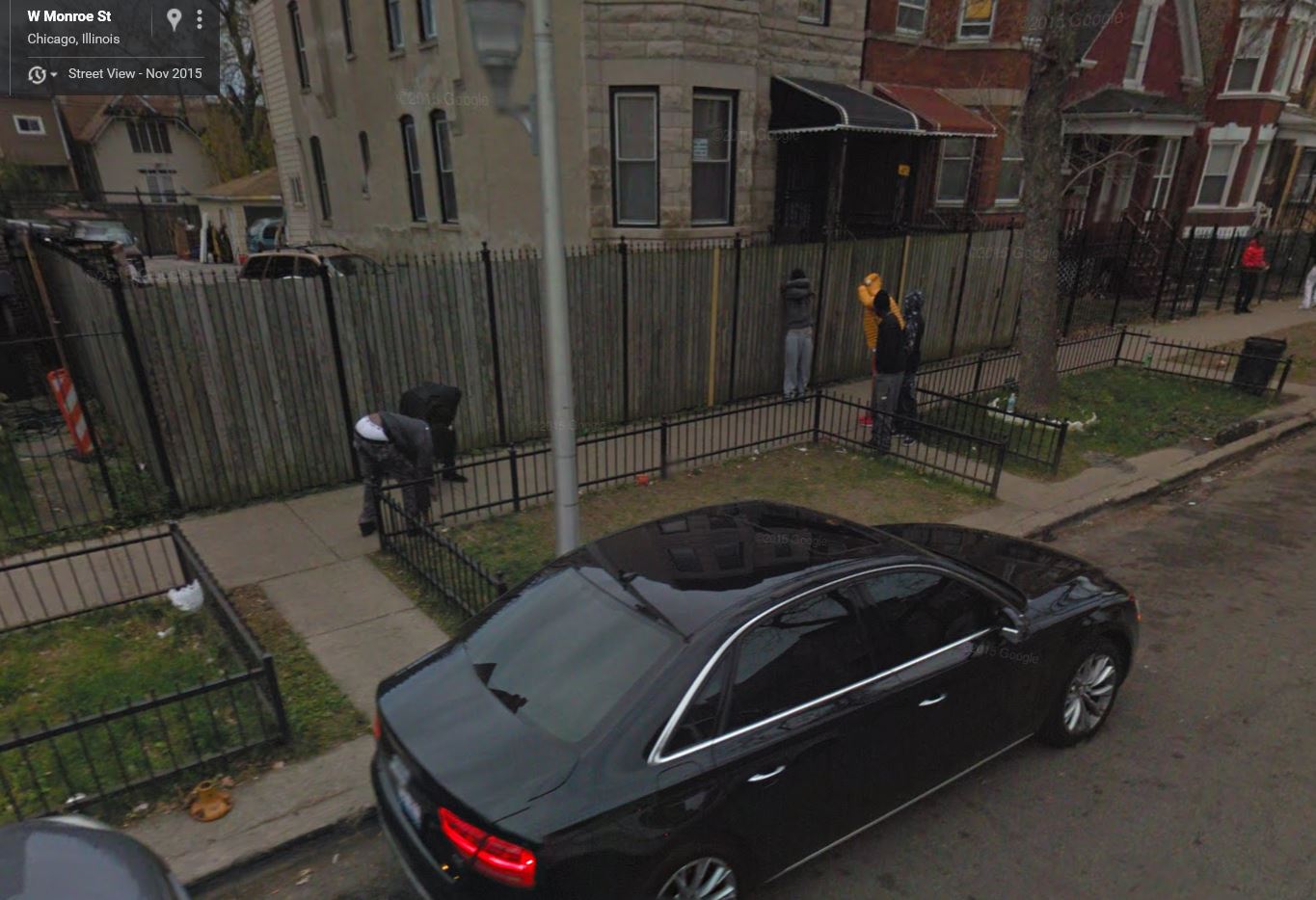
    My father grew up in this neighborhood, a mile away on North Avers Ave. The Greeks are long gone, of course. My father’s family moved to Albuquerque in 1947. I checked Google street view for that block of six shootings:

    These guys are totally not cool with the google car taking their picture.

    Think they’re up to no good?

    Kind of cracks me up.

    Here’s the thing. Those guys you see. Them. There. In that picture right there above. Those guys in front of that fence? They are the problem! Sometimes it really is that simple. Seriously. It’s not rocket science. There they are.

    And police officers know that. But now what?

    Chicago cops aren’t stopping these guys anymore because, well, why should they? The ACLU sues cops and the Chicago Police Departments for stopping six black guys who are just minding their own business:

    All this has led many officers to feel unsure about stopping anyone. Just this week, the president of the police union said many officers feel that “no one has their backs.” Other veteran officers agree that Chicago cops are dispirited and have slowed down on the kind of proactive policing that can remove a gun or criminal from the street.

    The makeup of Chicago’s gangs has changed dramatically over the years. They once were massive organizations with powerful leaders and hundreds of members who controlled large chunks of territory. Now small cliques battle for control over a few blocks.

    Experts also agree that personal disputes increasingly are playing a role in the violence. One veteran cop recalled with disbelief recently how a slaying he investigated boiled down to an insult over shoes.

    Police also said so-called net-banging on social media fuels conflicts. Gang members have been known to post menacing videos on YouTube, showing them furtively entering rival territory, waving guns and issuing threats.

    Ranking officers say reports from the field indicate more gang members are being caught carrying guns than in the past, a troubling trend that could explain in part the surge in shootings.

    Morale plummeted as officers expressed concern about their every move being captured on smartphone video, a Tribune story reported earlier this year. Some have suggested that officers became hesitant to make street stops and arrests for fear of backlash.

    Dean Angelo Sr., president of the Fraternal Order of Police, said street stops had plunged by 150,000 so far this year, but he blamed the more extensive paperwork that officers must fill out this year for every street stop.

    Another veteran cop said the forms are so complicated that they take as long as an hour to fill out, keeping officers from street duty and leading many to reconsider whether a stop is worth the effort. It’s affected the department’s ability to gather intelligence on gangs, he believes.

    The ACLU has disputed the notion that fewer street stops contribute to spikes in violence.

    Of course they have. But the ACLU is wrong. Dead wrong. Look, if you want to argue that these young men shouldn’t be stopped at all, fine. You agree with the ACLU (and don’t live on that block or hear the gunshots). And the ACLU is right in criticizing police who stop people for the sake of making a stop.

    As a cop you don’t (or shouldn’t) harass everybody walking down the block. You harass these guys on this block. And by “harass” I mean, within the law and constitution, make it little less fun for them to hang out in public and sell drugs. Yes, you as a cop give these guys a hard time. Is that fair? Yes. Because there have been six shootings on this block this year. Is it racist? No. Because these guys are the problem.

    If you’re a cop, you need to ask a bunch of questions 1) do you know these guy are slinging and shooting? 2) Should you stop these guys? 3) Are they committing a crime? 4) Are they a Broken Window? 5) What legal basis do you have to stop and frisk those guys?

    [The answers are 1) get out of your damn car and talk to them, or at least watch them disperse in your presence, 2) yes, 3) no, and 4) yes. 5) very little at first, but you can build it, ask for a consent search, or conduct a Terry Frisk.]

    You pull up to them. See what they do. You can crack down on this group by enforcing Broken Windows quality-of-life crimes. You get to know who they are. You can use your discretion and ticket them for something — drinking, smoking joints, jaywalking, littering, truancy, spitting — whatever it takes. You can arrest them when they can’t provide ID (they can’t, trust me). You can harass these criminals legally and within the bounds of the constitution. This is what police are supposed to do. It’s how homicides are prevented. It’s how some kids stay out of gangs. But if cops do their job, then we, society, need to support police officers against inevitable accusations of harassment, racism, and even discourteous behavior in their confrontations with these criminals.

    As a cop you will not win the war drugs, but as long as drugs are illegal you need to fight the fight against pubic drug dealing. But we’re telling cops not to do this. In Chicago cops are listening. And so are the criminals.