Tag: police culture

  • What you learn on the job

    I compiled a little top ten lost of things police learn on the job. You can see it at Criminal Justice Programs.com.

    Peter Moskos is a former police officer and author of the popular law enforcement blog, Cop in the Hood (www.copinthehood.com). He is currently a professor of law and police science at New York’s John Jay College of Criminal Justice, where he specializes in police culture, crime prevention and ending the war on drugs.
    It should go without saying that policing isn’t like what you see on TV shows and in the movies. But it’s not so easy to learn what policing islike. Here are a few of things I learned policing the streets of Baltimore’s Eastern District.

    1. Policing is really about the men and women you work with. People are willing to risk their lives for you—it’s a powerful feeling.

    2. Despite what police say, officer safety is not the number one priority. If it were, you’d never leave the police station. Danger is part of the job.

    3. The job can be dangerous, but it’s the drudgery of routine that wears you down.

    4. On the street, everybody lies. Some of the lies are more entertaining than others!

    5. To cops, overtime is like a drug. It’s something you’ll crave, and something that influences far too much of what you do on and off duty.

    6. Interactions with the public go much better when people show you their hands and sit still when asked.

    7. Policing is a job like no other. But, when the day ends, it is just a job. Don’t take things personally. Even when other people want you to. Especially when other people want you to!

    8. If they call for a doctor in the house, you might be the next best thing.

    9. You’ll be amazed at the things you laugh at. Anything can be funny… at least to a cop. And if you didn’t laugh, you’d cry. Laughing is much better.

    10. You won’t save the world, but you might save somebody’s life. What other job can offer you that?

  • You can’t make this stuff up

    One of the funnier (at least if you’re a cop) police reports you will ever read. [I’m warning you, it’s not suitable for kids] The report is here and a story about it is here. (By the way, despite what the story claims, I’m sure the actual line has been in many police reports.)

  • Police Office Saves Life

    This is a headline you don’t see enough and should see more.

    Here’s a BBC video from Madrid that is pretty great.

    Sure, everybody can wave all they want. But it takes a cop, an off-duty cop in this case, to jump on the tracks and actually do the right thing.

    [p.s. Why do trains in Madrid drive on the left?]

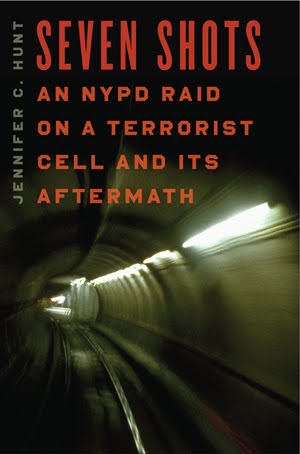
  • Seven Shots

    Seven Shots

    I read this book by Jennifer Hunt. I loved this book. I’ll tell you more about this book… but only when I’m done writing mybook.

    On July 31, 1997, a six-man Emergency Service team from the NYPD raided a terrorist cell in Brooklyn and narrowly prevented a suicide bombing of the New York subway that would have cost hundreds, possibly thousands of lives.

    In the meantime I’ll leave you with my breathless blurb they put on the back of the book (I had an advance copy):

    Seven Shots uncovers the stories, rivalries, and human beings behind the New York City police officers who defused the subway bomb attack that foreshadowed September 11th. With unparalleled access, Hunt uncovers the never-before-told stories of heroism, September 11th, and petty rivalries that drive and destroy life in the NYPD. This is a true-life crime story that shows, warts and all, the unrequited love of good police officers toward an organization that doesn’t love them back. At times gripping, tragic, and theoretical, Seven Shots penetrates deep into the police world. Seven Shots vividly brings me back to my own policing days with laughs, tears, excitement, and adrenaline-filled moments of sheer terror. A groundbreaking, page-turning work.

    [I just wish they had edited the redundancy out of the “unrequited love… toward an organization that doesn’t love them back” part. There’s no other kind of unrequited love. Things like that bother me more than they probably should.]

    It’s a great book and a wonderful ethnography with amazing insight into the police culture. Plus it tells a story about a big bomb that almost wan.

    You can buy it here.

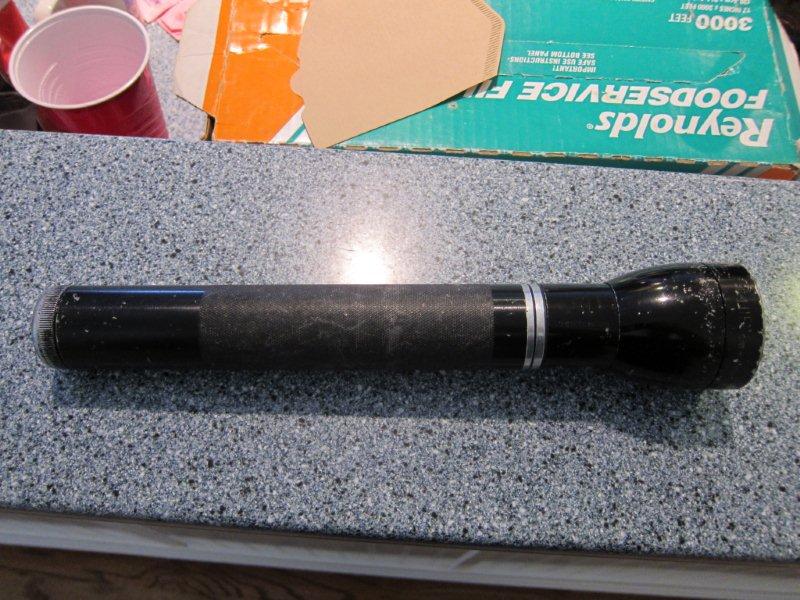
  • A well worn Maglite

    A well worn Maglite

    “My God,” I said on seeing this over the weekend, “how many people you hit with that thing?”


    “A bunch!”

    He reckoned he picked up this baby in 1985. It got twenty years of service after that. When I was police, this gentle and soft-spoken man had been a cop longer than I’d been alive.

    And over it his home on the Eastern Shore this weekend, a few of us, including about half a dozen from my old squad got together and ate crabs, drank beer, and told stories. A good time was had by all.

    Before:

    After:

    And here’s a shot from the pier at night. The stars at night are big and bright, deep in the heart of Delmarva.

  • A Slow Work Day at the FBI

    The FBI has slow work days? I kind of hoped they were pretty busy. But I guess we all have slow work days. But when I have a slow work day I like to listen to a Cubs game or write blog posts or play pinball.

    But when the FBI has a slow work day… well the the Justice Department’s inspector general has released a pretty damning report about FBI work on domestic terrorist organizations. Specifically a 2002 rally in Pittsburgh sponsored by a nonviolent anti-war group was “An ill-conceived project on a slow work day.”

    Did it really start with two agents, feet up in the office?

    “What do you want to do today, Marty?”

    “I don’t care. What do you want to do?”

    [Kudos to anybody that can tell me where that line is from. I don’t know and get this: can’t find it on google! It’s probably a movie from the 1950s as I learned it from my dad. Update: I figured it out. It’s from the movie Marty. Google wins again.]

    “We could keep an eye out on the war-protesters. They’re probably up to no good.”

    The New York Timesreports:

    The IG also concluded that the factual basis for opening some investigations was factually weak and that in several instances there was little indication of any possible federal crime, as opposed to state crimes.

    Regarding the Pittsburgh rally, controversy erupted in 2006 over whether the FBI had spied on protesters at the event several years earlier because of their anti-war views.

    At the time, the FBI issued a news release saying the surveillance had been based on an ongoing investigation.

    FBI Director Robert Mueller told a Senate hearing that the bureau had been trying to identify a particular individual believed to be in attendance.

    Turns out that was not true.

    Why does this matter? Well the Timespoints out that, “Domestic terrorism classification has far-reaching impact because people who are subjects of such investigations are normally placed on watchlists and their travels and interactions with law enforcement may be tracked.”

    My issue is more primal. Every time I hear that anti-war protesters and pacifists are considered a national-security American threat, I reach for my gun. Especially given the FBI’s has a long and shameful track record of investigating “subversives.” Certainly that was the case under J Edgar Hoover. But we’ve moved on, haven’t we?

    And I also have a much more basic complaint. The FBI, part of the Executive Branch, is not a police force (no matter how much they act like one on TV). The line between local police and federal law enforcement can at times seem like very fine line indeed. But it’s an important distinction to keep. For starters it’s a constitutional issue. But it’s also important because local police can be held accountable to local (and state and federal) politicians. And because law enforcement is supposed to be work for us and not become a domestic spying organization.

    Truthfully, I don’t mind the FBI investigating subversives. What I mind how this category is defined. Why do liberals and pacifist seem to get a lot of attention? I mean, you may not agree with them, but pacifists are, well, pacifist. And it just so happens that these anti-war folk (myself included, though I’m not much of a protester) happened to have been right. Maybe the FBI should spend more time investigating those who want to get us into these wars.

    [Since I’ve been around, off the top of my head I can think of US troops occupying, bombing, or invading Kuwait, Iraq, Panama, Grenada, Serbia, Afghanistan, Somalia, and Lebanon (I’m sure I’m forgetting one or two). Did any good come from anyof these? Maybe. But it’s damn hard to make an argument that good has come from all of these collectively.]

    Does that make me suspicious? Maybe. I guess it makes me a liberal. And I suppose the FBI, like most law enforcement, is basically conservative and suspicious of liberals.

    [I just thought of this one: You know you’re a liberal when… the thought of Michael Moore as president scares you less than Sarah Palin.]

  • College-Educated Cops

    I had a BA and all the requirements of a Masters’ Degree when I was a Baltimore cop. And now I teach some NYPD and many students who want to be police officers. So I am a bit partial to the idea that college is good for everybody, cops included (or else what am I doing in my school office at 10:30pm?).

    But I worked with many great people and police officers who had nothing but a Baltimore public education high-school degree. I know you don’t need college to police. But I like to think that college makes you a better person and being a better person makes you a better police officer.

    Anyway, a recent study shows that college makes cops less quick to use force.

    Rings true to me but I’m not sure why. Perhaps, if nothing else, college means you’re older when you join the P.D. And that makes you wiser. But I also like to think that college and college class helps teach people how to talk respectfully to people you don’t agree with. That’sa good tool for a cop.

  • Inner-Harbor Cop Fired

    This is the officer (not “man” or “dude”) who got pissed at a young white skateboarder.

    Peter Hermann reports:

    Last month, a three-member police panel called a trial board held a hearing and found Rivieri, a 19-year veteran, guilty of failing to issue the youth a citizen contact receipt and failing to file a report, but not guilty of using excessive and unnecessary force and uttering a discourtesy.

    The panel recommended that Bealefeld suspend Rivieri for several days. But Bealefeld has the discretion to up the penalty, and he opted to fire the officer whose actions were displayed on video and seen around the world.

    Three years after it happens the guy gets fired? Is there more I don’t know? Seems way too harsh to me.

    I wrote about the incident here.

    We don’t know what happened before the video starts. … Did the cop already tell the kids three times to stop skateboarding in the Inner Harbor? Did the kid flip off the cop right before the video starts? I think there are lots of possible situations that could justify the cop’s behavior.

    Now let’s say, for the sake of argument, that the video shows the whole story. If that’s the case, then the officer handled the situation horribly. If your goal is to get three kids to stop skateboarding, there are much better ways to do it.

    Still, sometimes a person does need a lesson. Sometimes an arrest isn’t appropriate. Or legal. So as good police, you’ve got to put on an act: yell, threaten, cajole, lecture. All these are part of the job. But it’s important to have an objective when you deal with a situation. Then you have to figure out the best method to achieve your goals. Yelling for the sake of yelling isn’t good policing.

    I heard a lot of cops talk like this when I was on the street. Sometimes it wasn’t needed, but sometimes it was. If you fired every cop who ever talked like this, you’d have about six cops left in the Eastern, and I wouldn’t be one of them. Sometimes this language and attitude is needed. Probably not in this case… but who am I to say?

    Rivieri gets to keep his pension, right?

  • Like Father Like Son?

    It’s yesterday’s news that Adrian Schoolcraft is suing New York and the NYPD for $50 million.

    It turns out, amazingly, that this isn’t the first Schoolcraft vs. P.D. lawsuit. No, it’s not the first. It’s not even the second.

    Turns out that Adrian’s father, Larry Schoolcraft, was also a police officer. In Fort Worth, Texas, I believe (though the Village Voice says Dallas). It seems that, like Adrian, after seven or eight years, Larry didn’t leave the police department on good terms, either.

    Schoolcraft v. City of Fort Worth was filed in 1999. Whatever it was about, it must have been for pretty big bucks because the city first budgeted $145,000 and then another $65,000 (1,2,3) for its legal defense. In 2000, Schoolcraft’s petition for review was denied by the Texas Supreme Court. I guess Larry lost.

    The Schoolcrafts have suffered a lot of loss.

    Larry Schoolcraft moved to upstate New York. Adrian Schoolcraft joined the NYPD in 2002 and hit the streets in 2003. A few months later his grandfather, Larry’s father, died. Soon after that Larry’s wife, Suzanne, died, either in 2003 from cancer or in 2004 from a stroke.

    A few years pass.

    Then in 2007, police got a call for a drunk man at a convenience store. Officers respond and decided the man, Larry Schoolcraft, can’t drive. Being a small town, they drove him home. Two or three days later, power company employees saw Larry passed out on his porch. It was cold. They called 911. Subsequently Schoolcraft sued the police. The local paper, the Leader-Herald, reported:

    The lawsuit filed April 15 claims Schoolcraft suffered permanent injuries because he was left outside in the cold.

    Schoolcraft’s attorney, James. W. Bendall, said his client had to be hospitalized and required surgery. Some of Schoolcraft’s muscles were permanently damaged because of exposure, the suit claims.

    Schoolcraft, who is in his 50s, was groggy because of some medication he had taken, his attorney said.

    The lawsuit claims deputies simply brought Schoolcraft to his porch [and left him there]. … Deputies claim they brought Schoolcraft into his home.

    Schoolcraft… had no memory of what occurred… [and] found out what had happened when his son, a New York City police officer, came upstate after receiving a call that his father was in the hospital.

    Out for two or three days in freezing weather? That’s some medication.

    No matter, after the 2007 incident, Larry went to live with his son Adrian in New York City. In February, 2008, Adrian’s maternal grandfather died. Two days later Adrian’s paternal grandmother dies, too.

    A very rough month. It might even be enough to push me over the edge.

    Two months after the death of his mother, Larry Schoolcraft filed his lawsuit against the Montgomery County Sheriff’s Office. Six days after the Leader-Herald wrote about the lawsuit, the paper ran another story, this one about how Larry’s home had been broken into eight months earlier, back around September, 2007, after Larry went to live with Adrian in NYC. Among the stolen goods, Larry Schoolcraft says, were the ashes of his wife and the couple’s infant son, who he says died shortly after being born in 1988.

    If it weren’t for bad luck, they’d have no luck at all. But at least they had each other for support. Through thick and thin, through all their misfortune, father and son, living together, probably spent a lot time talking, mourning, recovering, and perhaps the subject of police departments came up and just how unfair life can sometimes be.

    On June 1, 2008, just six weeks after Larry files his last lawsuit against the police, Adrian starts secretly recording conversations that will become the basis for his first lawsuit against the police.

    Maybe it’s all just coincidence. Who am I to say? But I’d love to know what Larry’s lawsuit in Fort Worth was about. I mean, wouldn’t it be something if Adrian’s lawsuit against his police department in New York just happened to be similar to his father’s lawsuit against his police department in Fort Worth a decade earlier? Wouldn’t that really be something?

    (Update with working links to all the posts on Schoolcraft.)
  • Al Baker steps to the plate… It is high, it is far…

    …It is gone!

    Al Baker clears the bases and the New York Timesis back on top!

    Al Baker is a man I don’t know. Never met him. Never spoken to him (at least I don’t think I have). But I know his name because the man is good reporter on the police beat for the New York Times. When I see Al Baker’s name on the byline, I know I’m going to get a good story with no B.S.

    Without fanfare, Baker (perhaps suspiciously eying the journalistic wreckage left by his colleagues) steps up the plate and hits a home run. Maybe he had the weekend off, but better late than never.

    Kudo’s to you, Mr. Baker. Well done, as usually. And thanks for not quoting anybody’s mom.

    Seriously, though, this is what I want in my news story. Real reporting. Not easy quotes. Compare Baker’s writing to the earlier articles. It’s like night and day. As a sportscaster might say, “All you young journalists out there, take note. This is how you play the game!”

    [p.s. Am I getting old? If I said, “It could be… It might be… it is!” Would anybody still get that home-run-call reference?]