In June, Ford Motor Co. invited the heads of some of the nation’s largest police fleets to Dearborn to talk about the future of police cars.
For nearly two decades, that market has belonged to Ford’s Crown Victoria — a vehicle that departments from coast to coast have come to respect for its toughness and reliability. Now the Crown Vic is running out of road.
“They told us that 2011 would be the last year they build the Crown Vic,”
…
About 85 percent of the approximately 75,000 police cars sold in the United States each year are Crown Vics.
The Crown Vic has my car (it’s also the NYC cab). There was still one or two Chevy Caprices rattling around, but they were in sad shape. Now you see a fair number of Chevy Impalas.
Back in Baltimore, I was warned that front-wheel drive isn’t practical here because they’re not as tough. And nothing in the world is driven more roughly than a non-take-home cop car.
As a cop, I was shocked by how horrible Crown Vics handle. Especially in the rain or snow, you really had to be really careful. Plus they’re big, which makes them harder to get through tight spaces and alleys. In Amsterdam, the cops had souped-up Volkswagen Rabbits. Not very American, but man those things could fly.
Police are and should be held to a higher standard. But I’m pretty much an absolutist when it comes to free speech. I don’t think you should be fired for what you do and say at home.
(But on the other hand I wouldn’t want a nazi or klan leader to be a police officer. Even if they argue that they can keep their private life and beliefs separate from their job performance.
We all say things in private that would be inappropriate, insensitive, and offensive if taken out of context or said in public. I know I have. But this guy was an idiot. I mean, first he writes an offensive comment to a columnist and then he forwards it to all his friends in the National Guard. So it wasn’t exactly private anymore. But I still think it’s free speech. But then what should the police department do? Doing nothing doesn’t seem like the answer, either.
Here’s the story by Maria Cramer in the Boston Globe.
Should being an a-hole to police get you locked up?
Seriously.
Remember, being an a-hole isn’t technically a crime. But many people have talked their way into handcuffs. Police can always get you for something.
I ask this because my wife seemed vaguely bothered by this concept. But it doesn’t bother me.
John Van Maanen wrote the classic academic piece appropriately titled “The Asshole.” Some of it is a bit dated now (it’s from 1978), but the core concept holds true. Police label people as suspicious persons, know-nothings, or assholes. Assholes are likely to get locked up (in Van Maanen’s time, beaten).
More recently Southpark’s Cartman said, “This will teach you to question my authoritay!” And Chris Rock’s “How Not to Get Your Ass Kicked By the Police” always deserves another viewing.
Now Rock, like Van Maanen, talks about getting your ass kicked. But the same applies to getting arrested for some B.S. charge. I honestly don’t know how police could do their job if they didn’t have a “catch all” offense to lock you up (but of course you need smart police officers to use and not abuse this discretion).
Seems like you should treat everybody with respect–strangers, waiters, employees in stores–but of all people you should treat with respect, a police officer with a gun, handcuffs, and the legal authority to put your ass in jail should be pretty high on the list.
In the old days, if you were a jerk to the police, they might beat you. That doesn’t happen much anymore. Ultimately cops have handcuffs. Handcuffs–and not, as Bittner once said, the use of force–handcuffs define the function of police.
But what are you supposed to do as a cop if somebody will not respect your authority? Look, if I tell a drug dealer to leave a corner and he says, “f*ck you.” He’s got to go. What is a cop supposed to do when verbally confronted? You can’t through down and play the dozens.
Every police/public confrontation ends up in one of three ways: the suspect must 1) defer to police authority, 2) leave the scene, or 3) get locked up. Right or wrong, there really is no other choice. Not that I can think of.
Generally, I had a pretty high-tolerance (at least by Baltimore cop standards) for taking sh*t. I’m a pretty mellow guy. Sometimes I would just laugh. I did not have a chip on my shoulder and I didn’t want to lower myself to ghetto standards. Other cops would be quicker to take things personal.
But if you questioned my authority? Well, ain’t nobody gonna punk me. Not when I was working. Cops can’t lose face. Period. To do so is dangerous if you ever have to walk those streets again.
I didn’t see it as my job to teach people respect. It was usually too late for that, anyway. But if you wouldn’t respect me, you would at least obey me. If I had to get in your face, so be it. Better to feared than loved, cops will tell you. I don’t buy that. Better to be obeyed than feared, I say. When people are afraid, they strike back when cornered.
But sometimes you have to make people think you’re crazy. Make them think you hate them. Make them afraid. I reserved that act for special occasions.
[Why do you think so many cops shave their heads? I did, too. Looking like a skinhead might not be good for community policing, but it can make a criminal think twice before wanting to fight you.]
As a cop, I didn’t want to be loved. I didn’t mind being feared. I did want to be respected. But all that really mattered to me was to be obeyed.
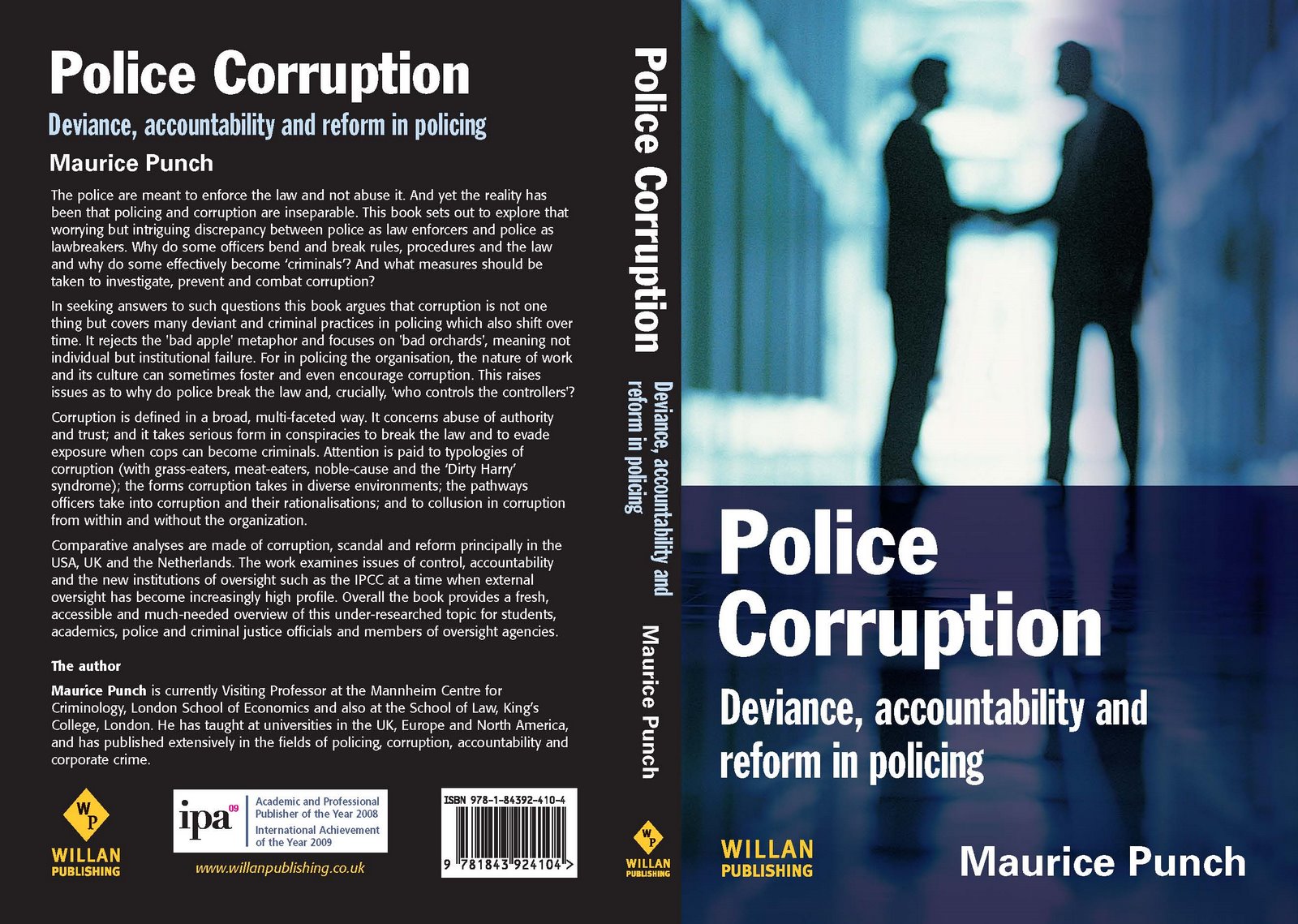
More than anybody else, Maurice Punch inspired my policing career (well, maybe Punch and John Van Maanen share top prize). Punch’s wonderful and classic study of the Amsterdam Police, Policing the Inner City inspired me into the whole police business, especially my research in Amsterdam.
Not only can Punch write, but we was always very helpful to me and willing to meet with me whenever I was in Amsterdam. Our semi-annual meetings were always the highlight of my trip to Amsterdam (and Amsterdam has some pretty tough competition when it comes to highlights). And Punch was helpful to me when I was just a young egg-head whipper-snapper with no research or writing or real work to my name. Without a doubt, were it not for Maurice Punch, I would not be where I am today as a professor, former police officer, or published author.
Now if all this sounds like shameless promotion for a friend… well it is. But I’d also be promoting this book even I didn’t know Maurice. It’s an excellent book and really does delve, smartly and with respect, into the complicated world of police corruption.
Punch’s short Zero-Tolerance Policing is also a gem that highlights the impact and transition of broken-windows policing in the U.S. to zero-tolerance policing in the U.K. and the Netherlands.
Come to think of it, I think I still owe Maurice a review of Zero Tolerance Policing. Luckily for me, not only is Punch very smart and a good writer… he’s very forgiving.
I was required to carry my gun off duty within the city limits and permitted to carry (and did) within the State of Maryland. So yes, I carried my Glock 17 when I went jogging and when I took out the trash.
Generally it’s strongly discouraged for police to take action off-duty (in the next post there are some comments on the subject). But deep down the city seems to like the idea of off-duty cops being like plain-clothes cops working for free. It’s one of the reason many police don’t like to live in the city they work.
Outside of people pissing in my alley (which happened to be the only way I could enter my apartment), I rarely if ever took police action off-duty.
One time I parked outside Whitey’s Newsstand on Broadway–I had a little side-business buying and selling vintage 1960s “adult” books (ie: smut paperbacks)–and a well-dressed hispanic guy came up to me offering to sell me weed. I think it was something about the TransAm I drove that made people think I was a good target.
I politely showed him my badge and gun and in no uncertain terms told him how that was very bad idea. But I didn’t take any police action. I didn’t want the hassle. But it sure would have been an easy lockup. He apologized and explained how he “didn’t mean any disrespect.”
And one time in Brooklyn, New York, I badged a bum harassing a female bartender. That is the type of situation you don’t want to escalate, because I was unarmed and without any police power. But the bluff worked and he quickly left the bar.
But I think the highlight of my off-duty police action was taking a beer away from some crazy belligerent fat lady on the bus.
When I was about to get on the bus a lady got off and said, “Hallelujah! It’s a zoo in there.” The Number 10 bus often was. In the back of the bus, a woman was going on and on, shouting and yelling about everything in general and white people in particular. She would end a few comments by saying: “Bet that scared all you white people!”
She asked a lady she seemed to know for $2 but didn’t get it. Then she popped a 40. I was dressed for court downtown. Without a word, I went up to her, showed my badge, took her bottle and deposited it outside the bus.
“I knew he was police!” she shouted, almost with glee.
I thought with the smug satisfaction that came from knowing she didn’t have money to buy another: “Oh, no, you di’int!”
I’m back from two weeks in Spain… but I’ll spare you the details except to say there was hiking in the Alpujarras involved. And very sore feet. And lots of pork.
Meanwhile, I was just quoted in a widely read article (the AP is great for that) about dirty narcs in NYC. Though I don’t condone it, I don’t have a lot of sympathy for criminals when they get framed. But there really is nothing worse than framing an innocent man.
Do white officers ever get killed in similar circumstances? Rarely. I know of only one case, in Florida, when a white officer was shot and killed accidentally by police. He was undercover and busting a group of (gasp) underage college tailgaters.
Part of the problem is that as a police officer chasing a criminal, when you hear police shouting, you don’t think they’re shouting at you. You know you’re police. You feel it. You’re used to hearing commands to show your hands and drop the gun. You shout such commands. You’re a cop. You don’t drop your gun. But you can’t see yourself and see you’re out of uniform and holding a gun. I don’t know what the answer is.
In other news, Nicholas Kristof wrote a powerful piece in the New York Times, Drugs Won the War. He mentions LEAP prominently.
And on Friday I’ll be in Chicago for an interview on WGN’s Milt Rosenberg show. 9 – 11 pm Chicago time. I’m very excited about that. You can listen here.
The glorious genre of Cop Lit has many notable contributors. The writing ranges from the driest academic tome to the cheesiest pulp fiction. There a pretty extensive list of police books at police-writers.com. A lot of them are crap. But many are good.
Two of the best older police books are Jonathan Rubinstein’s City Police and Joe Poss and Joe Poss and Henry Schlesinger’s Brooklyn Bounce. The former was an academic who went native (nobody knows whatever happened to Rubinstein–rumor was he retired and ran a liquor store in Philadelphia). Poss and Schlesinger are doing just fine, living in NYC.
Bad Cop and Badges, Bullets & Bars are two more good police books.
(And of course there’s my book, soon to come out in paperback with a brand new chapter.)
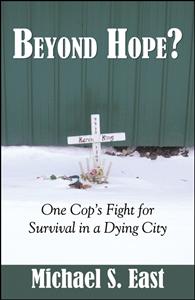
Now add veteran police officer Michael East’s Beyond Hope? to the list. It’s good. Very good.
The best police books, whether academic or pop, have a few things in common: a confidence in the writing, a good voice, an awareness of one’s surroundings, humility in knowing one’s limitations, the ability to link the personal observation to greater truths, courage to face uncomfortable truths, and the ability to tell a good yarn. In other words, a good police book needs many of the same qualities of a good police officer. But most cops don’t write good books.
Michael East has written a good book. Beyond Hope? is his story policing Saginaw, Michigan. I’ve never been to Saginaw, but it sounds grim. Kind of like a smaller, poorer, f**ked-up Baltimore.
Beyond Hope? is finally for sale. I was able to read an advanced copy so that’s how I know it’s good. Buy it today! If you like cop stories (and if you’re reading this you do) or have a thing for cities in decline, this is a book for you.
 More than anybody else, Maurice Punch inspired my policing career (well, maybe Punch and John Van Maanen share top prize). Punch’s wonderful and classic study of the Amsterdam Police,