It’s generally not good to bring a Police Chief from outside a department.
A former FBI agent? That’s not really good enough to be in charge in New York or Chicago or L.A.
The storyin the Tribune.
It’s generally not good to bring a Police Chief from outside a department.
A former FBI agent? That’s not really good enough to be in charge in New York or Chicago or L.A.
The storyin the Tribune.
Shame on the St. Louis Police Department! Of course people should be able to turn over lost items to the police. Maybe it’s just a minor gambit to get more money. I’ll cool with that. After all, it’s not like there’s no vacant space in St. Louis to hold things.
Here’s the story by Heather Ratcliffe.
When you work midnights, there’s no tomorrow. While you’re up, everything is “today.” Then, when you head home, you know you’ve got to be at work again on the same day. Tonight. Today. There is no “tomorrow.” It never comes.
To all the cops working the midnight shift, here’s to the start of daylight saving’s time! One shorter night at work and an extra hour before sunrise. Life just got a little better.
David Simon, of The Wire, Homicide, and The Corner fame, has written a very powerful article in the Washington Post.
The Baltimore Police stopped releasing the names of officers involved in police-involved shootings. Personally, I like reading the names in the paper to see if it’s anybody I know. Sure I could call up a friend and find out. But usually I don’t. Odd are I won’t know the officer.
I also know that if I had been involved in a police-involved shooting, I wouldn’t want my name released. I’d have plenty to worry about without my name in the papers. Reporters love presenting “both” sides of the story. But for most police-involved shootings, there is no “other” side. Often, as hard as it is for some to believe, the police are simply telling the truth.
I wouldn’t want to read about the bastard’s mother saying what an angel her son was, at least since the last time he got out of jail for shooting somebody. I wouldn’t want to read about “witnesses” (who weren’t there) say how that white officer shot him in the back for no reason at all. No, I shot him because the S.O.B. was trying to kill me.
Yet names should be released. If nothing else, this policy isn’t fair to officers who names are released. It leads one to think they’re guilty. The department is being sued by one of them.
But what it comes down to for me is that deep down I strongly believe in the press (mistakes and all). My uncle was a newspaper editor before I was a cop. Before I ever held a gun I was raising hell writing for the Evanstonian, my high-school newspaper. You might believe in the Second Amendment; I believe in the First.
Freedom of the Press is listed in the First Amendment for a reason. As a free country, we need a free press. In a free society, police should be held accountable to the public. What’s the alternative?
Read Simon’s piece. He’s a good writer. It’ll make you think. And that good.
In an American city, a police officer with the authority to take human life can now do so in the shadows, while his higher-ups can claim that this is necessary not to avoid public accountability, but to mitigate against a nonexistent wave of threats. And the last remaining daily newspaper in town no longer has the manpower, the expertise or the institutional memory to challenge any of it.
Part of the reason this country is in such a mess right now is because not enough people know what’s going on. They don’t read newspapers. They don’t know the facts. They’re ignorant.
Talk radio and the morning zoo is not a recipe for a well-reasoned worldview. Even the best TV news is horrible (except for the NewsHour). Between the right blaming “The Media” for almost everything (the answer to media bias is more media) and the economic realities killing the newspaper business, I worry. A less powerful press is not good for our country or our freedom.
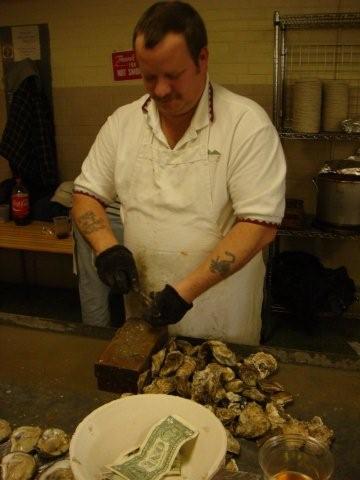
My wife, a friend, and I were on the 10:05 train to Baltimore this morning. Twelve hours and one Bull & Oyster Roast later, we’re back in New York City. It’s a shame we couldn’t stay longer, but a good time was had by all.
On the menu:
About 2 1/2 dozen delicious Maryland Oysters.
3 deep fried oysters (about 3 oysters each).
1 cup of delicious oyster soup (1 oyster).
3 big hunks of pit beef burnt ends.
A few regular slices of pit beef.
One small Italian sausage.
One piece of cake.
One diet coke (to keep the girlish figure)
And God only knows how many buckets of beer.
I don’t like oysters as much as crabs. But these were very good oysters. Unlike the crab feast, this was almost a stag affair. 80% male. And lots of tables brings cards and gamble at their table. Drinking, gambling… all we needed was whoring to make this church party complete.
I also learned from my friend cooking the beef (strange coincidence he’s a guy I actually know from meeting him in a bar in Somerville, Mass, many years ago…) that pit beef is not, as I’ve described it, smoked roast beef. Well it sort of is. But it’s marinated overnight first. Then baked to 100 degrees. Then grilled and smoked to 130. It’s delicious.
If this were in New York City all this would probably cost, including tax and tip, close to $200. Of course it’s notin New York. And that’s why we go to Baltimore, hon.
At St. Francis of Assisi, it’s all included in $38 ticket (plus maybe another $10 in tips).
Incidentals: On the money wheel I broke even (played $4 won $4). I didn’t play the liquor raffle (I won 3 bottles last time and didn’t want to press my luck) but my buddy did win.
Nor did I win any other raffle for a grand loss of about $10. And I bought a souvenir hat, also $10.
Using Amtrak miles, the train trip was free (otherwise that would be the $200 bank-breaker).
Before:
During: 
After: 
No carry outs seems like a fair rule. Though some people always try.
Back behind my sergeant’s Baltimore police home bar: 

Too bad a story about an honest Liberian customs officer is news.
But hell, if I made $15 a month… I would probably take the $20,000 bribe.
So I guess he’s a better man than me.
And they did give him a medal. And $1,000.
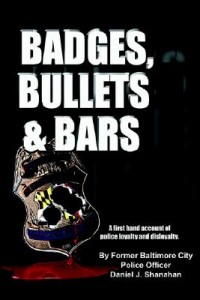
 When I was a cop in Baltimore, I kind of assumed I was the only active police officer going for a PhD at one fo them fancy graduate schools. I wasn’t.
I’ve also assumed I’m the only former Baltimore police officer to write a book based on time in the Eastern District. I’m not.
I’m not certain why I only heard about Daniel Shanahan’s Badges, Bullets, & Bars recently. Professor Edith Linn (retired NYPD) told me about it at the ASC conference in St. Louis. She’s written a great book herself, Arrest Decisions. In it, she quantifies many of the points about arrest discretion I make in my book.
I’ve ordered Badges, Bullets, and Bars and look forward to reading it. You can read the 1st chapter here. It seems pretty hard core.
The book is dedicated to:
“All the excellent Law Enforcement officers who shortened their careers by crossing the thin blue line and venturing into the wrong territory; sometimes into criminal territory. Therefore permanently tarnishing their badge, reputation, family, and all the good that badge stands for. This book is for the police officers that could not find their way back, wanted to make a difference, and unfortunately, could have.”
Yikes! I imagine most police stayed far away from Shanahan. The stories of mentally unstable cops are legendary and usually great for a laugh… until somebody gets hurt.
But I’ll withhold further judgment till I read his book. He certainly does not seem like a man you would want to cross.
You know, if you like police books, there’s a great web site: Police-writers.com. If I checked it more often, I would have know allthe books written by Baltimore police officers.
Check the Sun for the latest update on the shot Baltimore City police officer.
This has got me thinking about when things go bad.
If an officer needs backup, well first he or she shouldn’t have to askfor backup, because, well, that’s what being police is all about. You’ve got each others’ back.
But if you would actually like an extra unit to help keep everything under control, you ask for a 10-11. A 10-11 is a request for a meeting. It could be a meeting for any simple purpose (paperwork, coffee, question, or just for the hell of it). It’s not polite to ask another officer his location over the air. Because you have to answer. If you want to find somebody, better to ask for a 10-11.
But in the context of backup, a 10-11 will cause cops to gently run red lights. But it’s not an emergency. Everything is under control. Better safe than sorry.
Then, say you chaos in the background of a radio transmission, or the fight is on. If you need help and you need it now, you call for 10-16. That means “backup.”
You can also get assigned as10-16 to somebody else’s call. But that’s not a big deal. That just means backup is the sense that the call should have more than one officer responding (like for an armed person, a domestic, or anything in progress).
But when calling for backup, 10-16 is pretty serious. You wouldn’t ask for it lightly. But if you ask for a 10-11 with any sense of urgency the dispatcher will up it to 10-16.
A good dispatcher needs to keep track of all the units (15-plus in the Eastern, at least last time I checked) and call for backup when needed. Thus they’re worth their weight in gold.
If you’re really OK, you can do your best to call off the 10-16 saying something like. “No. I’ve got everything under control. I just need a 10-11.”
There’s no shame in asking for help if you need it. You just don’t want to put other officers at danger for you for no reason. If you need backup, you’ll get it. For a real 10-16, you’re going to haul ass.
And then sometimes, not too often but often enough, things go wrong. When the shit hits the fan, it hits quickly. Signal-13 is broadcast city-wide and there’s nothing higher.
There’s a pause when the Signal-13 alert tone comes the radio (it’s always preceded by a special tone). Everyone shuts up for a quick second to hear the details. Usually, it doesn’t concern you. It’s across town or it’s 10-32ed right way by the officer who didn’t really need (or want) the 13. Like if you don’t answer your radio, you’ll eventually get a 13 dropped until you do.
But if the 13 is for real, the adrenaline kicks in as you hit the gas and go code one. After a second or third 13 comes over the air, half the cars in the city will be heading your way (luckily, I was never on the receiving end of a Signal 13). As backup, you gotta be really careful. It’s a dangerous time to be a cop with lots of fast cars and tunnel vision.
When everything is under control again, you’ll hear “10-32,” enough officers at scene. But by then, after the 13 went out, it’s a little hard to call off the cavalry.
Cops will often come no matter. You get to meet your friends from other sectors and neighboring districts. You say hi, swap gossip, call each other names, and make social plans. It’s a little powwow (and can be quite a clusterfuck). Eventually calls-for-service or a higher up will act as the umpire and break it up.
And if a 13 includes the horrible words, “officer down,” that is not good. In the end, those close to the officer will go to Shock Trauma to be there for the officer and the officer’s family. The sergeant will arrange for family notification and pickup (not a fun part of the job).
Meanwhile those still working the street have to keep answering the same bullshit calls plus a few extra posts. People don’t stop being stupid just because an officer is down.
When the next shift comes in at the district, they’ll be filled in informally and then formally at roll call. If things have been really chaotic, you might skip roll call and go right to the street to relieve somebody. Overall, the mood will be professional and much more business-as-usual then you might expect.
Seven year later, when watching The Wire, I would still perk up and pay attention whenever I heard the Signal-13 sound. And this from a TV show.
Here’s the latest form the Sun:
The officer was shot in the jaw and cheek when he tried to make an undercover purchase, Bealefeld said. His partner returned fire and hit at least one of the suspects, according to police. As the suspects fled, the second officer helped his wounded partner, who was conscious and speaking after the shooting. He was conscious until he was placed under anesthesia for treatment at Shock Trauma.
And don’t forget about every Baltimore City police officer who has to go right to work and do the job like it’s any other day. If yourcoworker got shot on the job, you might get a day off.
Not police.
Stay safe.