Tag: police culture

  • Harm Reduction

    I enjoyed attending “New Directions for New York: A Public Health & Safety Approach to Drug Policy” sponsored at the New York Academy of Medicine and the Drug Policy Alliance.

    I was speaking on the Harm Reduction – Coordinating Strategies panel. Unfortunately, because I broke one of my rules and wrote on the back side of a copied piece of paper (rather than in my notepad), I left my notes at the conference.

    You can see the full program here.

    The instructions I received, and I chose to accept them, were these:
    The role we’d like for you to play on this panel is from a public safety perspective. We would like you to speak about where or how a harm reduction strategy would and could fit in the public safety sector, as well as what the barriers are. It would be tremendously useful to hear your thoughts on this matter as one who is an expert in the field of criminal justice and an ex-police officer that patrolled in an area with a disproportionately high rate of drug use.
    There were six on out panal and we each had about eight minutes.

    I made the following four points (or at least I tried to):

    When I arrived in Baltimore, Harm Reduction as it was perceived was seen as a failed program and Kurt Schmoke, a very smart man and advocate of Harm Reduction, was seen as a failed mayor.

    I support drug legalization (though I prefer to use the term regulation). I think it would reduce harm. But to play devil’s advocate to a room of harm-reduction supports I tried to make these points:

    1) It’s probably a safe bet that most academics and policy makers who support Harm Reduction don’t live in neighborhoods where Harm Reduction causes harm.

    As an example, in both Cambridge, Mass, and Baltimore I lived near methadone clinics. It wasn’t the end of the world, but I certainly prefer not living near a methadone clinic. Nobody wants to live next to a methadone clinic… and often for very good reasons. So if harm reduction involves methadone clinics, people who make policy need to understand the needs of all those affected, and not just those in the target population.

    For Harm Reduction to work, it’s very important to understand the opposition to it.

    2) Harm reduction needs to be judged with a multivariate perspective. That is to say, harm is a many faceted thing. For instance when it comes to drug addicts and a public drug market, there are a) the potential health harms to drug users, b) the harms of drug-trade (prohibition) violence, and c) to quality of life issues. If you’re just a normal working stiff, you very well might care most about the latter issue. But research, especially in the public-health fields, tends to be public-health oriented. In this case that means a lot of A and a little B.

    3) Though I’m happy to back in an era of science, understand that many people oppose Harm Reductions on moralgrounds, for instance: drugs are evil. Public-health people aren’t very good at conceiving of or talking about thing in moral terms.

    To find common ground, emphasize the impact on saving lives. That is common ground. Previously, Jill Reeves had given a powerful speech about her own perspective as an addict. She mentioned that one of the greatest needs for addicts is a nine-one-one Good-Samaritan law. In other words, you shouldn’t risk arrest by calling for an ambulance to save a life. That might be a good place to start forming common ground.

    4) Police generally are not sympathetic to Harm Reduction because, well, among other things, it’s not job. To ask police to care about clean needles for the health of addicts, well, it’s not their job. It would be like the police asking a doctor for help in bringing down a drug shop. It’s just not gonna happen. Public health messages geared to police need to focus of public safety and officer health.

    Clean needles, for instance, should be any easy sell. It’s easy to see the link between dirty needles and officer safety. When an officer is sticked, you really hope that needle is clean. I hated seeing officers crush needles in the gutter. Do any addicts get clean by virtues of a police officer crushing their needles? I don’t think so.

    In a different session, P. David Soares, Albany County District Attorney, made a very good point: if we want to stop young boys from working for drug dealers, it would help matters if we didn’t make it illegal for anybody under 16 to work at all.

    By far the loudest and longest applause (at least for what I attended) went to a CUNY colleague, Queens College Professor Harry Levine. He brought down the house (at least as much as you can at such a conference — but this conference was open to the public, so it was a little more rambunctious than the average academic fair).

    Levine ending his (precisely-timed) 10 minute speech by noting that if Obama had lived in New York under current NYPD arrest practices, he could easily have been arrested and, by having a criminal record, had no chance of becoming president. How many potential Obama’s lives out there right now, asked Levine, have we ruined through aggressive arrest policies in our war on drugs? The crowd, as is almost everybody in my New York world, was very pro-Obama.

    Levin is co-author of “Marijuana Arrest Crusade: Racial Bias and Police Policy in New York City 1997-2007.” I learned a lot about New York State marijuana law and police practice regarding said law. And it’s very readable.

    I don’t think Levine is on the NYPD Chief’s Valentine’s-Day mailing list this year.
  • $815,000 for fired Seattle-area cop

    Mike Carter of the Seattle Timesreports:

    A former Mountlake Terrace police sergeant whose views supporting the decriminalization of marijuana led to his dismissal in 2005 has won his job back and an $815,000 settlement from the city and Snohomish County.

    However, Sgt. Jonathan Wender will not return to the streets. In addition to the financial settlement, the city has agreed to keep him on administrative leave and to pay him a $90,000-a-year salary for the next two years, when he will be able to retire after 20 years with the department.

    In addition, he won back pay dating to when he was fired and the restoration of his retirement benefits, said his lawyer, Andrea Brenneke.

    In a lawsuit, Wender, 42, had claimed the city and county violated his right to free speech by targeting him for his political beliefs. Wender, who holds a Ph.D., teaches full time at the University of Washington and has written and lectured extensively about police work and drug policy.

    Read the whole story here.

    Officer Wender’s is a fellow member of LEAP (though I don’t know him). Too bad I couldn’t get wrongfully fired when I was a cop! But then that might not have been the wisest career move at the time.

    Officer Wender’s dissertation title was, I’m not making this up: “Policing as Poetry: Phenomenological and Aesthetic Reflections Upon the Bureaucratic Approach to Human Predicaments.” Wow… that title is straight out an Onionparody on PhD dissertations! On the other hand, the line, “There is a tragic beauty in working the streets, [and] I miss the intimacy of making order out of chaos,” iskind of poetic.

  • True Confessions

    True Confessions

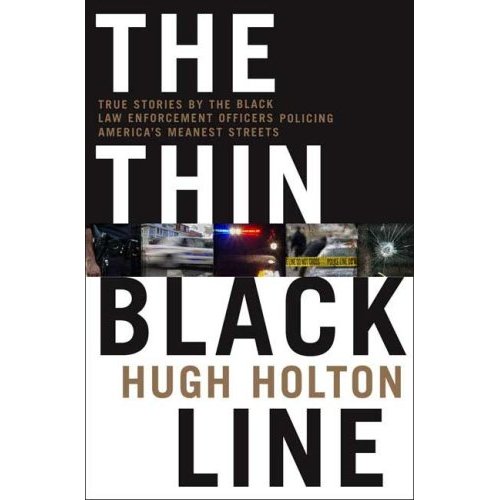
    A review written by me of The Thin Black Line: published in the Washington Post’s Book World.

    It’s a collection of stories told by black law-enforcement officers. Not a great book, unfortunately. But the review is well worth reading:

    THE THIN BLACK LINE: True Stories by Black Law Enforcement Officers Policing America’s Meanest Streets.

    By Hugh Holton.

    Reviewed by Peter Moskos.

    The stories police officers tell each other often don’t amuse outsiders. While fellow cops laugh, an outsider is left thinking, “Is it funny that a man bleeds to death?” or “You took crutches away from a one-legged homeless man?” But police don’t tell these stories to entertain outsiders. A story is more than a way to bond over a beer after work; it’s an essential tool of the trade.

    Stories provide sense to situations that lack it. Laughing at gore, the softness of human flesh and the misfortune of others isn’t necessarily a sign of an uncaring cop. Gallows humor is a way to compartmentalize, to maintain one’s sanity, to reserve empathy for situations in which emotion might be more productive.

    Before I was a police officer, I loved the TV show “COPS.” But after a few nights in a police car, I realized that “COPS” wasn’t the real deal. The dialogue was stilted, on guard, seemingly self-censored for the more politically correct masses. The Thin Black Line, a collection of 28 oral histories of black law enforcement officers in U.S. cities from coast to coast, is similarly restrained. I’m certain these officers have great stories to tell. They just don’t tell them here.

    Read the whole review here.

  • Bad economy = more traffic tickets

    Traffic tickets go up when local government revenue falls. Is that a surprise? Not really. Here’s the story in St. Louis Today. The study, by Thomas Garrett and Gary Wagner, quantifies it: “Controlling for other factors, a 1 percentage point drop in local government revenue leads to a roughly .32 percentage point increase in the number of traffic tickets in the following year, a statistically significant connection.”

    I don’t quite understand when people complain about getting tickets. Whatever happened to “do the crime, do the time” (or pay the fine)? Especially when many of those complaining people are the same people who have no sympathy for poor (usually black) men who get arrested for minor drug crimes.

    As long as poor black men are a gazillion times more likely to be arrested for drug possession than rich white men, I really wish that folks would stop bitching about how unfair traffic enforcement is. Yeah, it sure does suck when police decide to crack down on the illegal activity that you happen to think “isn’t so bad.”

    The argument has been made that law enforcement should be random. I don’t think it should be. But if it were, every law breaker would have an equal chance of getting caught. To be honest, it’s not a bad goal.

    Personally, I love traffic tickets. I wish even more were given out. And I wish the fines were higher. The city needs money and I don’t want it to come from me. Just follow the law, right? And… oh yeah, I don’t have a car.

  • Less overtime = More murder?

    Messing with police overtime is like messing with a dog’s food. You better makes sure it doesn’t come back to bite you. “It’s like our heroin,” one cop says in Cop in the Hood, “it’s just something we need.”

    The root of the problem is that half the department is assigned to patrol, chasing radio calls. So when it comes to officers that have the freedom to do police free from 911 calls for service–and we all know that 911 is a Joke–cutting overtime can have a huge impact on the kinds of policing that can actually prevent crime.

    Justin Fenton writes the story in the Sun:

    Killings rose as police cut OT
    Despite official denials, union chief sees effect on city safety

    Baltimore’s deadliest month of 2008 coincided with substantial reductions to the Police Department’s overtime budget – cuts that the police union president says are interfering with investigations and diminishing neighborhood patrols.

    Prompted by a directive from Mayor Sheila Dixon to cut more than $21 million this year amid the worsening economy, the department spent $800,000 less for overtime in November than in the same month the previous year, according to former homicide Detective Robert F. Cherry, who was elected union president this fall.

    The month saw 31 homicides, the worst November in nine years. The trend has continued, with six killings in the first six days of this month.

    “Detectives are being told, you can’t finish working a case, you have to go home. We can’t put foot men in a certain area, it will cost overtime. And district commanders are being beaten down if they spend over,” Cherry said. “You’re lying to the public if you say we’re attacking all forms of crime, and you’re lying if you say the budget cuts have no effect.”

  • Cops and Nurses

    I’m not the first to point out that cops and nurses have a lot in common. This is from a nurse/midwife:

    I was reading your book today on the train and thinking about cops and nurses. I was a one-woman nurse academy for the last year and it’s such a maddening process. I had to teach new nurses:

    1) the rules of a system;

    2) that nurses don’t always follow the rules, they do it another way, but please know the rules; and finally—if the nurses can handle such cognitive dissonance and it doesn’t utterly disillusion them:

    3) that the system is misguided and broken, and the informal way nurses do it doesn’t really benefit laboring women or respect birth either. And that just about everything in the labor room goes against evidence-based practice.

    I feel some success when the new nurses start talking about home birth. It’s the only sane response to learning about hospital birth at **** (or most NYC hospitals). But then after orientation the nurses have to go out and do the hospital job anyway, which means being asked to fit all patients into the same tight, wrong mold.

    I am about halfway through the book. It sounds like nurses have a similar response to cops. There is a lot of dehumanizing of patients, and gallows humor, and gory details over drinks. They get very good at writing reports (documenting in the chart) that fit a certain picture even if not really accurate.

    To an extent, nurses have a sisterhood and look out for each other, but there is also quite a bit of undermining and backstabbing (women culture vs men?). And yet it is amazing how often the nurses can still be kind and creative and still see the screaming bleeding whining person in front of them as an individual human needing support.

  • Mass cops protest

    Mass cops protest


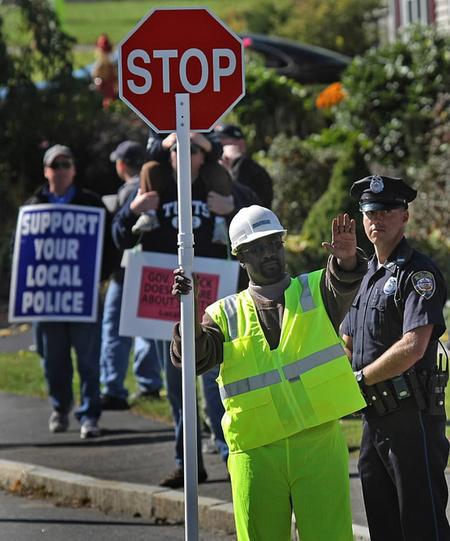
    Why not have road construction flagmen be cops? Yes, it’s a bit of a scam. But police have to make overtime some way. And better to pay a cop than pay a union private construction employee.

    Without this overtime, I wonder if arrests will increase.

    Read about it in the Boston Herald.

  • Wrongfully Convicted Cop Freed

    From John Kass and the Chicago Tribune:

    What bothers the Mettes—and just about every other cop—is that there were no protests on Mike’s behalf. Liberal university professors didn’t write angry op-ed pieces demanding justice. The crowd that fights wrongful convictions wasn’t interested, either, perhaps because Mike wasn’t some violent gangbanger with a rap sheet as long as his leg.

    He didn’t have a rap sheet. Mike was a good cop, and he was ignored.

    But soon, he’ll be coming home.


    The whole story is here.

  • Lieutenant in Taser incident commits suicide

    I just heard on the radio that Lieutenant Pigott, the lieutenant who, one week ago, ordered the man on the awning in Brooklyn to be Tased, shot himself. That’s very sad.

    The lieutenant, I believe in good faith, made a bad decision that violated departmental rules. Allpolice officers violate departmental rules. I know I did. And not always in good faith. But I was lucky; nobody died.

    Mr. Morales should not have been tased. But had I been in the same situation, it was a decision I very likely could have made. Mr. Morales, a crazed 35-year-old man, died.

    After 21 years on the force, the lieutenant’s life came crashing down. He caused a man’s death. He was stripped of his badge and gun. He was demoted from a specialized unit he loved to a desk job in motor pool. His future, as he probably saw it, consisted of lawsuits, disgrace, and no end in sight. The NYPD threw him under a bus.

    On Wednesday, the Morales family held a wake. Lieutenant Pigott apologized for what happened, saying he was “truly sorry.”

    On Wednesday night, the eve of Lieutenant Pigott’s 46th birthday, he gained access to another officer’s gun and shot himself. He leaves a wife and three children.

    It’s very sad.

    There’s more in Newsdayand the New York Times.

  • Police aren’t soldiers

    And soldiers aren’t police. Going from the armed forces to a police department may seem like a natural transition. It’s not. A different mentality is needed. Most soldiers can make the transition. Some can’t. De-emphasizing the military aspects of police departments would help.

    Here’s an interesting article in the Austin Chronicle about the problem for some soldiers’ reentry into the police world.