Tag: police culture

  • 10-32. They’re all going to be acquitted.

    I’m calling this trial for the defense. Now I’m only following on twitter, so take this with a grain of salt, but the trial of Goodson — the most culpable of the officers on trial for the death of Freddie Gray — is not going well for the prosecution. Judge Williams told the defensethat they may “truncate their case.” The defense filed a written motion for judgment of acquittal. (Doing so in writing is unusual.) Such a motion is rarely granted, and this case is probably no exception, but think about it: how can you tell the defense to “keep it short” if there’s a chance you’ll decide for other side?

    The prosecution called Neill Franklin, my old police academy commander, co-author, and co-believer in ending the drug war. The prosecution paid Neill to testify as an expert witness regarding “rough rides.” He didn’t know much about them. What cop would?

    Franklin did get busted for not knowing his 10-codes, which I find kind of funny. Now 10-codes are city specific and Franklin, in his defense, was never a street cop in Baltimore and has competing 10-codes to account for. But he was responsible for the department (Education and Training) that taught 10-codes. Franklin was brought in as an expert witness in “general orders, policies and procedures.” Well, in that case you should know your local 10-codes. I still know my 10 codes (admittedly, I’m a bit rusty on ones I probably never knew, like “request animal shelter.”)

    What are 10 codes? Think 10-4. You know what that means. Well there are a few others. Along with the “signal and oral codes,” Baltimore City has 10-6 (wait), 10-9 (repeat), 10-11 (meet me at… which, if used on a call, is a non-emergency call for more officers), 10-14 (wagon), 10-15 (emergency wagon), 10-16 (backup, but means emergency backup, and is less than a balls-to-the-wall “Signal 13”), 10-18 (shift is over!), 10-20 (location), 10-23 (arrived on scene), 10-29 (records check), 10-30 (wanted, but I hope some cops still use “thirty-dash-one” without knowing what it refers to), 10-31 (in progress), 10-32 (enough units on scene, ie: stop contributing to the clusterfuck), 10-33 emergency. And maybe since last year codes like 10-34 (civil disturbance) and 10-90 (looting) entered the Baltimore 10-code lingua franca.

    Now keep in mind these 10-codes are Baltimore City specific. And the fact that there isn’t a standard list of 10-codes (except 10-4, and 10-20 always means location) makes them not only useless but potentially dangeriou, especially when disaster strikes and you need inter-agency communication. There’s a justified movement to move away from 10-codes and go to plain English.

    That said, there is something efficient and clear about 10 codes. That is worth something. Also, they’re kind of fun.

    So Franklin didn’t know 10-15. That doesn’t look good for an expert on Baltimore arrest procedure. But the former major in charge of the police academy would have basically zero dealings with prisoners or prisoner transport; Maryland state police don’t use wagons. He did testify that seatbelting does not ensure an individualis secure and that it’s possible for prisoners to unseatbeltthemselves.

    Now Franklin’s job (yes, expert witnesses are paid) is not to do what the prosecution says or help any side. His job was to come to court, be put on the stand under oath, and answer questions honestly to the best of his abilities. He did that. That he didn’t help the prosecution is not his concern. But it is a problem for the prosecution. A big problem.

    There’s this:

    If Franklin really is the best witness prosecution can call in the least weak case the prosecution has? Well, that’s why I say it’s over.
  • “Will the anti-cop Left please figure out what it wants?”

    Heather MacDonald in City Journal:

    Will the anti-cop Left please figure out what it wants? For more than a decade, activists have demanded the end of proactive policing, claiming that it was racist.

    Equally vilified was Broken Windows policing, which responds to low-level offenses such as graffiti, disorderly conduct, and turnstile jumping. Black Lives Matter activist Shaun King launched a petition after the 2014 shooting of Michael Brown in Ferguson, Missouri, demanding that Attorney General Eric Holder “meet with local black and brown youth across the country who are dealing with ‘Zero Tolerance’ and ‘Broken Windows’ policing.”

    Well, the police got the message. In response to the incessant accusations of racism and the heightened hostility in the streets that has followed the Michael Brown shooting, officers have pulled back from making investigatory stops and enforcing low-level offenses in many urban areas. As a result, violent crime in cities with large black populations has shot up — homicides in the largest 50 cities rose nearly 17 percent in 2015. And the Left is once again denouncing the police — this time for not doing enough policing.

    King scoffs at the suggestion that a new 70-question street-stop form imposed on the CPD by the ACLU is partly responsible for the drop-off in engagement. If American police “refuse to do their jobs [i.e., make stops] when more paperwork is required,” he retorts, “it’s symptomatic of an entirely broken system in need of an overhaul.” This is the same King who as recently as October fumed that “nothing happening in this country appears to be slowing [the police] down.”

    The activists’ standard charge against cops in the post-Ferguson era is that they are peevishly refusing to do their jobs in childish protest against mere “public scrutiny.” This anodyne formulation whitewashes what has been going on in the streets as a result of the sometimes-violent agitation against them.

    That officers would reduce their engagement under such a tsunami of hatred is both understandable and inevitable. Policing is political. If the press, the political elites, and media-amplified advocates are relentlessly sending the message that proactive policing is bigoted, the cops will eventually do less of it. This is not unprofessional conduct; it is how policing legitimacy is calibrated. The only puzzle is why the activists are so surprised and angered that officers are backing off; such a retreat is precisely what they have been demanding.

  • “Everyone should experience the ‘fight or flight’ response when flight isn’t an option”

    “Everyone should experience the ‘fight or flight’ response when flight isn’t an option”

    Unlike some the other guy who lied about being a Baltimore cop, this guy has a few thoughts worth hearing. From Humans Of New York:

    I got an Ivy League education and then became a street cop for six years. I’d always been a knee jerk liberal. I was one of those kids screaming ‘off the pigs’ at protest marches. And then I ended up joining the force. I think it should be mandatory for everyone…. I think everyone should have to be a cop. It’s the ultimate social work. It’s the cop who has to step in when everything else has broken down. It’s where the rubber meets the road. It’s where conflict bubbles to the point of needing resolution, and somebody has to step in and protect the group welfare.

    Everyone should have to make an arrest. Everyone should have to feel the fear of trying to apprehend someone who doesn’t want to go to jail. It breaks my heart to see all the hate toward cops. Are there hateful, racist cops? Sure. And they should be punished. But I’ve worked in just about every industry. And I didn’t find any more racism in the police department than I’ve found in boardrooms and retail stores.

  • 56 Rounds: What it means to “have cops’ backs”

    56 Rounds: What it means to “have cops’ backs”

    Yesterday I was asked by a journalist what it means for politicians and police brass to “have cops’ backs.” It’s a fair question. It doesn’t mean not being critical of police. It doesn’t mean defending cops when they make an unreasonable mistake. It does mean giving cops the benefit of the doubt and supporting officers when they do their job.

    Take the recent police-involved killingof a father and son in Baltimore on the 400 block of E. Lanvale (314 Post, AKA Bodie’s Corner.)

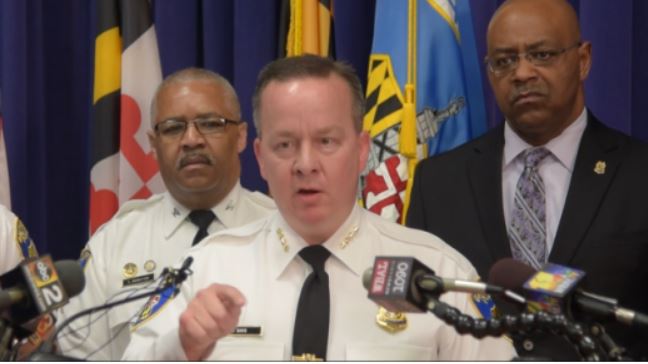
    This is Baltimore City Police Commissioner Davis having the cops’ backs (I transcribed from the video in this story):

    We had three police officers who were in the right place at the right time.

    The police came and did their job and did what they had to do.

    And I would add to that if not for the Baltimore police department yesterday, we could have had a mass shooting on our hands where several innocent lives could easily have been taken. I’m very proud of the work of our police officers yesterday. Their bravery. We can’t run from danger. We don’t run from bad guys with guns. We engage them.

    We fired 56 rounds yesterday, until this threat was eliminated. I want to put that right out there right now: 56 rounds. And you can see, and you can perhaps imagine confronting, in a neighborhood street in broad daylight, a father and son duo, with an intent to kill, that’s what it took to eliminate that threat.

    I’ll add to that, the son, one of the two men that we shot and killed yesterday, the son was out on bail for a handgun offense and the father was out on probation for a handgun offense. And that’s why I’ve personally spent so much time in Annapolis in this legislative session, in an effort to convince lawmakers, and we certainly have convinced the ones from Baltimore, about the necessity to do more with these laws and make these misdemeanors felonies. It’s about time. But that message still isn’t getting through.

    But our police officers and our community knows [sic] that unfortunately there are violent repeat offenders among us, who live right here in our city, who think nothing about carrying two guns like that in broad daylight and popping out of a car. If it weren’t for the bravery of the Baltimore City Police Department, we could be having an entirely different press conference right now.

    Kudos to Davis. You couldn’t ask for more. Now this is what one would expect from a good leader. But good leadership, especially in Baltimore, is not a given.

    Davis didn’t have to say what he said. He didn’t have to say anything. Or he could have had a spokesperson say something neutral like “we’re investigating the incident.” Or he could have raised an eyebrow by mentioning the number of shots fired before emphasizing how the “officers guns were taken immediately after the shooting and they remain on modified duty, as is departmental policy.”

    But Commissioner Davis didn’t do any of that. He went out of way to support his officers how bravely engaged with armed gunmen. This matters.

    Contrast this with former commissioner Batts who, in the name of progress and reform, threatened cops and led the city into riots and violence.

    But really contrast this with Baltimore City’s elected State’s Attorney, Marylyn Mosby, who pushes a cops-are-the-problem perspective. Her husband is running for mayor. She’s wasting her precious prosecutorial resources by prosecute good cops who may or may not have made an honest mistake.

    After this shooting, Mosby treated the officers like criminals. For the first time in as long as anyone can remember, officers involved in a good shooting were read their Miranda Rights like common criminals. For shame. These cops aren’t criminals; they aren’t suspects in “custodial interrogation.”

    Were it not for Davis and his strong and passionate words at the press conference (and also good journalism by the Baltimore Sun from which Davis quoted), it’s easy to imagine an anti-police narrative taking root. After all, this is Baltimore, where police are quick to gun down a father and son (with latter with junior-high-school graduation pictures at the ready) over a misdemeanor! (In Maryland and many states, illegal gun possession is just a misdemeanor).

    I’m sure some non-present “witness” could be found saying, “The cops didn’t have to fire all those shots. They had already given up.” Academics would criticize Broken-Windows policing. Al Sharpton, able to get a few days off work, would appear to criticize racist policing. Protesters could chant “56 shots!” while the national media returned to Baltimore and ask if (ie: hope that) more violence would be forthcoming.

    In that world, if Davis doesn’t have the cops’ backs, the next time a group of officers in an unmarked car see two guys getting out with guns? The cops could just keep on driving.

    Eventually, after the shooting stops and bodies drop, somebody would call 911.

    Would you engage armed gunmen? Why risk your life? Why face potential criminal prosecution? This is why having cops’ backs matters.

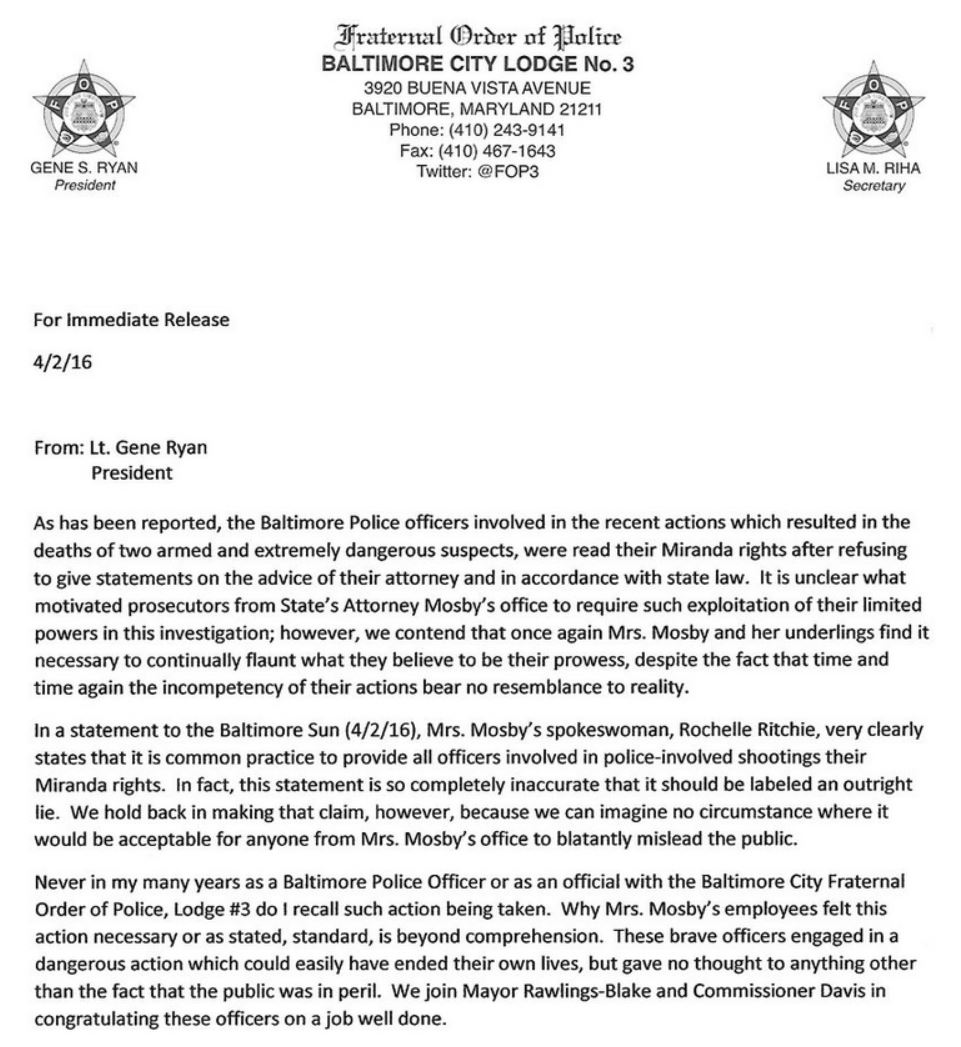
    Update: Regarding Mosby reading the cops their rights, here’s the FOP’s statement:

    2nd Update: Also, homicides year-to-date are up 25 percent this year compared to last. But given the post-riot near doubling in violence last year, being up only 25 percent from pre-riot figures is actually a massive improvement of sorts.

    3rd Update: Mosby’s office denies it. (I wasn’t there. But I don’t believe her. It’s not like she has a track record of telling the truth.) And the BPD decides not to engage. But the union will play:

    Lt. Gene Ryan, president of the Fraternal Order of Police, said Saturday that the statement from the state’s attorney’s office was “so completely inaccurate that it should be labeled an outright lie.”

  • Who is this man?

    Who is this man?

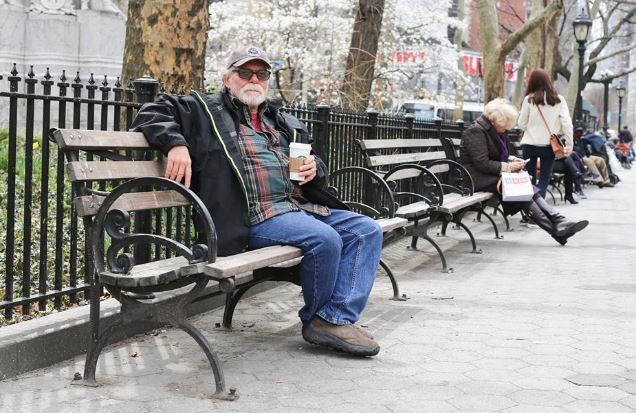
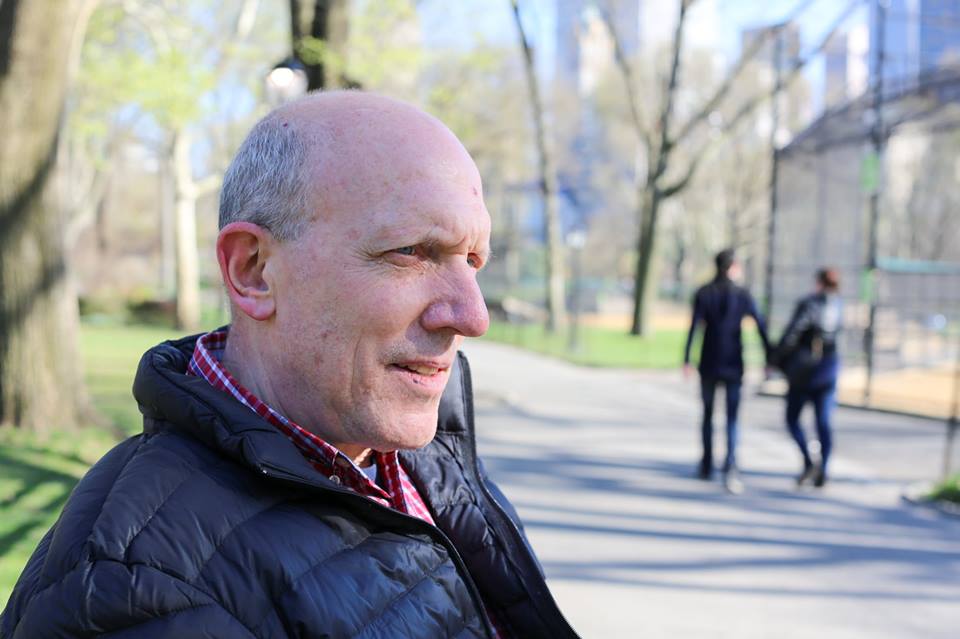
    Does anybody recognize this guy from Humans of New York? More than 13,000 shares and 147,000 likes on facebook.

    He says he was a Baltimore cop for 21 years and a heroin addict the entire time. It’s not inconceivable, but it doesn’t ring true. I see a guy sitting on a bench in NYC with a story. I don’t believe him. I prefer my facts verified.

    And I’m naturally suspicious. He says he took two-weeks’ leave and quit cold turkey. But he also says he was an addict the entire time? Which one is it? And how did he pass random drug tests?

    Update: It’s hard to prove a negative, but I’m called BS since nobody I know recognizes this guy (and that includes people who came on the job in the since the 1960s). It just doesn’t ring true. From various Baltimore cops, past and present:

    If he was addicted his whole time on the force, somebody on the street would have outed him to get a better deal from another officer. He’d have been too high to be as afraid as he claims. Who walks in on their junkie side partner and just says “well, as long as it doesn’t affect your work”? How many junkies would YOU trust YOUR life to? So he gets clean and doesn’t force his WIFE into rehab? She’s using every day and spending his money?????

    Nah. Good reading,though. I’ll wait for the movie.

    And this:

    Let’s say this fool retired 20 or even 25 years ago, it still would have been during the time when mandatory “random” urinalysis was conducted. From what I understand, when the program was started, within the first two years, everyone had been tested at least once.

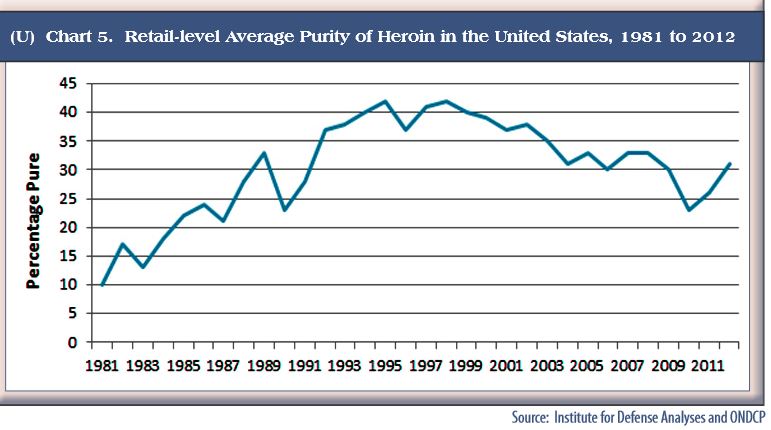
    That long ago, to use heroin in a powder form it would have had to have been “smoked” as the purity of the powder back then, I do not believe was high enough to snort. And there is no way he was doing it while working and getting away with it because he would have immediately went “on the nod” and not been able to work until he came off of his high.

    Locking himself in a hotel room, alone, for two weeks while he kicked it is another pile of manure. He would have needed at least one other person there to even try to pull it off to help him keep hydrated, etc. And the hotel staff after a few days of the do not disturb sign on the door know would have checked in some form to see if he was in there and did not skip out on the bill.

    The only thing this story is good for is fertilizer.

    The heroin purity argument is persuasive. Heroin, best I know, needs to approach 40 percent purity to make it snortable. It was nothing close to that in the 1980s. From the DEA:

    The only real chance nobody would recognize this guy is if were already retired in the 1990s.

    I know that there were some steroid users in the mid 80s, a couple of cocaine resignations, and a couple of positive test results where the addicted claimed addiction as a medical disability.

    And of course, why this matters:

    We have enough issues, now everyone will think half of us get high.

    Impersonating a former cop. But why did he have to pick Baltimore?

    2nd Update: I’ve heard back from more old-time former Baltimore Cops. Nobody has ever seen this guy before.

  • The “Gray Effect”

    Stephen Morgan, my grad-school colleague, released his Baltimore report (co-authored with Joel Pally) that looks at crime and arrests pre- and post-riot.

    [The Harvard sociology cohort of 1995 always turned to Morgan as the quant guy when we needed help with stats class, which was often. So rather than blame my own limitations and laziness, I prefer to entirely and falsely blame Steve for the fact that I still can’t really tell you what a poisson regression is and why you would want to use one.]

    I had some input in the drafts. One of my points was that the take-away would be an idiotic headlines like this one: “Study: There Has Been No ‘Ferguson Effect’ in Baltimore.”

    Citilab never talked to Morgan, which seems odd.

    Of course that headline isn’t the point of the study. I think the narrative focus of the study should have been centered around April 26, 2015 (the riot) and not early events half a country away (Ferguson). All policing is local. Buried halfway down that Citilab story is a mention of the “Gray Effect.” It is a better term. Perhaps because of the double meaning of gray, it can be applied elsewhere in a generic sense.

    I’m baffled by many people’s attempt to disaggregate a so-called “Ferguson Effect” from local police issues, since I’ve been arguing this is the same thing. But shorthand terms are only helpful if they have an accepted meaning. And clearly the Ferguson Effect does not. I’m not willing to waste time in a semantic debate or defend a term — the Ferguson Effect — that I never liked. So let’s call it the Gray Effect. My point is that police matter and that society influences policing, sometimes for the good and — as last year’s spike in homicides portends — sometimes for the bad. Call it what you will, the effect is real.

    Better reporting is done by Baynard Woods and NBC. From the latter:

    “I do think we provide some pretty compelling evidence that it is possible for the police to use discretion, to use alternatives to arrest, in a place like Baltimore without influencing the pattern of crime,” Morgan said.

    That is why Morgan says the eight months before Gray’s death could represent a “sweet spot.”

    The next part of Morgan’s analysis, the Gray period, was much less surprising.

    “Everything fell apart,” Morgan said.

    Crimes of all types, violent and non-violent, spiked, for an overall increase of more than 11 percent. [Ed note: In reported crime…. Homicides doubled, and there is good reason to believe more crime was non-reported. And decreasing arrests will also serve to reduce crime stats without a corresponding reduction in actual crime.] The drop in arrests became much more pronounced, from 19 percent to 30 percent, “consistent with the widely discussed conjecture that the Baltimore police pulled back from some routine policing in response to a perceived lack of support from the city’s leadership,” the researchers wrote.

    [Maybe it’s minor, but I’ll take credit for the subtle addition of “lack of support from the city’s leadership,” thank you very much. Correction: Steve, ruining my fun as only a quant guy can, says that phrase was in the earliest drafts and had nothing to do with me. –eye roll– ]

    From Woods in the Guardian:

    “One reasonable interpretation of these entangled effects is that the crime spike in the Gray period could be a Ferguson effect that would have remained dormant had it not been ignited by a localized Gray effect,” the report states. “However, the size and duration of the crime spike is almost certainly attributable to particular features of the unrest.

    The study found a decrease in crime in the period after the new police commissioner, Kevin Davis took office, which they dub the “Davis effect.” Davis replaced then-commissioner Anthony Batts, who was fired just after a Fraternal Order of Police report criticizing his handling of the riot came.

    The whole point of the Gray Effect (née Ferguson Effect) is that it is not necessarily centered around the events of Ferguson. Let’s the just accept that and move on. It is about media focus and changing political pressures of the past few years.

    The substantive issue is that anti-police movements and protests can affect policing and policing impacts criminals and crime. The events around the riots in Baltimore — specifically the failure of political leadership and the politically motivated prosecutions of police officer — were Baltimore’s Ferguson Gray Effect.

    Public events, media reporting, and political leadership all matter to police officers. And when this process is happening in many different cities, a shorthand label can be useful. When the factors combine to change policing in a negative way — when police are less proactive and more young black men are killed as a result — we need to recognize the facts and react accordingly.

  • Stop paperwork (2)

    Stop paperwork (2)

    An email from a Chicago Police Officer (emphasis added by me):

    I wanted to go through our new “investigatory stop report (ISR)” training before I replied. By now you realize we have an extremely long form to fill out every time we do a street stop. The form is ridiculous and redundant but fortunately the department has created a shorter form that will we start using on March 1st. I think they missed the point with the gripes about low street stops. The form sucks, is burdensome, and redundant, but it’s just paperwork.

    The issue is that there is still heavy oversight by the ACLU and many private attorneys and their quick access to all information on ISRs. So now, instead of just your sergeant deciding if you have articulated enough reasonable suspicion, each ISR has to be approved by a sergeant, the integrity unit, and then combed over by an endless amount of lawyers looking for the slightest hiccup in the report. Private attorneys have started contacted people stopped about two weeks after each incident, by phone and/or mail and asking them how the police treated them while they were stopped. This is really unsettling.

    All of this seems like a direct result from the McDonald shooting, even if it’s not. Although no one is talking about it (the media has moved on to other police issues from where we park to the “thin blue line” code of silence). Immediately after the dashboard camera video came out, most cops were defending the shooting even after seeing the video. I get it. I would not have shot, but I understand why Van Dyke did. A crazed maniac on PCP with a knife is certainly dangerous and it doesn’t morally bother me that he was shot. I do think it was a bad shooting, but not by much. Although, I come from a newer generation of policing with a different mindset I suppose.

    After the protests and eventually when the ISR system came out, everyone started to vilify Van Dyke as the cause of all this oversight whether or not they believed it was a good shoot or not. Those that believed it was a good shot, no longer say anything about it, if that makes any sense. Basically, no one is supporting Van Dyke anymore, at least not openly. Meanwhile, street stops are down an astronomical percent and homicides are at at 12-year high through February. On the 11th, the superintendent sent out an email to the department reminding them that it’s still okay to do street stops. No one took it seriously but the bosses have to do something to get numbers.

    The idea that every report is being read by people looking to sue police officers is not a way to encourage productive proactive discretionary police activity.

    The first two months of 2015 saw 51 homicides. 2016 has seen 101. That’s double, for those slow in math. If you don’t want to call this a “Ferguson Effect,” fine. I’ve never liked the term. But perhaps we can agree that if police feel they can’t do their job for fear of lawsuits and/or criminal prosecution and thus do their job differently and then crime goes up, something is going on?

    So if you don’t like “Ferguson Effect,” how about we call it the “when police feel they might get in trouble for doing their job, so police — mostly to satisfy critics on the left who seem not to care how many people die as long as police are not involved — get out of their car less, stop fewer people, interact with fewer criminals, and then murders skyrocket” effect?

    See part of the police job is to harass criminals. Maybe you can think of a better word than “harass,” but I use that work intentionally. Because policing isn’t all please-the-old-ladies-going-church. People don’t like to talk about it, but there is an actual repressive part of the job — legally and constitutionally repressive, but repressive all the same. When that doesn’t happen, criminals commit more crime.

    [What I also find interesting in that a change in police culture with regards to what constitutes a good shooting is happening in front of our very eyes in Chicago.]

    And here’s the email from the Acting Chief:

    Good Evening Everyone,

    I want to clarify concerns regarding the Investigatory Stop Report (ISR) and the Department’s Agreement with the American Civil Liberties Union of Illinois (ACLU). I have heard your concerns and I am working toward a solution.

    First, since January 1, 2016, Illinois Law requires all law enforcement agencies in Illinois to document investigatory stops and protective pat downs. We are not alone in this endeavor; the entire state is tasked with documenting investigatory stops and protective pat downs. Neither the law nor the Department’s Policy has changed as to when stops and pat-downs are appropriate; merely the documentation has changed.

    Second, Officers will not be disciplined for honest mistakes. I know that the Department ISR Policy has been in effect since January 1, 2016. The Department is working tirelessly to train everyone on the ISR policy and procedures. I know there is a learning curve and I appreciate your understanding as we make this transition.

    Third, I would like to clarify the agreement between the Chicago Police Department and the ACLU. The Department has not relinquished any control of our policies and procedures to the ACLU. The agreement does not provide the ACLU with any role whatsoever with respect to individual officers’ compliance with the Department’s policies. The Department alone is responsible for supervising compliance with policies and procedures. Rather, the Department’s agreement with the ACLU provides that a former federal judge, the Honorable Arlander Keys, will review CPD’s policies, practices, and data regarding investigatory stops and recommend any changes that are reasonable and necessary to comply with the law, and that the ACLU will have an opportunity to review and comment upon CPD’s policies, practices, and data.

    Fourth, our Department is working to reduce the burden on officers. Remember, completing an ISR is in the best interests of Officers based on the Illinois State Law. A properly completed ISR helps protect the officer by documenting the basis for the stop and any resulting pat-down. Additionally, the transparency of the agreement with the ACLU and the ISR create a trust and mutual respect between our agency and the communities we serve.

    Lastly, officer safety is one of my greatest concerns, and continues to be a valid basis for a protective pat down. Officers simply need to describe in the ISR why they believe their safety was at risk. To perform a stop, an officer must have reasonable articulable suspicion, based on the facts and circumstances, that a crime has been, is being or is about to be committed. And, before an officer conducts a protective pat-down, he or she must have reasonable articulable suspicion that a person stopped is armed and dangerous and therefore poses a threat to the officer’s safety or the safety of others. Neither of these requirements are new policies.

    I appreciate all of the hard work that each of you do on a daily basis. Additionally, thank you for your service and dedication to the people of Chicago. Take care and stay safe.

    Sincerely,

    John J. Escalante

    Interim Superintendent of Police

    Chicago Police Department

    Here’s the long form in question and my previous post on “stop paperwork.”

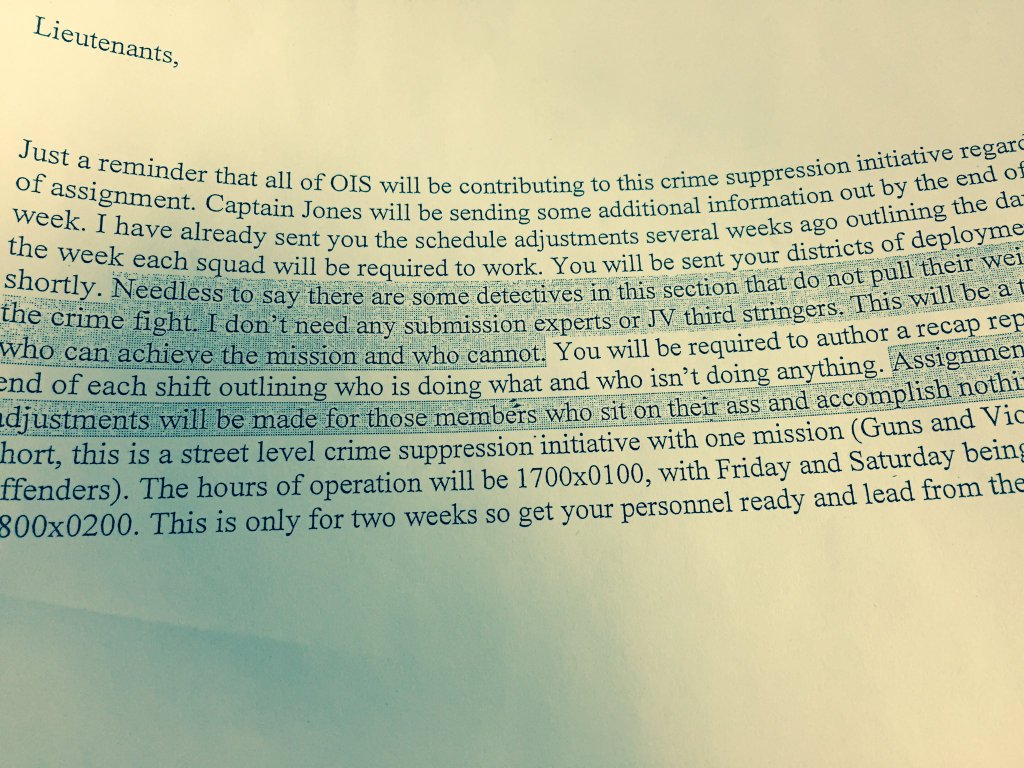
    Maybe Chicago could learn from the Baltimore way of motivating cops: pull your weight; and no “submission experts” or “JV third stringers” need apply!

  • Continuing with the “Ferguson Effect”

    The other week I wrote about the so-called “Ferguson Effect.” Alex Elkins has some more thoughts on this issue, over on his blog:

    The main “take-away,” the one the authors hope the media will pick up and run with, namely, that the Ferguson Effect, as construed by conservatives and certain media outlets, is “spurious.” This is too strident, in my opinion, in light of the available evidence that *something* did change over the past year. It’s not as if the change was in aggravated assault, a notoriously unreliable classification subject to manipulation by police command. No, the change was in murder, hardly a trivial matter.

    Lastly, the authors were unable to link crime trends to the sense that police had backed off in the era of #BlackLivesMatter. They write: “It is important to note that the city-level crime data used in this analysis cannot establish whether loss of legitimacy or de-policing is at the root of an observed increase in crime, or whether contagion induced by social media was responsible for transmitting these changes.”

    That, of course, is the argument that cops have made. Police have contended that after the deaths of Mike Brown and Freddie Gray, and the intense public criticism of over-policing, they have made fewer discretionary street stops and scaled back proactive Broken-Windows-style policing, and as a result, they say, opportunistic criminals have entered the void and committed more violent crimes, like murder.

    In light of all the killing in 2015, I’m willing to entertain this idea. I don’t understand why some seem to think that conceding this premise — that protest has had some effect on police — threatens the Left and its agenda. Massive street protests and intense sustained media attention surely have affected cops — indeed, many have said as much. We can grant that and still maintain the legitimacy of protest and our concerns.

    We have lots of work to do. Refuting the so-called Ferguson Effect — which essentially asks who’s to blame, which conservatives like Mac Donald use to undermine legitimate democratic protests against abusive state practices — when the evidence actually does indicate an increase in violent crime, should be the least of our concerns.

  • “Our Police Today… Frustrated, Bitter, Resentful”

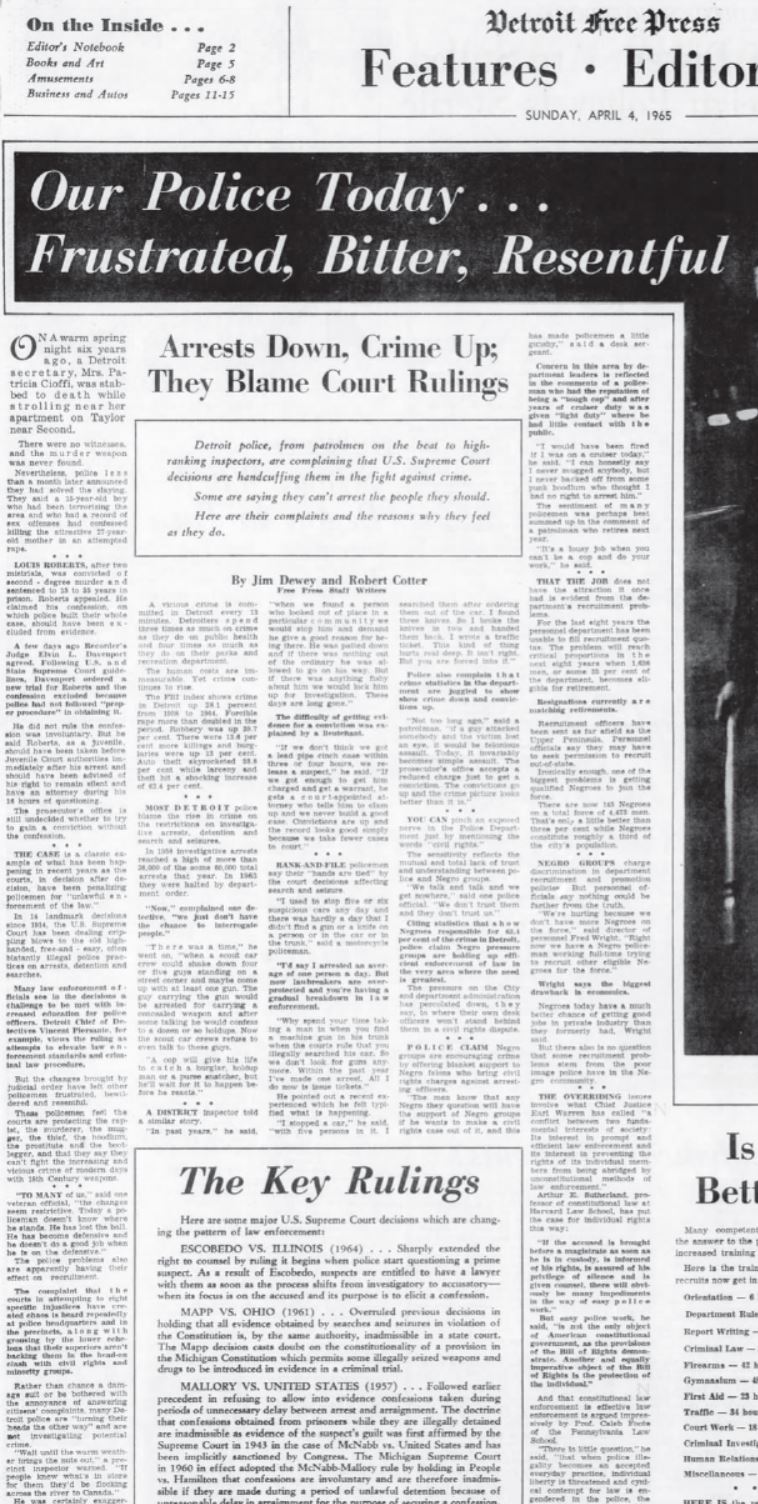
    “Our Police Today… Frustrated, Bitter, Resentful”

    Have you heard the news? There’s nothing new under the sun.

    “Today a policeman doesn’t know where he stands. He has lost the ball. He has become defensive and he doesn’t do a good job when he is on the defensive.”

    “A cop will give his life to catch a burglar, holdup man, or a purse snatcher, but he’ll wait for it to happen before he reacts.”

    “So we don’t look for guns anymore. Within the past year I’ve made one arrest. All I do now is issue tickets.”

    “It’s a lousy job when you can’t be a cop and do your work.”

    Police claim [black] groups are encouraging crime by offering blanket support to [black] felons who bring civil rights charges against arresting officers.

    That the job does not have the attraction it once had is evident from the department’s recruitment problems. For the last eight years the personnel department has been unable to fill recruitment quotas.

    And Prof Caleb Foote of the Pennsylvania Law School makes the case that “constitutional law enforcement is effective law enforcement”:

    “There is little question that when police illegality becomes an accepted everyday practice, individual liberty is threatened and cynical contempt for law in engendered in the police, the law violator and the law abider alike.”

    Of course this isn’t from today. It’s from the Detroit Free Press of April 4, 1965.

    (Of course, it’s worth pointing out that crime really was skyrocketing, and Detroit never recovered. Who knows? Maybe judicial changes were partially to blame.)

    [Thanks to Alex Elkins for the article, and also these Detroit murder numbers:]

    Detroit murders by year:

    1964 — 136

    1965 — 201

    1966 — 252

    1967 — 331

    Murder jumped by 47% between 1964 and 1965. Those numbers rival the increase in murder that some cities experienced in 2015; the national increase was around 15%.

  • Your Personal Ferguson Effect

    There’s an interesting comment in a previous postwhere an officer describes what he calls “my personal Ferguson Effect.” Two similar cases. One cop shot and killed a non-compliant unarmed person. The other cop did not shoot a non compliant person and is now dead.

    The knowledge after the fact of whether the suspect had a gun or not is certainly emotionally powerful in forming our judgements of these officers, but it is irrelevant legally to the officer on the scene attempting to effect an arrest of a non-compliant suspect.

    The fact that the media and the masses apply this rule of hindsight to police use of force and are pressuring police agencies to do the same for internal investigations makes me fearful that the courts will soon start pushing to adopt this same rule of hindsight. That is my personal Ferguson Effect.

    Leaving aside these specific cases, I’m curious if other officers have had specific moments in the past couple years — their own Ferguson Effect — that changed the way you do their job. Was there some discussions, protests, riots, news report, prosecutions, politician, Benghazi (I’m kidding about the last one, I hope) that changed the way you do your job?