Tag: police culture

  • Ferguson and Death in Baltimore’s Western District

    Ferguson and Death in Baltimore’s Western District

    Usually I focus on the Eastern District, because that is where I policed. But I was looking at stats for the Western District, where Freddie Gray died. Homicides in the Western went from a long-time record low (but still shamefully high) 21 in 2014 to a record high 66 in 2015. Holy mackerel, that’s a huge increase! (The Eastern went up from 34 to 55. Baltimore as a whole from 211 to 355 homicides.)

    People, crime is up.

    If memory serves me correct, the entire Western District is like 2.7 square miles and has a population of 40-some thousand. (Without going to block-level census data, population for Baltimore’s police districts is not easy to determine. And even with the census, could any area be as hard to count accurately?)

    66 homicides is about 25 murders per square mile. In one year. Extrapolated over a lifetime, you’re more likely to be murdered in Baltimore’s Eastern or Western District than die in the D-Day Assault on Normandy.

    I just spent a day in Malta, perched over the Grand Harbour, looking at Open Baltimore data. This is my view:

    (Which goes along great with this book.)

    Here’s what bothers me about all these killings: the concerted effort to shift focus elsewhere, specifically to police. And one result of this police-are-the-problem narrative is more dead people. I’m all for fixing society and even fixing police. In the meantime, can we let police do their job? In the Nation, Mychal Denzel Smith writes:

    The fight to end police violence is not separate from that to end intra-racial violence, because they are direct results of the same system, and must be addressed through the same measures.

    Actually, no. They’re not the result of the same system. Police violence does, some of the time, represent America’s history of racial oppression. But other times it represents nothing more than a good cop having a bad day or a bad cop simply being bad.

    Intra-racial violence may be a legacy of slavery (though I find it interesting that the Left doesn’t like subscribing to this belief) or it may be because of more recent discrimination. It also may be because people choose a culture and lifestyle that thinks it’s OK to pick up a gun and shoot somebody. It may — get this — be all of the above.

    But at some point, from a police perspective, I don’t care what caused it; I care what causes it. A homicide happens when somebody has a beef, gets a gun, loads it, finds the sucka, goes up to him, pulls out the gun, pulls the trigger, and aims well enough to hit the person. And then the person has to die.There are a lot of steps. So much can go wrong! If any one of those steps breaks down, the person lives! A homicide postponed is often a homicide prevented. This is where police can be effective.

    Except for the death of Freddie Gray, things had been looking up in Baltimore. People were moving into the city for the first time in decades. Homicides were near a multi-decade low. Police were arresting a small fraction of what they had been just a few years earlier. And then Freddie Gray done dies and some knuckleheads decide police are the biggest problem facing Baltimore City. Next there were protests, and then riots, and then six cops were criminally charged, at least most of them, for being in the wrong place at the wrong time.

    Nothing else changed in Baltimore. Not in the macro sense. The “system” didn’t change when some Baltimoreans decided to riot.

    Smith links to some post, Stop Pretending the “Ferguson Effect” is Real:

    In fact, 2015 has been one of the safest years in the past two decades. … As such, fears of a national “crime spike” are not based in reality.

    Really?!

    2015 saw a huge increase in murder, perhaps the largest increase in the homicide rate in US history. Just because we don’t yet know the accurate numbers doesn’t mean those bodies aren’t dead. Those dead bodies are a reality some people prefer not to see.

    The “system” didn’t get more racist and unjust on or after April 27th. There is “evidence” — no matter how much it is denied — that A) violence is up, B) policing matters, and C) Ferguson, broadly defined, changed things.

    But Smith says:

    This position rests on a few different fallacies: first, that police are being less aggressive out of fear of being the next cop to have their tactics publicly scrutinized, and secondly, that aggressive policing leads to a reduction in violent crime. There is no evidence to support this.

    Except it is true. I’ve been noticing this “there is no evidence to support this” a lot recently. And it’s always from those who deny the efficacy of police. It’s a smug assertion from people ideologically biased or simply too lazy to open their eyes to reality. Usually it’s from those who simply wish they could wish the existing evidence away, be it the effective Broken Windows policing in 1990s or the dramatic rise in violence last year.

    Smith turns to incidents of cops being violent to prove his point. But dammit, a schoolgirl brought to the ground in a classroom really does not prove anything about policing a drug corning in Baltimore. If you want to say the whole damn system is guilty, great; y ou might even be right. You still haven’t told a single police officer how to confront a violent criminal. And God only knows you’ve never done it yourself.

    So after Freddie Gray’s death and the riots of April 27, calls for service in the Western went down some 20 percent, compared to the previous year (this is a bit of an educated guess as Open Baltimore data goes back only to Jan 2015). Maybe people bought the narrative that police were no good. Maybe people thought police were too busy with real problem to bother with their petty bullshit. For whatever reason, calls for service went down and crime went up. (Even at a reduced load, there were still 280 calls dispatched a day, just in the Western District. As one friend put it, “If they hate us so much, why do they keep calling for us to be with them?”)

    Those racist cops, most of them black and other minorities, were worried about their safety and worried about being arrested for making on honest mistake or no mistake at all. Moreso, police were disgusted at a political system that made them the scapegoat and a liberal narrative that made police out to be the bad guys while simultaneously making a hero out of some two-bit junkie criminal who never held a real job and cycled in and out of the criminal justice system. Of everybody who’s died in Baltimore. Hell even if you think Freddie Gray was killed, of everybody who’s been killed in Baltimor — hell, of everybody who’s been killed by police in Baltimore, you go make make a hero out of this guy?! It just don’t make sense. Of course that affected how police do their job.
  • “Stop question and frisk” is dead

    “Stop question and frisk” is dead

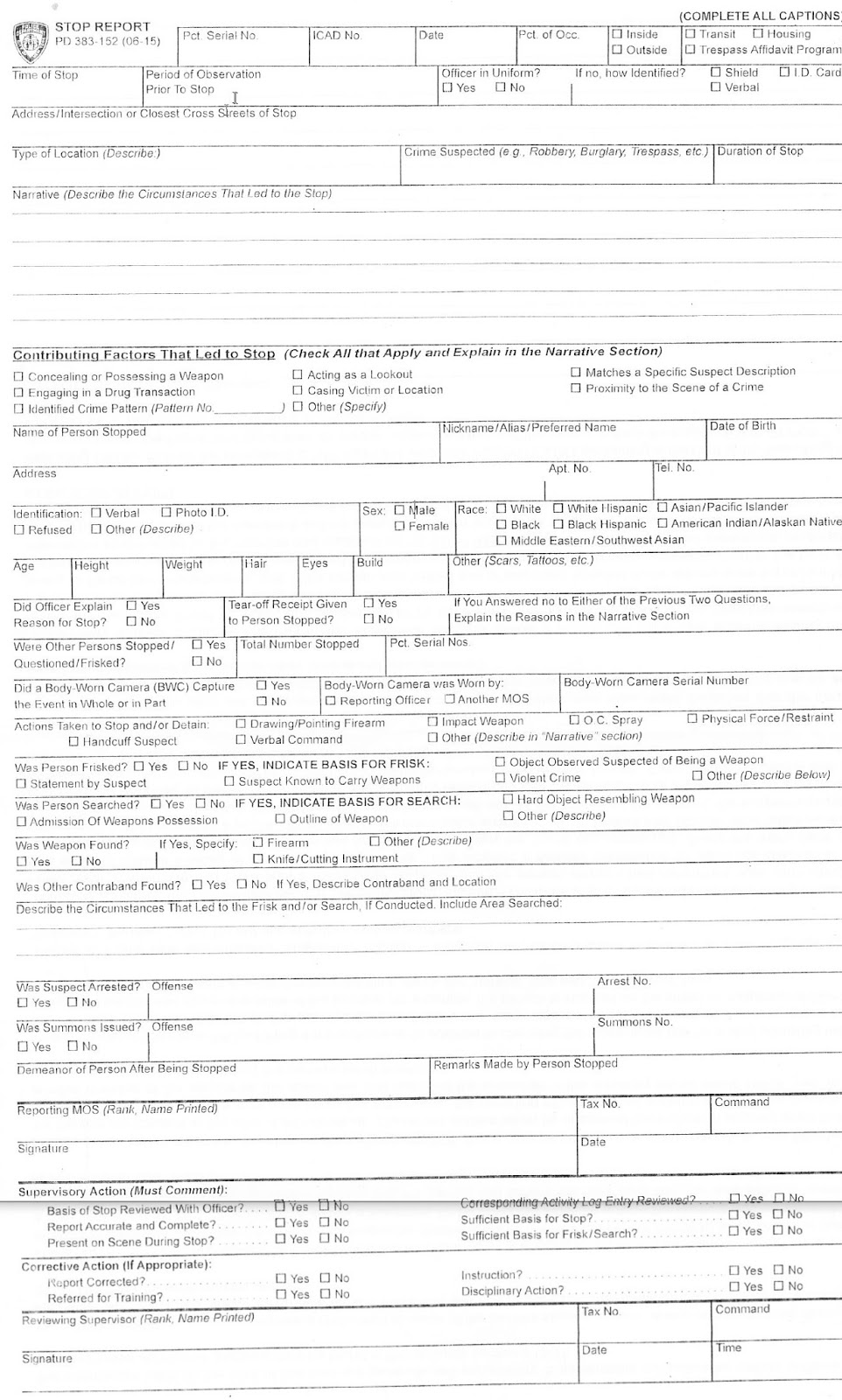
    Welcome the NYPD’s “PD 382-152” (06-15), née UF-250, AKA Stop Report, just FYI:

    This new “UF-250” replaces the old “UF-250” from 2002 that made an unconstitutional mockery of reasonable suspicion as laid out in Terry v. Ohio. (Also FYI, the original form actually called a UF-250 is long dead; long live the UF-250!)

    If the goal is fewer stops, add paperwork to each and every stop. Two things will be accomplished:

    A) There will be fewer stops.

    B) More stops will go unrecorded. (Who the hell has time or desire to fill out a form every time and tell a sergeant every time you stop somebody?)

    And what’s clever, is that in the supervisory action (must comment), you can’t just swipe down the “yes” column. It throws a “no” in there just to slow you down.

    More importantly, and correctly, there’s an actual “narrative” section. Yes, police officers will actually have to “articulate” their “reasonable suspicion” rather than checking a box saying “furtive movement.”

    And the back:

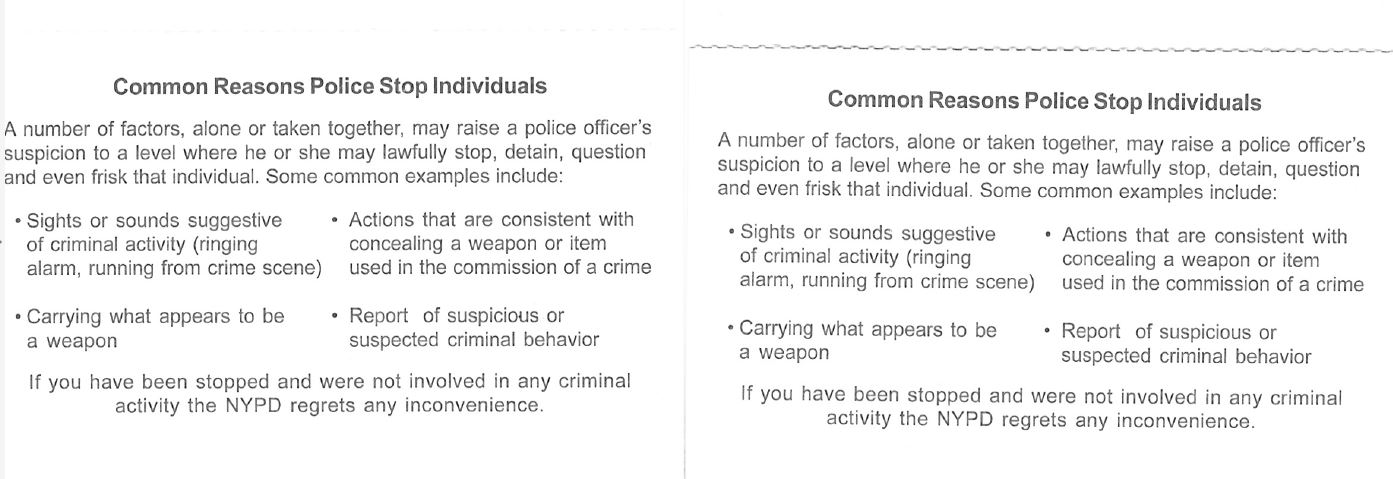
    And then you’re supposed to give the person this card (fat chance):

    Years or weeks from now, when past years’ “stop question and frisk” controversy is but a footnote to NYPD history, this form will still exist. And then, every time an officer doesn’t fill one out — because, for instance, there’s work to be done or there won’t be any forms available — he or she will be in violation of the patrol guide.

    Business as usual will adopt to get things done in a organization designed to be dysfunctional. Because we don’t really want an officer spending 5-15 minutes filling out a form and debriefing a sergeant every time they briefly stop somebody or pat a criminal down to make sure they’re not armed. (Can you “frisk” a person without “stopping” them? I don’t think so.) And then one day further in the future an officer will get in trouble for not following the absurd rules.

    Footnote from 2000: “Completion of the UF-250 form has been required since 1986. In 1997, however, Commissioner Safir declared filing the UF-250’s “a priority” that should be “rigorously enforced.” As a result, filings by the SCU, to cite one example, rose from 140 in 1996 to 18,000 in 1997.

  • “Law enforcement is instilled”

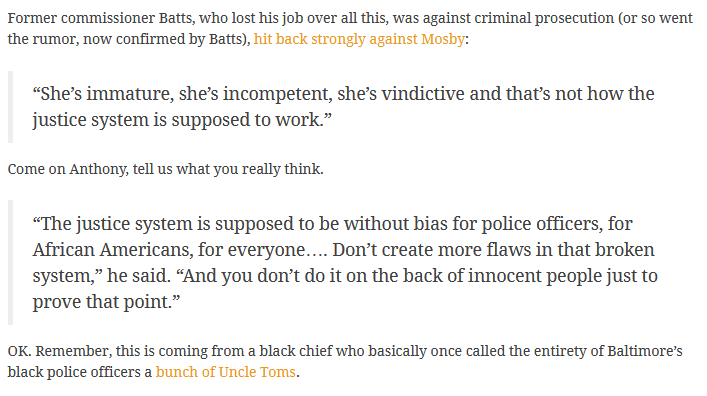
    Marilyn Mosby, Baltimore State’s Attorney, keep emphasizing that she comes from a family of cops:

    To the rank-and-file officers of the Baltimore City Police Department, please know that these accusations of these six officers are not an indictment on the entire force. I come from five generations of law enforcement. My father was an officer. My mother was an officer. Several of my aunts and uncles.

    (I was never understood why she said “five generations” when she meant two.)

    But five relatives who are cops is kind of rare. Impressive, even. What are the odds?

    Well it turns out at least four of these “generations,” including both of Mosby’s parents, were bad cops. What are those odds?!

    Her mom repeatedly tested dirty for coke and was suspended multiple times. She had a her gun taken away and nine disciplinary actions and drug rehab. Yowzas. But at least she didn’t get fired. Mosby’s dad, also a Boston cop, was fired in 1991 after being acquitted by a jury for assault and robbery. He got his job back on what cops would call “a technicality.”

    Her uncles? Two of her mom’s brothers, both cops, were also fired, one in 1991 and the other in 2001. A third uncle successfully sued the Massachusetts state police for discrimination. On the plus side there’s no evidence that her grandfather, a founder of the Massachusetts Association of Minority Law Enforcement Officers in 1968, did anything illegal as a cop.

    Hey, it’s bad enough to have criminals parents, but it’s worse to have criminal parents who are cops. But it happens, I suppose. Not the kid’s fault. But to use these disgraceful cops as a badge of honor and distinction while prosecuting good cops? That’s disgraceful.

    Mosby says, “I come from five generations of police officers, so law enforcement is instilled.”

    God only knows what these clowns instilled in her.

    [This is not new news, but first I’ve heard of it. I think I was in Greece when this news broke in July.]

    July 2016 update:

  • Courage, not fear

    I still can’t believe this guy got shot down by a cop playing whack-a-mole with his service weapon. The D.A. said:

    The evidence in this case shows the shooting to be accidental, and possibly negligent, but not criminally so. “This shooting is not justified, but also not criminal.”

    I don’t know if I buy the stutter-step no-double-tap explanation. But at least the legal concept is sound. Something can be wrong and not criminal.

    In fact, the only charges are against the paralyzed victim with the dead wife. [Update: Charges were dropped. He died.] This seems kind of mean. And there are no national politicians weighing in. Just a small local protest. Al Sharpton must be previously engaged. (As is often the case, this unnecessary shooting happened in California.)

    Officer Feaster claims he didn’t know he shot Thomas:

    No, no. … I don’t think I shot him. I wasn’t even pointing at him but the gun did go off.

    Did go off“? What are you saying? It just blew?

    Let’s leave aside whether Feaster is the world’s best shot or the world’s worst cop. Perhaps it doesn’t matter. The question I have, the question any reasonable police officer might have, is why the hell did he draw his gun in the place. What made this cop so afraid that he felt the need to approach a crashed presumed drunk driver with his gun drawn and shot the man trying to get out of the wreck? The guy was going to run? What use is your gun in that case? A car just flipped. What exactly was the threat?

    In the same vein, a reasonable police officer wonders, as did Levar Jones complying with orders, why he got shot. Why did cops feel that innocent Jonathan Ayers was a lethal threat while driving away? Why is a man not carrying a gun a lethal threat when he drops his hand?

    Why did all these police officers see non-existent threats? Why were they so damn afraid? (I’m tempted to add “…these days,” but maybe it’s always been this way. I don’t know.)

    In the face of danger you need to act but not overreact. You need courage, not fear. There’s a line I always liked in Birds Without Wings:

    His courage was not the foolish kind of a young and silly man. It was the courage of a man who looks danger in the face, and forces himself not to flinch.

    Hell, a little fear can be a good thing; you don’t want to be blasé in the face of danger. It starts in the police academy. “Stay alert, stay alive!” It’s a good lesson. Even “make a hole” isn’t so bad when it’s put in the context of situational awareness. But too much fear becomes paranoia. And that’s not conducive to good policing (or a happy life).

    Here are some of the videos cops watch in the police academy. Some I saw myself. Others are more recent. They’re all on YouTube (which didn’t even exist when I was a cop). I guarantee you that every last one one of these has been watched in some police academy somewhere. Every cop I know knows 1) Dinkheller.

    And 2) here’s that woman cop getting her ass kicked trying to arrest some big guy. His daughter is there. The cop kind of came back, but never recovered.

    Go on. Watch them. Watch them all. It won’t take but 10 or 15 minutes. I’ve cued them all up to the key moment. It’s a parade of snuff films (though many of the cops do live, somehow). Can you watch all of these and not perceive threats and car stops a bit differently?

    3) Here’s a man who wouldn’t stay in his car.

    4) Here’s a routine traffic stop.

    5) Here’s another routine traffic stop.

    6) And other routine car stop.

    7) This was a routine car stop but the guy drove away.

    8) Here’s a guy in cuffs and a girl. What could possible go wrong?

    9) Three cops. One suspect. Everything under control?

    10) This guy isn’t wearing a shirt and doesn’t seem hostile.

    11) This guy is naked and unarmed. There are three cops, two of them with tasers. The guy is still a threat.

    12) And sometimes this happens. Things can go from 0 to 100 really quickly.

    13) This guy does a little jig. He must be just be an odd character.

    14) And everything seems OK here. Except for that shot cop.

    15) This is what happens when you don’t put suspects on the ground.

    16) We all know that when it comes to an armed man, it’s easier to act than react.

    17) And people who have done time can be especially dangerous.

    18) Out-of-shape fathers with their 16-year-old sons? Could always be cop killers.

    And to cops these aren’t just abstract videos. There are people I know, friends, some taught in the academy, who were shot and lucky to live. Others, the pictures on the walls, weren’t so lucky.

    Certainly cops need some of this. Some people are willing, even eager, to kill police. You can’t go on the job as a pacifist. But at some point fear isn’t healthy. It isn’t good for the job. It can even make the job less safe.

    And I worked in a dangerous post. It made me less afraid. You face danger a few times, and you learn to respect it. Cops in the Eastern don’t squeal every time somebody steps on a leaf. But you don’t shoot at everything that moves.

    But what if your work in some place without much danger? How do you stay awake, much less alert? (In my squad we could be alert and asleep!) And then, during some “routine” traffic stop or domestic — blam — something goes off script. Maybe you, the young cop who took the warrior mindset to heart, get a flashback to one of those videos in the academy where the cop got ambushed. And you think: “This is exactly how that cop got killed.”

    [Cue trippy flashback music and echo]

    “This officer hesitated [tated] and it cost him his life [life, ife, f…]”

    “Better to be judged by 12 [elve] than carried by six [six, ix, x…].”

    So you misidentify a threat, overact, and pull the trigger. You’ve screwed up because you’ve gone through life in a constant state of “Condition Yellow” because you didn’t want to slip into unaware “Condition White” in which:

    You may very well die — unless you are lucky. I prefer to not depend on luck.

    Some insist you cannot go through life using this system without becoming a hair-trigger paranoid person who is dangerous to ones self and others. I believe well-adjusted police officers can run through the color code dozens of times every day and be no worse for wear. Most experienced police officers who learn the color code realize they have been taking these steps on their own all along.

    Maybe. For some. For me even. (This is why cops don’t sit with their back toward the door.) But even if constant hypervigilance doesn’t make you paranoid, it is very tiring. Exhausting, even. I don’t miss it. And stress affects some people more than others. NYPD officers are much more likely to commit suicide with their service weapon than be killed by a criminal. Why?

    I don’t know the answer. I don’t like the “warrior” or “guardian” dichotomy. I would certainly put the emphasis on the latter, but you need a bit of both. You can’t let the warrior mindset take your soul.

    Seth Stoughton writes in the Harvard Law Review:

    Officers learn to be afraid. That isn’t the word used in law enforcement circles, of course. Vigilant, attentive, cautious, alert, or observant are the terms that appear most often in police publications. But make no mistake, officers don’t learn to be vigilant, attentive, cautious, alert, and observant just because it’s fun. They do so because they are afraid. Fear is ubiquitous in law enforcement.

    And to those who say police need to abandon this warrior mindset for guardian mindset. Well, they’ve got an answer for that, too. And it’s not crazy. What do you do when it’s time to fight?

    At some basic level policing does involve confronting and fighting criminals intent on hurting you or others. I always notice that when people talk about police reform or improving community relations, the word “criminal” will never come up. It’s as if the entire job of policing is nothing more than dancing with kids and smiling at church-going ladies in fancy hats.

    See, just as the public needs to have a more realistic perspective about the “epidemic” of police killing innocent people (happens, but not too much), police need to get a realistic grip about being shot on the job (happens, including to friends of mine, but still less than cops think). Nationwide police get shot and killed about 3 times every month. That’s an annual homicide rate (cops getting killed per 100,000 officers) of under 5, which just happens to be almost identical to the national homicide rate. Of course keep in mind cops are on-duty only a fraction of the time, so cops on the job have a homicide rate 5 times higher than the national average. But hell, it’s still safer to be a cop than to live in Baltimore.

    Stay alert. Stay alive. But for God’s sake stop being so damn afraid all the time.

    [In memory of the police officers killed in the above videos: Kyle Wayne Dinkheller, Jonathan Richard Schmidt, Edward Scott Richardson, Billy Colón-Crespo, Ramón Manuel Ramirez-Castro, Darrell Edward Lunsford, Sr., Thomas William Evans, and Robert Brandon Paudert. They gave their all.]

  • Backdated seatbelt memo?

    The Sun on that BPD seat belt policy:

    Chief Deputy State’s Attorney Michael Schatzow said Porter showed a “callous indifference for life” when he deviated from department policies. Defense attorneys have said other police officers routinely break such policies, but Schatzow said those officers should not be considered “reasonable.”

    What’s interesting is that the “new” policy, says the department, came out on April 3. Yet a source, a person I trust, says that policy didn’t actually come out till after Freddie Gray’s arrest, on April 12. The department backdated the memo. I wouldn’t put that past them. According to reports, the April 3 memo “went out on April 9, just three days before Porter’s encounter with Gray in Sandtown-Winchester.” Wouldn’t that be convenient. But it was never read in roll call. Nobody seems to have seen it until after Freddie Gray died. There should at least be an email trail, that 80 page attachment. When did that arrive in the in-boxes?

    Of course even if there were no 2015 update, the 1999 memo should still be in effect. Or maybe there was another update in policy between 1999 and 2015? I don’t know. How could anybody know? The whole damn system is messed up. I suspect the department didn’t know about the 1999 memo and assumed the 1997 policy was still valid. (Which I can’t find but nobody seems to doubt.)

    So it’s possible that in 2015 somebody in the Baltimore City Police Department backdated a new policy to screw the officers involved in the death of Freddie Gray, unaware that the policy they were updating was actually identical to what the new memo said. (The 2015 memo might say the year of the policy it is updating, right? I’d be curious to see it.)

    Either way, based on 1999 general orders or 2015 policy, all prisoners should be seatbelted. And also no police officer: “while riding gratis on any type of public conveyance, [is] permitted to be seated while other passengers are standing.” One questions at hand (the other is about delayed medical care) is whether violating the seat belt policy can be a crime (because Freddie Grey died) It seems like a reasonable person might have doubts.

  • Fiddlesticks!

    @PeterMoskos wins the “Most Profanity in One Quote” Award. https://t.co/Rt22OJRYjy

    — Jeffrey Butts (@JeffreyButts) December 5, 2015

    I’m humbled and honored to win the Golden Middle Finger award. I’d like to thank all the sailors and pirates who taught me everything I know, gosh darnit.

    In all seriousness, this Guardian piece by Baynard Woods might be the first fair thing The Guardianhas written about police since the Coldbath Fields Riot of 1833:

    “I can imagine for Porter it’s difficult,” said Leon Taylor, an African American who served as a Baltimore City police officer for over a decade. “It’s more difficult when you feel that you’re part of the community and the community is willing to negate all of the positive things that you’ve done and all the greater things you could have accomplished because of this incident.”

    “If he’s convicted then his lawyer is under an ethical duty to present Porter with other alternatives to being sentenced for the crime or crimes for which he was convicted,” Colbert [a professor of law at the University of Maryland] said. “That’s where he’ll be faced with being offered a negotiation that would likely require his testimony against other officers in exchange for leniency in his ultimate sentence.”

    Peter Moskos, a former member of the Baltimore police department who is now an author and professor at the John Jay College of Criminal Justice in New York, acknowledged that there is a blue wall but said it only goes so far.

    “The general rule of thumb is: No, cops will not go out of their way to say bad things about another cop certainly,” he said. “But cops also aren’t willing to go to jail for the misdeeds of another cop. ‘Why am I going to risk my pension and my job for your fuck up’ is the general attitude … To some extent, when the shit hits the fan, all bets are off. You do have to cover your ass first.”

    “It seems like they’ve adopted a divide and conquer strategy to get the desired outcome of the case,” Taylor said of the prosecution, but noted that ultimately it depends on the outcome.

    Moskos was a bit more fatalistic.

    “I mean the problem is, even in the best case scenario for cops, they’re still fucked because Freddie Gray went into the van alive and came out dead,” he said. “That can’t happen.”

    Yeah, I got four bad boys and two f-bombs in there, thank you very much. Just for the record, we chatted for half an hour and there were long stretches without single a curse word.

    As a side note, it always cracks me up when people who don’t know policing talk confidently about the “Blue Wall of Silence”: “There’s a very strong police culture that values and enforces a code of silence,” Colbert says. How the hell would he know?

    Cops testify against cops all the time. Cops are testifying against cops right now. And right now people will insist it never happens. I mean, I bet Colbert knows a few professors, maybe some lawyers, who haven’t always been on the level. What has he said? How many of you would go out of their way to rat out a colleague? Do students tell on other students who cheats? Not in my experience. Hell I know of a married sociologist who slept with a student. Have I said anything? No. And this isn’t out of some academic “wall of silence.” I don’t even like the guy. But what can I do? It’s not a crime. And I can’t prove it. Policing is no different.

    But one thing Colbert said does make perfect sense. Mosby needs to get a conviction against Portor. She needs to. Because if she does, she can leverage the sentence over him. “Reckless endangerment” can get up to five years (though it’s a misdemeanor… how is that possible?). Five years would mean three years with good time. Or, they tell him, you can walk free if you testify enough against Ceasar Goodson to get a felony conviction (Goodson is the only one of the six who might be found guilty of anything real). Such proscutorial games are standard practice, of course. But that doesn’t make it right. Still, if Portor is acquitted of everything, which he will be if he does well on the stand (which is not a given), this whole “charge everybody who was there” is going to come crashing down on Mosby, as it should.

  • Chicago Cover Up

    From the mayor on down to the officer on scene, the cover-up seems pretty big. Multiple false reports are very worrisome. Though a detective taking a statement from Van Dyke shouldn’t qualify as another false report. But Van Dyke’s partner, Walsh, is certainly culpable.

    Update: The New York Timessays “at least five other officers on the scene that night corroborated a version of events similar to the one Officer Van Dyke.”

  • [Not Following] General Orders

    [Not Following] General Orders

    You want to know why cops are always bitching? You want to know how cops can feel like they’re the victims? You want to know what it’s like to be on trial for violating a General Order? (In the NYPD this in known as the Patrol Guide. Same thing.)

    Sun columnist Dan Rodricks is unfairly dismissive of the ignorance defense when he writes:

    Not knowing the law — not noticing the speed limit on a street or stretch of highway, as a simple example — is usually not an acceptable excuse. A police officer not knowing a policy (or missing the memo about one) isn’t much of one, either.

    In terms of breaking the law, it’s important to point out that General Orders are not laws. Also, speed limits are posted.

    And yet it seems reasonable to expect cops to know the rules of their organization. But it’s not. It’s impossible. If you want to point fingers, blame the organization. But the issue remains: what are well meaning cops supposed to do?

    This is going to be boring, OK? But if you want to understand police, I’m going to take you into the weeds. Because the devil is down there in those weeds.

    [Actually if you can figure out why cops are always bitching, let me know. Because I’ve never figured that one out.]

    I wanted to look up the Baltimore City Police Department’s General Order on seat belt regulations for prisoner transport. Why, because it seem like Officer Porter might go to jail for ignorance of this one.

    First I had to go to my school office because that’s where I keep my old binder of G.O.s. The binder is too big to carry with you. So as a cop you don’t have it on you for reference. Mine was last updated in June of 2001. Fourteen years later it would be even thicker. Orders go into the G.O.s. They never come out.

    I easily found the binder and discovered with it a folder of loose things that I was given during my brief career that I couldn’t or didn’t file in the binder.

    Now keep in mind, it’s been awhile since I’ve done this. So I might be a bit slow. But hell, I do have a PhD from Harvard and graduated Magna Cum Laude from Princeton. What I’m saying is that even though I’m not a rocket scientist, I’m not the dullest tool in the shed. And I’m a good researcher! Nevertheless, it took more than half an hour from the start of my quest to the start of writing this. And I got lucky. Almost unbelievably so.

    So where does one start? [A professor just came to my office and told me students today don’t even know what a table of contents is. Or an index. Whoa. That’s mind blowing, but off subject…] Except the book of General Orders has no index. Hell, it doesn’t even have page numbers! But there is a Table of Contents, without page numbers:

    I’m going with Section K: Adult Arrests. Flipping forward a few pages my bet is on K14, persons in police custody. G.O. Number 06-92. So I flip open to K. My binder actually has tabs with writing on them. Because I’m nerdy and organized like that. Or maybe they made us do that in the police academy. I don’t remember.

    So I open to K and K-1 is something about Career Criminals Program of 1982. I couldn’t care less. I assume it’s long irrelevant even in 2000. But how would one know? It modifies the Career Criminals Program of 1976. Signed by Commissioner Battaglia? He doesn’t even ring a bell. He must have not been in for long.

    And then you just start flipping. After K-1 comes Annex A, Annex B, then K-2. The top of the page doesn’t say which K you’re on. And there are lots of “Annex.” It’s easy to get lost. Eventually I find K-14. Signed by Commissioner Edward Woods. He signed a lot of these.

    Note the “Rescission” section to remove from the manual. How would you even find Memorandum 2-82? I have no idea.

    Is this it? Annex A on Custodial Safety and Welfare of Persons in Custody.

    It doesn’t say anything about seat belts. Does that mean there is no G.O. on seat belts? In this case I know there is. But what if I didn’t? How would you know? There is no index. But I think I need to find a section on prisoner transport.

    Oh, here’s a doozy from 1985, amending an order from 1977.

    “Make the following pen changes to Annex D, Section I, page D-3: Paragraph 1, lines 3&4 — Delete: [blah blah blah].” You know it’s old because it’s signed by Commissioner Bishop Robinson. First black commissioner. I always liked his name. Pomerleau is the oldest one finds in the G.O.s. He was commissioner from the Mayflower landing till 1981.

    There are 18 pages of K-14. I go through them. Nothing seems to concern seat belts.

    I don’t know what to do. So I go through my G.O. Supplement folder. Slim chance. But you never know.

    I see the pages on ethical conduct.

    These were my favorite. I used to check them off one-by-one when I violated them. I’m hilarious that way. But this matter because if they can’t pin anything else on you, they can always get you for “conduct unbecoming.”

    I may have missed a few, but of the first 31 rules of conduct, I checked off all but 12 as violated. And I was a good cop, an honest cop. And yet in less than two years on the job I managed to violate the majority of good conduct rules. My favorite was “Section 7: Members of the department, while riding gratis on any type of public conveyance, are not permitted to be seated while other passengers are standing.” This is off duty, mind you. And it doesn’t say “give up your seat if the bus is full.” Nope. If anybody is standing, you must stand.

    Some of the rules, of course, you need to violate in order to do your job. (Section 2, for instance, prohibits use of slang while talking to the public. I never did violate Section 28 by playing cards, which I could have done.)

    Now at this point I, like you, am distracted and have kind of given up. And right then… I’ll be damned at what literally flutters from the folder. This very sheet: “The Police Commissioner’s Memorandum 19-99, Subject: Seat Belts.” I’m not making this up. This literally fluttered down from heaven above, or at least the binder I was holding. Like Mana from fucking heaven!

    This came out before I was hired. So there’s no reason it’s not in the binder. But it’s not in the binder and I have no idea where it should be filed. It’s not like it says K-14 part 3 or anything. Is there a special section for “Memorandum”? I don’t know. One can’t know. And that’s my point.

    But there it is, halfway down (while on the back of the sheet is something unrelated about dog bites):

    • Use a seat belt when operating or riding as a passenger in any departmental vehicle.

    • Ensure that all other occupants of a departmental vehicle that you are operating use a seat belt or a federally approved child safety seat when applicable.

    • [Don’t use child safety seats in the rear of cage cars.]

    • Ensure that prisoners transported in prisoner transportation vehicles are secured with a seat belt. [emphasis added]

    • Use extreme caution when transporting anyone in departmental vehicles. [Thanks for nothing.]

    This one is signed by much-hated Commissioner Thomas Frazier. He was just before my time but was the guy who initially approved my research! (The best thing that ever happened to Frazier’s reputation was Commissioner Batts.)

    So that is it, right? Buckle up prisoners. No exceptions. That’s certainly what I thought the rule was. But maybe I was wrong. Supposedly there was a rule saying you didn’t have to, for officer safety? I doubt it. but maybe that happened after 2001. And the new 2014 G.O. was going back to the old May 1999 G.O.? Unlikely. But…

    I don’t know, and there’s no way to find out

    And I still haven’t found the section on prisoner transport, assuming there is one. But there must be. Unless there isn’t. And then what if I did find it and there are two General Orders that conflict with each other? Then what?

    When I quit the police department, one of the things I told myself was that if I could change the system of General Orders, I would be the unsung hero of police officers who had never even heard my name. I could make the world a better place and die a happier man. But how does one change the system? Better people than I have run police departments and yet General Orders and Patrol Guides get worse and worse.

  • Trial of Officer Porter, Day 4

    Here’s the recapof Day 4 of the trial of Officer William Porter.

    I’m not there and I’m no lawyer, so far be it from me to figure out what’s going on.

    But I’m having a tough time figuring out Porter’s role in a crime. Today seemed to be focused on seat belts. Gray wasn’t Porter’s prisoner. It wasn’t Porter’s job to buckle him in.

    I’m curious about this line: “The defense grilled him [Capt. Bartness] about the complexity and inanity of internal police rules, but Bartness did not take the bait.”

    Other useful facts.

    From Sun columnist Dan Roderick:

    For one thing, the revised rule about seat-belting all prisoners went out on a department-wide email blast with an 80-page attachment. Porter was assigned to the Western District, and the officers there complained about the district’s slow, antiquated computer system. The Baltimore Police Department had general computer network issues earlier this year. And there was some kind of a virus back in the spring. And there’s no way to know if Porter ever received the email with the new seat belt policy. And the memo about the seat belts apparently was not read aloud at roll call.

    I find it hard to believe that Porter or any cop would be unaware that a prisoner should be buckled in. But keep in mind I was there 15 years ago. Things can change.

    But perhaps more important is this: the old rules, until a week before Gray’s death, said you didn’t have to buckle in a suspect if it wasn’t safe for the officer to do so. It’s absolutely probable that Porter did not get the new memo, that disallowed the “officer safety” exception. The new rule made a rule that I thought was the old rule. But there’s no good way for an officer to get the new rule.

    But I had no idea, from when I was there, that there was ever an “officer safety” exception to the seat belt rule. Keep in mind I never drove the wagon. And we (almost) never took prisoners in normal patrol cars. We had one cage car, so I did transport a few prisoners. But not often.

    I’m not certain why this matter, but it does show you the SNAFU environment of a police department. When I was there, new G.O.’s were read at role call. Usually. If you weren’t at work that day, you didn’t get the memo. Or maybe you sergeant would give you the memo to put in your bursting binder. Now G.O.’s come out pretty often, and most are irrelevant to your job. So you ignore or don’t understand them.

    Now, apparently, they come in an email. With an 80-page attachment. And you have to access it on a shitty district computer that may not work. What is an officer supposed to do? Seriously? Does the whole squad line up and take turns reading the attachment? Or do go out and answer calls for service? Or better yet, give special attention to the drug corner by the church that the State’s Attorney Mosby — the current prosecutor — pressured you to get rid of?

    I mean when is the last time you read you read the fine print to the changes of your credit card? Or read the legalese before clicking “accept” on something online?

    Should police officers be familiar with the rules? Of course. Can a police officer be familiar with every General Order? No. Is ignorance of the law ever a good excuse? Well, legally no. But morally, actually, yeah, it can be. And is the whole damn police organization one reflexive CYA designed to fuck a cop for violating some General Order when somebody needs to be fucked? Abso-fucking-lutely.

  • But they made him write it down!

    From the Twittersphere:

    The idea that the academy would keep your B.S. classwork just to f*ck you is what gets my goat. “See, we didn’t actually try and teach anything but we made him write it down!” Though I’m not surprised. That’s the academy I remember from 15 years ago. And I have no reason to think anything changed (and keep hearing that it hasn’t)

    Anyway, I tweeted (maximum 140 characters each) a bunch of lessons I learned from Baltimore’s academy, back when it was on Guilford St. One guy just wrote me and mentioned that when they moved to the new academy, his class “didn’t see an instructor for 4 weeks straight.” Classic. And that wasn’t even the worst. That would have to be the trainee who got shot.

    This is all taken from Cop in the Hood.

    What was the Baltimore City Police Academy like?

    Overall there was little emphasis on subject retention. Very little attempt was made to relate class material to actual police work.

    As one trainee said, “They’re not doing it to protect our ass, they’re doing it to cover theirs.”

    The Baltimore Police Dept’s book of General Orders, without index or page numbers, comes in at a binder-bursting 5 inches thick.

    BPD academy instructor: “Every knows this is a joke, but I just have to teach you what the General Orders say.”

    Deviation from G.O.s–no matter how smart, creative, well intentioned–potentially subject to dept disciplinary action

    Yet some violations of General Orders are so ingrained as to be standard operating procedure.

    At end of academy, less than half the class saw relation between what they learned and what police need to know on the street

    One of few useful lessons in Balto police academy come on Day 1: “When in doubt, shut your mouth and look sharp!”

    Primarily, the point of the academy is to protect department from legal liability that could result from negligent training.

    Yet police patrol demands lesson wholly lacking in the academy: bold, independent, intelligent, and thoughtful actions