Tag: police culture

  • Here’s what’s up in Oklahoma

    This is an email I received from (someone I believe is) an Oklahoma Police officer. He answered my question — why does Oklahoma lead the nation in people killed by police? — very well. It’s knowledge I don’t have, and I can’t say it better myself. He agreed to let me reprint it here, anonymously:

    To clarify, the reserve academy is 240 hours (nights and weekends), the full time academy is 600 hours (increased to 600 4-5 years ago). Reserves are limited to the number of hours they may work. When I started in ____ the reserve academy was 168 (min hours, most add additional training to it) and I think full time was 320. A few years before that it was less and less.

    They have increased training greatly over the last 15-20 years. The main reason it has taken so long to increase the hours and why it isn’t as high as the national average is that most departments can’t afford to have an officer tied up at the academy for more time. Most have a difficult time making it while they are gone as it is, due to a lack of manpower. The only area where the standards in OK exceed standards is firearms. They made the qualification course easier 3-4 years ago, but it’s still difficult. (Before they used to start at 50 yards, now they have eliminated those and added more at 25 yards).

    As for the reason for more shootings by officers and other issues in general, there are many things that contribute.

    1) OK is a “conservative” state. They continually increase penalties while at the same time cutting budgets, causing less personnel, less continuing education opportunities, increased early release of inmates (I think the last news article I read on our prisons stated at they are only about 60% staffed). In my opinion, the ones on parole are far from adequately supervised. There is also, in my opinion, a lack of mental health services.

    2) Pay. No one wants to say it, but low pay contributes to they quality of officers. You get some that do it for the right reasons, then some that never should be officers. It’s hard for most agencies to find suitable officers. With the exception of a handful of agencies in the metro areas and the OK Highway Patrol, I would estimate the average salary as 30K. Some smaller agencies in our area start at just above minimum wage. Some small towns have one full time and actually pay one or two reserves (many end up going to the full time academy and becoming full time at some point).

    3) Low number of officers per square mile outside of OKC, Tulsa, Norman, and Lawton. There are no agencies outside of the metro areas that I know of they have more than one officer per unit. In many areas, the nearest backup may be 15-20 miles away. (More likely to fight or attack a solo officer.) It’s not that these areas are not populated, just not as densely populated. The tax bases do not generate enough to hire additional officers.

    4) Meth and prescription drugs, abused everywhere, but sadly more so in OK. Leads to increases crime and violence in general

    5) Suicide by cop. This seems to be happening more in OK. A few weeks ago I was involved in a pursuit and shootout with a man who had murdered his brother and told some people he wouldn’t be taken alive. As a result of his actions, a state trooper was injured by glass flying into his eye when a bullet from the suspect struck his windshield. The suspect was shot and killed. The same night one of the troopers that came to assist with that stopped a car and the driver pulled a pistol and started shooting at him, causing the trooper to retreat to his car and return fire. The suspect then exited his vehicle and shot himself in the head. The last I heard no one was able to determine why the man did it.

    6) Change in our society. I used to think my elders didn’t know what they were talking about when they spoke of changes, but I have noticed them myself over my 35 years of life, especially the last 10. With newer generations, ethics and personal responsibility seems to have declined. Children are doing things in school now that we would have never done or even thought about doing. Some (sadly some of my own family) have no respect for themselves or anything else. (I’m not sure if this is everywhere or just in our region.). We also have a high percentage of our population on various forms of welfare and large economically depressed areas (not that this makes someone a criminal).

    7) Broken juvenile justice system and some parent that just don’t care. In OK, they can do nearly anything without consequences, and they know it. By the time they turn 18 is too late and they continue to be criminals.

    8) Drug trafficking and cartels. I-35 , I-40, and I-44. Besides local drug manufactures, large amounts are brought through our state. (Same is true for AZ, NM, and TX).

    9) EVERYONE in OK is armed. I personally do not have an issue with it. I purchased my first firearm, a Colt single action .22, from an elderly neighbor when I was 9 years old. I have collected and enjoyed shooting ever since, both competitively and recreational. In OK, I would estimate that over 50% of the population have weapons and many hunt. It is legal for citizens to own suppressors, machine guns, and short barreled rifles (with appropriate paperwork and ATF tax stamp). The vast majority of gun owners are very responsible, however, with increased gun ownership, there is naturally going to be increased issues involving firearms. Same is true with alcohol (our state had a huge problem with DUI), fattening foods, and smoking.

    All of this sounds bad, but Oklahoma is actually a good state to live in, it just had some issues like anywhere else.
  • “Who gave this reserve cop a gun?”

    Uh, it’s his own gun. But headline aside (writers don’t write the headline), I like to think I make some good points in this CNN piece about Robert Bates, the Tulsa County “reserve deputy” who thought his gun was a Taser and shot and killed a criminal.

  • “You’re doin’ fine, Oklahoma!” Not.

    A 73-year old man, Robert C. Bates, liked to play cops and robbers. He thought he was going to get to Tase a bad guy. But instead of holding his Taser, Bob was holding his personal gun. Bang. You’re dead. Oops.

    Bates wasn’t a real cop. He was a “reserve deputy sheriff,” which isn’t necessarily a bad concept, within reason. But this isn’t reasonable. Bates paid to play. He gave money to the Tulsa County sheriff’s election campaign. Maybe he could have been a deputy sheriff without donating money. But he gave cars to the undercover unit to which he had access. And now, irony of ironies, Bates might be convicted based on the evidence provided by the very eye-glass cameras he perhaps gave to the department!

    Bates didn’t even have good reason to even Tase Eric Harris. Cops were on scene. Harris wasn’t getting the upper hand. He wasn’t going anywhere. Despite what Bates later said, I do not think Bates thought Harris was armed. I say this because Harris was flying. Booking. Like a man who does not have a gun in his waistband. His arms were pumping, not going to his dip. Not in what I saw. And this is very much contrary to what supposedly “independent consultant” Sgt. Jim Clark claimed while defending Bates after being paid to investigate the shooting.

    [And Kudos to the cop who tackled Bates. Good job. He was a fast runner and knew exactly where to tell the driver to stop the car, though the driver was a bit slow in doing so.]

    “This horrible situation is going to be about what a corrupt sheriff’s office does after a bad shooting,” said Daniel Smolen, said a lawyer for the SOB who was shot.

    I think Smolen may be right…. wait. Did I just speak bad of the dead? Yeah. And I say this without at all saying the shooting was justified. And I’m certainly not defending an elected sheriff who allowed the guy to be on the scene with a gun. But what a bastard Harris was: Violence. Drugs. Guns. Robbery. Assault on cops. Escape from prison(?!). The whole nine yards. A real life of crime.

    I mention this in relation to my Washington Post article in which I describe how cops were so bothered about the shooting of Walter Scott. That one was different. This was a tragedy. A fuck up. And blame can and should be placed. But if you want cops to shed a tear over the death of Eric Harris, you’re going to be waiting a long time. Harris was a harbinger of violence and doom.

    [Having watched the whole unedited video in the CNN office today, it’s unfair to just air the part where cops say bad things to Harris. One line — “fuck your breath” — out of context is just a gotcha moment. The media should also show Harris yelling at the cops. Now granted, Harris has just been shot. Maybe you wouldn’t like the line even in context, but the context matters. Harris, on the ground after a dangerous chase, is yelling about how he “didn’t do shit.” This is a man who had just ran from police after selling an illegal gun to an undercover cop. My actual thought when I heard his protests of innocence was, “fuck you!” Though I did manage to just think this and not blurt it out in the middle of a newsroom. I also didn’t just have to chase, catch, and restrain this jerk. This situation, to paraphrase Jay-Z, has 99 problems, but the cops’ words ain’t one.]

    Maybe it’s because as a police officer you’re around of lot of death and even a lot of people murdered. So perhaps it’s inevitable to rank order the value of life. It’s one way you cope with dealing with a lot of death. An innocent kid is worth more than a guilty adult. A robbery victim’s life is worth more than the robber’s life. Somebody who could have prevented his own death by complying with lawful orders deserves less sympathy than somebody who didn’t run. The death of a guy killed after some minor vehicle violation is more tragic than a long-time felon who dies after running and selling undercover cops a gun. Somebody killed with intent is different than somebody killed in an accident. And both of those deaths would be different than somebody who happens to die as a result of less-lethal force.

    So Bates had a Taser. And I think Bates wanted to use his toy. Oh, boy! I suspect moments like this were exactly why Bates had given so much to the Tulsa County Sheriff. He wanted to play cop. Bates and the Tulsa County Sheriff’s Department have made a mockery out of professional policing. Clearly Bates should not have have had a gun and a Taser.

    Let us not start to consider “slip and capture” (a term I had forgotten before today) justification for using a gun instead of a Taser. Yeah, apparently it is possible to hold and fire a gun that you think is a Taser. “Slip and capture” reminds me of the invented concept “excited delirium,” which to some people means it’s OK when people die after getting tased. Just because you give something a name doesn’t make it real, or defensible. At best, “slip an capture” is a description. Bates, from everything he said before and after firing one round, obviously did not intend to shoot and kill Harris. But that doesn’t make it OK. And with proper training you don’t do it.

    And it’s interesting to note that both in this case and the shooting of Walter Scott in South Carolina (and the shooting of Oscar Grant on the Fruitvale BART platform), that these victims would be alive if the cops (or, “cop” in the Oklahoma case) had not been armed with a Taser. I’ve never been a big Taser fan. I wonder if this is something to consider. There’s particularly irony in people being killed because officers have less-lethal weaponry. (Not running from cops is also a wise preservation strategy, though that didn’t help Grant.)

    Finally, let me observe that I don’t know much about Oklahoma except a song (and the history and meaning of “Sooner”). But maybe Oklahoma is not “doin’ fine.”

    Oklahoma (together with fair New Mexico) has the highest rate of police-involved killing in the nation! The rate at which people are being killed by police in Oklahoma is twice the national average and five times the rate in New York or Michigan. Five times higher? That’s a big difference. It’s also the subject of my next post.

  • “This one is different”

    An op-ed of mine to appear in Sunday’s Washington Post:

    This one is different.

    Walter Scott was killed — shot multiple times in the back — by North Charleston, S.C., police officer Michael Slager last weekend. Scott, already running away, was no threat to the officer when the first shot was fired. He was even less of a threat when Slager paused and fired the eighth and final round.

    To non-police, Scott’s death may look familiar: Not even a year after Eric Garner died during an arrest in Staten Island, N.Y., and Michael Brown died in a police shooting in Ferguson, Mo., here was another black man killed by police.

    But to law enforcement officers observing the North Charleston tragedy, the case is nothing like “another Ferguson” — and that’s where the police perspective and the civilian perspective on these events diverge.

    Click through to keep reading.

  • Seven (7!) Percent of Oakland Cops Live in Oakland

    I don’t know what the right percentage is, regarding cops living where they work. Though I am partial to 100 percent of cops living or having had lived in the city they police. But whatever the right number is, the percentage is larger than friggin’ seven percent, which is what you find in Oakland. Now is this why Oakland cops have such troubled community relations? Well… actually, yeah, in part. Maybe not the majority part. But certainly a partial part.

  • How much would they have pay you to do this?

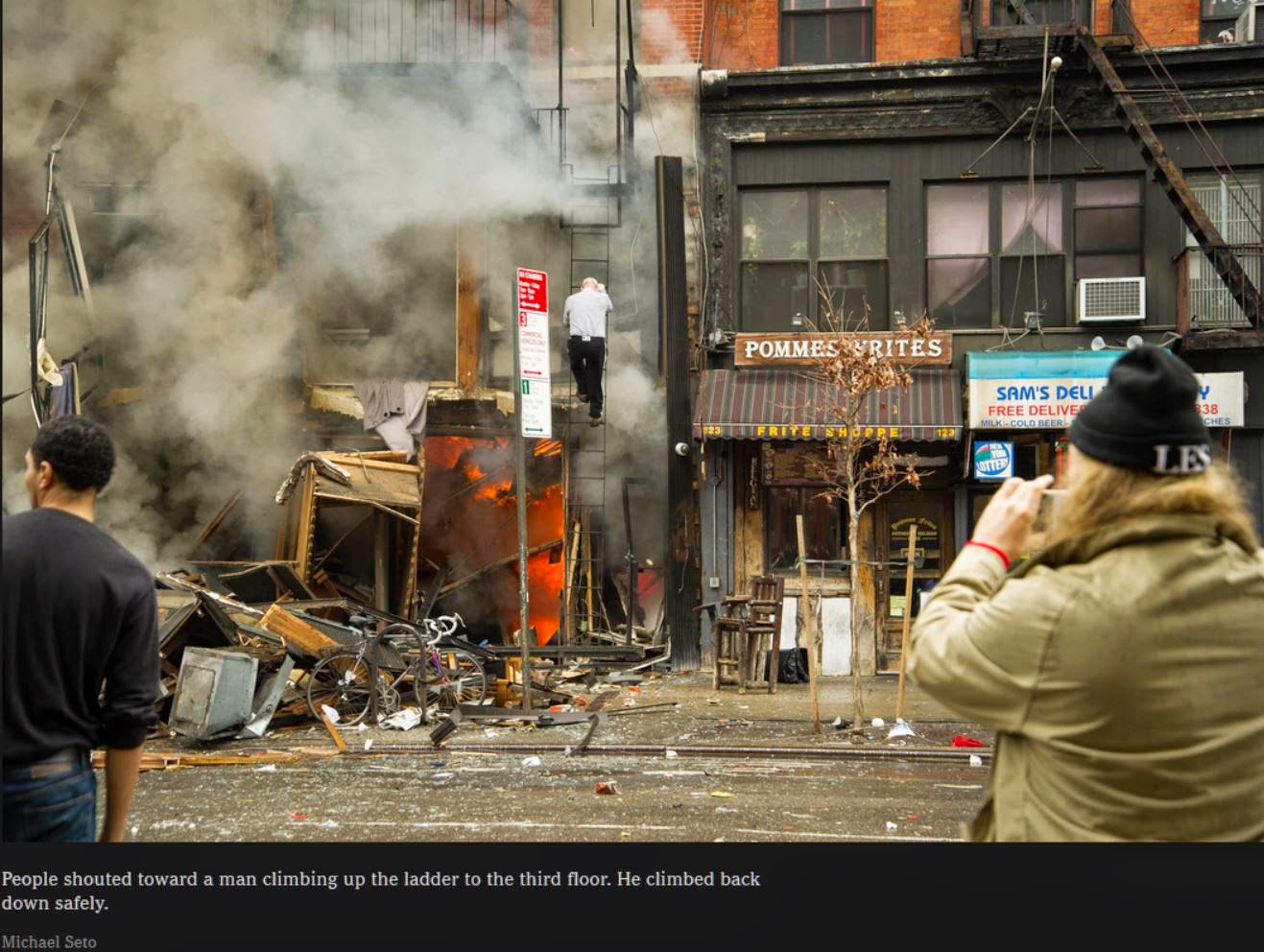
    How much would they have pay you to do this?

    Civil servants too often get disparaged. But that man on the ladder is a New York City civil servant and he is climbing up, not down. I’m no longer a civil servant, but this makes me proud just to be fellow worker for the City of New York.

    Here’s a video of climbing down here.

    Previously unidentified, he is Bronx Firefighter Mike Shepherd. He was off-duty and just happened to be nearby. Talk about being a first responder! While other people took pictures of an exploding building, he climbed into the flames to look for and save people!

    This is what I mean about the job being different if you walk into danger. His base salary is about $77,000. How much would they have to pay you to think and react this way?

    According to the Times:

    Mr. Shepherd went up the fire escape and climbed floor by floor. At the building’s second floor, the floor was buckling. People on the ground began yelling for him to get down. He continued his ascent to the fourth floor, yelling, “Anyone here, anyone here?”

    And my eyes get a teary when I read thisabout one of the presumed dead:

    A day after the explosion, Hyeonil Kim, 59, the owner of Sushi Park, said the police and rescue workers were still not able to locate Moises Ismael Locón Yac, 27, a member of his restaurant staff. Of the 15 employees at work on the day of the blast, three were injured, according to Mr. Kim. Of those people, two remain hospitalized; one, a Nepalese man, was injured badly, he said. Mr. Kim described Mr. Locón as “earnest” and good at his job.

    “Everything I lost is just lost, nothing I can do about it,” he said. “But this friend —” Mr. Kim stopped speaking, overcome by sobs.

    Locón was from Guatemala and lived in Queens, not far from me.

    Now I’m not saying you should climb into a burning building (and don’t do it if you’re wearing polyester). Just be happy others will do it for you!

    [Also, I don’t mean to pick on that guy taking a picture. He actually did help somebody!]

  • Are applicants for the police job down?

    I don’t know. And that’s what I told Meaghan Corzine of CBS St. Louis. Luckily, I wasn’t her only source. It’s a good story.

  • “Why become a cop?”

    My latest piece at CNN.com is up. They titled it: “Why would you want to be a cop?”

    I speak to a lot of police officers, retired, on the job, and soon-to-be. Anybody who knows cops knows it’s in their nature to complain (there’s an old barb about there being just two things cops don’t like: change and the status quo). But the idealism of my students can be lost with on-the-job realities: incompetent bosses, nasty working conditions, and any quota system (be it for revenue or arrests) that demeans their professionalism.

    Police officers try to maintain their pride and idealism on the job, but it can be a tough battle when faced with a hostile political structure and a misunderstanding public too quick to blame police for society’s ills. Blaming one officer for the misdeed of another is neither fair nor productive. To have the hashtag #blacklivesmatter held against you is both frustrating and absurd. The general public doesn’t seem to care about black lives unless a cop is involved. Police see and help victims every day while most murders don’t even make the evening news.

    Police do become thin-skinned to criticism — too quick to take offense to even well intentioned criticism — because the job isn’t just what you do for a living, it ends up defining who you are. The job damages you physically and, more worrisome, drains you emotionally.

    Policing demands a level of hyper-alertness synonymous with post-traumatic stress disorder.

    So as best they can, police officers make do with the job they have. Certainly police can and should play a role in rebuilding the public’s trust. But the public should have more empathy for those who have no choice but to deal with society’s problems — poverty, massive incarceration, racism, crime — that we, collectively and to our shame, cannot or will not fix.

    [Special thanks to Sgt B and to A.D. for his comment on a previous post. I probably could have done it without you, but it certainly wouldn’t have been as good!]

  • “Generating New Revenue Streams” by policing

    Sometimes it’s important to remember how you got to Point B from Point A to where you are today.

    You don’t just stumble into a system like Ferguson’s where the city tries to get 30 percent of it’s total budget from fines, citations, and court fees. Ferguson isn’t unique.

    I just stumbled across this article from 2010, writen by a police officer, that lays out the potential of using police for revenue:

    Based on the research for this article, there is a clear presumption of need for law enforcement to generate new income streams. A first necessary step in that process is to examine possible revenue-generating ideas.

    Their most prominent recommendations were:

    • fees for sex offenders registering in a given jurisdiction,

    • city tow companies,

    • fine increases by 50 percent,

    • pay-per-call policing,

    • vacation house check fees,

    • public hours at police firing range for a fee,

    • police department-run online traffic school for minor traffic infractions,

    • department-based security service including home checks and monitoring of security cameras by police department,

    • a designated business to clean biological crime scenes,

    • state and court fees for all convicted felons returning to the community,

    • allowing agency name to be used for advertisement and branding,

    • triple driving-under-the-influence fines by the court,

    • resident fee similar to a utility tax,

    • tax or fee on all alcohol sold in the city,

    • tax or fee on all ammunition sold in, the city,

    • public safety fees on all new development in the city,

    • 9-1-1 fee per use,

    • police department website with business advertisement for support,

    • selling ride-a-longs to the public, and

    • police department–run firearm safety classes.

    Modeled after other California agencies, the party ordinance allows an administrative citation to be issued at loud parties where the music is plainly audible 50 feet from the property line. The first citation is $100, a second $200, and a third or subsequent citation within 12 consecutive months is $500. The goal of the ordinance is to reduce repeat party calls, improve the quality of life for surrounding residents, and generate a revenue stream to offset the cost of response and enforcement.

    It’s just so blatant and wrong to see police (or the courts, or prisons) as a source of generating revenue. If you need money, that is what taxes are for.

    Anyway, for what it’s worth, West Covina, CA, does not seem best to be a particularly bad offender in terms of milking its residents, best I could understand their municipal budget. And some of those ideas above are actually pretty good ideas.

  • President’s Task Force on 21st Century Policing (2): The Problem with Procedural Justice

    Three years ago I wrote about the problem of “procedural justice.” If you’ve misplaced your copy of William Stuntz’s The Collapse of American Criminal Justice, just read Leon Neyfakh’s review in the Boston Globe.

    Procedural justice still matters because the Presidential Report places emphasis on it: “Police and sheriffs’ departments should adopt procedural justice as the guiding principle for internal and external policies and practices to guide their interactions with the citizens they serve.” I disagree.

    Now procedural justice seems like something that is hard to be against. But one opposite of procedural justice isn’t arbitrary justice but moral justice. If one emphases moral justice over procedural justice, you’re saying police and the criminal justice system shouldn’t just be judged on following the rules.

    Sometimes you need discretion and the ability to bend the rules — to break procedure — to do the right thing. I write about this in Cop in the Hood at the start of Chapter 6. [Long story short: Grandmother hits 17-year-old grandson she is the legal guardian of because, well, she had good reason. He calls police to report this assault. I do not arrest grandma. Instead I threaten to arrest this “kid”.] As a police officer, whenever I could, I used my discretion to value moral justice over procedural justice. (Not that I would have phrased it that way at the time. I was just “doing the right thing.”)

    Adam Gopnik of the New Yorker, a big fan of my writing, also described the issue:

    “The Collapse of American Criminal Justice,” was published, last fall, is the most forceful advocate for the view that the scandal of our prisons derives from the Enlightenment-era, “procedural” nature of American justice…. In a society where Constitution worship is still a requisite on right and left alike, Stuntz startlingly suggests that the Bill of Rights is a terrible document with which to start a justice system–much inferior to the exactly contemporary French Declaration of the Rights of Man.

    The trouble with the Bill of Rights, [Stuntz] argues, is that it emphasizes process and procedure rather than principles. The Declaration of the Rights of Man says, Be just! The Bill of Rights says, Be fair! Instead of announcing general principles–no one should be accused of something that wasn’t a crime when he did it; cruel punishments are always wrong; the goal of justice is, above all, that justice be done–[the Bill of Rights] talks procedurally. You can’t search someone without a reason; you can’t accuse him without allowing him to see the evidence; and so on. This emphasis, Stuntz thinks, has led to the current mess, where accused criminals get laboriously articulated protection against procedural errors and no protection at all against outrageous and obvious violations of simple justice. You can get off if the cops looked in the wrong car with the wrong warrant when they found your joint, but you have no recourse if owning the joint gets you locked up for life. You may be spared the death penalty if you can show a problem with your appointed defender, but it is much harder if there is merely enormous accumulated evidence that you weren’t guilty in the first place and the jury got it wrong.

    There’s also Alex Vitale’s critique of the Presidential Task Force in The Nation. Now Alex and I disagree about many police issues (such as Broken Windows), but I like people I disagree with. And he makes this point well:

    Today’s Task Force falls into this same trap…. Such procedural reforms focus on training officers to be more judicious and race-neutral in their use of force and how they interact with the public.

    Similar goals were set in the late 1960s…. Similarly, Johnson’s initial draft of the 1968 Safe Streets bill called for resources to be devoted to recruitment and training of police, modernization of equipment, better coordination between criminal-justice agencies, and innovative prevention and rehabilitation efforts, and had the support of the ACLU and other liberal reform groups…. Over the next decade, the result was a massive expansion in police hardware, SWAT teams and drug enforcement units, and almost no money towards prevention and rehabilitation.

    …Community policing also tends to turn all neighborhood problems into police problems…. The tools that police have for solving these problems, however, are generally limited to punitive enforcement actions such as arrests and ticketing.

    By conceptualizing the problem of policing as one of inadequate training and professionalization, reformers fail to directly address the ways in which the very nature of policing and the legal system served to maintain and exacerbate racial inequality. By calling for color-blind “law and order,” they in essence strengthen a system that puts people of color at a structural disadvantage.

    What is not discussed in the report is dialing back in any meaningful way the war on drugs, police militarization or the widespread use of “broken windows” policing that has led to the unnecessary criminalization of millions of mostly black and brown people. Well-trained police, following proper procedure, are still going to be engaged in the process of arresting people for mostly low-level offenses, and the burden of that will continue to fall primarily on communities of color, because that is how the system is designed to operate–not because of the bias or misunderstandings of officers. A more respectful and legally justified arrest for marijuana possession is still an arrest that could result in unemployment, loss of federal benefits and the stigma of a drug arrest.

    We cannot produce true justice by reforming police procedures. Instead, we need to call into question why we have come to rely so heavily on the police to manage social problems.

    Thinking about it another way, punishing Ferguson cops who write racist emails on the job is certainly the right thing to do, but blaming cops will do next to nothing to change an unjust system in which police officers are mere pawns.