Tag: police-involved shooting

  • Things cops watch

    I don’t post a lot of these videos, but this one is revealing. I honestly didn’t know which way this was going to go. Indian River Country, Florida, December, 2015. 3AM. A man has just gone to the convenience store to buy cigarettes. He’s riding a scooter without tags (that’s southern for “license plate”).

    Stop the video right at 00:15. Don’t go a second further.

    The video:

    Ask yourself what you would do or do differently as the police officer. As a non-police officer, what would your reaction be if the cop aggressively brought this guy to the ground right there and then? Police brutality? White cop attacking unarmed black man? It’s easy to imagine the officer being criticized for excessive use of force.

    Most non-police will probably see a seemingly compliant black suspect asking a white officer, “What’s the problem, sir?… No, no, no, no, I don’t want no problem.” Just a minor traffic violation.

    Of course nobody knows if the suspect is armed or what he is thinking. And that’s the problem.

    The man’s son said:

    It’s crazy how it happened…. I don’t understand how it happened, from you going to the store on a scooter. What was the point of stopping him?… When I left him, he didn’t have no gun…. He doesn’t carry weapons at all. He doesn’t have any enemies. He doesn’t feel threatened by anyone.

    Who do you believe?

    Now watch the rest of the video.

    After being shot in the leg, the cop manages to shoot and hit the suspect twice. Impressive. The suspect was later found by a dog. Both men lived.

    Here are the warning signs (AKA things you should watch for as cop and not do if you’re not a cop):

    0:04: “Don’t go reaching into anything,” says the cop. Fair enough.

    0:05: Why does the suspect hold his hand up like he can tell the cop to stop? That’s not allowed. But as a cop I would probably let that slide. What can you do? But it’s a sign.

    0:09: The suspect gets off the hood, like he was a choice to disobey an officer’s order. I don’t know what I would have done, but I’ll tell what the cop should have done: take the guy down without hesitation. Or create space. But that’s easy to say in hindsight.

    It happened so fast. It often does. I’d like to think otherwise, but I probably would have been shot.

    My sergeant’s words come to mind: “Never arrest alone.” Words to live by.

  • Stop paperwork (2)

    Stop paperwork (2)

    An email from a Chicago Police Officer (emphasis added by me):

    I wanted to go through our new “investigatory stop report (ISR)” training before I replied. By now you realize we have an extremely long form to fill out every time we do a street stop. The form is ridiculous and redundant but fortunately the department has created a shorter form that will we start using on March 1st. I think they missed the point with the gripes about low street stops. The form sucks, is burdensome, and redundant, but it’s just paperwork.

    The issue is that there is still heavy oversight by the ACLU and many private attorneys and their quick access to all information on ISRs. So now, instead of just your sergeant deciding if you have articulated enough reasonable suspicion, each ISR has to be approved by a sergeant, the integrity unit, and then combed over by an endless amount of lawyers looking for the slightest hiccup in the report. Private attorneys have started contacted people stopped about two weeks after each incident, by phone and/or mail and asking them how the police treated them while they were stopped. This is really unsettling.

    All of this seems like a direct result from the McDonald shooting, even if it’s not. Although no one is talking about it (the media has moved on to other police issues from where we park to the “thin blue line” code of silence). Immediately after the dashboard camera video came out, most cops were defending the shooting even after seeing the video. I get it. I would not have shot, but I understand why Van Dyke did. A crazed maniac on PCP with a knife is certainly dangerous and it doesn’t morally bother me that he was shot. I do think it was a bad shooting, but not by much. Although, I come from a newer generation of policing with a different mindset I suppose.

    After the protests and eventually when the ISR system came out, everyone started to vilify Van Dyke as the cause of all this oversight whether or not they believed it was a good shoot or not. Those that believed it was a good shot, no longer say anything about it, if that makes any sense. Basically, no one is supporting Van Dyke anymore, at least not openly. Meanwhile, street stops are down an astronomical percent and homicides are at at 12-year high through February. On the 11th, the superintendent sent out an email to the department reminding them that it’s still okay to do street stops. No one took it seriously but the bosses have to do something to get numbers.

    The idea that every report is being read by people looking to sue police officers is not a way to encourage productive proactive discretionary police activity.

    The first two months of 2015 saw 51 homicides. 2016 has seen 101. That’s double, for those slow in math. If you don’t want to call this a “Ferguson Effect,” fine. I’ve never liked the term. But perhaps we can agree that if police feel they can’t do their job for fear of lawsuits and/or criminal prosecution and thus do their job differently and then crime goes up, something is going on?

    So if you don’t like “Ferguson Effect,” how about we call it the “when police feel they might get in trouble for doing their job, so police — mostly to satisfy critics on the left who seem not to care how many people die as long as police are not involved — get out of their car less, stop fewer people, interact with fewer criminals, and then murders skyrocket” effect?

    See part of the police job is to harass criminals. Maybe you can think of a better word than “harass,” but I use that work intentionally. Because policing isn’t all please-the-old-ladies-going-church. People don’t like to talk about it, but there is an actual repressive part of the job — legally and constitutionally repressive, but repressive all the same. When that doesn’t happen, criminals commit more crime.

    [What I also find interesting in that a change in police culture with regards to what constitutes a good shooting is happening in front of our very eyes in Chicago.]

    And here’s the email from the Acting Chief:

    Good Evening Everyone,

    I want to clarify concerns regarding the Investigatory Stop Report (ISR) and the Department’s Agreement with the American Civil Liberties Union of Illinois (ACLU). I have heard your concerns and I am working toward a solution.

    First, since January 1, 2016, Illinois Law requires all law enforcement agencies in Illinois to document investigatory stops and protective pat downs. We are not alone in this endeavor; the entire state is tasked with documenting investigatory stops and protective pat downs. Neither the law nor the Department’s Policy has changed as to when stops and pat-downs are appropriate; merely the documentation has changed.

    Second, Officers will not be disciplined for honest mistakes. I know that the Department ISR Policy has been in effect since January 1, 2016. The Department is working tirelessly to train everyone on the ISR policy and procedures. I know there is a learning curve and I appreciate your understanding as we make this transition.

    Third, I would like to clarify the agreement between the Chicago Police Department and the ACLU. The Department has not relinquished any control of our policies and procedures to the ACLU. The agreement does not provide the ACLU with any role whatsoever with respect to individual officers’ compliance with the Department’s policies. The Department alone is responsible for supervising compliance with policies and procedures. Rather, the Department’s agreement with the ACLU provides that a former federal judge, the Honorable Arlander Keys, will review CPD’s policies, practices, and data regarding investigatory stops and recommend any changes that are reasonable and necessary to comply with the law, and that the ACLU will have an opportunity to review and comment upon CPD’s policies, practices, and data.

    Fourth, our Department is working to reduce the burden on officers. Remember, completing an ISR is in the best interests of Officers based on the Illinois State Law. A properly completed ISR helps protect the officer by documenting the basis for the stop and any resulting pat-down. Additionally, the transparency of the agreement with the ACLU and the ISR create a trust and mutual respect between our agency and the communities we serve.

    Lastly, officer safety is one of my greatest concerns, and continues to be a valid basis for a protective pat down. Officers simply need to describe in the ISR why they believe their safety was at risk. To perform a stop, an officer must have reasonable articulable suspicion, based on the facts and circumstances, that a crime has been, is being or is about to be committed. And, before an officer conducts a protective pat-down, he or she must have reasonable articulable suspicion that a person stopped is armed and dangerous and therefore poses a threat to the officer’s safety or the safety of others. Neither of these requirements are new policies.

    I appreciate all of the hard work that each of you do on a daily basis. Additionally, thank you for your service and dedication to the people of Chicago. Take care and stay safe.

    Sincerely,

    John J. Escalante

    Interim Superintendent of Police

    Chicago Police Department

    Here’s the long form in question and my previous post on “stop paperwork.”

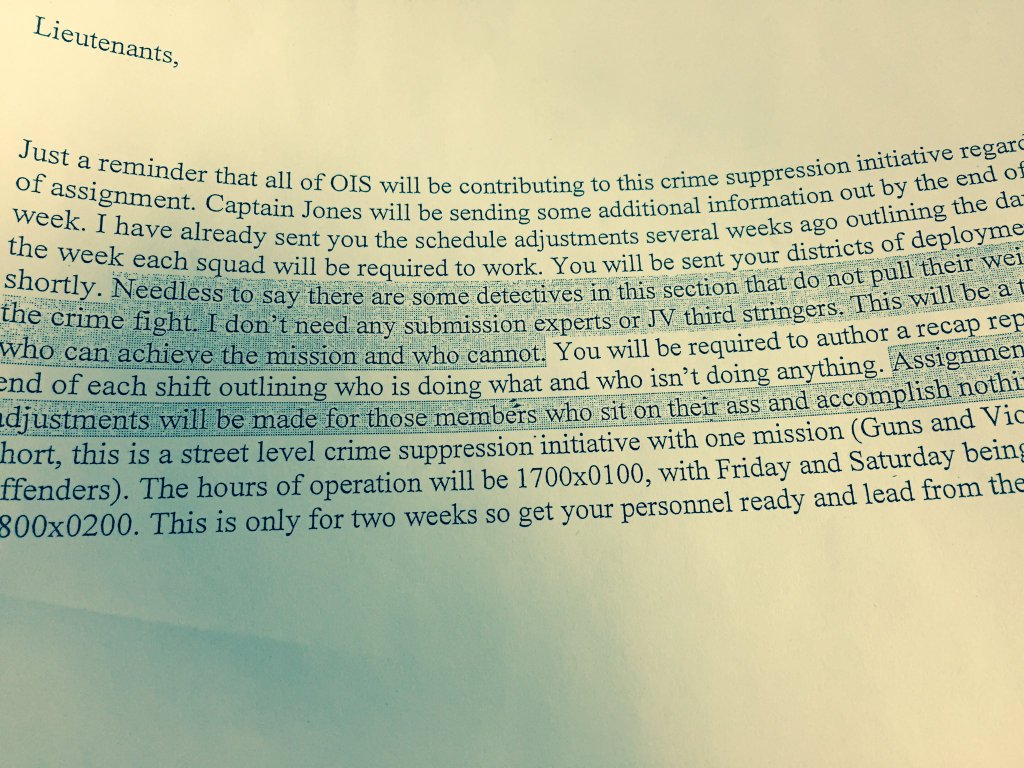
    Maybe Chicago could learn from the Baltimore way of motivating cops: pull your weight; and no “submission experts” or “JV third stringers” need apply!

  • NYPD Officer Liang found guilty

    Do I think Peter Liang wanted to kill Akai Gurley? No. Do I think Liang messed up so bad that he should be found criminally guilty of manslaughter and official misconduct for failing to help Mr. Gurley as he lay dying in a public housing stairwell?

    Yeah.

    But, as a side note, Liang is right about this:

    He felt unqualified to perform CPR, as is required of an officer under such circumstances, because he received poor training at the Police Academy.

    And I certainly don’t think he (or anybody) should be given a long sentence without mens rea.

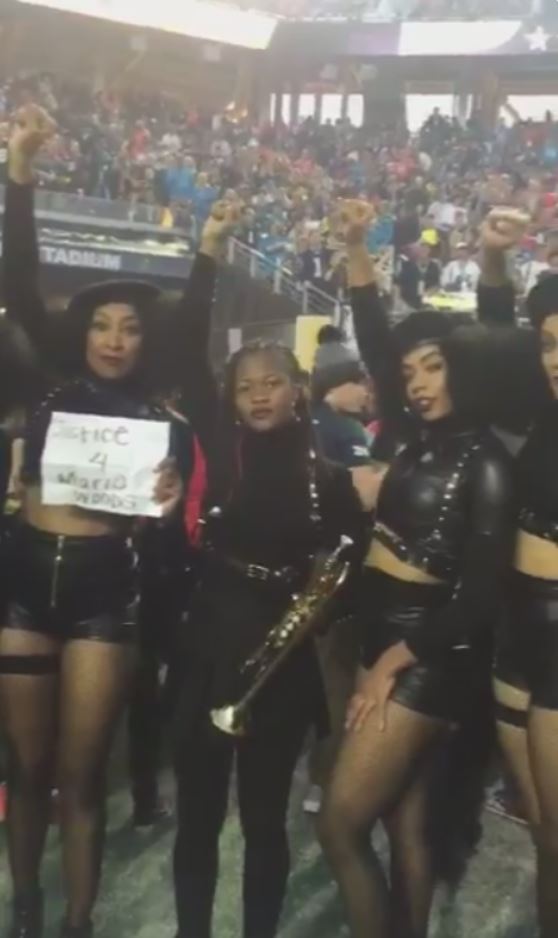
  • “Justice 4 Whom”?!

    “Justice 4 Whom”?!

    Generally I couldn’t care less what Beyonce’s dancers think. But “Justice 4 Mario Woods” and a black power salute? Are you effing kidding me? Mario Woods was shot and killed by San Francisco police back in December. It was a good shooting.

    Christ almighty there are plenty of bad police shootings. Not this one. Woods doesn’t need justice. “Justice 4 Mario Woods” means there was an injustice done by police. But right there and then, Mario Woods was armed and dangerous and needed to be stopped.

    Crazy Mario Woods had already stabbed a stranger. And now he’s just walking down the street holding the bloody knife. Police tell him to drop the knife. He won’t. Police knew Woods had knife, had just used it, and may have wanted to use it again. Police use less lethal force… one, two, three, four, and five times. Woods won’t drop the knife even after being beanbagged and tased. It’s like he’s on a mission. (Based on what Woods said, I suspect this was suicide by cop.) If he gets closer to others and starts cutting, police might not be able to shoot. It’s a crowded street. Woods needed to be stopped.

    The Guardian, which since Coldbath Fields Riot of 1833 has published exactly one unbiased story about police, says, “Mario Woods was allegedly armed with a kitchen knife.” No. He had just tried to kill somebody. He was armed with a kitchen knife.

    One thing that bothers me about press accounts of this incident are journalists who still talk about the knife being “alleged” or the victim being “allegedly” stabbed. For legal reasons, I understand why you might throw in “alleged” when describing the suspect. But when the suspect is dead, you can drop the “alleged” crap. Dead men can’t sue any more than than they can be convicted of crime.

    The very first reporter who called me, the one who brought this shooting to my attention, mentioned almost in passing that Woods “allegedly stabbed somebody.”

    “What?” I said, “Well, that would really matters to police. He had just cut somebody? That would change everything.”

    “Allegedly,” she insisted.

    “Well, did he just cut somebody or not?!” To police, this detail would matter tremendously.

    To the best of my memory, I swear the reporter said: “Yes, but he hadn’t been convicted yet.”

    I felt like I was entering the Bizarro world of liberal media make-believe I’ve heard conservatives foam about. Did she really expect police to wait until conviction before deciding the victim was real and knife sharp? Go tell the stabbed dude he was only “allegedly” stabbed. Here’s what the actual victim did say:

    “I’m trying to get my life together. My life has been a shambles since this happened.”… “I got stabbed by someone I don’t even know and I don’t have a beef with or anything like that.”… Jacob says he is the forgotten victim, the one who was attacked and the victim protesters and city officials have ignored.

    Woods, who according to his mom and lawyer was a gentle man (of course) who was turning his life around (“He was really kind and easy to deal with and really appreciative. Terrific. Never aggressive”) had an extensive violent criminal history. He had spent nearly all his adult life in prison. Now Woods’s record doesn’t mean cops get to kill him for no reason, but it might shed some light on why Woods would do some crazy shit.

  • Courage, not fear

    I still can’t believe this guy got shot down by a cop playing whack-a-mole with his service weapon. The D.A. said:

    The evidence in this case shows the shooting to be accidental, and possibly negligent, but not criminally so. “This shooting is not justified, but also not criminal.”

    I don’t know if I buy the stutter-step no-double-tap explanation. But at least the legal concept is sound. Something can be wrong and not criminal.

    In fact, the only charges are against the paralyzed victim with the dead wife. [Update: Charges were dropped. He died.] This seems kind of mean. And there are no national politicians weighing in. Just a small local protest. Al Sharpton must be previously engaged. (As is often the case, this unnecessary shooting happened in California.)

    Officer Feaster claims he didn’t know he shot Thomas:

    No, no. … I don’t think I shot him. I wasn’t even pointing at him but the gun did go off.

    Did go off“? What are you saying? It just blew?

    Let’s leave aside whether Feaster is the world’s best shot or the world’s worst cop. Perhaps it doesn’t matter. The question I have, the question any reasonable police officer might have, is why the hell did he draw his gun in the place. What made this cop so afraid that he felt the need to approach a crashed presumed drunk driver with his gun drawn and shot the man trying to get out of the wreck? The guy was going to run? What use is your gun in that case? A car just flipped. What exactly was the threat?

    In the same vein, a reasonable police officer wonders, as did Levar Jones complying with orders, why he got shot. Why did cops feel that innocent Jonathan Ayers was a lethal threat while driving away? Why is a man not carrying a gun a lethal threat when he drops his hand?

    Why did all these police officers see non-existent threats? Why were they so damn afraid? (I’m tempted to add “…these days,” but maybe it’s always been this way. I don’t know.)

    In the face of danger you need to act but not overreact. You need courage, not fear. There’s a line I always liked in Birds Without Wings:

    His courage was not the foolish kind of a young and silly man. It was the courage of a man who looks danger in the face, and forces himself not to flinch.

    Hell, a little fear can be a good thing; you don’t want to be blasé in the face of danger. It starts in the police academy. “Stay alert, stay alive!” It’s a good lesson. Even “make a hole” isn’t so bad when it’s put in the context of situational awareness. But too much fear becomes paranoia. And that’s not conducive to good policing (or a happy life).

    Here are some of the videos cops watch in the police academy. Some I saw myself. Others are more recent. They’re all on YouTube (which didn’t even exist when I was a cop). I guarantee you that every last one one of these has been watched in some police academy somewhere. Every cop I know knows 1) Dinkheller.

    And 2) here’s that woman cop getting her ass kicked trying to arrest some big guy. His daughter is there. The cop kind of came back, but never recovered.

    Go on. Watch them. Watch them all. It won’t take but 10 or 15 minutes. I’ve cued them all up to the key moment. It’s a parade of snuff films (though many of the cops do live, somehow). Can you watch all of these and not perceive threats and car stops a bit differently?

    3) Here’s a man who wouldn’t stay in his car.

    4) Here’s a routine traffic stop.

    5) Here’s another routine traffic stop.

    6) And other routine car stop.

    7) This was a routine car stop but the guy drove away.

    8) Here’s a guy in cuffs and a girl. What could possible go wrong?

    9) Three cops. One suspect. Everything under control?

    10) This guy isn’t wearing a shirt and doesn’t seem hostile.

    11) This guy is naked and unarmed. There are three cops, two of them with tasers. The guy is still a threat.

    12) And sometimes this happens. Things can go from 0 to 100 really quickly.

    13) This guy does a little jig. He must be just be an odd character.

    14) And everything seems OK here. Except for that shot cop.

    15) This is what happens when you don’t put suspects on the ground.

    16) We all know that when it comes to an armed man, it’s easier to act than react.

    17) And people who have done time can be especially dangerous.

    18) Out-of-shape fathers with their 16-year-old sons? Could always be cop killers.

    And to cops these aren’t just abstract videos. There are people I know, friends, some taught in the academy, who were shot and lucky to live. Others, the pictures on the walls, weren’t so lucky.

    Certainly cops need some of this. Some people are willing, even eager, to kill police. You can’t go on the job as a pacifist. But at some point fear isn’t healthy. It isn’t good for the job. It can even make the job less safe.

    And I worked in a dangerous post. It made me less afraid. You face danger a few times, and you learn to respect it. Cops in the Eastern don’t squeal every time somebody steps on a leaf. But you don’t shoot at everything that moves.

    But what if your work in some place without much danger? How do you stay awake, much less alert? (In my squad we could be alert and asleep!) And then, during some “routine” traffic stop or domestic — blam — something goes off script. Maybe you, the young cop who took the warrior mindset to heart, get a flashback to one of those videos in the academy where the cop got ambushed. And you think: “This is exactly how that cop got killed.”

    [Cue trippy flashback music and echo]

    “This officer hesitated [tated] and it cost him his life [life, ife, f…]”

    “Better to be judged by 12 [elve] than carried by six [six, ix, x…].”

    So you misidentify a threat, overact, and pull the trigger. You’ve screwed up because you’ve gone through life in a constant state of “Condition Yellow” because you didn’t want to slip into unaware “Condition White” in which:

    You may very well die — unless you are lucky. I prefer to not depend on luck.

    Some insist you cannot go through life using this system without becoming a hair-trigger paranoid person who is dangerous to ones self and others. I believe well-adjusted police officers can run through the color code dozens of times every day and be no worse for wear. Most experienced police officers who learn the color code realize they have been taking these steps on their own all along.

    Maybe. For some. For me even. (This is why cops don’t sit with their back toward the door.) But even if constant hypervigilance doesn’t make you paranoid, it is very tiring. Exhausting, even. I don’t miss it. And stress affects some people more than others. NYPD officers are much more likely to commit suicide with their service weapon than be killed by a criminal. Why?

    I don’t know the answer. I don’t like the “warrior” or “guardian” dichotomy. I would certainly put the emphasis on the latter, but you need a bit of both. You can’t let the warrior mindset take your soul.

    Seth Stoughton writes in the Harvard Law Review:

    Officers learn to be afraid. That isn’t the word used in law enforcement circles, of course. Vigilant, attentive, cautious, alert, or observant are the terms that appear most often in police publications. But make no mistake, officers don’t learn to be vigilant, attentive, cautious, alert, and observant just because it’s fun. They do so because they are afraid. Fear is ubiquitous in law enforcement.

    And to those who say police need to abandon this warrior mindset for guardian mindset. Well, they’ve got an answer for that, too. And it’s not crazy. What do you do when it’s time to fight?

    At some basic level policing does involve confronting and fighting criminals intent on hurting you or others. I always notice that when people talk about police reform or improving community relations, the word “criminal” will never come up. It’s as if the entire job of policing is nothing more than dancing with kids and smiling at church-going ladies in fancy hats.

    See, just as the public needs to have a more realistic perspective about the “epidemic” of police killing innocent people (happens, but not too much), police need to get a realistic grip about being shot on the job (happens, including to friends of mine, but still less than cops think). Nationwide police get shot and killed about 3 times every month. That’s an annual homicide rate (cops getting killed per 100,000 officers) of under 5, which just happens to be almost identical to the national homicide rate. Of course keep in mind cops are on-duty only a fraction of the time, so cops on the job have a homicide rate 5 times higher than the national average. But hell, it’s still safer to be a cop than to live in Baltimore.

    Stay alert. Stay alive. But for God’s sake stop being so damn afraid all the time.

    [In memory of the police officers killed in the above videos: Kyle Wayne Dinkheller, Jonathan Richard Schmidt, Edward Scott Richardson, Billy Colón-Crespo, Ramón Manuel Ramirez-Castro, Darrell Edward Lunsford, Sr., Thomas William Evans, and Robert Brandon Paudert. They gave their all.]
  • Perhaps the worst police-involved shooting ever

    I don’t say that lightly. There have been some bad ones.

    Click on this link or you can jump to about 0:50 sec on this:

    Andrew Thomas, the victim, a drunk driver, is paralyzed. He is white. So is Paradise, California.

    1:35: “I got a male in the car refusing to get out.”

    Maybe, you think, just maybe, it’s because you just shot the mother f*cker for no reason?!

    And yet I hadn’t even heard of this shooting until a Baltimore cop just brought it to my attention tonight. We were talking about Baltimore cops actually do their job pretty well, all things considered. A Baltimore cop would never do this; we can’t imagine this happening in Baltimore. Apparently the officer in this shooting won’t face charges.

    And yet in Baltimore six cops are being tried for failure to seat belt and bring prompt medical care? Has the world gone mad?

    It’s not just that white people don’t care about black lives. Honestly, most white people don’t care about white lives, either.

    [Update: he died]

    [Further update: The officer was found guilty of involuntary manslaughter and sentenced to 6 months in jail.]

  • Chicago Cover Up

    From the mayor on down to the officer on scene, the cover-up seems pretty big. Multiple false reports are very worrisome. Though a detective taking a statement from Van Dyke shouldn’t qualify as another false report. But Van Dyke’s partner, Walsh, is certainly culpable.

    Update: The New York Timessays “at least five other officers on the scene that night corroborated a version of events similar to the one Officer Van Dyke.”

  • “The Deadliest County for Police Killings in America”

    Oh, Bakersfield. Now it’s in the Atlantic. Of course you heard about Bakersfield and Kern County here first, back in April. And even gave Bakersfield an honorary mention, back in 2014, too.)

    The actual reporting is going on in the Guardian, the only paper, and an English paper, that seems to honestly care about investigating the issue of trigger happy cops (as opposed to just highlighting individual cases of questionable shootings).

    In the Atlantic piece, I think Conor Friedersdorf lets #BLM off the hook too easily. And it’s worrisome when the left-wing media starts blaming the media:

    Perhaps that’s partly because the Black Lives Matter narrative has dominated press coverage of police misconduct–in Kern County, most of the victims are Latino. But the issues raised by the Black Lives Matter movement affect a variety of communities, even if that’s not always acknowledged in the media.

    But a limitation of Black Lives Matter is a laser-like focus on state-against-black violence. Black Lives Matter can and should focus on whatever they want. Certainly blacks in America have specific and unique and legitimate grievances not shared by other minority groups. But the problem of bad and/or unnecessary police-involved killings affects a lot of poor America. But if one attempts to shift the focus to other communities by, say, substituting another word for “black,” one faces immediate racial reprimand. Still, and to Black Lives Matter’s credit, we wouldn’t be talking about this at all were it not for #BLM.

    Along with more investigative coverage in American papers, it would be nice to see more attention placed on where the problem seems to be worst (west of the Mississippi and in high Latino areas). The flip side of this is to look at departments, like the NYPD, that have have low rates of police-involved shootings. We have departments that could be used as case studies in best practices. But the police-are-the-bad-guys crowd can only see all police as an outlet for criticism.

    I’ve said it before and I’ll say it again: if we want to — and we do want to — reduce the number of black people shot by police, we need to reduce the number of people shot by police. On society’s side this happens with reductions in overall violence. On the police side this happens with better hiring, training, and tactics.

  • Does rhetoric incite violence?

    Why don’t anti-abortion politicians who say ‪#‎BlackLivesMatter‬-rhetoric endangers cops take responsibility for Officer Swasey’s murder at Planned Parenthood?

    If anti-abortion rhetoric doesn’t have any relation to the murder of Officer Swasey and innocent women at Planned Parenthood, how could anti-cop rhetoric have any relation to people attacking cops? On the flip side, if anti-abortion rhetoric does incite violence against abortion clinics, why wouldn’t the same be true for anti-cop rhetoric and subsequent attacks on cops?

    As to the question of rhetoric inciting violence, shouldn’t we at least be consistent? It’s frustrating when ideology and making political points seem more important than the murder of police officers and other innocent people.

    Update: When I posted this idea on Twitter, I got one response saying that we shouldn’t “jump to conclusions” that the attack on Planned Parenthood has anything to do with anti-abortion rhetoric. Of course not.

    On the other side, somebody from the Left informed me that #BlackLivesMatter isn’t anti-cop, “it is [just] against the abuse of law enforcement in taking of black lives.” Besides, “violence in #BLM rhetoric is self-defense.” Of course….Just like pro-life people are really only against the abuse fetuses take when aborted.

    So can rhetoric lead to violence? Sure, sometimes. But if so, do we just accept it as an unfortunately side-effect of free speech in a gun-loving society? I would say yes, at least up to a point. But regardless, we shouldn’t say that only people on the other ideological side can be inspired into violent action by idiotic rhetoric.