Tag: police-involved shooting

  • Bang bang, they shoot you down

    Bang bang, they shoot you down

    The data on police-involved shootings are notoriously bad (that’s a link to Jon Stewart worth clicking on!). And yet, at least we kind of know which data are missing. That makes the data not as bad as you might think. At least when it comes to police-involved justifiable homicides (for shootings, we don’t know. But if you multiply homicides by two or three, you’ll probably be close enough).

    Now I’ve compiled the UCR data on justifiable police homicides from 1998 to 2012. And the data are not complete. Some cities send data. Some don’t. Others send a few years… and then decide they have better things to do.

    But of the 70 biggest cities in the US, only about 15 jumped out to me as horribly lacking in data. And if you take the 45 cities for which the data is probably good enough, which cities have the highest rate of police-involved homicides?

    New York isn’t close to the top. (The UCR data from New York actually are not good — but the NYPD actually provides excellent data on shootings, but for some reason they just don’t bother reporting to the UCR.) But if one were to compile the data from the UCR and the NYPD (as I did) one would find an average of 12.2 annual police-involved shooting deaths. Let’s round up to 13, for the few cases of non-shooting police-involved homicides. That’s an annual rate of about 0.16, which is low. Very low. It puts New York 50th on the list of the 55 largest cites in the US (for which there is probably good data). New York’s rate is one-sixth the rate in Baltimore City, for instance.

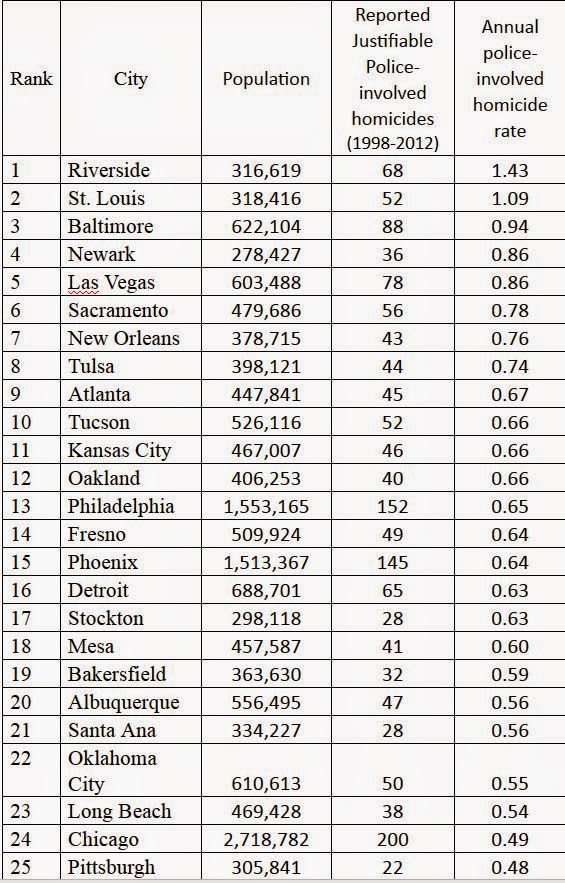
    My lovely Baltimore is number three on the list, in case you were wondering (I was). Baltimore City has seen 88 police-involved homicides over 15 years. Baltimore’s annual rate of police-involved homicide is under 1 per 100,000. These killings are justified, I should point out. I can vouch for a few of them 2nd-hand. At least one reader of this blog can vouch 1st-hand.

    Number two in the USA is St. Louis (city, not county). 52 justifiable homicides over 15 years. The rate is just over 1 per 100,000.

    Number one in the US — the city with the highest rate of police-involved homicides — is Riverside! Riverside? Where the hell is Riverside? Is that even a city? I had to look it up. Yes, it is a city. Also a county. In California. But since other cities in Riverside County report their own data, I have to assume that “Riverside” is just the city of Riverside.

    According the UCR, there have been 68 justifiable police-involved homicides in Riverside over 15 years. With a (growing) population of 316,000, this is a crazy high police-involved homicide rate of 1.43. This rate of police-involved homicides in Riverside is higher than the overall homicide rate in 43 countries! Anyway…

    The top 25 cities for justifiable police-involved homicides from 1998-2012 — and this is only based on data police provide to the UCR — but if you do rank high on this list, you probably do provide accurate numbers. It’s also only for the most populous 70 cities in America. Homicide numbers are total for 15 years. The rate is annual, per 100,000 residents. And there may be errors.

    Also keep in mind this doesn’t take the city’s crime rate into account. Sure, Baltimore cops shoot a lot of people. But a lot of criminals in Baltimore need to be shot! Baltimorians shoot each other even more. So while the BPD does indeed kill citizens twice as often as say, police in Chicago, there are more situations, per capita, in Baltimore (and Newark and St. Louis) where police need to shoot. So more noteworthy are lower-crime cities that have a lot of police-involved shootings. I don’t know what to say about Riverside or Sacramento or Las Vegas, Nevada. And why are six of the cities in California?

    Justifiable Police-Involved Homicides, UCR data, 1998-2012

  • Utah shooting of unarmed man justified

    Dillon Taylor was another unarmed white boy shot and killed by police. In (mostly) conservative circles, Dillon Taylor was compared to Michael Brown of Ferguson, Missouri. In some liberal circles, people believe police only shoot and kill black people. But Taylor, who is white, got almost no press (and I think the officer who shot him was hispanic). Michael Brown was black (and shot by a white officer). There were protests about both shootings (no looting in Utah), but unless you make an effort to follow these things, you’ve probably never heard of Taylor.

    Comparing Taylor and Brown, one person wrote:

    But they are alike in this important way: Neither young man deserved to die that day. Neither Michael Brown nor Dillon Taylor was convicted of a crime related to their activities on their last days, and even if they were, it wouldn’t be a capital crime. And this doesn’t appear to be an uncommon mistake.

    Well leaving aside what “common” means, a police officer does not shoot you because of the crime you did or did not commit. You are justifiably shot because a reasonable police officer believes you to be an imminent and potentially lethal threat

    To be clear, Taylor was not armed (nor was Brown). But Taylor sure doesn’t act like like he’s no threat. Taylor was — and acted like — an armed criminal. Still, knowing only that Taylor did not have a gun when he was shot, anti-police folk went out and filled in their ignorance with their ideology. The inevitable conclusion: police are to blame.

    But comparing the homicide of Taylor and Brown, there is one important difference: the officer who shot Taylor was wearing a body camera! As is usually the case, the video shows exactly what police claimed to have happened. We’ll never for sure what happened in the moments before Brown was shot: Here’s the Taylor shooting:

    The shooting was declared justified. This is maybe not the best shooting, as Taylor was eventually raising his shirt, presumably to show he wasn’t armed. I also can’t see Taylor’s right hand, which could change things. But at some point it seems to me that Taylor is doing the old “life your shirt to show you’re not armed” thing. So it does seem unfortunate to shoot a guy when he finally does comply with “getting his hands out.” But there was a period of non-compliance. And then there sure was a quick move from a concealing waistband. And had Taylor been armed, and I think a reasonable officer had good reason to believe Taylor was armed, then yes, this is a justified shooting.

    There are certain things you have to take on the job: dumb people; dirty people; violent people. But a depressed criminal idiot (perhaps with a death wish), playing “I might have a gun on me” is not one of them. Still, though I’m willing to give the officer on scene the benefit of the doubt, well, like I said, it’s not the best shooting. But yes, I think it is justified.

    Many people don’t realize how many idiots police deal with. As a police officer, more than once I was approached by a kid (always on a bike) who would quickly reach into his waistband and act like he was pulling a gun to shoot me. Honestly, driving toward them, I never had time to react. Also, they were young teenagers. And unarmed. Still, it’s the kind of dumb move that can get you killed.

    And yet when I’ve told seemingly smart people (who are far removed from ghetto policing) that this happened a few times, they stare at me in disbelief. They simply can’t believe that anybody, much less a unarmed young black male, would do something so potentially lethally stupid as pretend to pull a gun out and shoot a cop. And yet that attitude was routine enough that I didn’t even deem it worth mentioning it in my book. It was just some real life FATS training, I suppose.

    It was more common, it might be worth pointing out in this post, for young men to routinely (and without any prompting from me) raise their t-shirts to show they were not armed. That move would baffle ride-alongs.

    [For what it’s worth, I strongly suspect that police who work in violent areas — and though those officers will be involved in more shootings overall — those same officers will shoot fewer unarmed people because those officers are acculturated to a certain level of danger. Those cops who work the tough beat have more experience and less fear. I have no idea how to test this killer hypothesis.]

  • When police-involved shootings aren’t about race

    There’s still the strange belief among some people that police only do bad things to black folk. When I was on Chris Hayes the other night, some commentators thought the initial stop was racially biased. Chris himself questioned whether a white person would have been stopped for a seat-belt violation. I find that crazy talk. There was so much bad going on in that shooting that to be distracted by the initial stop seems to miss the greater point. I know the vast majority of cops don’t give a damn about your race. And the idea that white people don’t get stopped for seat-belt violations is also demonstrably false. (If you want to download and read a large and rather academic pdf report from the National Highway Traffic Safety Administration on the matter, knock yourself out.)

    Bad things do not only happen to black people. Most bad shootings don’t become issues till there’s unrest and/or Al Sharpton raises a fuss. And sometimes, a fuss should be raised. (And the last time the Rev tried to help some poor white guy who claimed he was brutalized by police, well, Sharpton sure picked the wrong white guy.)

    I’ve written a few times times about police killing white people, first on this blog in 2008. And then in 2009 there was the horrible police f*ck-up that resulted in police shooting and killing Rev. Jonathan Ayers. This was never big news. (In fact, to my dismay, my limited account of Ayer’s death seems to be the most extensive on record.)

    I’m not saying race never matters, but cops are not shooting black people because they’re black. Cops are not stopping black drivers for seat-belt violations because they’re black (though police may be searching your car for drugsafter that stop because you’re black). To believe that race is the issue in policing ignores and won’t solve the problem of people of all races who are wrongfully shot (or tased, or maced) by police. The issues have less to with race than with bad training and police officers making bad split-second decisions.

    So here’s a black cop shooting Bobby Dean Canipe, an unarmed white person (and a 70-year-old disabled vet at that).

    Clearly in hindsight this is not a good shooting. It’s a traffic stop and an old guy with a cane. And yet when Canipe gets out of his pick-up truck, on the highway, and I see a long hard object turn toward my face — and keep in mind I’m watching a youtube video and I *know* it’s not going to be a gun — I felt my ass pucker.

    Would a reasonable officer have feared for his or life in that situation? Yeah, potentially, probably, I think so.

    Sure it would have been great if the cop had known it was a cane. It also would have been great if the guy hadn’t gotten out of his truck and reached for his cane.

    A mistake. But I think a reasonable one. I’d let the cop off.

    [Hat tip to a commenter for bring this shooting to my attention.)

  • “Unarmed” man not shot by police

    One of the things that keeps coming out of the Ferguson shooting is that Michael Brown was “unarmed.” As if “unarmed” people cannot be a threat to cop.

    That’s bullshit.

    Now I’m not talking about whether Michael Brown was or was not a threat. I do not know. But the fact that he was “unarmed” does not mean he wasn’t a threat.

    This is a video (from 5 months ago) of an “unarmed” man on the whom I think the police officer should have shot. But the cop didn’t. I guess the officer didn’t feel his life was in danger. Kudos to him. Seriously. But I think his life was in imminent danger. And I think I would have shot the guy.

    Just based on the description of the video (and the fact that the train isn’t leaving and a police officer is involved), let’s assume guy threatened to shoot subway passengers. A cop responded. The guy attacks the cop. That’s where the video starts.

    The cop tries to retreat. Then the cop maces him at 0:15. There’s a nice deflection at 0:17. (Shazam! Jujitsu shit.) The asp comes out at 0:21. [Wack.] Little if any effect. The guy keeps coming at the police officer. Notice how few seconds have passed.

    The grappling continues. The guy keeps coming. What would you do?

    Now when you can use lethal force is not cut and dried. It’s up to the police officer. And I can’t read this police officer’s mind. But he didn’t use lethal force. That was the choice he made. Maybe he never felt his life was in danger.

    But I’m telling you I think I would shot guy point-blank at 0:45.

    Would this have been a “good” (ie: justified) shooting. Abso-fucking-lootly.

    I’ve been in fights. And I haven’t shot anybody. For whatever reason (backup, for instance) I never felt my life was in danger. I won’t say this cop should have shot the guy. He felt he didn’t need to. And he turned out to be right. But had he shot him, I would defend that shooting (as would the law).

    But what if there’s no video? What if the cop does shoot? What if, as would happen, some “eyewitness” on the subway says “the guy had his hands in the air [which, actually, he kind of did]. And he was surrendering when the cops shot him for no reason!” Then what do you assume?

    Because when cops hear of a cop shooting an “armed person,” they assume something like this happened. Cop know, based on everything they have done and seen, that police do not shoot people for no reason. Cops think: there but for the grace of God, go I.

    Also note there is a train of people, not one of whom helps the cop. (Or you could say it’s good nobody helped the other guy, who was asking for help).

    So this subway cop showed amazing (and perhaps even unwise) restraint in use of force. But yes, in hindsight, it’s clearly better that nobody got shot.

    So did this officer receive any kudos for his bravery or his restraint? I don’t know. Should he? Yes. Did he? I doubt it.

  • Race and justifiable police homicides (VII): hispanics

    Fact 7: What about hispanics? Hard to tell because many police departments don’t keep track. Half of all homicides (justifiable police homicides) have no “ethic origin” listed. When it is listed, 1/3 of those killed are hispanic, which strikes me as very high. Overall, including all the missing data, hispanics come out at 16 percent. So the real number of hispanics killed is somewhere between 16 and 33 percent. The census lists 17 percent of Americans as hispanic (which includes all races).

    That’s all I got for now. If you can think of any other question I can answer with the data I have, leave a comment, and I’ll do my best.

  • Race and justifiable police homicides (VI): black police shoot white people, too

    Fact 6: Black police officers do kill white people. This really isn’t surprising, but I mention it because I’ve seen a few people on twitter doubt this fact. Black officers (about 1 in 7 of all police) kill about 27 blacks and 9.4 whites per year. White police (of whom there are many more) kill an average of 81 blacks and 200 whites each year (both for the past 15 years).

    Like the previous fact, this doesn’t mean much without greater context. But it’s worth pointing out that there aren’t too many black officers working in high-crime white neighborhoods.

    The next and last fact concerns hispanics. Spoiler: the data isn’t good enough.

  • Race and justifiable police homicides (V): black police

    Fact 5: Black officers are disproportionately more likely than white police to kill black people. But this should come as little surprise since black officers are much more likely to work in black areas and in cities where there are more blacks. Again, given the bad data, take all this with a huge grain of salt, but according to the data we do have (UCR justified police-involved homicides 1998-2012), 73 percent of those killed by black police are black (which is kind of amazing). For white police officers, 28 percent of those killed are black.

    Put a different way, if you are black and shot by police, the odds are about 1 in 5 you’ll be shot by a black cop. If you’re white and shot by police, there’s less than a 1 in 20 chance your police-officer shooter will be black.

    In these 15 years, 547 black police officers killed 402 blacks and 141 whites. 4,388 white police killed 1,213 blacks and 2,998 whites.

    Also, the officer’s race is “unknown” 10 percent of the time. (n = 535)

    Next question: Do black police shoot and kill white people?

    Update: Additional data were added to this post in January, 2015.

  • Race and justifiable police homicides (IV): On the increase

    Race and justifiable police homicides (IV): On the increase

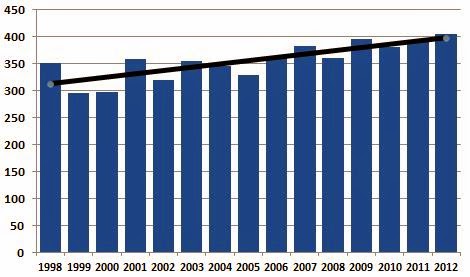
    Fact 4: Police-involved killings are going up. This one surprised me. Because police-involved shootings are generally correlated with overall homicides. But homicides are more or less steady right now, and down 10,000 since 1998 (14,000 in 1998, 13,000 in 2012).

    The trend is about five more killings a year, for the past 15 years. Keep in mind this is based on flawed data. So it could be indicative or something, or maybe it’s not.

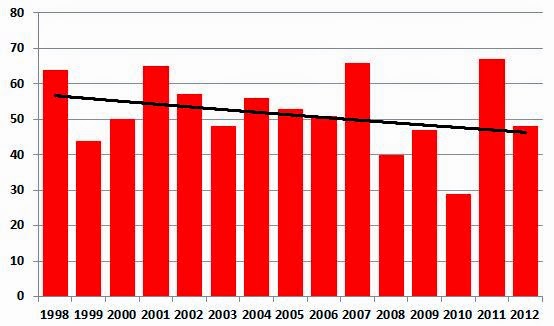
    Meanwhile the trend is for fewer officers to get shot and killed. (If you go back further, like to the 1970s when more than 100 officers were shot and killed each year, the trend is way down.)

    So cops may just be quicker on the draw. Or perhaps too quick on the draw. Or some combination of the two.

    The next post examines if black police are more or less likely to kill people. What do you think?

    As a side note, justifiable killings by civilians have been increasing at an even greater rate over the past 15 years. From 191 in 1998 to 309 in 2012. I would assume (but do not know) that “stand your ground” laws have something to do with this. Also, (surprising to me) the race relationship of those killings have become even more intra-racial (and the greatest increase is seen in justified killings by black).

    [Data on police fatal shootings comes from the Officer Down Memorial Page.]

  • Race and justifiable police homicides (III): one a day

    [Update: Using better data, the number is more like three a day.]

    Fact 3: UCR data on justified police-homicides are notorious incomplete. These numbers are an undercount. But given the data we have, as reported (or not) to the DOJ by local police departments, police kill at least one person a day (426 in 2012, to be exact, 30 percent were black, 63 percent were white). Again, how you want to use or misuse that statistic is up to you. And you need to take it with a large grain of salt. Either at least one person a day needs to be shot to protect somebody from getting killed or seriously hurt. Well, either that or police are cold blooded murderers who fill a one-body-a-day quota in the murder department. I’m more partial to the former explanation…

    But it might be worth mentioning that the combined total for deaths from police shootings in Japan and Britain was… zero. Germany had eight.

    Now ask yourself this: are police-involved killings in the US going up or down. That’s tomorrow’s fact.

    And now, for the nerdy set, some numbers:

    In 2012, police killed a total of 426 people. Of those:

    white men: 267

    black men: 128

    white women: 6

    black women: 4

    “Asian or Pacific Islanders”: 9

    “American Indian or Alaskan Native”: 5

    The rates of justifiable police homicide, are roughly (per 100,000):

    black: 0.33

    Indian/Native American: 0.17

    white: 0.12

    Asian: 0.06

    To put these numbers in some perspective, there were 13,063 total homicides in 2012.

    white men: 4,332

    black men: 5,745

    white women: 1,651

    black women: 858

    Asian men: 160

    Asian women: 82

    Native/Indian men: 72

    Native/Indian women: 22

    The 2012 US homicide rates (per 100,000, and again, roughly):

    black: 16.5

    white: 2.7

    Asian: 1.6

    Indian/Native: 3.2

    One other interesting tidbit, if you’re still with me, is if one looks only at murders in which the killer is known to be a “stranger” (which is just 15 percent of all homicides… and this does not include the larger category of “relationship not determined”). Then the numbers plummet:

    white men: 912

    black men: 812

    white women: 112

    black women: 90

    Asian men: 45

    Asian women: 9

    Native/Indian men: 15

    Native/Indian women: 1

    I mention this because fear and public policy is built so much around the concept of people (I’ll say it: white women) being killed at home or in a robbery by some stranger (I’ll say it again: a black man). And yet there were just 32 such victims in 2012. And 2012 was a high year. 2011 saw just 25 white women killed by black strangers.

    The odds of being killed by a stranger, especially if you’re a woman, are almost infinitesimally small. Though to be fair, they’re still greater than the chance of being killed by lighting or attacked by a shark.

    [Rates are based on these population numbers (which are not cut and dried): white 224 million; black 40 million; Asian 15 million; Native/Indian 3 million. Homicides from the 2012 UCR homicide supplement.]

  • Race and justifiable police homicides (II): white and black

    Fact 2: Blacks are more likely than whites to be shot and killed by police, but probably less so than you’d suspect. 34 percent of those killed by police are African American. But put another way, 62 percent of those killed by police are white. (Actual numbers provided in next post.)

    What you want to make of these data probably depends on your ideological persuasion. While the percentage of blacks killed by police (1/3) is disproportionately high compared to the percentage of Americans who are black (about 13%), one-third is low compared to other indicators of violence, such as the percentage of homicide victims and offenders who are African American (about 50 percent, give or take).

    Since police-involved shootings correlate with gun violence in the population — and many black communities receive a disproportionate amount of police attention — one might expect the percentage of those killed by police to be closer to (or more than) 50 percent.

    Based on the data, it does not seem that police are particularly trigger-happy around blacks compared to whites. (Though once could still argue that police are too trigger-happy overall.)

    And keep in mind I make mistakes. If something seems fishy about my facts, let me know and I can double check.

    Question for tomorrow’s fact (#3): how many people (per year or per day) do police kill in the US?

    [The source for all police-involved homicides is self-compiled UCR homicide supplements from 1998 to 2012. I’ve selected the value of 81 (“felon killed by police”) for V29 (“Offender 1: circumstance”). I know that not all police departments report to the UCR, so the real numbers may be a bit more. But most police departments — certainly all the big ones — do report to the UCR. And the UCR covers “93.4 percent of the total population as established by the Bureau of Census.” The coverage for justifiable homicides, however, is less complete.]