Tag: race

  • Fighting Liberal Lies

    I try and fight them lies on both sides. And finally one ace reporter, William Freivogel of St. Louis Public Radio, sets the record straight regarding ProPublica’s lie that that black teens are “21 times” more likely than white teens to be killed by police. This is the first light of day my lengthy bitching on the matter has received. Makes me almost think some of the time I waste trying to spread some truthiness is worth something.

    But this isn’t before that damn 21-times figure was repeated as fact by both a New York Times editorial and the Economist. [sigh] And what also bothers me is that I spoke at length with one of the ProPublica authors. He seemed to understand a) the sever statistical limitations of UCR homicide data, b) the statistical need for a larger “n,” and c) the concept of a statistical outlier… but then he still refuses to publicly update or correct anything because the numbers — statistically somewhere between meaningless and misleading — are, well, computationally correct. I think he and his team are statistically savvy enough to know this is ideological bullshit.

    One of the ProPublica authors recently doubled down: “We weren’t cherry picking years. We looked
    at all of the years. But we were looking at what is happening in the
    most recent years. The disparity is growing.” But… but… they looked at the last three years. And if you look at just the last year or two (worth repeating: this is based on basically meaningless data), the number is actually shrinking. 

    It’s one thing if they just happened to pick a year that was a statistical outlier. I could have pointed that out and they could say “Oops. my bad” (besides, it’s not like the more correct numbers couldn’t also help them make the same point). But to say they considered all the years and then chose the outlier that statistically means the least? Come on, now.

    After reading this, take a break by watching David “1 of 3 Hanks” Klinger on the Daily Show. Klinger is the guy heavily quoted in that St. Louis Public Radio piece. Good stuff.

  • Racial progress, nicer white people, and black-on-black crime (Or: Why don’t white people care about justice?)

    There is a great interview with Chris Rock in New York Magazine. What stuck with me was his insight that “black progress” is a misnomer. What America has seen over the years (in fits and starts) is “white progress”:

    So, to say Obama is [black] progress is saying that he’s the first black person that is qualified to be president. That’s not black progress. That’s white progress. There’s been black people qualified to be president for hundreds of years. If you saw Tina Turner and Ike having a lovely breakfast over there, would you say their relationship’s improved? Some people would. But a smart person would go, “Oh, he stopped punching her in the face.” It’s not up to her. Ike and Tina Turner’s relationship has nothing to do with Tina Turner. Nothing. It just doesn’t.

    The question is, you know, my kids are smart, educated, beautiful, polite children. There have been smart, educated, beautiful, polite black children for hundreds of years. The advantage that my children have is that my children are encountering the nicest white people that America has ever produced. Let’s hope America keeps producing nicer white people.

    This got me thinking about the common refrain (at least among some people) that blacks don’t care about black-on-black crime. Just because you (and some in the media) keep saying so doesn’t make it true. In fact, the idea that black people don’t care about crime (and its corollary that blacks only care injustice at the hands of police) is so demonstrably false it’s almost absurd to even point out instances of blacks caring about black-on-black crime.

    But I will.

    As this link points out, “You may not have noticed black protests against crime, but that doesn’t mean they haven’t happened.” And even better this and this, which shows specific incidents of protest in Chicago, Harlem, Newark, Saginaw, Gary, and Brooklyn. I’ll also add Baltimore. Coates concludes:

    There is a kind of sincere black person who really would like to see even more outrage about violence in black communities. I don’t think outrage will do it at this point, but I respect the sincere feeling.

    And then there are pundits who write more than they read, and talk more than they listen, and prefer an easy creationism to a Google search.

    Now there is a caveat. People care less, as is reasonable, when one criminal kills another criminal than when an innocent person is killed. But there are plenty of killings to cover all the bases.

    And this is worth watching, this, if you haven’t already:

    (And no, that woman does not have flowers growing out of her head. She’s just standing in front of it.)

    In dealing with black-on-black crime, society has a system to deal with criminals. You kill somebody and (at least in theory) you get found, arrested, tried, convicted, and jailed. That is our justice system at work. It may not be the system, but it’s the system we have.

    But things are different when killings are sanctioned by the state. That’s why so many opponents of the death penalty focus on the fact that we sometimes execute innocent people. Do you think it’s never happened… or does it just not bother you?

    So people are upset about crime. But they’re also upset about justice. The Rodney King riots didn’t happen just because Rodney King got his ass beat. The riots started when the police officers got away with it (at least at first). The protests are about the whole damn system being rigged. Of course people were upset when Zimmerman killed Trayvon Martin. But the real outrage was that Zimmerman got away with it. Justice shouldn’t be something only Al Sharpton shouts about. It’s a basic American value. Especially, I should add, to a group to which it has been historically denied. (And how did conservatives get away with co-opting “freedom” and liberals with co-opting “justice”? It makes no sense.)

    When police officers get away with murder, it’s not only about crime. It’s about justice. Police officers are backed by the state. Police are the law. So yes, it is worse when a police officer kills an innocent person. (And notice I said “innocent” and not “unarmed.”)

    You could ask — especially if you think black people don’t care about crime — why don’t white people care about justice? Where was the uproar over the police-involved killing (and judicial exoneration) of the Reverend Jonathan Ayers? And there are countless other questionable police-involved shootings. And I don’t mean “countless” figuratively as in “a lot”. I mean “countless” literally as in we don’t count them! What’s up with that?!

    All this said, I do think it’s a shame that the whole Ferguson uproar seems to involve an incident in which a police officer probably acted correctly. Especially since there are any number of cases to pick from in which police have killed an innocent person. I also think people are misguided when they see bad police-involved shootings only in terms of race. I also know people are simply ignorant if they actually believe that police don’t shoot unarmed white people (or give them tickets for seatbelt violations)!

    But everybody is upset about crime. Why don’t white people care about justice?

  • Why are white people so loud?

    Or (though you didn’t know it) a favorite subject of mine: White People Rioting for No Reason. I’m surprised there is nothing from College Park on the list.

    I have no moral here. Other than you can’t fight stupid.

  • Who do you believe?

    Let me start by saying we’ll never know for certain what happened when Officer Wilson shot and killed Michael Brown.

    [Update: but we not do have a much better idea based on a DOJ report.]

    No. Seriously. Think about it. You don’t know what happened. I don’t know what happened. So whatever you think, whatever I think… the only thing I can guarantee is that it’s probably not true.

    And this is the problem I have with these situations. Nobody knows what happened, but everybody fills in their ideological world view. “Racist cop shot a black kid down for no reason” vs. “cop attacked by vicious criminal defends himself.”

    Now there are other issues, very real and serious issues related to injustice in America in general. I’m talking about 2.3 million prisoners. And in suburban St. Louis in particular I’m talking about towns that seem to exist largely for the feudal financial purpose of exploiting the residents who live there. I’m talking about towns — majority black, mostly — that bring in 30, 50, 70 percent of their budged on municipal and police issued fines. This is wrong. But those issues don’t actually directly concern the reality of what happened with Police Officer Darren Wilson killed Michael “Big Mike” Brown.

    [But boy would it be nice if we could seriously address and rectify the problems in America without some violent spark? But we as a country don’t seem capable of that.]

    Back to the shooting. Now that we’ve admitted that we don’t know exactly what happened and we never will, let’s stop being so righteous, smug, or disparaging of those who don’t have your same world-view.

    So now let’s get to what we do know.

    When the shooting first happened, I was presented a liberal narrative by a TV producer who stated that an “another innocent black kid, college bound, was walking down the street when he was stopped by police and shot while he was surrendering while his hands were in the air.”

    I responded, “I don’t believe that, but go on.”

    Today we know that narrative I was first presented with wasn’t true. Some say that doesn’t matter. I think it does. If you want a martyred victim, pick a better martyr (and I hate to say it, but there are plenty: Ayers and Diallo jump to mind.)

    Dorian Johnson wasn’t the only witness, but he was there. And since Michael Brown is dead, he’s the only one with a front row seat other than the cop who killed Brown. So Johnson is a pretty good source to have. But Dorian’s version of what happened has changed. I think that matters. If you don’t tell the truth the first time, I’m much less willing to believe you the second time.

    When I was a cop and would ask somebody’s name and date of birth after I pulled them over for some traffic violation, often they would have no ID. Maybe, just maybe, they actually did just forget their valid license. Maybe. Once in a blue moon it happened. I wouldn’t have a problem with that. So I would call in their name and date of birth. And wait. And then nothing would come back. They were not in Maryland’s DMV system. So then they would try again and tell me a second name and/or date of birth. Like I was supposed to believe them the second time? Moskos don’t play that game.

    Anyway, they would get locked up for a violation and failure to have ID. But they were really locked up because they committed a traffic violation, and I couldn’t write them a ticket because I had no idea who they were. And they lied to me about that. CBIF (jail) could sort out their ID. Not my problem. I had other calls to answer.

    Anyway, when Brown was killed many people bought the only narrative then at first presented: college-bound angel shot by racist cop for no reason. Many still do. And it might be true… but it probably isn’t. There actually is evidence that shows this narrative isn’t true. And then of course the narrative changes to match the new evidence. But, like I said, Moskos don’t play that game.

    So we have two narratives. And for the record I have not yet read all the testimony, but I have read all the testimony of Officer Darren Wilson and Dorian Johnson. Have you?

    So here is what they agree on.

    [Before I get into all of this let me say that we also know that the Ferguson Police Department handled this and pretty much everything after this just about as horribly as as police department could. Why didn’t they say anything? Why didn’t they make any attempt to control the narrative? Even if they don’t have a PR person, don’t they at least have friggin’ lawyer?! Why couldn’t they get a crime lab there faster? Why didn’t they handle the valid feelings of outrage more responsibly? Why didn’t they do anything right?! But that is all for another post.]

    1) Johnson and Michael Brown go to a corner store and Brown steals a bunch of 79-cent Cigarillos. These are “blunts” used to smoke marijuana in. This is an unarmed robbery. A yoking, as they say in Baltimore. Now Brown is dead so we don’t actually know this, but Johnson claims he wasn’t expecting this. Maybe he wasn’t. But he doesn’t seem to think it’s a huge deal. He stays with Brown as they walk away.

    2) Walking in the middle of the street, they get stopped by Officer Wilson. By all accounts he curses at the two of them. (Though Johnson says Wilson starts with saying “fuck” and Wilson says he doesn’t till “fuck” till a bit later. Whatever. I’ve seen a lot of cops yell at people in the ghetto walking in the street, and it often involves the police cursing.)

    Officer Wilson tells them to get on the sidewalk. They don’t. For some weird reason they ignore the police officer’s request to not walk in the middle of the street.

    3) Wilson backs up his police vehicle to block/confront them. This quickly escalates into a struggle between Wilson and Brown. But the nature of this struggle is in dispute. Johnson says Brown is trying to get away and being held by Wilson. Wilson says Brown is attacking him in his police car.

    4) Brown, for some reason, is still holding the stolen Cigarillos in his hand and passes them to Johnson.

    5) Brown gets shot at by Wilson while Brown is still at the car.

    6) Brown and Johnson run away, Wilson pursues. Brown gets shot at again.

    7) Brown is shot many times and dies. His body lays in the street far too long.

    Those facts are not in dispute. Much of the rest is. Johnson says Wilson treated them disrespectfully by almost backing into them with Wilson’s marked police vehicle after Johnson and Brown disobeyed Wilson’s order to get on the sidewalk. (Though like Rashomon, much of their seemingly contradictory views can actually be mutually possible… but now I’m getting too deep).

    So now it comes down to who you believe. Yes, I tend to believe police officers because I worked with police officers who told the truth (“within the bounds of reason,” as H.L. Mencken said). This is hard for many people to believe. It’s like people project their own shadiness on police. Lying gets you fired (if you get caught). But the average cop is more honest than the average student or professor.

    So I basically believe Officer Wilson because based on my experience, my training, and my having been a police officer, what he says basically rings true. Now you may think he’s a lying bastard — and you may be right — but, well, I doubt it.

    I’m going to tell you why you should believe Officer Wilson over Dorian Johnson. And yes, this involves relativism, character judgment, moral subjectivity, and all that. But seriously, we’re talking about trust and honesty.

    Here’s what we know about Dorian Johnson, based on his own testimony.

    Dorian grew up around violence and has been shot. I don’t know why. That’s neither here nor there. I’m just putting it out there because that’s a major life event.

    Now he’s got a serious girlfriend and a kid and shares a two bedroom apartment. He wakes up around 7 – 7:30am (much earlier than I do, I should add).

    This is his typical morning:

    I start my morning, I wake up, I take a shower, and ask my girl does she like breakfast, what would she like for breakfast. I head out to go get it. Upon getting breakfast I get me some Cigarillos. I smoke marijuana in my morning when I start my day off, so I was going headed to the store.

    Dorian, to put it mildly, is “not real pressed on time.” “Because like I said, I was still on the verge of looking for new work.”

    So he’s like a Shaggywho can’t cook. I’m not judging. I have no problem with that lifestyle. Seriously. Honestly I’m kind of jealous. To each his own.

    So he goes out in his pajama shorts to buy his girl breakfast and meets up with Big Mike. They decide to “match” (“it is just smoking together basically”). OK.

    They got to a store and Big Mike, to Dorian’s surprise, robs the store. By now it’s close to noon and, can I just mention it’s five hours later and while he says he’s still not stoned he still hasn’t gotten his girlfriend’s breakfast!

    Here’s an interesting exchange with the grand jury:

    Q: Again, I’m not judging you, but somebody just stole something?

    A: Right.

    Q: On the video that we watched, he grabbed ahold of the man?

    A: Right.

    Q: He said something to him and he lunged at him, OK, you are walking down the street?

    A: Yes, Ma’am.

    Q: The police tell you to “get the fuck on the sidewalk”?

    A: Correct.

    Q: And you say “I’m almost home.” You are thinking to yourself we are not doing anything wrong, didn’t you? Somebody did just do something wrong, so that still begs the question why you did not listen to the police?

    Dorian doesn’t really answer that one, but goes on to say they weren’t stressed because he didn’t think they were being stopped for the robbery. See in the criminal’s mind, you’re only dirty while committing the criminal act. In the cop’s mind, the criminal is always dirty.

    So on one hand we have a police officer with a good record and a believable story. He also has evidence of being attacked that fully supports his version of the story .

    On the other hand we have a stoned if charming unemployed slacker who willingly hangs out with a guy who just robbed a store and then ignore a reasonably lawful order from a police officer. Also, he told his girl he’s getting breakfast but failed at this rather simple goal. Also, he seems to see nothing particularly odd with his life style choices.

    Look there is a chance that Johnson’s version of events is true. But really? Odds are slim. There is contradictory evidence. There is strong evidence that Michael Brown did punch Officer Wilson. There is strong evidence that Michael Brown was partially in the police car when Wilson shot him. There is strong evidence that Brown’s hands were not hands-up in surrender when he was shot. Now you can believe what you want. But the factual evidence we have really is, as they say, “consistent with” Wilson’s testimony.

    So no, I don’t believe Johnson’s version that Officer Wilson — unthreatened except for his ego — fought to hold Brown close to himself, and then shot Brown for no reason, and then chased Brown down and killed him.

    Why would you think that is true unless your world view that says society is unjust and all cops are cold-blooded racists?

    I think it’s much more likely that, as Wilson testified, Wilson realized he was dealing with a guy who just robbed a store, Wilson was attacked by said robber, Wilson fought for his life, and Wilson won. It’s happened before.

    So what I’m saying is I don’t know what happened, but it is totally possible that Officer Wilson is a good police officer who, while doing his job, was threatened by a man who did indeed attack him, and reacted accordingly. Why is it so inconceivable that a criminal who just committed a crime would attack a police officer? Is that less likely that a cop killing a black man for no reason? If so, the world really has gone mad.

    Who do you believe?

    I remember late one night I pulled over a respectable middle-aged black woman over because her head lights were not on. She called me racist and then called 911 saying she was being harassed and threatened by a cop: me. She was convinced her head lights were on (her parking lights were on). But they weren’t. Had they been, I wouldn’t have pulled her over. I wasn’t even planning on giving her a ticket (but I had to once she complained, which is a whole other story). Anyway, the call comes out for a cop harassing a driver on Broadway. My sergeant comes over to figure things out. He deals with the situation.

    So it goes to traffic court. I’m there. She’s there. And she’s looking as middle-class church-going 50-year-old hat-wearing respectable as any woman can. I give the boilerplate summary of a traffic stop. She calmly tells a story about how her lights were on and she knew it and she has no idea why she was pulled over by a racist cop. The judge wakes up, because this isn’t normal for traffic court. He asks if I have anything to add. I do. I tell him this was the oddest traffic stop I even had. I go on a bit more, but it comes down to this: I say her headlights were not on; she says they were. I’m sure as snow that that woman believed she was right (after all, she could see the lights on her dashboard). But her headlights were not on.

    It was literally he-said she-said. Now the judge wasn’t there when I stopped her. He couldn’t know for sure. But he believed me. He paused for a moment and actually banged his gavel (not well used in traffic court) and said, “guilty.” I thanked him. She huffed off.

    This is the way our justice system works. We need to believe the word of police officers over the word of criminals. (Or else we need to get rid of police). My word as a police officer was trusted over an honest woman because I was a paid civil servant sworn under oath to uphold the law and constitution. Now you may not believe me. But the judge did. As he should.

    So in the Darren Wilson case the grand jury did not believe there was probably cause to indict the officer. And they were right. Or at least read more testimony than I did before you disagree.

    [Admittedly, the questioning in the testimony wasn’t very aggressive. But then while it may be rare a grand jury doesn’t indict, it’s also even rarer that a grand jury deals with an innocent person! So despite the softball nature of the grand jury, evidence was presented. And, unlike at a trial, and you only needed 9 of 12 to bring charges. They didn’t get that. Why? Because and — do consider at least this possibility that this may be true — Darren Wilson might, just might be a police officer who was doing his job and had to protect his own life.]

    This is where cops and conservatives think Ferguson protesters are crazy. Now *I* don’t think that. Because I think there are lots things worth protesting about in this country. It’s how we make a better country. And there is injustice in America! I even wrote a book about racial injustice and incarceration (no, not Cop in the Hood. In Defense of Flogging is the one you didn’t buy)!

    But none of that means Darren Wilson is guilty of anything. As I said, we don’t know for sure what happened and we probably never will. But do we as society — or do you, individually — really believe Dorian Johnson’s version more than Police Officer Darren Wilson’s?
  • *Let’s* Monday Morning Quarterback

    *Let’s* Monday Morning Quarterback

    Imagine, say, you get a call for an armed person waving a gun in a park.

    Here’s what you don’t do: drive right up to that person on muddy slippery ground to put your partner in an unprotected and defenseless position a few feet from the suspect.

    I feel sad for the officer involved. He does have to live with shooting what turned out to be a non-lethally armed 12-year-old boy in Cleveland, Tamir Rice.

    The problems here abound. The dispatcher didn’t relay information that the caller said the gun was “probably fake.” That could have have changed things. By my main problem with the police here is driving right up to an armed suspect. The only reason to do that is to drive into the armed suspect.

    Why would you drive in a snowy park to put yourself on slippery turf within feet of an armed suspect?! It makes no sense. You should do everything you can so you do not put yourself in what James Fyfe called a “split-second decision.” Because that is when mistakes are made.

    So you park your friggin’ car half a block away and approach on foot. Why? Because your aim is probably better than his. Why? Because you can suss the situation. Why? Because you can issue commands with distance on your side. Why? Because you might notice that it is a 12-year-old kid. And while that may mean nothing, it increases the chance you notice it’s a fake gun. Why? Because you shouldn’t be a lazy f*ck, you lazy f*ck!

    So this was bad policing. But that doesn’t make it a bad shooting.

    You wave a gun, you get shot. That is the way it works. Because you can’t — or at least I wouldn’t — roll the dice with your own life. You can’t give the person a chance to shoot you because then it’s too late.

    Also, what the hell is a 12-year-old doing out alone on a cold day pointing an illegal fake gun at people?! (It’s illegal because the orange “safety” tip has been stripped off)?! Where did he get this gun? Could it be from his wife-beating father or drug-dealing mother? I don’t know. Hey, didn’t somebody ask: where’s junior?

    Oh, he’s playing in the park.

    I know it’s not politically correct to blame parents. But seriously, shouldn’t we blame these parents who did a lethally bad job supervising their son? Instead we blame the cop who had the bad luck to get a bad call and be riding shotgun with a another cop, the driver, who was pretty effing stupid. But the parents had far more time to make far different choices, you know, so their 12-year-old son wouldn’t be out in public on a cold day waving a gun around. Shame shame shame.

    Some have criticized the officer for saying the guy he shot was around 20. It’s interesting to me that the 911 caller also never mentioned that the suspect was a kid. Here’s the 911 call.

    The video can be seen here.

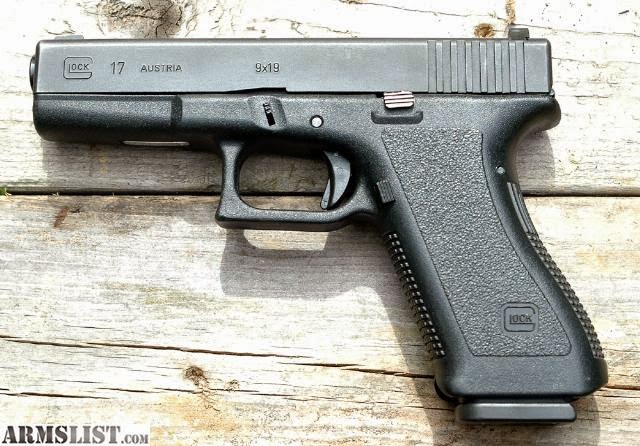
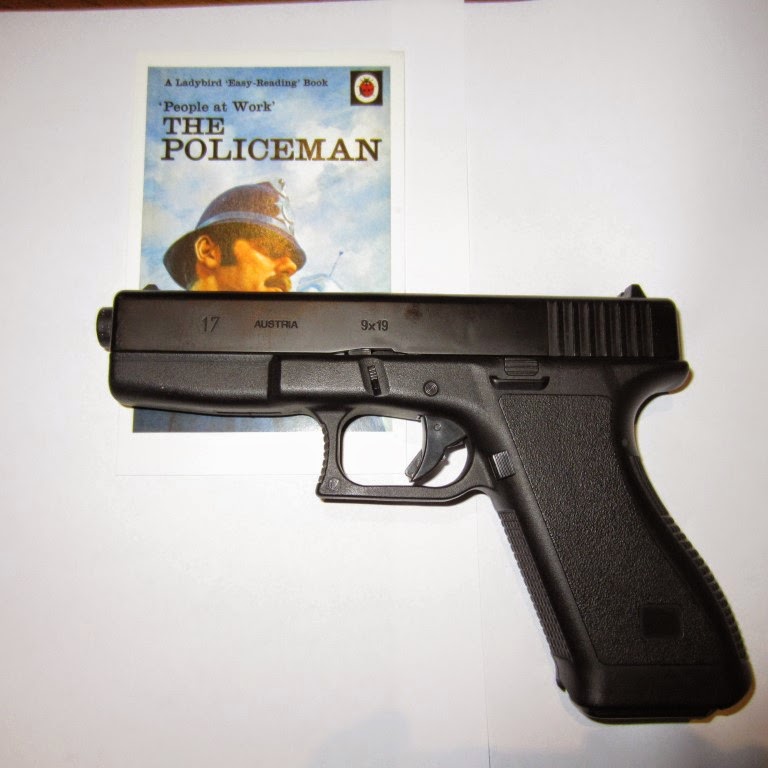
    What the video won’t do is convince you how real a fake gun can look. But if it looks real. It needs to be treated as real. Not convinced, take a look at this gun. Real or toy?

    Why it’s a plastic toy. Can’t you tell? No? Well, neither can cops.

    That’s a replica of my service weapon. It’s probably pretty similar to what the kid had. And here’s real Glock 17.

    Can’t tell the difference? Well, neither can cops!

    So please do correct anybody who says this kid was shot while holding a “toy gun.” This is a toy gun.

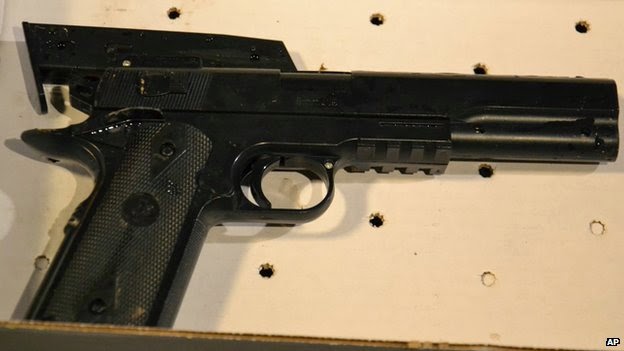
    Update: from Campbell’s comment, this is the gun that the kid had:

    Except that keep in mind that part sticking up in back would be in the gun.

    [Update: here’s a later poston this subject]

  • Those pesky facts

    What if everything you thought about Michael Brown was wrong? Do you believe in evidence? Science? Evolution? Global warming? Can new evidence change your opinion? Is your conviction that a police officer killed an innocent surrendering black youth in Ferguson, Missouri, so strong that facts and evidence simply do not matter?

    Might you accept that there are racial injustices in the world in general — and perhaps in Ferguson in particular — while also understanding that perhaps the police officer in this case actually acted properly? Just maybe? The Atlantic says:

    A new report on Michael Brown’s official autopsy results appears to support Officer Darren Wilson’s version of the events on August 9, according to two medical experts.

    St. Louis medical examiner Dr. Michael Graham told the paper that the autopsy “does support that there was a significant altercation at the car.” The other expert, forensic pathologist Judy Melinek, went even further, saying that the wound on Brown’s hand “supports the fact that this guy is reaching for the gun” and adding that another shot, which went through Brown’s forearm, means Brown could not have facing Wilson with his hands up when he was shot, an apparent contradiction of the now iconic “hands up, don’t shoot” posture adopted by protesters in Ferguson.

    These recent leaks are meant to prime the public for an inevitable result: a grand jury investigation that ends with no charges being filed against Wilson.

    This is no way changes my belief that the police response to the protests was both tactically horrible and way over-the-top.

  • “Why we need to fix St. Louis County”

    Well said by Radley Balko in the Washington Post:

    When a local government’s very existence depends on its citizens breaking the law — when fines from ordinance violations are written into city budgets for the upcoming year as a primary or even the main expected source of revenue — the relationship between the government and the governed is not one of public officials serving their constituents, but of preying off of them.

    When the primary mission of a police department isn’t to protect citizens but to extract money from them, and when the cops themselves don’t look like, live near or have much in common with the people from whom they’re extracting that money, you get cops who start to see the people they’re supposed to be serving not as citizens with rights, but as potential sources of revenue, as lawbreakers to be caught. The residents of these towns then see cops not as public servants drawn from their own community to enforce the laws and keep the peace, but as outsiders brought in to harass them, whose salaries are drawn from that harassment. The same goes for the judges and prosecutors, who also rarely live in the towns that employ them.

    This isn’t as much about a police shooting as it is about the release of residual anger over an antagonistic system of governing that virtually requires its poorest citizens to live in misery and despair.

    If Bel-Ridge wasn’t collecting the equivalent of $450 in fines each year for each of the town’s residents, the town of Bel-Ridge probably wouldn’t exist.

    This is what St. Louis County government is built upon. And this is what needs to be changed.

    When I was a cop, I knew my ticket money went to the city. Hell, I was happy to help Baltimore. But I never felt that my job depended on me fining residents.

    New York City gets about $500 million annually from parking tickets, which is the biggest chunk of about $820 million overall in fines. New York’s overall budget is about $70 billion. So we’re talking one to two percent of the city’s budget coming from fines. I don’t know about court fees, but I doubt they’re a money maker for the city.

    I don’t think a big-city perspective really gets at what is going on in these small towns where government seems to exist for the sole purpose of taking money from residents: “Pine Lawn, with an embattled mayor facing federal charges of steering towing jobs to a particular company, brought in close to 70 percent through its courts last year. At least four other St. Louis County municipalities — Beverly Hills, Bella Villa, Calverton Park and Cool Valley — all took in more than half their general revenue that way, according to reports submitted to the state.” And “It’s illegal: “The city of Bourbon was breaking state law. Under Missouri law, a city is only supposed to make 30 percent of its revenue off tickets.”

    Thirty, 40, 70 percent of budgets comes from fines and court fees? Mandatory private garbage collection? Per person occupancy permits? It sounds like a straight-up criminal racket, and one enforced by police and the courts.

  • Racial disparity in police-involved homicides: 4:1

    Trying to set the record straight is a bit like pissing into the wind. The substantively wrong pro-publica story has now been repeated by every news source I can find.

    I suspect that over time the idea that from 2010-2012, blacks males 15-19 years-old were 21 times more likely than non-hispanic-whites males to be killed by police will simply become remembered as: police are 21 times more likely to shoot black people. But it’s not true! (There I am again, getting spattered by my own pee.)

    The real figure they’re talking about — not just the numbers from 2010 to 2012 — the real figure is not 21 to 1 but 9 to 1. And when one includes hispanics in the count, the black-to-white ratio goes down to 5.5 to 1. If one looks at black and white men of all ages killed by police, the ratio is (just?) 4 to 1. (Ed note: based on later better data, the ratio is actually closer to 3 to 1.)

    Now you may wonder why I’m quibbling. What’s my point? Well, it’s important to base opinions and public policy on fact. And for starters, 4 to 1 versus 21 to 1 is a huge difference.

    One could also argue that even a disparity of 4:1 is unacceptable. And it is, on some level. But in the population examined by ProPublica — the same subset in which blacks are 9 times (not 21 times) as likely as whites to be killed by police — the black-to-white homicide ratio is 15:1. We know police-involved homicides correlate with homicide and violence in the community they police. So what rate of disparity would one expect in police-involved homicides? Certainly not 1 to 1.

    If you’re going to honestly talk about racial disparities in police-involved shootings, you need to discuss levels of violence among those with whom police interact. If one thinks police shootings are primarily an issue of racist police — if one thinks police only shoot black people, if one thinks white people are never stopped by police for minor offenses — one is not only wrong, but one won’t come up with any effective solutions. The vast majority of police-involved shootings are justified. That said, there are bad shootings. But this is more a police problem more than a race problem.

    If one wishes — as one should — to reduce the racial disparity of police-involved shootings, one needs to focus on racial disparities in crime and violence in general. If one wishes — as one should — to reduce the incidences of unjustified police shootings and improper police use-of-force, one needs to improve police training and reduce police militarization.

    To replicate the pro-publica study, here are the numbers for the past 15 years (15-19 year-old black and non-hispanic-white men, shot and killed by police and reported to the Uniform Crime Reports). This is the black-to-white ratio for police-involved homicides. All are based on population rates per 100,000 (using constant 2010 census figures, not adjusted for year):

    Past 1 year (2012, n = 24): 13 to 1

    Past 2 years (2011-2012, n = 45): 16 to 1

    Past 3 years (2010-2012, n = 62): 21 to 1

    Past 4 years (2009-2012, n = 92): 17 to 1

    Past 5 years (2008-2012, n = 110): 17 to 1

    Past 6 years (2007-2012, n = 140): 15 to 1

    Past 7 years (2006-2012, n = 162): 12 to 1

    Past 8 years (2005-2012, n = 183): 10 to 1

    Past 9 years (2004-2012, n = 209): 9 to 1

    Past 10 years (2003-2012, n = 226): 10 to 1

    Past 11 years (2002-2012, n = 249): 9 to 1

    Past 12 years (2001-2012, n = 262): 9 to 1

    Past 13 years (2000-2012, n = 286): 9 to 1

    Past 14 years (1999-2012, n = 312): 9 to 1

    Past 15 years (1998-2012, n = 339): 9 to 1

    With the above data, you can’t say anything conclusive from just the first few years of data. Certainly the group that I would least want to pick and highlight is the three-year (2010-2012) statistical outlier. Cherry-picking the highest number would be dishonest, but even assuming it’s just accidental is still shoddy research. One would expect the results to bounce around for the first few years and then settle down. Only then can one find validity — the idea that the number has any meaning.

    Why pick the past three years instead of the past 2, 4, or 15 years? One key to analyzing statistics is skepticism of “amazing” anomalies, especially from a small group. Something can be (in fact, will be 1 in 20 times) statistically significant but substantively irrelevant.

    But why is the 3-year cumulative number so high? Because only one non-hispanic white teen got shot and killed by police in 2010. Since the sample is so small, one strange year can screw up the data. But over more years the numbers settle down. Here one needs to go back maybe 8 to 10 years to find any substantive meaning. (And even then all this UCR data on police-involved homicides should be taken with a gigantic grain of salt.)

    [Also, there’s a bit more rambling detail, in less coherent form, in one and two previous posts. Here’s a follow-up post.]

  • Black are 4 times more likely than whites to be killed by police

    [Update: Cut to the chase. You might just want to read my summary post.]

    Related to the “not 21 times” previous post, I received a tweet from one of the authors: “Differences in our methodologies: you count Hispanic homicides as white… deflate the results.”

    So back to running stats for me. But there’s a problem in that the UCR homicide data does a particularly poor job in counting hispanics. Most cities simply do not record hispanic data.

    As a result, 56% of homicide data has nothing for “hispanic or not.” I would guess that most of this 56% is non-hispanic, since cities without many hispanics are less likely to care about counting hispanics, but we do not know. In general, you really shouldn’t use data when half is missing.

    [The UCR would like police departments to do like the census: record race and then overlay hispanic-or-not on top of that. (If you’re a cop, this is probably how you record domestics.) But I don’t think any police department does this. So what the UCR seems to do, for the departments that list hispanic at all, is just call them all white hispanics.]

    But if one does exclude hispanic whites from the count of whites over the past three years, one finds all of 9 young white males shot by police over the past three years. If one then uses non-hispanic white for the population denominator, I get a black-to-white ratio of 21:1 [replicated! And updated from the original post].

    But what I will quibble about is the validity of that number. It means very little because there’s just not enough data.

    I mean, one could look at just one year. The last available year, 2012, has a black-to-white ratio for teen males killed by police a less headline worthy 7:1 [13:1 if you exclude hispanic whites]. But you can’t just look at one year — or three. Put bluntly, police don’t kill enough teens each year to be statistically useful (which is good news, I suppose).

    And since we can look at more years, we should. So if one wants to only look at 15-19 year-olds males shot by police, let’s look at the past 15 years. The most shocking result I discover is that a majority of “whites” killed by police are listed as hispanic. (109 versus 95. And overall there are 6.3 million non-hispanic whites and 2.1 million hispanic white males 15-19.)

    The overall black-to-white ratio (15-19 year-old males) is 5.5:1. If one removes white hispanics from the sample (I’m not sure you should), the black-to-white killed-by-police ratio goes up 9:1. Though if one removes white hispanics for the overall homicide rate, the overall black-to-white homicide ratio in society goes from 9:1 to 15:1. All this gets a bit silly.

    So let’s include everybody.

    The overall racial disparity in homicides — and presumably other violent crimes as well (but they’re not counted as reliably) — is 6:1. The racial disparity among police-involved killings is about 4:1 (3.8:1, to be exact). Given the former, I don’t find the latter disturbing high (though I suppose reasonable people could disagree).

    Here’s the thing. We should focus on bad police-involved shootings. And also we should focus on overly aggressive use of less-lethal force. These are issues of training, issues of a relaxing a paranoid “warrior” mindset. Sure, race matters, but if you want to improve policing, you need to move past the idea that police only do bad things to black people. This isn’t a black and white issue. It’s a police issue.

    [It’s always good to put a disclaimer in any post related to police-involved shooting. The data, in general, is very limited. That said, some of the UCR data on police-involved homicides is good. While one cannot infer absolute numbers, looking at ratio of included data, such as race, presents much less of a problem, since one is looking a ratio within the data.

    [Update: Also, some of the numbers have changed as I’ve updated and corrected and double-checked figures. Nothing substantively major. But you’re not going crazy if you think the actual headline used to 3 times and now it says 4 times (the actual number is 3.8. Using different population figures and/or just making a mistake, I first came up with 3.3).]

  • Black teens are not 21 times more likely than whites to be shot and killed by police

    [Update: Cut to the chase. You might just want to read my summary post.]

    One of my liberal de Blasio-loving not-so-fond-of-cops friend send me an email with the subject “you gotta check yo facts” and a link to ProPublica: “Young black males in recent years were at a far greater risk of being shot dead by police than their white counterparts – 21 times greater.”

    “Well, that’s interesting,” I thought, “It also can’t be true.” Since I kind of know these numbers (and had discussed them with my friend). So I guess I do have to check my facts. I then wasted a half day running the numbers myself (when I could have been giving my undivided attention to the Orioles’ loss).

    Now it’s always dangerous to say my numbers are right and theirs are wrong. But I trust my numbers, because I just ran them. And I’m good at this. And then I ran them again. I’d like to see their numbers because, well, I think they’re wrong. But clearly one of us is wrong. I hope it’s not me.

    In the past three years (2010-2012) among those 15-19 year old, 54 blacks and 36 have been shot and killed by police. This is according to the UCR stats that are not perfect. But while the data here are not complete, they’re OK in many ways. And the black-white ratio should hold-up just fine.

    If my data are wrong, please do correct me.

    In the 15-19 population population, there are 8,728,271 white males. (Click through to: “Annual Estimates … by Sex, Age, Race, and Hispanic Origin”) There are 1,978,081 black males, 15-19 years-old (2010 census).

    Per year, for the past 3 years, this is a police-involved homicide rate of 0.14 per 100,000 for whites and 0.99 for blacks. 0.91 divided by 0.14 is 6.5, not 21. For the past three years black males 15-19 are 6 or 7 times more likely than white males to be shot and killed by police, not 21 times.

    From ProPublica:

    The 1,217 deadly police shootings from 2010 to 2012 captured in the federal data show that blacks, age 15 to 19, were killed at a rate of 31.17 per million, while just 1.47 per million white males in that age range died at the hands of police.

    Now even if one takes a 3-year rate per million (which is statistically odd for two italicized reasons), the rate for blacks is 30 (close to 31 but not replicated). Where I think the error lies is that the rate for whites is not 1.47 but rather 4.3. That’s a big difference.

    My numbers are based on the years 2010-2012: 36 whites shot and killed. 8.7 million white males 15-19.

    [Their 95% confidence interval is vast: “between 10 and 40 times greater risk.” This, leaving aside the wrong number, seems to me to be a gross misuderstanding of confidence interval. The overall number (the “n,” in stat terminology) of young people killed by police over the past three years is not large. But there’s a difference between a small “population” and a small “sample” size.

    A confidence interval tells you the odds your sample reflects the total population. Say you ask 100 potential voters if they would vote for Obama. Four or 40% say yes. So what are the odds that Obama would win 40% of the vote? Well you don’t know for sure because you didn’t ask everybody. But based on those 100 you did ask, you can come up with a range, say 35-45 percent, at which you can say there is 19 in 20 chance that if we did ask everybody, it would be in this range. That’s a confidence interval.

    Again, if I’m wrong here, correct me! It’s been 18 years since I took a statistics class in graduate school. And I wasn’t even good at it.

    If you poll everybody — if you have an election — you don’t have a confidence interval. You have a result! Even with its flaws, the UCR is pretty complete. If blacks are X-times more likely to be killed, that’s that! There is not a sample but a population. You don’t have a confidence interval if you sample everybody in a population. You have a number. But it is a small population.

    I also wonder why they only picked people shot and killed, rather than all persons killed. It’s a minor difference, but why make more work when you don’t have to? 99.2 percent of people killed by cops are killed with a gun.)]

    Well conveniently you can just add more years to get a larger population. I don’t know why they didn’t. (Well, I suspect because it’s work. It’s a bit of a pain to download and select from each year’s UCR sample. But that is what researchers do. I mean, I just happen to have the last 15 years compiled and ready to use because, well, that’s what researchers do. On a Saturday night. While watching baseball.)

    So instead of looking at the past three years, let’s increase the population by looking at the past 15 years. From 1998-2012, 210 white and 242 black male 15-19 year-olds have been shot and killed by police. This comes out to an annual rate of 0.16 (per 100,000) for white males and 0.82 for black males.

    So over the past 15 years black male teens are 5.1 times more likely — five times more likely — than whites to be shot and killed by police. Five times; not 21.

    Now maybe 21 and 7 and 5 are close enough for you. Or maybe you think 5 times more is 5 times too many. But what number would be OK? Given ration disparities in violent crime, one shouldn’t expect 1:1. One might expect police to be more likely to shoot and kill people who shoot and kill other people. (Remember that we’re using rates here, which take into account the population difference, that there are 7 whites for every black in America.)

    The homicide rate for black men 15-19 is 9 times the rate for white men. (From 2010 to 2012, looking at men 15-19, 2,382 blacks and 1,209 whites have been murdered by criminals. The homicide rate for these young white men is 4.6 per 100,000. For these young black men, the homicide rate is 40.7.)

    So given the 9:1 racial disparity in the homicide rate among young men, what racial disparity would one expect in police-involved shootings? There’s no right answer to this question. But I don’t think it’s unreasonable for the racial disparity of those young men shot and killed by police to be reflective of the racial disparity in violence and homicides among young men. And in fact, the police-involved ratio, at 5:1 (not 21:1 or even 9:1), is much less.

    [Updated to reflect population data from 2010 census rather than ACS estimate. It doesn’t change much. Also, see next post and my summary.]