Tag: rising crime

  • Two-year increase in homicide

    Two-year increase in homicide

    Over the past two years, homicide increased 31 percent in America’s 52 largest cities.
    The cities range from little Richmond (220,000 people) to big NYC (8.5 million), from comparatively safe San Diego (homicide rate 3.5 per 100,000) to dangerous St. Louis and Baltimore (rates of 50+).

    Collectively 50.5 million people live in these 52 cities, or roughly one-sixth of America’s population. Homicides increased 31 percent over two years (4,946 to 6,496, which is about 36 percent of all US homicides). 45.3 million people live in cities in which homicide rose; 5.3 million live in cities in which homicide decreased.

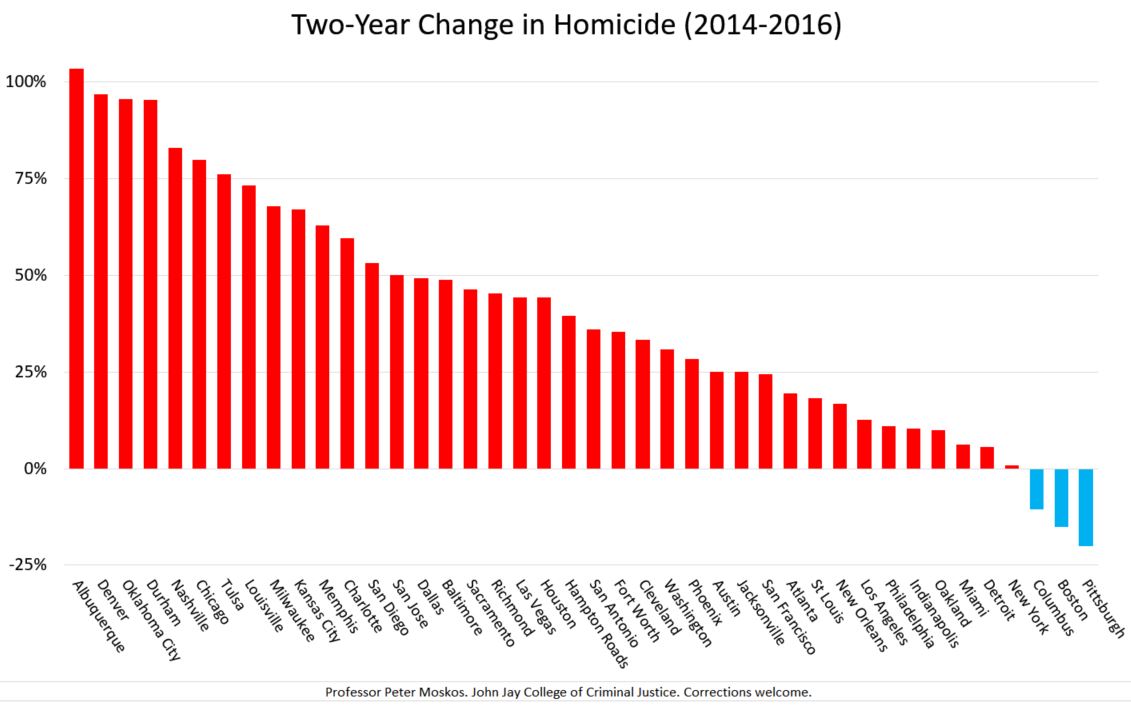
    For graphic representation in the chart above, I removed cities with fewer than 40 or more murders in 2016 because a low n leads to overly dramatic year-to-year changes. This affected El Paso, Seattle, Portland, Raleigh, Omaha, Tucson, Wichita, Long Beach, Minneapolis, and Fresno. (I also dropped Bakerfield its 153-percent increase is either a crazy outlier or my numbers are wrong.) Of the 43 remaining cities, 39 saw homicides go up.

    The cities that seem to be bucking the trend of greater violence over the past few years are Seattle, Portland, Fresno, Boston, Tucson, Columbus, and New York City. In terms of raw numbers, the cities with the largest increases in murders are Chicago, Houston, Baltimore, Memphis, Dallas, Milwaukee, Las Vegas, and Kansas City. Were one to take the eight cities with the biggest increase out of the equation — and there’s not any moral or statistical justification for doing so, but just for fun, because the Brennan Center likes doing this trick — the rest of the cities have a collective 2-year 20-percent increase. That’s 20 percent more than we’ve seen in a very long time. So, no. It’s not “just Chicago.”

    Here are the top 52 cities and their two-year change in homicides, 2014-2016.
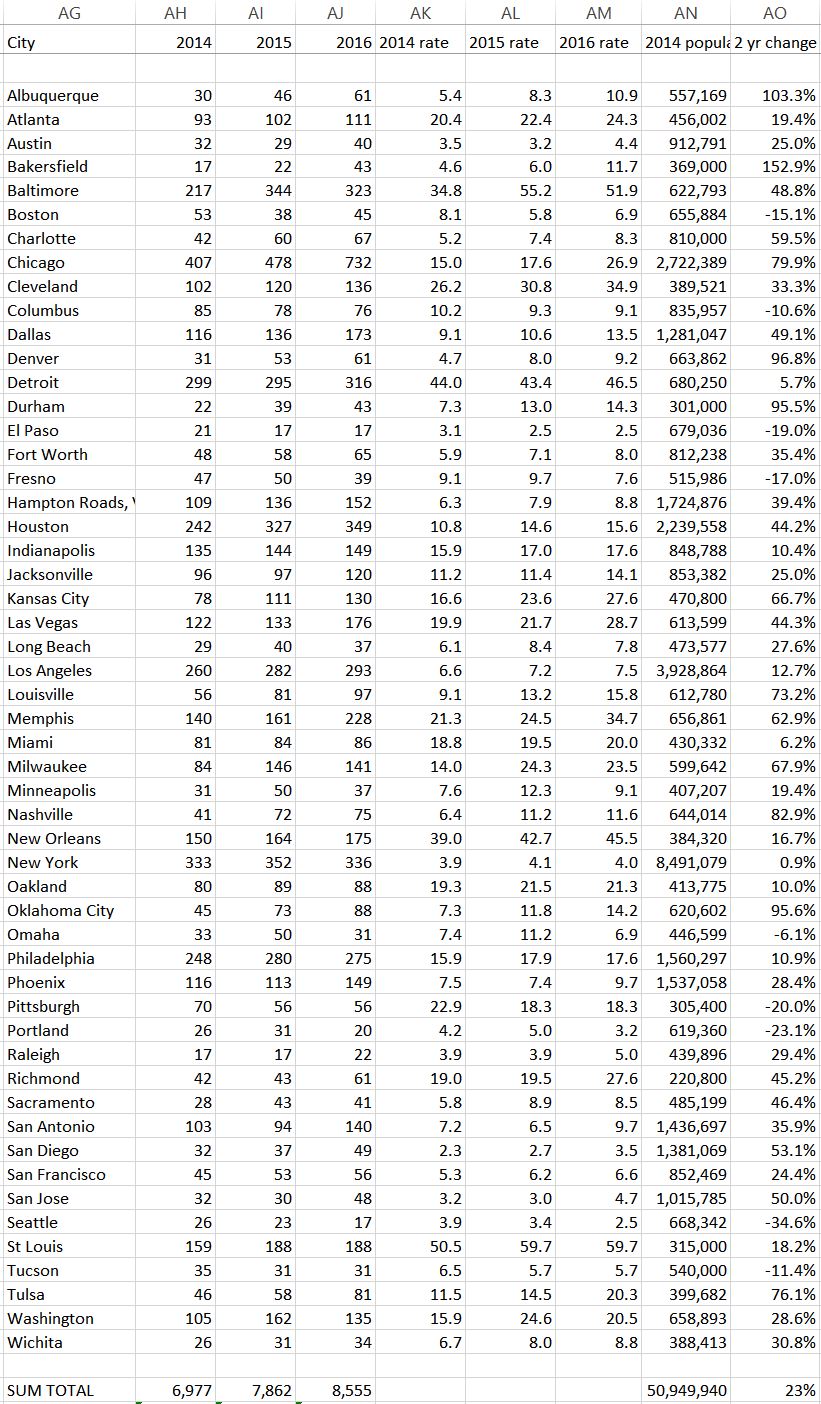
    And the data in text form, for your cut-and-pasting needs. Albuquerque: +103% | Atlanta: +19% | Austin: +25% | Baltimore: +49% | Boston: -15% | Charlotte: +60% | Chicago: +80% | Cleveland: +33% | Columbus: -11% | Dallas: +49% | Denver: +97% | Detroit: +6% | Durham: +95% | El Paso: -19% | Fort Worth: +35% | Fresno: -17% | Hampton Roads, VA: +39% | Houston: +44% | Indianapolis: +10% | Jacksonville: +25% | Kansas City: +67% | Las Vegas: +44% | Long Beach: +28% | Los Angeles: +13% | Louisville: +73% | Memphis: +63% | Miami: +6% | Milwaukee: +68% | Minneapolis: +19% | Nashville: +83% | New Orleans: +17% | New York: +1% | Oakland: +10% | Oklahoma City: +96% | Omaha: -6% | Philadelphia: +11% | Phoenix: +28% | Pittsburgh: -20% | Portland: -23% | Raleigh: +29% | Richmond: +45% | Sacramento: +46% | San Antonio: +36% | San Diego: +53% | San Francisco: +24% | San Jose: +50% | Seattle: -35% | St. Louis: +18% | Tucson: -11% | Tulsa: +76% | Washington: +29% | Wichita: +31%

    July 13 Update: A short while back I finally sent an email to one of the authors at the Brennan Center expressing my concerns about what I see as their deception. I received a brief reply stating, in part, “the statistics you cite [to wit: “Chicago accounted for more than 55 percent of the murder increase last year” & “A similar phenomenon occurred in 2015, when three cities — Baltimore, Chicago, and Washington, D.C. — accounted for more than half (53.5 percent) of the increase in murders”] refer to the increase in murders in a group of 30 cities that we study in our reports – not the national increase in murder.” I replied:

    Thanks for replying. But these clarifications do not negate the basic mis-truth of the highlighted statements (which have been cited and repeated which clarification). As as academic, I do not understand this. It’s not enough to have the truth somewhere in a publication. The summary and abstract, especially when right beneath the title, need to be be accurate standing alone. Surely you understand that readers, especially journalists on deadline, may not have the time or statistical knowledge to parse data as I do. They read and quote the summary. And isn’t that what you want them to do? So these need to be factually correct.

    Chicago simply does not account for half of the increase in “urban murders.” Personally, I would only feel comfortable saying “Chicago accounted for (roughly) 12 percent of last year’s homicide increase” (assuming a national increase of about 2,000). But since we have the two-year data, why not use it? I would feel more comfortable saying “Chicago is (approximately) 9 percent of the nation’s homicide increase over the past two years.”

    You’ve chosen to highlight a large percentage (55.5%) that is large only because of the self-selected limitations in your sample size (“in this group of cities”). Taking a percentage increase within a limited sample is not correct. For instance, were we to look at just the top five cities (NY, LA, Chicago, Houston, and Philadelphia), one could say Chicago accounts for 95.5 percent of the total increase in urban murders. While mathematically true, this would be substantively meaningless if not downright misleading. Or, to further illustrate this point, why not just take the top three cities? The numbers would allow us to say: “Looking at the three largest cities, Chicago accounts for 102 percent(!?) of last year’s urban homicide increase.” Of course, the numbers come out this way, but one city accounting for more than 100 percent of an increase is both conceptually impossible and mathematically absurd. Does this make sense? The larger sample you use lessons the magnitude of the absurdity, but not the nature of its existence.

    Were one to take a larger sample, looking at the top 50-plus cities, then Chicago accounts for 38 percent of last year’s increase. And 20 percent of the two-year increase. Were one to include all urban areas, of course, the percentage would be much smaller. But any arbitrary limit on the denominator is statistically dubious.

    But back to my initial point — what is highlighted (and cited in the media) is right there is the lede/summary/subtitle without qualification — how is one expected to interpret, “Chicago accounted for more than 55 percent of the murder increase last year”? Do you think this is an accurate presentation of data?

    Here our correspondence seems to end.

    In addition to the UCR, here are some of my source. Corrections welcome.

    https://www.abqjournal.com/923137/city-sees-highest-number-of-murders-in-20-years.html

    http://www.kerngoldenempire.com/homicide-tracker http://www.city-data.com/crime/crime-Bakersfield-California.html

    http://www.cleveland.com/metro/index.ssf/2017/01/year_in_review_homicides_surge.html

    http://www.newsobserver.com/news/local/community/durham-news/article123339719.html

    http://www.elpasotimes.com/story/news/crime/2017/03/23/rash-homicides-anomaly-police-say/99555590/

    http://www.star-telegram.com/news/local/community/fort-worth/article128019874.html

    http://abc30.com/news/domestic-violence-related-murders-rise-sharply-in-fresno-during-2016/1679846/

    http://fox59.com/2017/03/02/early-2017-homicide-total-climbs-as-mayor-hogsett-stays-the-course/

    http://jacksonville.com/homicides/2016

    http://www.kshb.com/homicide-tracker-2016

    http://homicide.latimes.com/neighborhood/long-beach/year/2016

    http://www.miamiherald.com/news/local/crime/article104679101.html

    https://projects.jsonline.com/apps/Milwaukee-Homicide-Database/

    http://www.startribune.com/statistics-show-minneapolis-violent-crime-edged-up-in-2016/409711555/

    http://www.nola.com/crime/index.ssf/2017/01/new_orleans_finishes_2016_with.html

    https://oaklandmofo.com/blog/oakland-homicide-count-is-rising

    http://dataomaha.com/homicides/2015

    https://www.phillypolice.com/crime-maps-stats/

    http://www.azcentral.com/story/news/local/phoenix/2017/03/29/maricopa-county-phoenix-area-homicide-map-2017/99735018/

    https://newsinteractive.post-gazette.com/homicide/

    http://koin.com/2017/01/01/4-of-portlands-20-homicides-from-2016-remain-unsolved/

    http://www.kcra.com/article/meet-the-tiniest-deer-being-nursed-back-to-health/10247250

    http://www.sandiegouniontribune.com/news/public-safety/sd-me-county-homicides-20170226-story.html

    https://www.tucsonaz.gov/files/police/pt1_16_summarytable_0.pdf

    http://www.kjrh.com/news/local-news/tulsa-homicides-in-2016-interactive-map-shows-location-of-homicides-during-record-year

    http://www.sandiegouniontribune.com/news/public-safety/sd-me-county-homicides-20170226-story.html

    http://wtkr.com/2015/12/22/norfolk-is-the-deadliest-city-in-hampton-roads/

    [Posts in this series: 1, 2, 3, 4, 5, 6]
  • Prelude to a post

    Prelude to a post

    Homicide is going up. It’s been going up for two years. And yet educated people still act shocked.

    I’m tired of refuting the homicide-increase deniers, but their arguments comes down to these collectively nonsensical points: A) homicide isn’t up in every city; B) homicide is up a whole lot in some cities; C) the increased risk of homicide isn’t spread equally among society but disproportionately concentrated among poor young black males with access to guns living in neighborhoods with historic and systemic issues of racism and segregation; and D) homicide is still lower than what it was when it was really high. To which I say A) statistically speaking, that’s why we look at averages; B) indeed, that’s a big problem, but it doesn’t negate the general increase; C) no shit, Sherlock, same as it’s ever been; D) ah, go fuck yourself!

    You see, writing about this same old topic has made me cranky because I can’t believe I still have to. And I’m disappointed that so-called progressives waste time building a denialist house of cards instead of rolling up their sleeves and doing something to prevent poor black men (disproportionately) from getting murdered. But for whatever reason, a few years back, many of the left ceded crime prevention to conservatives. Somehow I missed the meeting where we decided that the only important criminal justice issues were to be police misconduct and the use of lethal force against African Americans (well, that and Mass Incarceration). And when generally respectable institutions like the Brennan Center make false statements about murder — repeatedly — we’ve got a problem.

    To wit:

    • Alarmingly, Chicago accounted for 55.1 percent of the total increase in urban murders.
    • A similar phenomenon occurred in 2015, when three cities — Baltimore, Chicago, and Washington, D.C. — accounted for more than half (53.5 percent) of the increase in murders.

    Since 2014, violence has increased. And it’s increased a lot. But Chicago neither accounted for “55 percent of the murder increase last year” nor “55.1 percent of the total increase in urban murders”! To say so once might be a mistake. To say it a few times might reflect statistical idiocy. But to do so again and again? I don’t get it. If forced to confront this false statement, they’ll probably end up saying, “it was poorly worded and we meant 55 percent of the total of the cities we looked at.” [Update: yup.] But regardless, it makes no statistical sense. Talking about the percent of total change one city makes in a small sample is bullshit, statistically and morally. Because it’s possible to pick a sample in which Chicago is 100 percent of the increase. I don’t think they’re idiots. But if not, are they trying to deceive? Or do they just get there by accident? If Chicago’s increase of 254 accounted for 55 percent of the murder increase last year, that would mean a total increase of 208 murders outside Chicago last year, nationwide. The actually increase in murders in 2016 is probably 2,000 more than 2015. And 2015 was 1,500 higher than 2014.

    Second, in 2015, Baltimore, Chicago, and DC accounted for nothing close to half of the increase in murders. The national increase (2014-2015) was around 1,500. 255 is 17 percent of 1,500, not 53.5 percent. So how do they come up with these numbers? I’ve figured it out. Put it this way, if your sample only included Baltimore, Chicago, and DC, you could say these cities accounted for 100 percent of the increase in murder. Add a few cities, and that’s basically what they’ve done.

    There’s a method to what, when, and why they do what they do. They don’t just pull number from thin air. They use faulty methods until they get a number they can replicate. And then they just put it in words, knowing nobody ever checks these things. Either that or the authors are complete statistical idiots, but I doubt that.

    Baltimore just finished the first half of 2017 with 170 homicides, the most since 1992, when the city had 115,000 more residents.

    An assistant city health commissioner who oversees anti-violence initiatives was jumped and robbed in downtown Baltimore on his way back to work after having a sandwich for lunch. In the hospital, skull fractured, he said, “I think we need to look into what is causing people to engage in this kind of behavior.” No. Actually, we don’t. Cause I’ll tell you the cause: bad or absent parenting on top of 500-years of systemic racism combined with 20th-century government programs designed to segregate and limit the ability of blacks to succeed. I can speak the liberal shibboleth. I even believe the liberal shibboleth! So what? Now what? One can and should acknowledge history, but that won’t change it. And the greater point, at least when it comes to crime and violence, is that none of this is new. Somehow, despite social injustice and white supremacy, crime and violence had been going down for basically 25 years. The violence problem has gotten worse just in the past two years. Talking about historic social issues, as important as they are, is nothing more than a distraction to avoid dealing with today’s issues of criminals and wrong-doers.

    Crime wasn’t supposed to go up, of course. Crime reduction, say some, is just part of the grand social justice and intersectionality equation. DOJ reports (on policing in Baltimore, for instance) focused exclusively on improving police, necessarily as that is, and ending racially disparate policing. They managed this without even talking about crime prevention and racially disparate rates of violence. This recent crime rise needn’t and shouldn’t have been politicized, but, as I warned, if the left won’t even acknowledge an increase in violence (disproportionately among poor black men) we effectively cede any crime “solution” to the “Trumpian right.” So now we get BS talk crime and terrorism, like somehow crime and terrorism is mostly due illegal immigrants and Muslim grandmothers. So yeah, I’m cranky in my middle age.

    But the past two years, 2014-2016, has seen the largest two-increase in homicide, in, well, probably ever. And the response of otherwise smart people is either to A) scratch their head and go, gosh, gee, maybe it’s poverty and guns and historic policies of racism. Except those haven’t changed in the past two years. Or B) it’s not a problem because, well, homicide is really up in Chicago? I don’t even know how to counter that. If you care more about right-wing overreaction to murder than the lives of those murdered, you win. Don’t care. But for people with a conscious that trumps ideology, read on.

    Here are the cities I looked at: Albuquerque, Atlanta, Austin, Bakersfield, Baltimore, Boston, Charlotte, Chicago, Cleveland, Columbus, Dallas, Denver, Detroit, Durham, El Paso, Fort Worth, Fresno, Hampton Roads (Norfolk, Newport News, et al), Houston, Indianapolis, Jacksonville, Kansas City, Las Vegas, Long Beach, Los Angeles, Louisville, Memphis, Miami, Milwaukee, Minneapolis, Nashville, New Orleans, New York, Oakland, Oklahoma City, Omaha, Philadelphia, Phoenix, Pittsburgh, Portland, Raleigh, Richmond, Sacramento, San Antonio, San Diego, San Francisco, San Jose, Seattle, St Louis, Tucson, Tulsa, Washington, Wichita.

    I got the homicide numbers best I could for each city going back as far as possible. It’s a lot of grunt work (but actually a bit easier than it used to be, thanks to journalists keeping track).

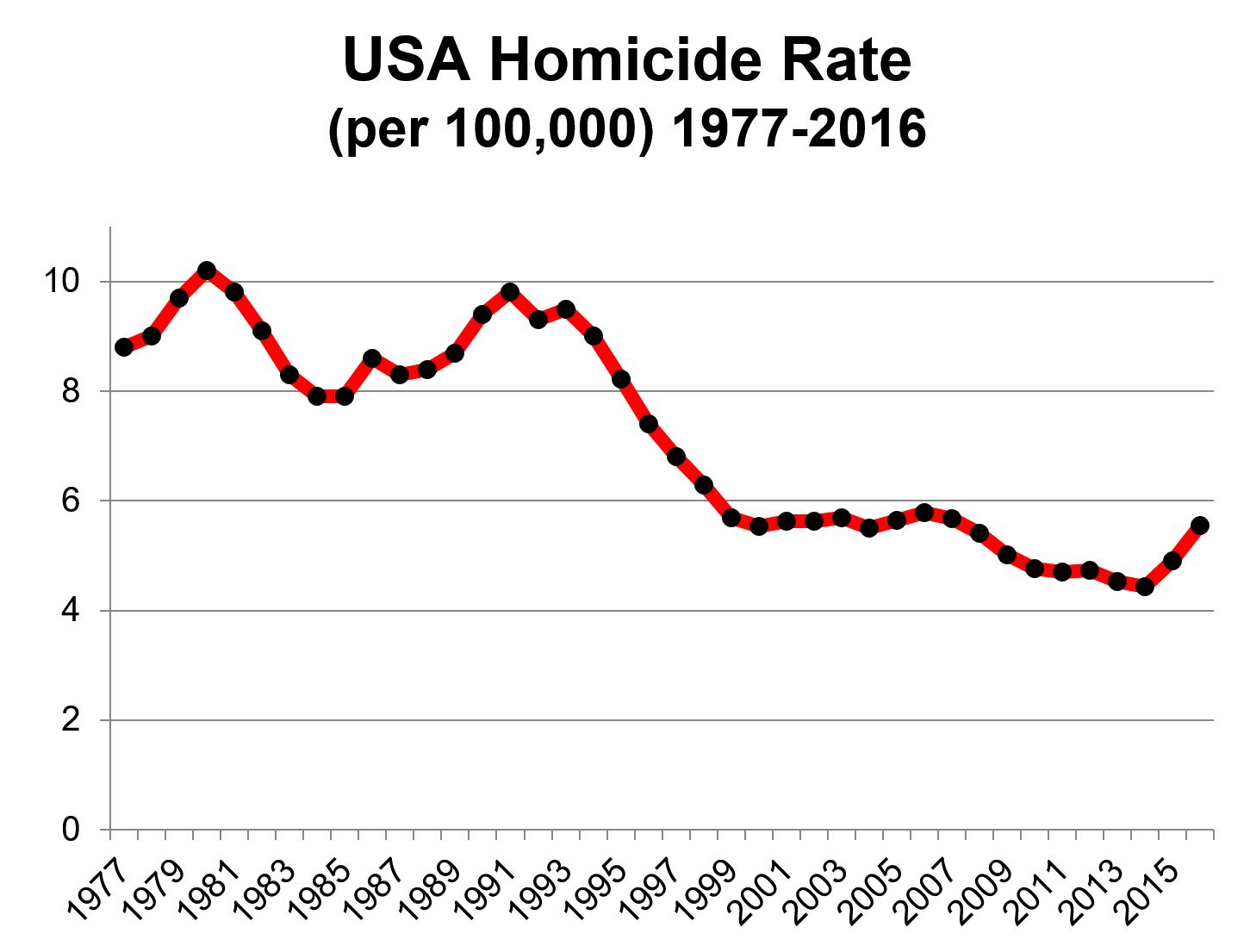
    For those cities, 2013 was the least violent year ever, with a collective 4,900 homicides. It could have gone lower; God did not ordain an urban homicide rate of 9.8 be the bottom below which no more lives could be saved. Generally, overall, homicide had been decreasing for 25 years. It could have continued to go down. But alas, people decided that police were the problem. And the problem to bad policing wasn’t better policing but less policing. How’d that turn out?

    I’ll push the data in the next post.

    [Posts in this series: 1, 2, 3, 4, 5, 6]
  • How to make people care about violence

    How to make people care about violence

    Over at Nola Crime News, Jeff Asher tweeted this graphicjust now.

    Click on it; it moves! So while people are dying, I’m thinking about data presentation. There’s something about a moving line that may make one pay attention to dead people in a way that actual dead people don’t.

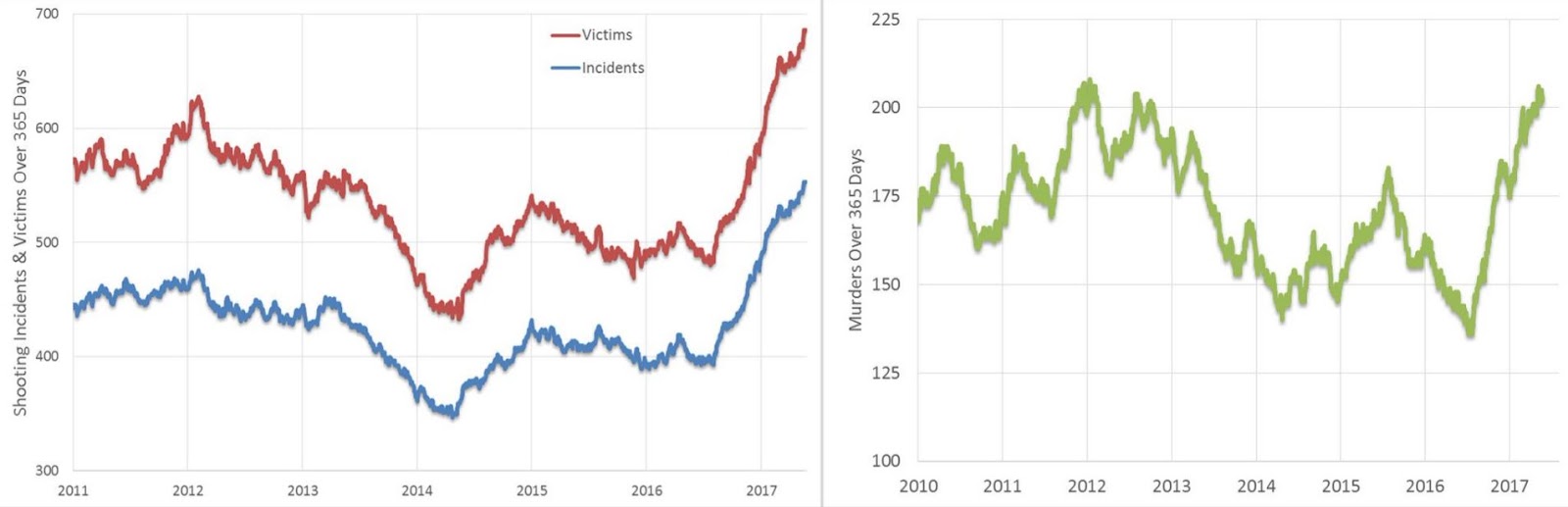
    Jeff’s graphic looks at Baltimore City shooting victims over the past 365 days. Each data point tallies the total number of shooting victims over the past 365 day. This nullifies seasonal change, which is worth a lot. But by taking a past-year average, you lose the “BAM” of what happened literally overnight, after six police officers were criminally charged for the death of Freddie Gray. The violence didn’t just “increase.” It stepped up, by two-thirds. Overnight. After April 27, 2015. The visual above indicates a rapid but continuous increase over the course of a year. But it’s still a good visual and can’t think of better one.

    I don’t know how to present a good visual that shows what has happened in Baltimore. In the past I’ve tried with a pre- and post-riot trend line. Not just once, but twice. But that’s hardly convinced the masses that police (or more dead bodies) matter.

    People are already talking about the rise in violence in Baltimore in terms of poverty or drugs or police legitimacy or blah-dee-blah. And sure, all that matters. But stop it! None of that, not any of that, explains the increase in violence. Police because less proactive because A) innocent cops were criminally charged and B) Political pressure (from the mayor, the police commissioner, and the US DOJ) told police to be less proactive as a means to reduce racial disparity in policing. You see it Baltimore. You see it Chicago. You see it in New Orleans. The problem is you’re seeing it basically everywhere.

    Here’s New Orleans, again from Jeff Asher.

    These increases are no joke. This is a “holy shit” type increase in violence. And the chart under-presents the quickness of the increase.

    What happened in New Orleans? I don’t know NOLA as well as Baltimore or New York. But the NOLA PD has seen a 30 percent reduction in manpower and a massive reduction in proactive policing (as measured by drug enforcement. I also suspect the consent decree hasn’t helped police in terms of crime prevention, since, and this is important: crime prevention isn’t one iota of any consent decree. Somehow, crime is supposed to manage itself while police are better managed.

    The only big city of note without an increase in violence is NYC. And even here, people objectto the exact kind of proactive policingthat keeps crime from rising. Luckily, at least in New York, even liberal Mayor de Blasio isn’t listening to the “police are the problem” posse.

  • “You Get the Police You Ask For”

    Since I’ve been remiss at writing anything here recently, I’m going to link to a piece from Jim Glennon at Calibre Press:

    [Baltimore] Mayor Pugh then thanked federal officials for their assistance in the arrest of a man who murdered a three-year-old in 2014.

    The Mayor’s expectation that the FBI can assist in the day-to-day in Baltimore not only won’t happen, it can’t. The Feds, and I am not one to bash them, are great at what they do. But what they don’t do is don uniforms and walk a beat.

    The Baltimore cops may be undermanned but that isn’t the reason for the surge in crime. They have been understaffed before. What’s different in the past two years? An absence of proactive policing. The surge in crime began immediately after the cops pulled back. Though no division of the elite political class, few criminologists, no mainstream media outlets, and no legal activist groups like the ACLU will openly acknowledge this.

    Why? Because they are the ones who wanted proactive policing stopped in the first place.

    The anti-police pundits blather on about how the violence isn’t as bad as in the early 1990s. They’ll yammer about how the crime surge is only in about 75 of the country’s counties. They’ll wax poetically about economic issues, past history, immigration, lack of trust between the police and the community, and then they will go back to their security-controlled TV studios and gated communities, sip chardonnay and chitchat about law enforcement ills with like-minded peers.

    Meanwhile, real people are dying, and the FBI, the CIA, the DOJ, and the VIPs won’t be able to stop the carnage.

    So politicians, pundits, etc., you got what you asked for. The question is: Did the citizens ask for it?

  • “How much do they care?”

    My previous post was supposed to be about this article by Frank Zimring from 42 years ago. But then I got caught up in the false data put out by the Brennan Center.

    A friend sent me this fascinating article (“A Tale of Two Cities,” Franklin Zimring, December 20, 1974, Wall Street Journal, p.14) because some of it regarding “the troubles” in Northern Ireland is blessedly dated. But much of what he wrote could be published tomorrow and considered current. (Also, I was a little shocked to learn Zimring was a professor and writing in 1974. I was three. And he’s still doing well.) His point was that more people, by far, are killed in Detroit. But everybody is much concerned about violence in Northern Ireland. (By American standards, Northern Ireland was never that lethal with (3,600 killed over 32 years.) Why?:

    When do people perceive violence as a major social problem, and why? What kinds of antiviolence programs will they tolerate? How much do they care?

    Detroit is used to high homicide rates; most of those killed in Detroit are ghetto dwellers; and killings in Detroit are not a direct threat to public political order as it is in Ulster,

    The first reason why Detroit (and her sister cities) can absorb so much violence without alarm is that Americans have had ample time to get used to high homicide.

    But how is it possible to adjust to such rates of violence? In an important sense, it’s easy.

    Because most of the urban body count in the United States involves the faceless young black male “non-citizens” who live and die without conspicuous outpourings of social concern. It is, in fact, misleading to talk of a single homicide rate in American cities, because ghetto-dwelling blacks kill and are killed at rates 10 times as high as big-city whites. Urban violence does, of course, affect a broader spectrum of society–small shopkeepers, street robbery victims, and men, women and children who just happen to be at the wrong place at the wrong time. But the great majority of victims are the black poor.

    And most of us are pretty safe, after all….Perhaps we can protect ourselves and accept violence as an occupational hazard of urban life for the poor?

    Yet there are moral and practical problems with learning to live with violence… The moral problems lie at the heart of the American dream our national greatness is defined in large measure by what we can provide for the least-advantaged among us

    Yet the prospects for constructive action are dim…. The political cant that passes for dialog on violence in this country is simply another symptom of failure to face up to our profoundly serious problems.

    Even with the best of intentions, our urban body count will be hard to diminish. If we continue to adjust to bloodletting, and to view violence as a nonproblem, there is every chilling prospect we will get what we deserve.

    In another 42 years, in 2058, I’d like to think this piece will no longer be timely. But I doubt it. What’s happened in the past 42 years? Half of Detroit left, literally. The population of Motor City dropped from 1,513,000 to 689,000. And the homicide rate? It’s right where it was, 42 year ago, just under 50 per 100,000.

  • No, it’s not just Chicago

    Homicide is up at a record setting two-year pace. But you wouldn’t know it from yet another press release by the Brennan Center. I think they time these to provide a “crime is not a problem” narrative to journalists, quite a few of whom are about to write year-end stories with the headline: “Oh shit, homicide is way up!” While I can’t really question the motives of crime increase deniers, I can debunk the worst of their claims:

    False claim #1) “Nationally,” says the Brennan Center, “The murder rate is projected to increase 31.5 percent from 2014 to 2016 — with half of additional murders attributable to Baltimore, Chicago, and Houston.”

    This is so not true, I don’t know where to start.

    It’s the “half” part I’m talking about. (In a previous post I mentioned that 31.5 percent should be 23.2 percent.)

    Collectively, Baltimore, Chicago and Houston will see about 540 more murders in 2016 than in 2014 (my numbers are 1,406 vs. 866). Meanwhile, nationally, there will be roughly 3,600 more murders (17,768 vs. 14,164). Ergo, QED, and I told you so: Baltimore, Chicago and Houston account for 8 percent of all murders and fifteen percent of the additional murders in the US from 2014 to 2016.

    8% = 1,406/17,768

    15% = (1,406-866)/(17,768-14,164)

    A few days ago, they doubled down, “The 2016 murder rate is projected to be 14 percent higher than last year in the 30 largest cities. Chicago is projected to account for 43.7 percent of the total increase in murders.” I guess this depends on what “total” means. Because Chicago will be 14 percent of the “total” national increase.

    14% = 300 / (17,778 – 15,696)

    Now I think Chicago might be 43.7 percent of the increase in the top 30 cities. But that is some meaningless made-up playoff stat. I mean, if you look at the top three cities, it turns out Chicago makes up 102(?) percent of the “total increase.” When your formulas can get you absurd results, it means you’re doing it wrong!

    Are they lying or just in error? Are they making honest mistakes or intentionally misleading? I don’t know. But these “fact” are up there, cited by many, corrected by none.

    False claim #2) It’s all Chicago’s fault

    Stop blaming Chicago just because it’s leading the pack.

    Imagine I said, “the Chicago Bulls of the 1990s were really good!” And you replied, “No, not really, because Michael Jordan was playing for them.”

    Or if I said, “the Alps are a really tall mountain range!” And you replied, “Well, they wouldn’t be so tall without Mt. Blanc.”

    It’s difficult to respond to the reply becausethough substantively irrelevant, it is technically and semantically correct. (Is there some rhetorical term for this kind of distraction argument? Something in Ancient Greek for “hey look, a squirrel!”) Indeed, Michael Jordan led the Bulls and the Alps would not be as tall without its tallest mountain. But so f*cking what? The rest of the Bulls were good basketball players. And the Alps would still be tall without its tallest mountain!

    The national increase in homicide is a problem with or without Chicago. As I’ve written before, you can remove Chicago and other cities (not that you should) and the increase in homicide is still very large (albeit, yeah, smaller). There will be about 17,800 murders in 2016. About 4 percent of these [800 / 17,800] happen in Chicago. The two-year increase in Chicago homicide is about 10 percent of the national total [(777-407) / (17,800-14,164)]. Conversely, 90 percent of the national increase in homicide is not in Chicago.

    Chicago, of course, is special. But let’s not get distracted. The rise in homicide is not just a problem in “a few, select cities.” It’s a problem except in few select cities.

    False claim #3) Some years murder goes up and some it goes down.

    Well, yes, that’s true. But not right now. The increase in murder is not, despite what they say, some story of random statistical year-to-year fluctuation:

    A similar phenomenon occurred in 2015, when a group of three cities — Baltimore, Chicago, and Washington, D.C. — accounted for more than half of the increase in murders. This year Baltimore and Washington, D.C., are projected to see their murder rates decline, by 6 percent and 18.6 percent, respectively.

    Well, you know, up one year and down the next…. Except murder is up. Not up-and-down. And when a few cities go up one year, and other go up next, and all of them go up overall, it’s we who took advanced statistics call “a trend.”

    And dammit, cause Baltimore is personal, Baltimore is not a city running contrary to this upward trend. 2015 was off-the-charts bad for crime Baltimore, after the riots. 2016 was horrible, as in the worst year ever… except compared to 2015. I mean, it’s good 2016 is not worse than 2015, but it’s not good. To say crime is down in Baltimore is disingenuous at best. The highest murder rate ever — 2015 — should not be the new normal by which we judge success.

    False claim #4) “Concerns about a national crime wave are still premature.”

    OK, but if not now, when? 27(?) of the 30 biggest cities have seen an increase in murder over the past two years. We need to do more than simply, “suggest a need to understand how and why murder is increasing in some cities.” Are we not supposed to care as long as violence remains segregated in poor segregated black neighborhoods? And we know why murder is increasing in some cities. It’s not rocket science. “Lack of socioeconomic opportunity has long been credited with high levels of crime.” Yes, no shit. Of course violence happens more in shitty neighborhoods without “socioeconomic opportunity.” But that’s neither here nor there because “socioeconomic opportunity” hasn’t gone down the shitter in the past two years. “Socioeconomic opportunity” might explain (part of) the problem. But it doesn’t explain the increase in homicide in the past two years. (Last year, in fact, saw a record decrease in poverty).

    False claim #5) Sure homicide is up, but not crime overall.

    First of all, if you think rising homicide doesn’t matter because other crime is steady, for shame. Second, homicide matters more than other crime. Period. If homicide is up, stop right there. But the statistical problem is that data on crime overall is not that good. A lot of crime isn’t reported. We know that. (There’s the NCVS, but they have their own problems.)

    And I’m not even talking about intentional data manipulation here. An unreported mugging is still a mugging. And the reality gap between crime and reported crime is worse than you think. And it’s even worse from a statistical perspective, because there’s no reason to think that errors and missing data are consistent year-to-year. (I’m a big stickler about non-random missing data, if that means anything to you.)

    When police get out of their car less, they make fewer arrests. And when cops make fewer arrests, *poof* reported crime goes down in sync. It’s like a crime never happened. (Except, of course, it did.) If cops get out of their cars more, if cops confront more criminals, there will be more crime recorded. (Which can be falsely interpreted as an increase in crime.)

    So when it comes to crime, I trust murder. And very little else. Conveniently, homicides are correlated with all kinds of crime. So if homicides are up (and I’m using “homicide” as synonymous with “murder”), and somebody tries to tell you crime is steady… you shouldn’t believe them (even if they believe what they’re saying). Question crime data. Hell, question all data. How else will we know if data is valid or from some fake news meme. And when bad data gets out there, it’s a problem for all data.

    False claim #6) Crime is still at a historical low

    Kind of, sort of. But who’s to say what “normal” is? Why should the high crime decades be the standard bearer? Why not the lower crime decades? Crime is kind of where it’s always been, if one excludes the high crime 1970s and 1980s. And certainly by civilized world standards we’re still crazy murderous.

    The point shouldn’t be some arbitrary historical date but current trends. And we don’t apply that “historically low” BS to other issues. You know what other things, big picture, are at historical lows despite recent uptick? Racism, hate crimes, authoritarian rulers, scurvy, and the bubonic plague. I can’t put this strongly enough, but f*ck historic lows (and keep in mind when it comes to crime our “lows” are pretty high). When bad things rear their ugly head, of course we worry and try to nip the problems in the bud before they become an epidemic.

    [Posts in this series: 1, 2, 3, 4, 5, 6]
  • The best of times, the worst of times

    The best of times, the worst of times

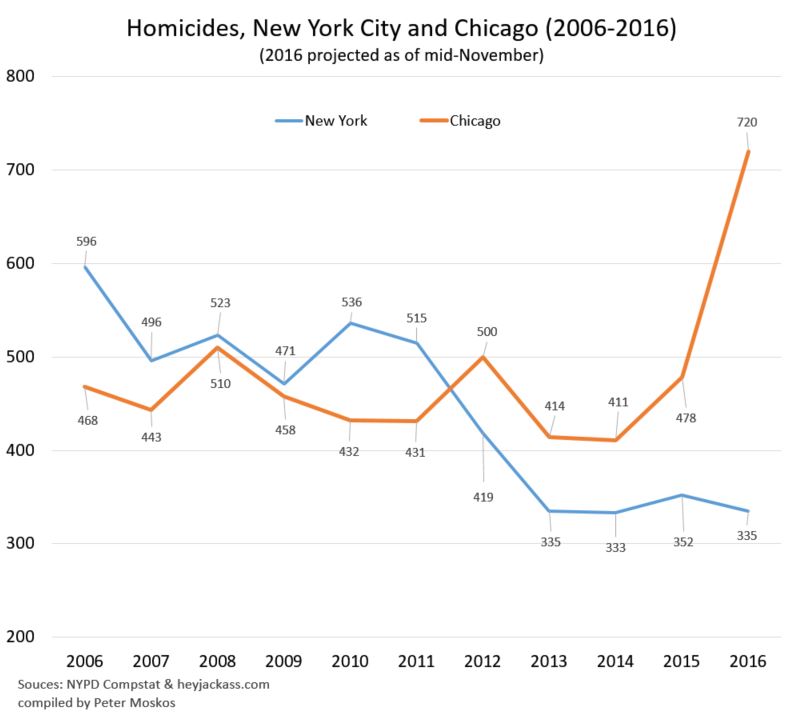
    Ah, the ol’ Tale of Two Cities trope. But the diverging homicidal paths of Chicago and New York City are striking. The New York Post has a surprisingly good (especially for the NY Post) article on homicide in Chicago and NYC.

    These are raw numbers and not a rate. Chicago is roughly one-third the size of New York City. [Notwithstanding rumors to the contrary, the national increase in murder would still be large, even without Chicago.]

    First observe NYC’s unheralded murder drop from 2011 to 2013. Police weren’t even willing to take credit! Why? Because it corresponded with the demise of stop and frisk. And then liberal Mayor de Blasio came on the scene in 2013. If you listened to cops, the city was going to immediately descend to some pre-Giuliani Orwellian hell. That did not happen.

    It turns out that quota-inspired stops and misdemeanor marijuana arrests are not good policing. Now we knew that (though even I’ll admit I was surprised that literally hundreds of thousands of stops didn’t have some measurable deterrent effect on gun violence.)

    In Chicago, stops also stopped, but unlike New York, it was not because cops stopped stopping people they didn’t want to stop. Cops in Chicago got the message to stop being proactive lest controversy ensues. Bowing to political and legal pressure, police in Chicago (and also Baltimore) became less proactive in response to the bad shooting of Laquan McDonald, excessive stop-related paperwork, the threat of personal lawsuits based on these same forms, and a mayor in crisis mode.

    Less proactive policing and less racially disparate policing is a stated goal of the ACLUand DOJ. See, if police legally stop and then frisk six guys loitering on a drug corner and (lucky day!) find a gun on one and drugs on another, the remaining four guys, at least according to some, are “innocent.” I beg to differ. (Though I should point out that in the real world, the “hit rate” never comes close to 20 percent.)

    And then there’s my beloved foot patrol. Policing is the interaction of police with the public. But there are no stats I know of to determine how many cops, at any given moment, are out and about and not sitting inside a car waiting for a call. From the Post:

    A high-ranking NYPD official credited the city’s increasing safety to the widespread, targeted deployment of cops on foot patrol.

    “Most cities only place foot posts in business districts. We put our foot posts in the most violent areas of the city, as well as our business district,” the source said.

    “It’s not a fun assignment, but it’s critical to keeping people safe.”

    Meanwhile in Chicago:

    Former Chicago Police Superintendent Garry McCarthy — who was fired last year amid controversy over the police shooting of an unarmed teen — said criticism of policing methods by local officials there had left cops “hamstrung.”

    “They’re not getting out of their cars and stopping people. That’s because of all the politics here,” said McCarthy, a former NYPD cop.

    “In Chicago, performance is less important than politics. It’s called ‘The Chicago Way,’ and the results are horrific.”

    My buddy Gene O’Donnell says:

    “The harsh reality in Chicago is that you have the collapse of the criminal justice system,” O’Donnell said.

    “The police aren’t even on the playing field anymore, and the police department is in a state of collapse.”

    O’Donnell, who was an NYPD cop during the 1980s, said that although “New York had a similar dynamic” during the height of the crack epidemic, “we had a transformation, because people realized you don’t have to tolerate that.”

    Guns are part of the mix:

    Veteran Democratic political consultant Hank Sheinkopf noted that Chicago “is much more porous to guns” than New York, with a “direct pipeline” leading there in “a straight line from Mississippi.”

    But that is more of an excuse than an explanation. Newark, New Jersey, just a PATH-train subway ride away from Manhattan, has more of a gun problem than New York City. Hard to imagine a subway and a few bridges plugs the gun pipeline.

    There are other differences between Chicago and New York in terms of poverty and segregation (greater in Chicago), commitment to public housing that actually works (greater in New York), and maybe even lower-crime foreign immigrants (greater in New York… but I say “maybe” because it’s still substantial in Chicago, with 22% foreign born).

    And then there’s this:

    Psychology professor Arthur Lurigio of Chicago’s Loyola University cited an “intergenerational” component to the mayhem, with sons following their fathers — and even grandfathers — into the city’s extensive and ingrained gang culture.

    “Chicago’s problem wasn’t a day in the making — it’s 60 years in the making,” he said.

    “Working at the jail as a staff psychologist, I’ve seen two, maybe three generations pass through.”

    I don’t mean to criticize an academic willing to highlight culture and the inter-generational transmission of violence, but I quibble with the line that Chicago’s problems are 60 years in the making. I mean, yes, it’s true…. But the explosion of homicide in the past two years is, well, a problem exactly two years in the making.

    Chicago may always have a higher homicide rate than New York because of history and structural issues. But the short-term solution is getting more cops out of their cars, back on beats, and supported when they legally confront violent people we pay police to confront.

    Violence-prevention depends, in part, on such confrontation. And since violence is racially disparate, this will mean racially disparate policing. Innocent people — disproportionately innocent black people — will get stopped. There’s no way to square this circle (though we can help sand down the rougher corners).

    The alternative to proactive policing is what is happening in Chicago. Police have responded to public and political (and legal) pressure: stops are down, arrests are down, and so are police-involved shootings and complaints against police. Police are staying out of trouble and letting society sort out the violence problem. How’s that working out?

  • “Biggest Spike in 50 Years”

    “Biggest Spike in 50 Years”

    If only we cared about homicide victims as much as we did about traffic fatalities, we might see an article in the paper about the biggest homicide spike in 50 years. Instead, there is a Times article about distracted driving: “Biggest Spike in Traffic Deaths in 50 Years? Blame Apps.”

    The rise in traffic deaths — the total number of highway deaths in America (35,000) is roughly twice the number homicide victims (16,000) — has been reported by the Wall Street Journal, NBC, Newsweek, and Reuters. None of these stories talk about a “statistical blip,” or “traffic deaths are still at historic lows,” or “no need to worry, because certain high-speed roads account for most deaths.” No. Nor should they. Because the rise in deaths is real and real people are dying. When it comes to traffic deaths, we take the data and try and figure what is happening and how to prevent it. Why aren’t we doing that with homicide?

    Violence begets violence. And the longer we stick our head in the sand, the worse this will be. I know the phrase “law and order” is right-wing, but the concept that people have a basic right to live is not. The left shouldn’t cede law-and-order issues to the right. Ideological prisms need to be set aside for basic human decency. It’s better to address the violence problem before thousands more are killed.

    I understand, or at least I think I do, the motivations of those on the left who minimize the significance of the homicide increase. There’s a very real concern that those on the right will use crime to push ineffective and even racist policies that hurt the very people most at risk. Or maybe it’s difficult for some to objectively examine the homicide increase in light of everything that has happened, post-Ferguson, with demands that police be less racially disparate and proactive.

    Murder victims are disproportionately poor young black male high-school drop-outs. This is politically awkward at best, certainly when it comes to the matter of black lives. But some on the left have gone so far to say that since “most Americans” aren’t at greater risk of being killed, “warnings” are politically “provocative.” Good God! I mean I know that you , dear reader, are much more likely to be killed in a car crash than be the victim of a homicide. But for many other people, the opposite is true. Because it affects others more than you is reason to care even more.

    So I read this Times article about traffic deaths and notice how much it, word for word, could be applied to the nation’s spike in murder, the one nobody is talking about. Even the graphic could basically be copied (though I made one for murder). I did change a few things in [brackets] — eg: “transportation” to “justice” and “highway fatalities” to “homicides” — to create the article I wish were getting as much press:

    After steady declines over the last four decades, [homicides] last year recorded the largest annual percentage increase in 50 years. And the numbers so far this year are even worse. In the first six months of 2016, [homicide] deaths jumped [13.1] percent, from the comparable period of 2015, according to the [Brennan Center].

    “This is a crisis that needs to be addressed now,” the head of the agency, said in an interview.

    Alarmed by the statistics, the Department of [Justice] in October outlined a plan to work with the [police] and advocacy groups to devise a “Road to Zero” strategy, with the ambitious goal of eliminating [murder] within 30 years.

    The Obama administration’s [Attorney General, Loretta Lynch,] said that the near-term effort would involve identifying changes in regulations, laws and standards that could help reduce fatalities.

    “This is a serious public safety concern for the nation,” [she] said at a recent conference in Washington held by the National [Violence Prevention] Board. “We are all trying to figure out to what extent this is the new normal.”

    Deadly [Murder] Rise

    After decades of steady declines, the number of deaths stemming from [homicide] has risen in the last two years to its highest level since 2009.

    [Posts in this series: 1, 2, 3, 4, 5, 6]
  • Homicide is up, and it’s not Trump’s fault yet

    Somehow, between the Cubs winning the World Series, the presidential election, friends and family visiting, and, you know, my job, I missed this.

    The Brennan Center, which has been repeatedly telling us not to worry about rising homicide, predicts that this year’s homicide increase will be even bigger than last year’s increase (last year’s was 10.4%, this year’s is predicted by the Brennen Center to be 13.1%). The Brennan center says “Nationally, the murder rate is projected to increase 31.5 percent from 2014 to 2016.”

    [Update/correction: Their math, as has been pointed out to me, does not add up. By my math, a 13.1 percent increase after a 10.4 percent increase is a 24.9 percent 2-year increase. I’ve changed a few things in this post to reflect the correct number.]

    Homicides up by 25 percent in just two years? This is the biggest two-year increase ever.

    Their conclusion:

    There is no evidence of a national murder wave.

    What the f*ck? I’m getting these numbers from their report! It’s like Bagdad Bob all over again. I wonder how long they can keep this up.

    Oh, but they do go on:

    Increases in these select cities [Baltimore, Chicago, and Houston] are indeed a serious problem.

    You think? But…

    most Americans will continue to experience low rates of crime. A few cities are seeing murders increase, causing the national murder rate to rise.

    Apparently, goes their logic, as long as homicide goes up more in some cities than others, it’s not really going up elsewhere, even though it is. To say the increase in homicide is due to a few “select cities” is simply not true.

    Chicago, Baltimore, and Houston are not at all creating the national trend. They’re just the leaders of the pack. One could remove “these select cities” — not that you should, mind you, but I have — and we’re still left with a huge increase in homicide, nationwide.

    [And the “most Americans” part really gets my goat. Like we didn’t to worry abut minorities at risk? I’d like to hear the Brennan Center tell that to everybody afraid after Trump’s victory.]

    And mark my words: when the official UCR data on this year comes out next year, those on the Left will be quick to blame Trump and everybody and everything except what has happened since 2014, post-Ferguson, locally with policing and nationally with the DOJ. These past two years have been an unprecedented and unmitigated disaster in terms of rising murder, particularly among poor young under-educated African-American men with guns. And the only person who even pretended to care (and based on his record, I seriously doubt his sincerity) just won the presidential election.

    Speaking of my words, a short while back I wrote this:

    Here’s what scares me right now more than guns: the potential right-wing law-and-order backlash. … It will be the largest [homicide] increase in decades. And yet the Left has been in denial about this (and/or discounts its significance). … we’re virtually conceding law-and-order issues to Trump and the fascist Right. Politically and morally, this is bonkers.

    And this:

    Politically, I don’t want to the only people responsive to rising crime to be Trump and the “law-and-order.” They scare me.

    And that’s the world we live in. The Left wouldn’t address this issue. Well, let’s see what happens now.

  • Spin This: The biggest murder increase in 45 years

    Murder is up. Who knew? (I’ve been saying so since last October.) Eventually, we’re all going to have to accept this (not in a moral sense but in a statistical sense). The accepted liberal reaction to this increase seems to be “it’s not a big deal” and “Don’t freak out.” Let’s not get “hysterical.” Let’s talk about “gun control.” (In the early 1990s, by the way, it was all about “drug treatment.” That didn’t happen either. And crime went down.)

    What I really do not understand is why the Left is willing to concede crime prevention to the Right. (I bet Trump won’t be downplaying this in tonight’s debate.)

    False argument #1: The best violence-reduction strategy is a job-production strategy.

    It sounds nice, but I say bullsh*t. As if unemployed people just can’t help but shoot each other.

    Do not get me wrong: Poverty is bad. But it just so happens that 2015, the year with the big murder increase, also saw the biggest decrease in poverty since 1991. 3.5 million people rose out of poverty last year. That’s great news. It really is. (Full report & summary in the NYT.)

    But we still hear this from people like this St. Louis alderman:

    How do we use that [crime] data to elevate the consciousness of our community? How do we use that data to provide the opportunity for people to get meaningful jobs, with livable wages?

    No. I mean, yes! Please, work on that, too. But the question from these data is how the hell we get police back into policing and crime prevention. Sure, it sucks when dad loses his job, but consider how much worse it is for dad to get killed coming home from work. (I would even say that you can’t have a real job-production strategy until you achieve violence reduction. Who the hell is going to open a business where you will get robbed and workers get mugged walking to their car?)

    The Guardian goes on to summarize the Brennan Center’s position:

    Last year’s national murder increase was not a uniform trend, but a sum of contradictory changes in cities across the country. Early analyses of the 2015 murder increase suggested much of it might be driven by murder spikes in just 10 large cities.

    (Now I see how clever the Brennan Center was to put out their paper last week, so it becomes cited immediately to put things “in context.”)

    False argument #2: It’s just happening a few cities.

    No. It’s not.

    Homicide (and almost all violent crime) is up in every grouping of towns and cities (such as “under 10,000” and “over 1,000,000”). Period. Now that doesn’t mean it’s up in every city. But what a weird and nonsensical standard. Sure, if we remove all the places where crime is up, crime wouldn’t be up. But that’s we have fancy statistical concepts like “overall,” “in general,” and “trend.”

    Even if we were to remove the 6 cities with the largest increase — and I don’t know why we would — but just to see if the problem is isolated in a few cities, let’s take out Baltimore, Chicago, Milwaukee, Washington, Cleveland, and Houston (collectively those cities saw about 420 more murders in 2015) — even without these cities the rest of America would still have 600 more murders and the biggest homicide increase in 25 years. That’s how bad these just released numbers are.

    Now we can say that violence in concentrated in certain neighborhoods. That’s true. But we’ve long known this. Indeed, as you can tell from looking out your window, there aren’t armed marauders outside your castle gates. What matters, or at least should matter, is that more American are being murdered. I find it distasteful (particularly when it comes from the Left) to say “most people” don’t have to worry about crime because the “average person” is still safe. The fact that violence disproportionately affects a subset of Americans may indeed mean it’s not a “national crime wave,” but it is all the more reason to care.

    False argument #3: It might just be a statistical blip.

    But it’s not. I mean, it could be a statistical blip…. If it were just one or two percent. But it’s up 11 percent. The last time we saw an 11 percent one-year increase in murder was 1971. That’s exactly my entire lifetime. And that was in the middle of eight-year run when homicides doubled from ten to twenty thousand. This “blip” was literally the deaths of 1,600 more Americans. The number of people killed went up from 14,164 in 2014 to 15,696 in 2015. That one-year increase negated 5 years of homicide decline.

    If you think this increase in murder “no cause for alarm” and people who care are “overreacting,” to you, I respectfully say “go to hell.” We worked too hard to get to where we are (or were) with lower crime. And a “don’t-overreact” reaction does not help. And it may lead exactly to the right-wing law-and-order backlash you so fear. (But on the flipside, to those who don’t really care but will use these deaths to make some racist point about “black-on-black” crime and “those people,” I say with all my heart, “no really, to hell with you, too!”)

    Why I care (and why you should, too):

    Among academics, it’s quite uncool to blame criminals for crime or give police credit for crime prevention. But then how many statisticians who use the UCR Homicide Supplement can point to a specific row and say, “Yeah, I handled that one.”

    Too many who say they’re for “justice” never really have to think about the injustice of just even one real murder victim (one not shot by police). But then maybe I care because I was a Baltimore cop. Every single cop can tell you a story about a dead person. Why? Because they care. Granted, some cops do care more than others, but you can’t police and not care.

    I wasn’t a cop for long (less than 2 years in total), and even I lost track of how many victims I dealt with. But a few do stand out. And this isn’t even getting into my cop friends who were shot, killed, nearly killed, had to kill somebody, or carry physical and emotional wounds for life.

    I remember the stare of a young black man at the same track we ran around while in the academy. His backpack made me think he was a good kid, on his way home from school. He was shot, perhaps after being robbed. We made long eye contact, even though he was dead.

    I remember the guy with a gunshot to the head one 321 Post. He was still alive when I got to him. But he clearly a goner, with blood and brain dripping from the hole in his head. His sisters were wailing while he died.

    How many Harvard PhD students have the intimate experience of sorted through a victims’ clothes? Clothes that are literally dripping with blood and yet still reeking of body odor. You’re trying to go through everything, looking for pockets, for any sign of identification of the life that used to be. And then there are the death notifications.

    Think of all those deaths. Last year there were 133 more murders in Baltimore than there were in 2014. [This year the numbers are down slightly compared to 2015, and the chutzpah of some people to herald Baltimore’s “crime drop” is shocking.] Take a moment and picture all those dead bodies, almost all shot young black men and teenagers. Visually stack them up like cordwood if you wish, or lay them all head-to-toe. It’s real human carnage.

    If you took all the Baltimore murder victims from just last year and laid them head-to-toe where the Ravens play football, that line of dead bloody bodies could score six endzone-to-endzone touchdowns. And the increase in violence last year happened all after April 27th. All it took was one man’s in-custody death coupled with anti-police protests, bad leadership, a riot, and a politician’s horrible choice to press criminal charges against six police officers in the matter of Freddie Gray’s death. (All charges ended up being dropped after multiple trials without a single conviction on any charge.)

    This is actually one time I don’t care about the historical perspective. Less than the 1990’s crack-crazy murder rate is not good enough. We got down to a homicide rate like Canada (about 1/4 of ours), and maybe I’ll be satisfied. We can start caring now. Or we can start caring after a few more thousand people are needless killed. And if you think I’m over-reacting, consider that you might be under-reacting.

    [Posts in this series: 1, 2, 3, 4, 5, 6]