The latest Brennan Center report projects the 30 largest cities will see a 14.6 percent increase in homicide this year.
You know the last time the nation saw a 15 percent annual increase in the homicide rate?
Never.
Remain Calm. All is well.
But don’t worry, they say in their best “you are getting sleepy” voice. There’s no reason to concerned:
However, in absolute terms, murder rates are so low that a small numerical increase leads to a large percentage change. Even with the 2015 increase, murder rates are roughly the same as they were in 2012 — in fact, they are slightly lower. Since murder rates vary widely from year to year, one year’s increase is not evidence of a coming wave of violent crime.
A handful of cities have seen sharp rises in murder rates. Just two cities, Baltimore and Washington, D.C., account for almost 50 percent of the national increase in murders.
These serious increases seem to be localized, rather than part of a national pandemic, suggesting community conditions are a major factor. The preliminary report examined five cities with particularly high murder rates… and found these cities also had significantly lower incomes, higher poverty rates, higher unemployment, and falling populations than the national average.
Hmmmm, Statistical aberration are always a possibility and poverty and falling population makes me drowzzzzzzzzzzzy.
But when I snap out of it, I’m still concerned. Why do so many seem to be in denial about such a large increase in murder.
Can’t we be politically correct and also ask what the heck is going on? When FBI director Comey said he was concerned, he received loud chiding from the political left and even a presidential rebuke.
If you think it doesn’t matter, please let me know exactly what conditions need to be met, specifically how many more people have to die, before we are allowed to be concerned and move on from silly semantic debates. Shouldn’t we better focus our efforts and, if you’re so inclined, even your outrage?
No, don’t panic. But frankly, I think it’s OK to be a little concerned.
I have an idea! Instead of denying a dangerous increase in lethal crime, why don’t we put on our thinking caps and ask what has changed this year with regards to policing and violent crime. But before you answer take a deep breath and then come back after a good night’s sleep!
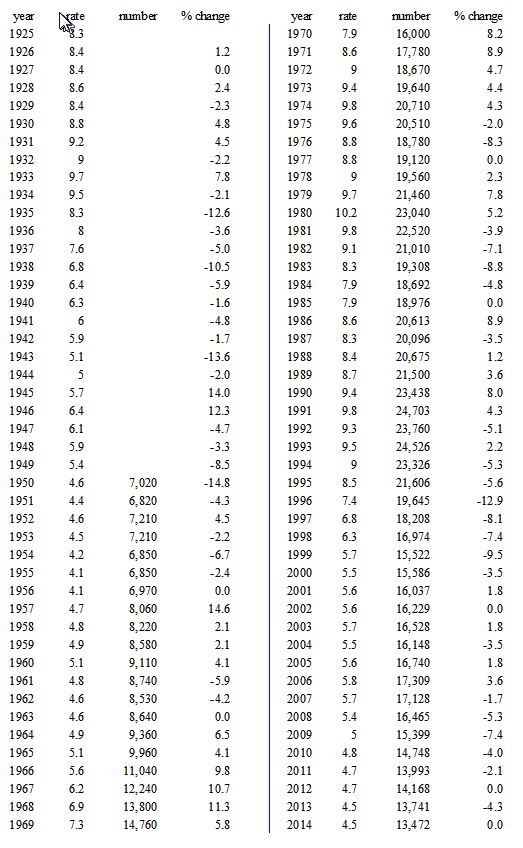
sources include:
http://www.druglibrary.org/schaffer/Library/homrate1.htm
http://www.bjs.gov/content/pub/pdf/htius.pdf
https://www.fbi.gov/about-us/cjis/ucr/crime-in-the-u.s/2010/crime-in-the-u.s.-2010/tables/10tbl01.xls
https://www.fbi.gov/about-us/cjis/ucr/crime-in-the-u.s/2014/crime-in-the-u.s.-2014/tables/table-13
(Correction: Originally I missed the the fact the Brennan Report was only talking about the rate in the 30 largest cities. This post has been changed to include that rather important detail.)
[Posts in this series: 1, 2, 3, 4, 5, 6]
The latest Brennan Center report projects the 30 largest cities will see a 14.6 percent increase in homicide this year.You know the last time the nation saw a 15 percent annual increase in the homicide rate?
Never.
Remain Calm. All is well.
But don’t worry, they say in their best “you are getting sleepy” voice. There’s no reason to concerned:
However, in absolute terms, murder rates are so low that a small numerical increase leads to a large percentage change. Even with the 2015 increase, murder rates are roughly the same as they were in 2012 — in fact, they are slightly lower. Since murder rates vary widely from year to year, one year’s increase is not evidence of a coming wave of violent crime.
A handful of cities have seen sharp rises in murder rates. Just two cities, Baltimore and Washington, D.C., account for almost 50 percent of the national increase in murders.
These serious increases seem to be localized, rather than part of a national pandemic, suggesting community conditions are a major factor. The preliminary report examined five cities with particularly high murder rates… and found these cities also had significantly lower incomes, higher poverty rates, higher unemployment, and falling populations than the national average.
Hmmmm, Statistical aberration are always a possibility and poverty and falling population makes me drowzzzzzzzzzzzy.
But when I snap out of it, I’m still concerned. Why do so many seem to be in denial about such a large increase in murder.
Can’t we be politically correct and also ask what the heck is going on? When FBI director Comey said he was concerned, he received loud chiding from the political left and even a presidential rebuke.
If you think it doesn’t matter, please let me know exactly what conditions need to be met, specifically how many more people have to die, before we are allowed to be concerned and move on from silly semantic debates. Shouldn’t we better focus our efforts and, if you’re so inclined, even your outrage?
No, don’t panic. But frankly, I think it’s OK to be a little concerned.
I have an idea! Instead of denying a dangerous increase in lethal crime, why don’t we put on our thinking caps and ask what has changed this year with regards to policing and violent crime. But before you answer take a deep breath and then come back after a good night’s sleep!
sources include:
http://www.druglibrary.org/schaffer/Library/homrate1.htm
http://www.bjs.gov/content/pub/pdf/htius.pdf
https://www.fbi.gov/about-us/cjis/ucr/crime-in-the-u.s/2010/crime-in-the-u.s.-2010/tables/10tbl01.xls
https://www.fbi.gov/about-us/cjis/ucr/crime-in-the-u.s/2014/crime-in-the-u.s.-2014/tables/table-13
(Correction: Originally I missed the the fact the Brennan Report was only talking about the rate in the 30 largest cities. This post has been changed to include that rather important detail.)
[Posts in this series: 1, 2, 3, 4, 5, 6]