Tag: sociology

  • Ethnography Bashing

    I don’t mind a mixed review of my book (Contemporary Sociology), but it does bother me when a reviewer calls my participant-observation research a “major flaw.” It’s like a man who doesn’t like olive oil, fish, and lamb bashing a Greek restaurant for being too “Mediterranean.” If you don’t like the concept, don’t review it.

    Basically, goes the tired old sociological argument, because I was a cop, I can’t see police objectively. This is called “going native.” Like all sociology majors, I learned this in college (in my case as a Princeton sophomore in Professor Howard Taylor’s most excellent “Introductory Research Methods in African American Studies”–the class that made me a sociologist!).

    While going native certainly is a possibility. Given the sum of my book and writing, to say I did so is a bit absurd.

    The reviewer writes:

    This raises the possibility that [Moskos] was not privy to some of the more sensitive issues and events that may have happened. He states categorically that he witnessed no instances of illegal police behavior while on the Baltimore Police Department which suggests that he failed to encounter them either because he was shielded from such events or he did not define them as illegal because he had adopted the police view that such activities were necessary to get the job done.

    Actually, I stated categorically I saw no instances of police corruption. I wrote a bit about illegal behavior: “High-arrest officers push the boundaries of consent searches and turn pickets inside-out. Illegal (and legal) searches are almost always motivated by a desire to find drugs.” So much for a thorough reading.

    I did write this (p. 78):

    I policed what is arguably the worst shift in the worst district in Baltimore and saw no police corruption. … Incidents do happen, but thepolice cultureis not corrupt. Though overall police integrity is very high, some will never be convinced. But out of personal virtue, internal investigation stings, or monetary calculations, the majority–the vast majority–of police officers are clean.

    Sometimes reality causes cognitive dissonance to people with strong prejudices. I guess the idea that most cops are clean (cleaner than professors, I like to add) is just too shocking for some in academe. Rather than face up to one’s own anti-police biases, I guess it’s easier just to bash ethnography.

  • Dorm Room Dealers

    Dorm Room Dealers

    There’s a great new academic book out by A. Rafik Mohamed and Erik D. Fritsvold: Dorm Room Dealers: Drugs and the privileges of race and class.

    Too many books (my own included) treat drug crimes like it’s some black thing that whites wouldn’t understand unless some kind-hearted interpreters explain to “us” those strange things “they” do.

    Well it ain’t like that. Most drug dealers are white. Most drug users are white. It just doesn’t make the news (or get police attention).

    And yet, you may be thinking… if most drug crimes are committed by white people, and whites are just as if not more likely than blacks to take and sell drugs, then why do I think of drug criminals as black and why are most people in prison for drug crimes black?

    As they say: Ah-hxaaaaaa!

    We don’t fight the war on drugs against rich college-educated white folks.

    Most prohibition violence in the drug trade happens in non-white neighborhoods. So there’s a reason we focus on crime more on drug crimes in some neighborhoods than others. To me it’s the publicdrug trade that is so brutal.

    But what about all those college drug dealers? Why do we never hear about them? Well this book answers that. I might write a proper book review later, but for now let me say this: I mean, I went to college. Anybody who has gone to college knows you can buy drugs in college. It’s like these college drug dealers have no fear of ever getting caught.

    Exactly.

    These dorm-room dealers sell drugs like they’re dorm-room posters. Everybody can see them. They have no fear. You see, the rules are different for them. College drug dealers get in the game, make some cash (or support their habit), and then graduate and get a job, maybe in daddy’s firm.

    Am I oversimplifying? Of course. You should buy the book. If for no other reason than it makes a great ethnographic counterpart to Cop in the Hood. Here’s how the other half deals drugs. There’s a good lesson there for all us all.

  • Ghetto Reading List

    Ghetto Reading List

    In a footnote (p. 215) in Cop in the Hood, I list what I consider essential books in urban sociology (they’re not all about the “ghetto”).

    Somebody was nice enough to take the time to put this list on Amazon. It’s nice to see all these books in one place.

  • More Prison, Less Crime?

    More Prison, Less Crime?

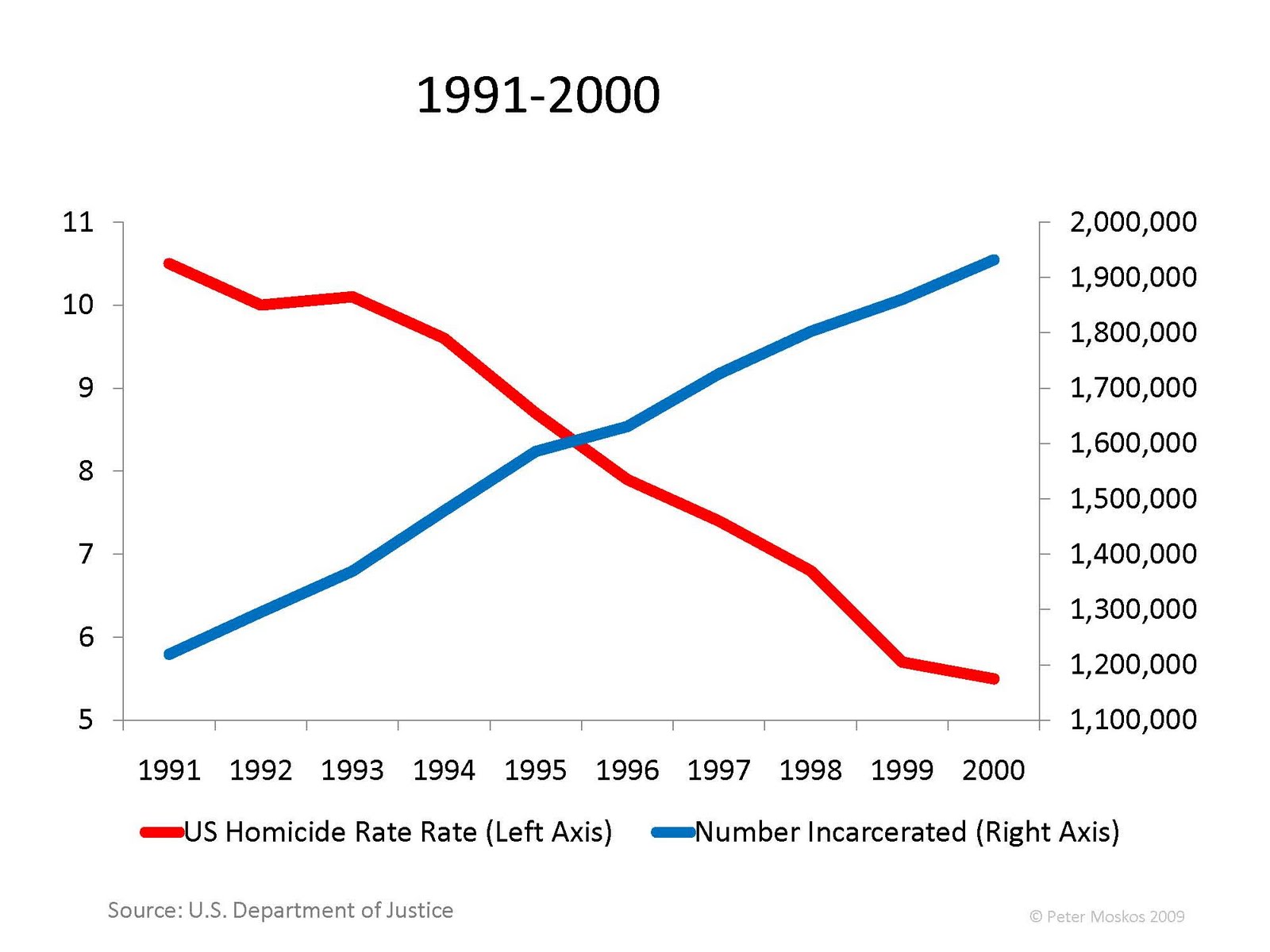
    If you look at this chart, it’s not hard to think that the great crime drop was caused by locking up all the criminals. A student brought this up in class. In the 1990s, it looks pretty convincing:

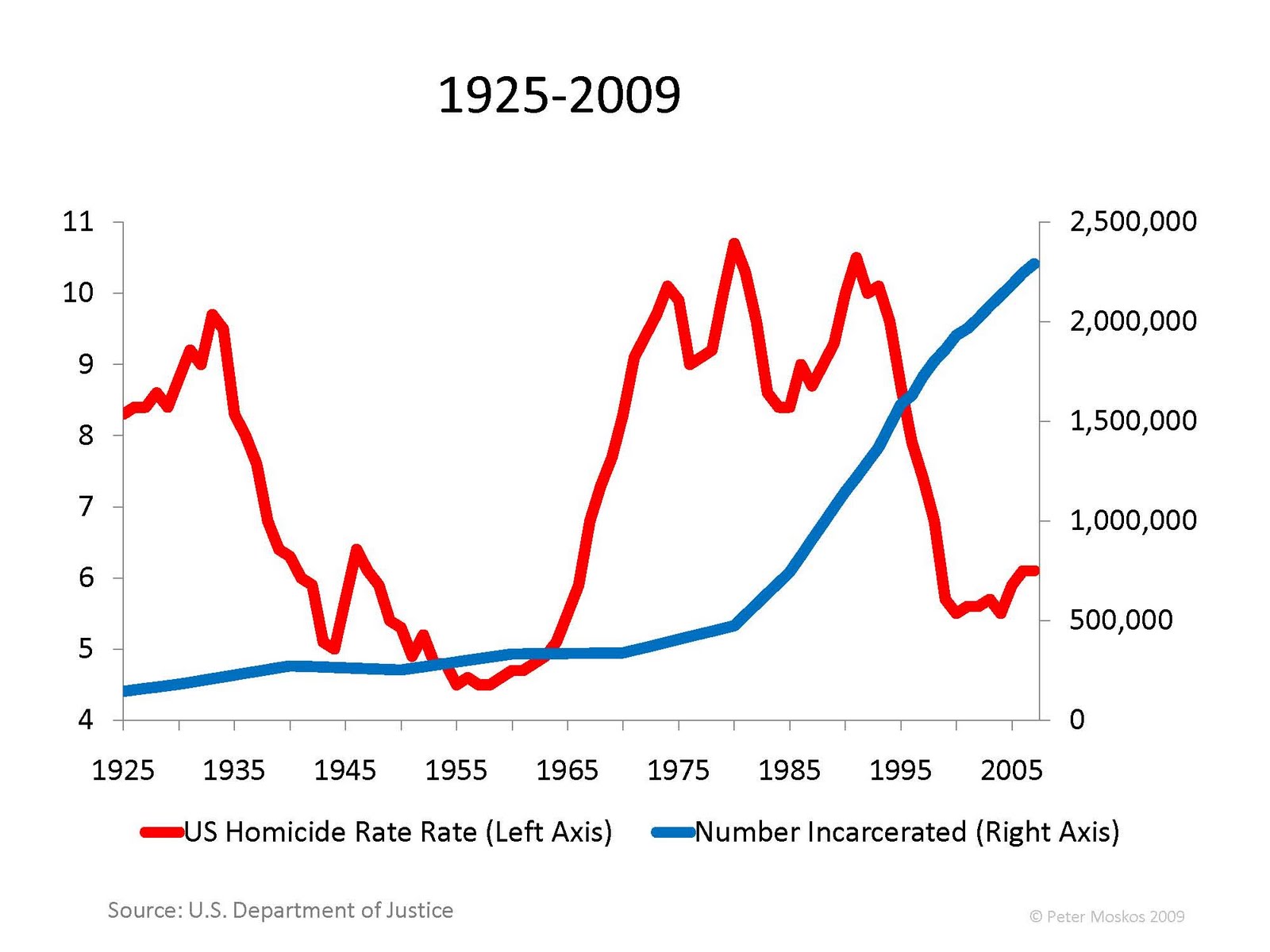
    But just looking at the 1990s misses the big picture. Here’s the same data going back to 1925. Crime went up and down and up and down, but the prison rate stayed more or less the same, and then skyrocketed after 1970.

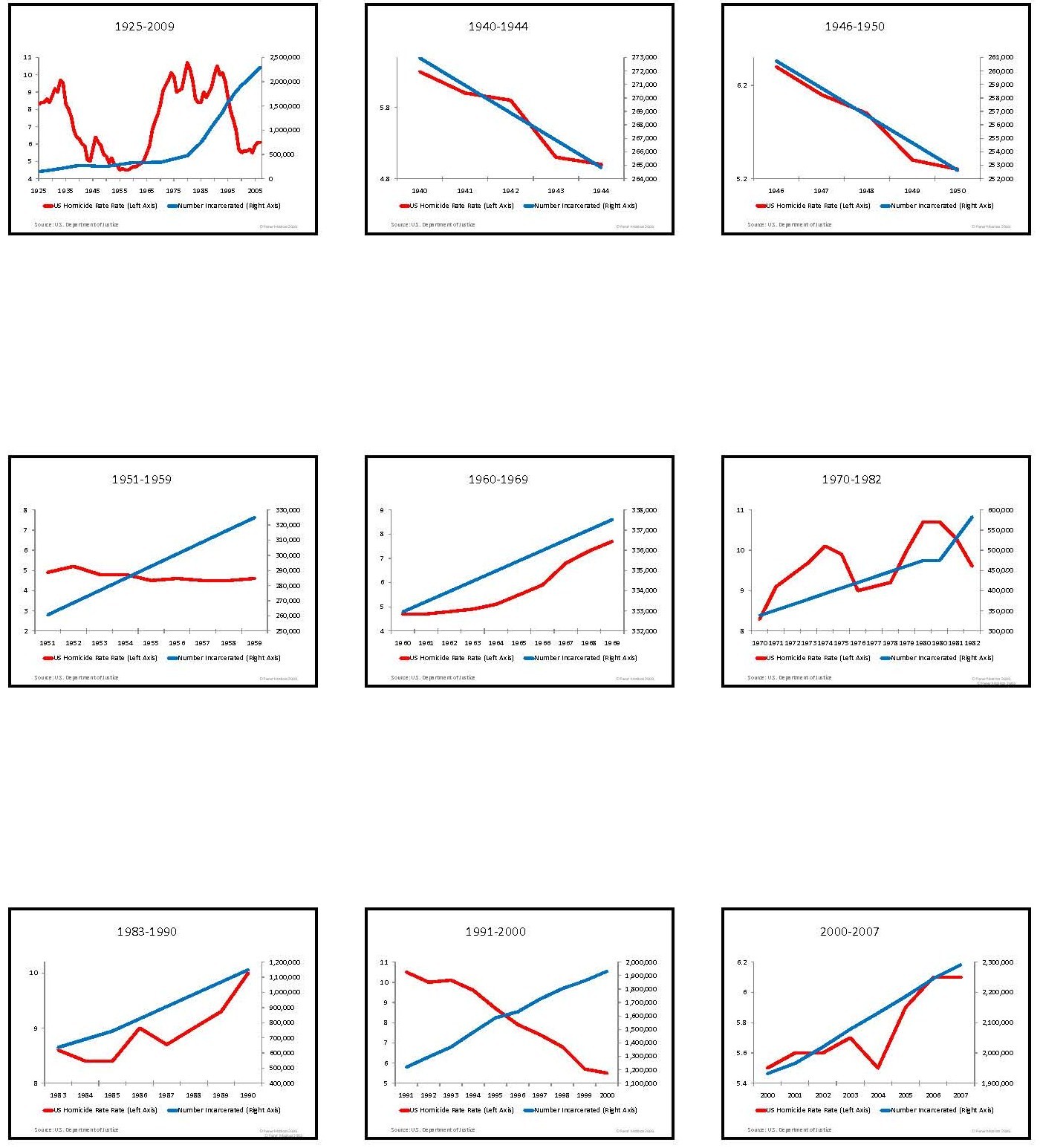
    And here’s what happens it you look at each decade separately:

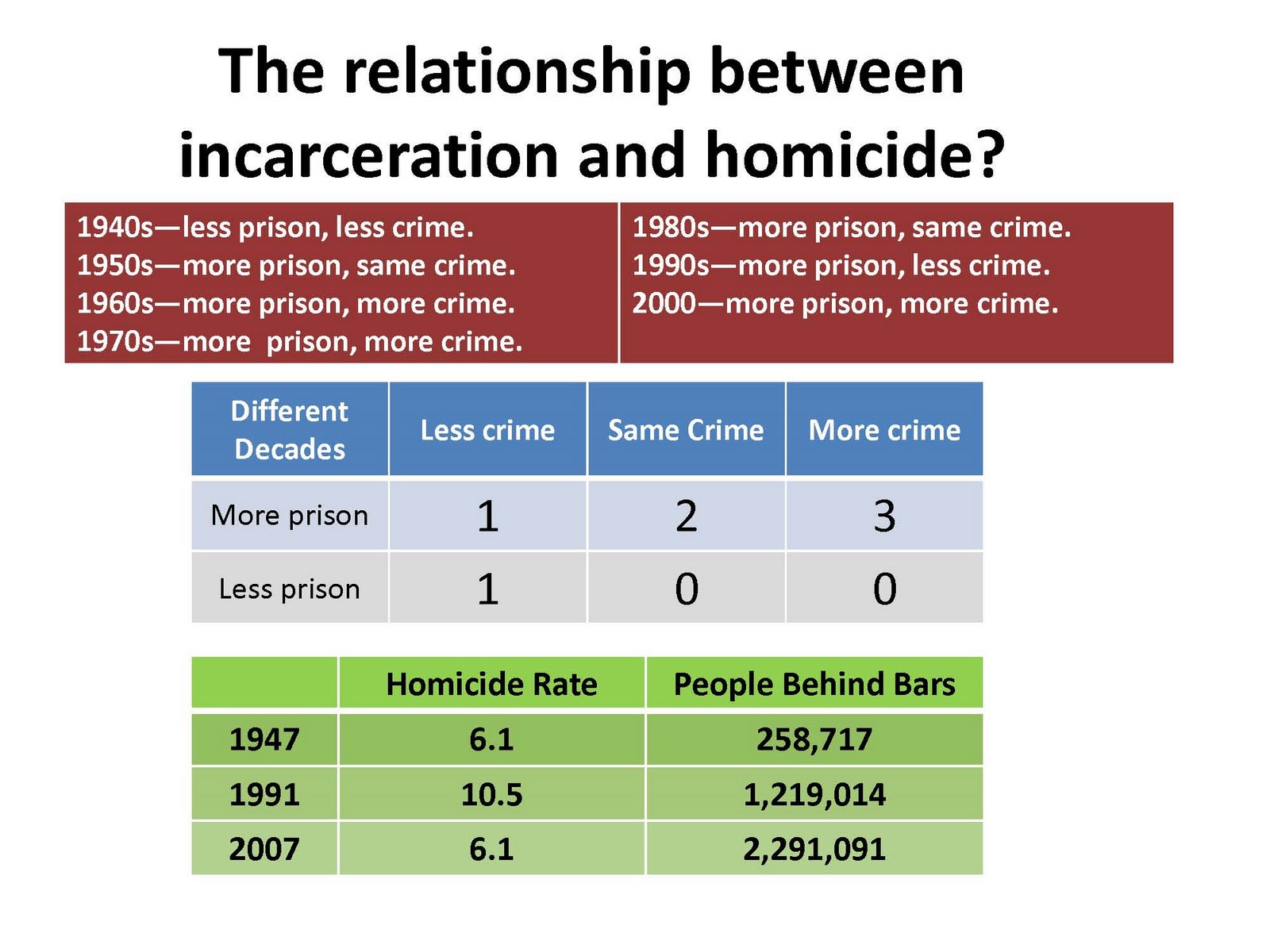
    What it comes down to is this:

    In three decades we’ve had moreprison and moremurders. In two decades we’ve had more prison and murders were basically unchanged. In one decade we had lessprison and lessmurder. And in just one decade, the 1990s, we’ve had more prison and less murder.

    Between 1947 and 1991, the prison population increased almost 500 percent. Meanwhile the homicide rate went up by more than a third. Did locking up more people increase the homicide rate? Probably not.

    So what makes the 1990s the decade of choice that proves incarceration is the solution to crime? Was there some magic tipping point? Was there something special about the second million we incarcerated that didn’t apply to the first million? Probably not.

    I’ll put it another way, in 1947, the homicide rate was 6.1 per 100,000 and we had 259,000 people behind bars. In 2007, we had the same murder rate of 6.1 and yet 2.3 million people are behind bars. What good have we gotten from locking up an extra two million people, spending something like $50 billion per year for the privilege?

    You think there might be a better way?

  • A story of no story

    The other night I had a minor but perhaps brilliant idea. What if there were a correlation between the numberof prisons in a state and that state’s incarceration rate? Perhaps the more prisons there are, the greater the political influences that play in a state, leading to more people locked up! Prison-Industrial-Complex shit I’m talking about!

    Of course, biggerstates would have more prisons, but that’s the beauty of stats: they can take population into account and just compare the number of prisons with a state’s incarceration, holding population constant.

    So I found and put every state’s incarceration rate into an SPSS file. Then I added the state’s population. Finally I used wiki to get a decent number for the number prison institutions in each and every state.

    Then a crunched the numbers and found… uh, there’s no correlation. So I tortured the data a bit (maybe it only works for the highest and lowest levels of incarceration!). No dice. No brilliant idea. No publishable paper. Just a waste of a few hours that would have better been spent writing.

    Oh well.

  • Those Slippery Stats

    Somebody tried to do to me what I tried to do to the Heritage Foundation. I was accused of playing fast and loose the numbers in my Washington Post op-ed.

    In the old days I could have just challenged him to a duel. I’d feel pretty confident going into that battle! Instead I have to defend my honor with a written reply to this:

    “In many ways, Dante Arthur was lucky. He lived. Nationwide, a police officer dies on duty nearly every other day.” [emphasis added]

    Let’s see – 365 days a year. That makes nearly 180 such deaths each year.

    I’ve been out of the crim biz for a while, but that number sounded high to me. So I went to the UCR. Sure enough, in 2007, 140 police officers died in the line of duty. As Moskos and Franklin say, nearly one every other day.

    But 83 of those officers died in accidents, only 57 were homicide victims – one every 6 days. Still a lot. But how many of those were drug-related? The UCR has the answer:

    One.

    Nor was 2007 unusual. In the decade ending 2007, 1300 police officers died on the job. About 550 of these were in felonies, not accidents. And of these, 27 were drug-related. Three a year is still too many, but it’s a far cry from one every other day.

    Maybe I should have looked at a DVD of The Wire instead of the UCR.

    Moskos and Franklin argue that federal laws should allow states to make the manufacture and distribution of drugs legal and regulated rather than criminal. The authors make several good arguments against current drug laws, which have created many problems that legalization might ameliorate. But I’m skeptical as to whether legalization would make much of a difference in police safety.

    You can read the whole post here.

    The Wire line is ironic since both Franklin and I actually policed the streets of The Wire.

    I replied with this:

    I take my numbers seriously and I criticize others for exactly what you’ve criticized me for. So I feel I need to defend myself thoroughly. You’re not being fair to me.

    As is often the case, a little qualitative insight is needed to round out the quantitative data. The numbers aren’t showing the real picture. You have too much faith in the UCR numbers. For what it’s worth, I was in the unique position of actually putting data into the URC for a year before analyzing the same data coming out the other end. Sort of a unique position for a researcher (conflict of interest?), but I can actually identify some of the UCR homicides in 2000/2001 as “mine.”

    First the non-disputed part.

    The best source for info on officer deaths is The Officer Down Memorial Page. It’s much more detailed than the UCR (and probably more accurate, too). Over the past four years, the average deaths per year is 162.5. Not half of 365, but close enough to say “nearly one every other day.” But you grant me that.

    But Dante Arthur wasn’t killed. He’s not a UCR or officer-down stat. And of course we’re all happy for that. But his life-changing war-on-drugs injury (he got shot in the mouth) all but disappears from the public record after a few days in the Baltimore Sun. It would be great to have a database on prohibition violence, but we don’t have one.

    But the real issue you’re getting at is the circumstances of deaths and injuries. Fair enough.

    It’s a generally accepted figure in Baltimore that 80% of homicides are drug related. How do we come up with that. Well… yes, to some extent it’s just made up. But it’s based on experience and common sense and made up by homicide detectives. And it rings true. So grant me that 80% figure for Baltimore homicides if you will.

    Go to the UCR homicide supplement for 2006 (you could pick any year, but I just happen to have that file handy). There are 270 homicides listed for Balto. There were actually 276 murders that year, but that’s another issue.

    Run a frequency table for “Offender 1: Circumstance.” Narcotic drug laws are listed as the cause in 3 murders, or 1.1 percent of all homicides. 1.1 percent?! That’s a big difference from 80%

    At this point one of my favorite lines comes to mind, “What are you going to believe? Me or your lying eyes.”

    I think it’s safe to assume that a similar under-representation exists for the drug-related circumstances of officers killed.

    If two drug dealers are fighting and one kills somebody, that’s not listed in the UCR as drug-related. It’s an “argument over money or property.” If a cop is killed in a car crash responding to the scene, it’s listed as a motor-vehicle death. If another drug dealer is found dead along the way with no witnesses, the death is listed as “circumstances undetermined.” But it’s all drug deaths. The UCR doesn’t tell the whole story.

    If the UCR listed officers injured, Arthur Dante’s injury would not be listed as drug related. It would be listed as “arrest” or “other arrest.” And I simply don’t believe the UCR data on officers assaulted. I think they’re worthless (but that’s not for this post).

    I like your pie chart, but you’re not looking at the meaning of the data correctly. Of those 103 “traffic stops,” how many of those are drug related. I don’t know. But I’d guess 80-90%. Man wanted a drug warrant. Police trying to conduct a discretionary search of a car for drugs. Officers don’t get killed pulling over my mom.

    “Disturbances”? I’d guess about 1/3 with the rest being domestic violence (though probably 1/3 of those are drug-related as well). “Other” and “Other Arrest”? Probably half. “Ambush”? Maybe 25% (I keep thinking of those crazy white kooks killing people. Those are not drug related.)

    And I’d guess probably 10-15% of traffic deaths are drug-related. My friend Crystal Sheffield died in such an accident, trying to backup another officer involved in, yes, a drug-related dispute. But you won’t find that in the UCR.

    So put it all together and what do you have? A lot of prohibition and drug-related deaths. And there are multiple times more injured than killed in similar circumstances. We don’t put a number in the op-ed because we don’t have a number (maybe you and I could keep that database?)

    But from our experience and my participant-observation research, we both know (often personally) officers hurt and killed in the drug war. We both have a pretty good idea about how it fits into the total picture. So UCR data be damned!

    Writing a 800-word op-ed is different that writing an academic journal article. But I wasn’t and don’t play fast and loose with the numbers. It just so happens that the UCR numbers themselves play fast and loose with the facts.

    (and I do graciously accept apologies.)

  • Incarceration

    Incarceration

    Nothing new here. But it’s good to have a refresher course every now and then. It’s too easy for prisoners to be out of sight and out of mind.

    (plus these are the neatest diagrams I’ve found in the subject)

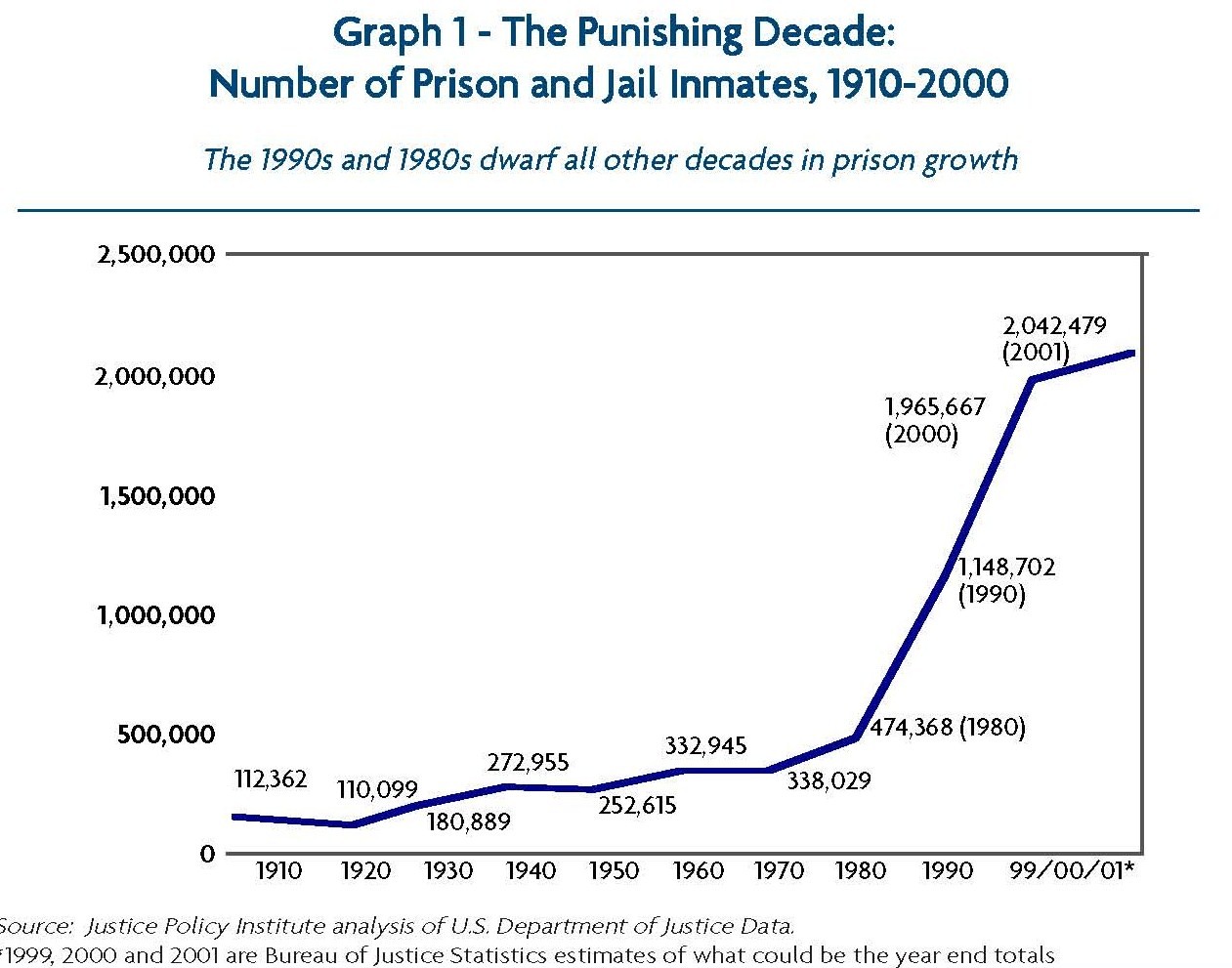
    Now it’s 2,300,000 behind bars.

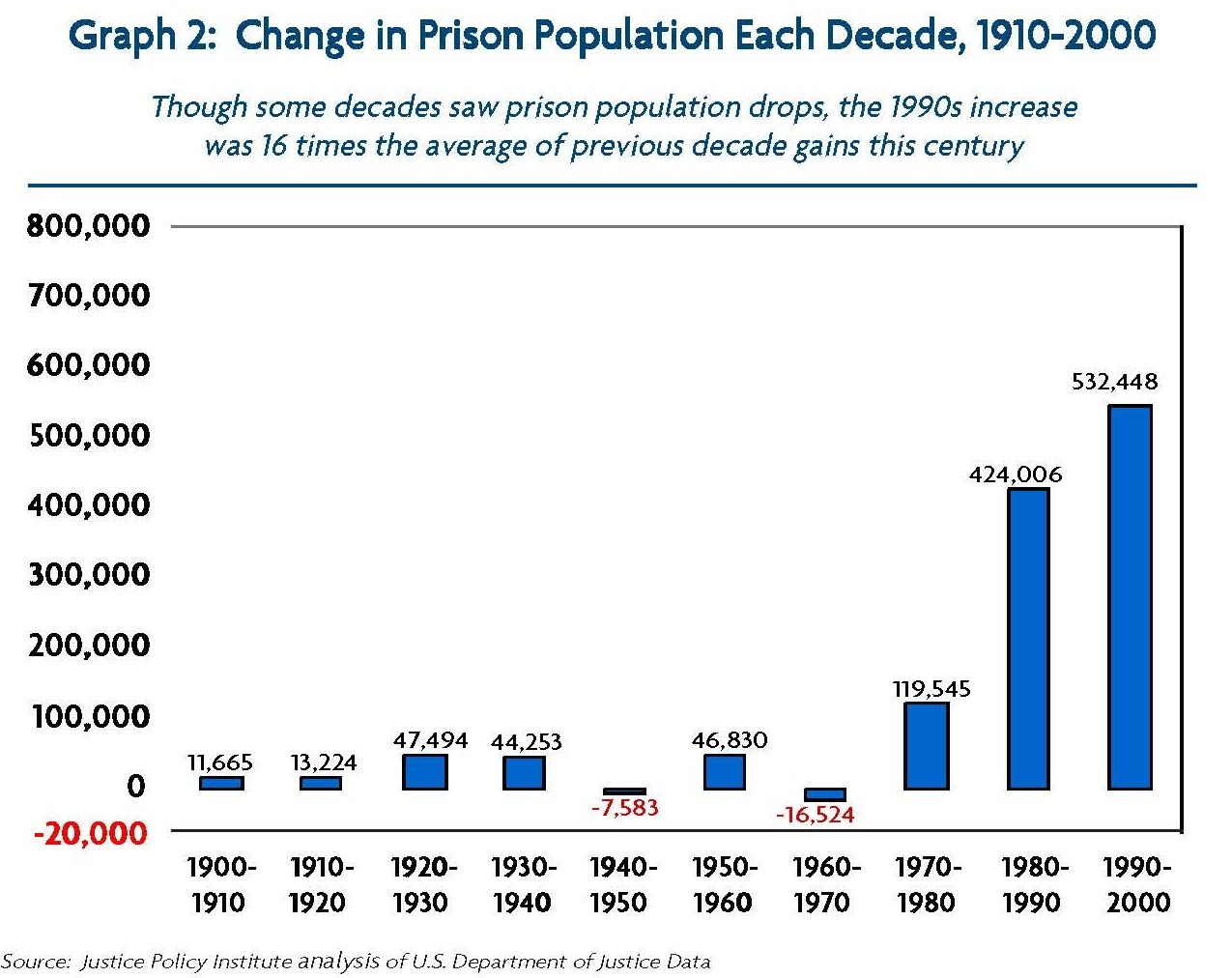
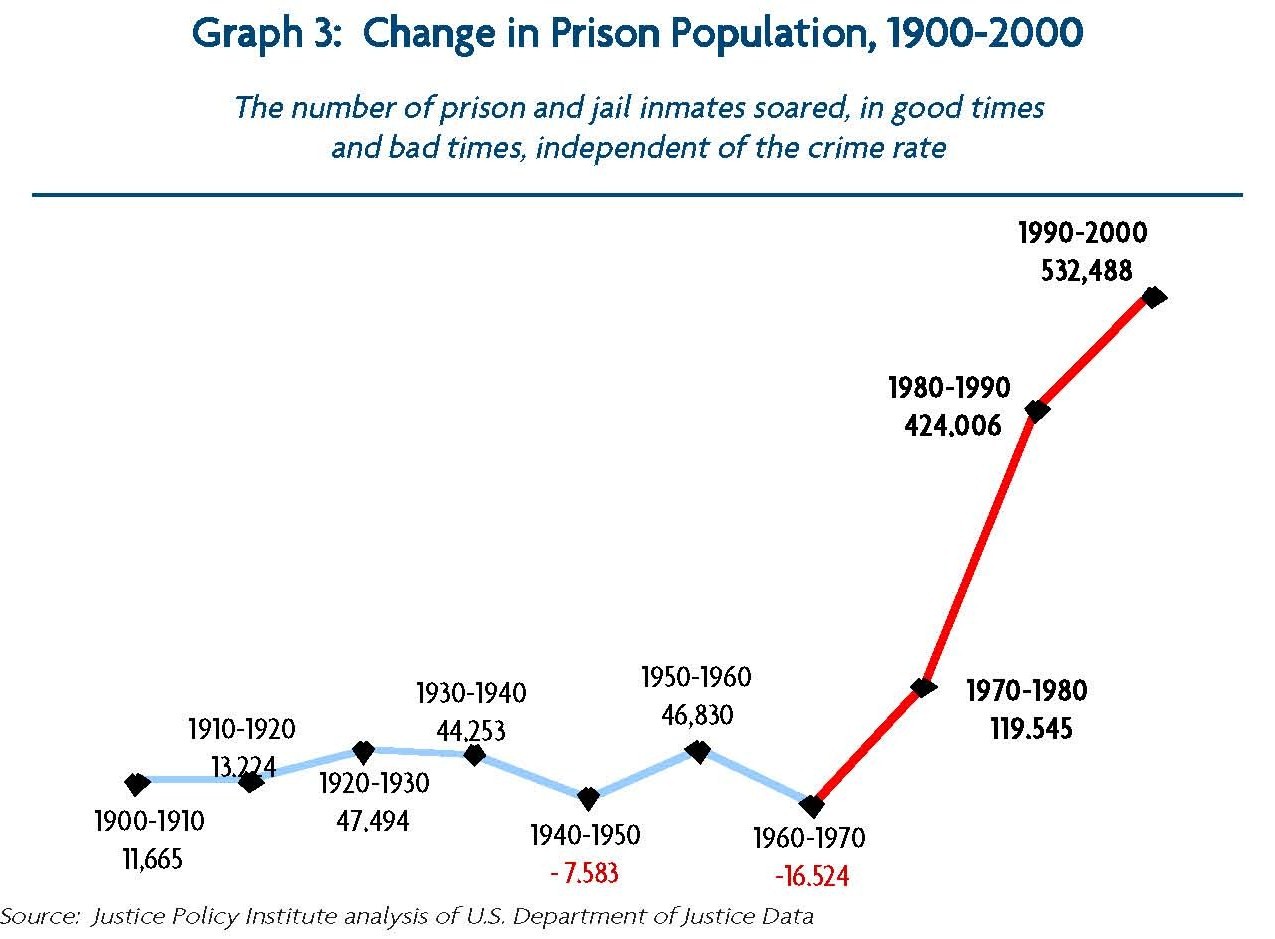
    The increase is all since 1970 and the war on drugs.

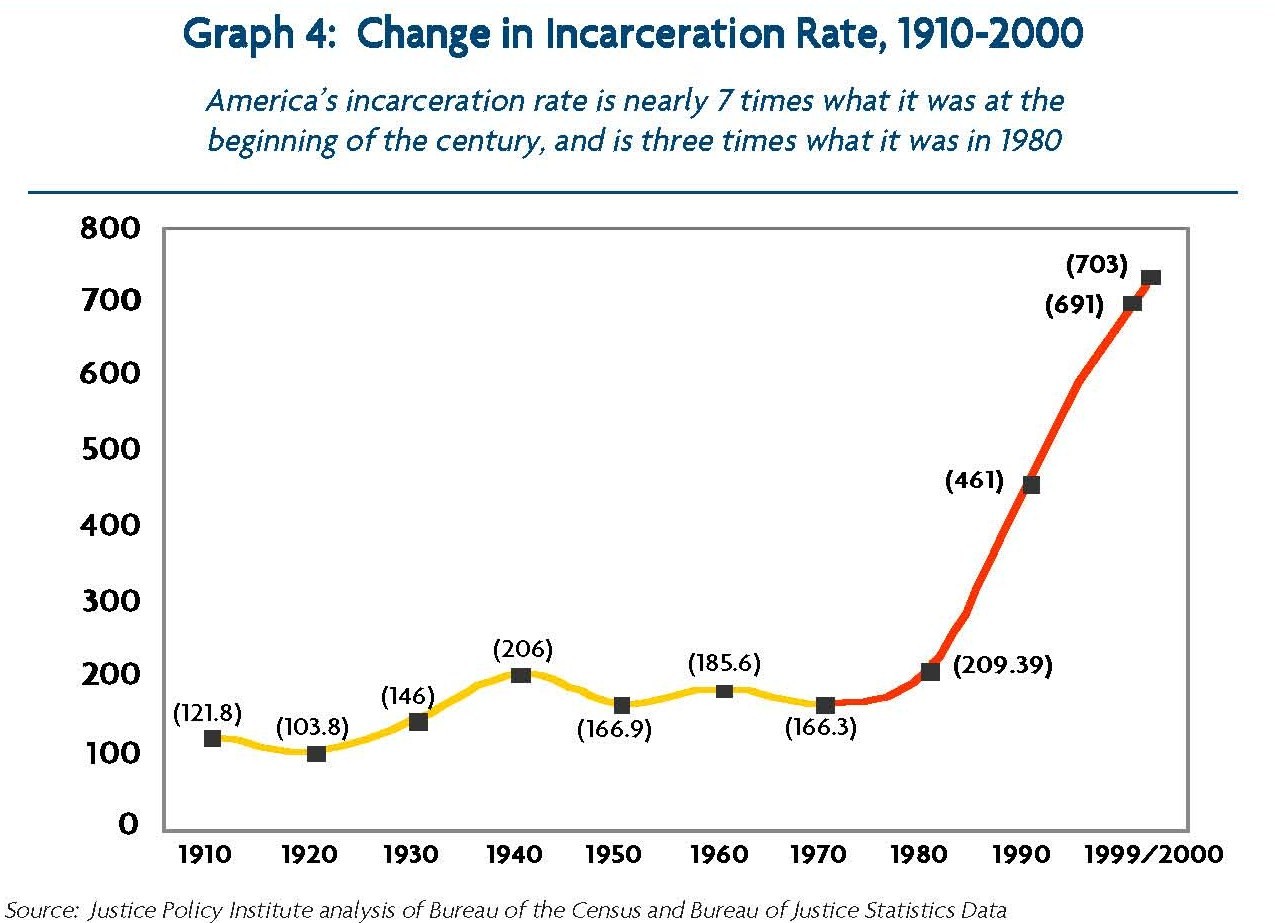
    It has little relationship to the crime rate. This is important. Because people generally don’t have a problem with locking up criminals because there’s more crime. We’re just locking up more people. And the crime rate doesn’t change because of it.

    The incarceration rate is going still going up. Now it’s above 750.

    You can read the complete Justice Policy Institute report here. It’s from 2000, but the later reports don’t have the pretty diagrams. The latest report, Prisons in 2007, can be found here.

  • Teach Grammar!

    Stanley Fish gets to the issues on teaching the craft of writing in “What Should Colleges Teach?

    I was blessed to have good English teachers throughout my Evanston public-school education. I also had good and literate parents. Collectively, they somehow taught me skills I use pretty much every day: write, type, and edit (though I must have been sick on the day spelling was taught).

    I think I’m pretty good at getting my ideas across in writing. I wouldn’t say I likewriting (does anybody?). It’s work. But I think I’m pretty good at it.

    So I never know what to do with students’ basic bad writing. I’m not an English teacher. Yet I often feel like I’m playing one in my classroom. Doesn’t anybody teach grammar and syntax? This does not seem to be an appropriate subject matter for my “Seminar in Police Problems.” Yet teach basic grammar I must. Why do I ever have to remind college seniors–as I do every semester–that sentences need a subject, verb, object, and then a period. Why is subject/verb agreement so difficult? Why do my students, class after class, insist on capitalizing the words “police officer” and many other nouns (is there some Germanic underground I don’t know about)?

    To argue that grammar and basic writing (not thought-provoking composition) should be taught in elementary and high-school is besides the point. College is a great place for teaching. And what’s more important than teaching how to write?

    Read Stanley Fish’s piece in the New York Times.

  • Sentence Length [or lies from the Heritage Foundation]

    Sentence Length [or lies from the Heritage Foundation]

    In a Heritage Foundation foundation report by Charles Stimson and Andrew Grossman, I learned a very surprising fact:

    Convicted persons in the United States actually served less time in prison, on average, than the world average and the European average. Among the 35 countries surveyed on this question in 1998, the average time actually served in prison was 32.62 months. Europeans sentenced to prison served an average of 30.89 months. Those in the United States served an average of only 28 months.

    From “Adult Time for Adult Crimes: Life Without Parole for Juvenile Killers and Violent Teens”

    [Update/Correction:two hour later]

    I’m generally no fan of the conservative Heritage Foundation. In fact, just between you and me, I generally hate them and everything they stand for. But I wasn’t going to bring that up because I like to be tolerant and forgiving by nature. And if two of their researchers can write a good report, I’m more than happy to read it and learn.

    And though it’s rare to catch people in all-out balls-to-the-walls lies (though I’ve caught the DEA red handed on the issue of drug prices), there’s nothing too rare about academic and moral dishonesty.

    I decided to do a little fact checking, since, well, I didn’t really believe that our prison sentences were shorter. Plus I don’t trust the Heritage Foundation.

    [The actual Heritage report, by the way, is about why we should keep sentencing juveniles to life without parole. It seems like a strange cause to fight for. What do they chant at rallies? But that’s neither here nor there. I’m interested in the time people spend behind bars.]

    First read the above quote from the Heritage Foundation and think about what it means.

    Stimson and Grossman are not two fresh-faced grad students to be treated with kid gloves for bad statistical analysis. One is a “Senior Legal Fellow” and the other a “Senior Legal Policy Analyst.” And besides, they’re trying to influence policy and get more kids locked up forever.

    Plus their report claims to be all about getting the “facts” right. And much of their report resonated with the cop in me. And 10 pages of endnotes certain gives them the ersatz veneer of rigorous academic analysis.

    I copied the data (“Table 18.01: Average length of time actually served in prison”) to SPSS and crunched the numbers just like they did. Indeed, the average US sentence length is listed as 28 months and the mean length of time for the all countries listed is 32.62 months.

    But anybody who does basic stats–and if you can copy the data from a table into a stats program, crunch the numbers, and publish them, you had better know basic statistics–should see two red flags. First is the two-decimal result. The original data is rounded to the nearest month. Using two-decimal places implies a statistical precision but in fact is statistical nonsense. Besides, who really cares about 1/100 of a month (just about 8 hours)?

    The second red flag is the use of mean and not median for “average.” The difference between the two matters. “Mean” is the average in the sense of adding up all the numbers and dividing by the total number of numbers. The “median” is the point at which half the numbers are above and half the numbers below. Both “mean” and “median” are averages, but “median” is generally better for analyses of numbers that have a set minimum (often zero) on one side but are open-ended on the other side (as in, they can go up to a gazillion!).

    Take income. Medianincome is always lower than meanincome because the millionaires (the outliers at the high end) push the mean average way up. If next year everybody in the U.S. made $1,000 less but Bill Gates, one person, made a trillion dollars more, the meanAmerican income would go up by $2,000 per person! But the medianincome would go down $1,000, just like the average income.

    So if Stimson and Grossman used median, the average would go from 33 to 26 months and the U.S. would go from below average to above average. So if they’re using means, they’re either statistically ignorant of trying to pull a fast one. But no matter, I’m not going to spend time writing all of this for a difference of seven months.

    But wait… there’s more.

    2) Statistical outliers: Malcolm Gladwell didn’t invent them just to sell books. You generally shouldn’t include them in statistical analysis. The outliers here, in terms of sentence length, are Colombia, Qatar, Moldova, Latvia, and Suriname (with a mean of 90 months). Remove these four countries and the mean goes down to 23.5 months and the median to 19 months.

    Now sometimes “outliers” aren’t outliers but rather extreme case. If you’re talking about average world prison sentence length, you shouldn’t ignore America because there are more two million prisoners in America. But who cares if prisoners in Qatar serve 74 months? There are only 520 people in prison.

    Anyway, the difference between 19 months versus 32.6 months matters, but it’s still not what gets my goat.

    Oh, I’m just getting started.

    3) The table only includes 35 countries. Looking at each of these countries as equal for the purpose of statistical analysis is crazy. You’ve always got to apply qualitative common sense to quantitative analysis.

    Surinam? 665 prisoners in the whole friggin country!

    Montserrat? Montserr-who?! Where the hell is Montserrat!? What I’m trying to say is, who give a flying f*ck about Montserrat? What happens in Montserrat sure as hell must stay there because I didn’t even remember that the capital of this Caribbean island was buried in 39 feet of volcanic mud in 1995 and abandoned. The totalpopulation of this non-nation is less than 5,000!

    Give me a f*cking break. For statistical purposes, these countries doesn’t exist. The US has two-point-three-friggin-million people behind bars! Equating Montserrat with the United States is bullsh*t… and the authors of this report should know this.

    You ain’t seen nothing yet!

    4) “European average,” they say.

    Now call me crazy, or chauvinistic, or “Old-Europe,” but when I say “Europe” in terms of criminal justice policy, I mean–and I think most people understand me to mean–the rich civilized part of Europe that’s now part of the European Union. (By my calculations, Greece only joined Europe about 5 years ago.)

    It’s not just geography. It’s culture. This report counts Moldova as European. Technically, yes, Moldova is part of Europe. But technically Israel is part of Asia. And Egypt and Morocco are part of Africa. But I don’t see too many Arabs in my neighborhood calling themselves African-American.

    To say “European average” and give equal weight to (ie: not adjust for population) to Moldova and Germany is crazy. Oh, but wait, Germany and France aren’t even included in the data! How can you have a “European average” without Germany and France? No offense to Botswana and Mauritius (they’re on the list), but it’s not a world average if you don’t have Russia, China, Indonesia, or India!

    If you want to be honest, say 10 years ago Moldovan prisoners served more time than U.S. prisoners. But who gives a flying f*ck” about Moldova?! (Poor Moldova. I’m sure they’re very nice. In fact, it says right in their tourism website that Moldova is, “rich in fertile soil and in hardworking and caring people.”)

    And no matter which countries I count as European, I can’t duplicate the report’s average of “30.89” months. Seems to me the mean average for European countries included would actually be 34 months. But I’ll assume that was was just bad work rather than intentional dishonesty, since the correction would be in their favor.

    So let’s get back to the original question: do European prisoners serve more time than the U.S. average of 28 months? Here are some of the European countries listed:

    Denmark: 3

    Netherlands: 4

    Iceland: 5

    Ukraine: (yeah, what the hell, I’ll count the Ukraine as European): 5

    Finland: 8

    England and Wales: 14

    Portugal: 26

    Spain: 29

    I’d bet good money that Germany and France (which aren’t included in the data) fall somewhere between the Netherlands and England, with France being higher than Germany. That tends to be the way it is with those countries and criminal justice issues.

    So why all this type over something as minor as sentence length? Because I don’t like being played for a fool. Because I posted a lie thinking it was true. I posted it because the numbers really surprised me. I posted it because it went againstwhat I believed.

    I don’t like it when ideological groups spread lies. When people believe lies, and people tend to believe what they hear and read, the liars win. And liars, at least the ones that aren’t pathological, tend to have an agenda.

    Mind you, this is just the one paragraph I actually fact-checked. But coming from the intellectually empty and morally counterproductive Heritage Foundation, it shouldn’t have come as any surprise.

  • So You’re Going to be on TV?

    Today was my third time on TV. I loveradio interviews. TV? I’m still not comfortable with it. Radio is kind of like real life. TV is a bizarre and totally different creature.

    In case you’re going on TV, here are a few things I wish somebody had told me before my first time.

    1) Make sure you’re going to be introduced in the way you want to be introduced. If you have a bio online, make sure there’s a concise correct version. Often they’ll take your info straight from your website, if you have one. Make sure they say the name of your school. That’s important to your school. Author of [your book] is also good. (But do not expect any notable increase in book sales no matter how much media attention you get.)

    2) Make sure you have a contact name. And there’s a good chance it won’t be the person who contacted you. Make sure you have a photo ID. Once you get past the front desk (today this was at 30 Rock, which is kind of cool because there really are little tour groups being led around just like you see in… 30 Rock!), you enter the TV studios and it’s never obvious where to go. You’re likely to pass at least a few people walking around. But they’ll all avoid eye contact because they don’t want to get stuck helping you. It’s nice to be able to actually ask for somebody by name.

    3) While you don’t want to be late, there’s no advantage to being early. There’s a “green room” to sit in while you wait. Bringing something to read is a good idea. In a big building you probably won’t get phone reception or public wifi. Of course it’s a good idea to watch the show if you never have before so you know what style of host it has. But don’t worry if you don’t know. For what it’s worth, they haven’t read your book, either.

    Makeup takes about 5 minutes. And right before you go on you’ll get mic’d and given an earbud, with batteries clipped on the back of your pants. The audio person will come over your earbud and do a quick sound check. If you need water, make sure you have it. Don’t be afraid to demand water, even on set. If you start yelling for water, it will appear. Bright lights and nerves will cause dry mouth.

    4) It’s always best to see your interlocutor. But there’s a good chance you’ll be sitting at a table, staring at a not-in-use teleprompeter with an ear bud in your ear. You don’t see the host.

    Today they put me at the kids’ table when the host was standing all but 10 feet away from me. I have no idea why. But it makes for worse TV. It’s hard to have a “natural” conversation when you’re on camera but only have the verbal cues of a phone conversation. And think about it, who wants to be filmed when they’re on the phone?

    5) You can’t see the host… except there is a little monitor in view. Youcanlook at the monitor… but don’t. Because if you do look at the monitor, you look all shifty eyed on camera. And then people think you’re a lying bastard.

    But it’s hard not to look at a monitor with your picture on it. And when I look at the monitor, all I can think of is how fat and squinty eyed I look. I mean, my eyes are kind of squinty. But I’m not *that* fat. So if you’re not next to the person you’re talking to, ask one of the tech guys (like the guy who mic’d you) to point out exactly where the camera is. (It’s at the top of the teleprompter box.) Look at the camera, even if you can’t see it. And don’t be afraid to ask the same guy to turn off the monitor, if it’s distracting. Ironically, on TV, the odds are slim that there will be anything on that screen you actually need to see.

    6) Once your segment is on. Always assume you’re on camera. Because you might be. In a big studio the “on” camera will have a lit-up red light. In a remote studio, you’ll have no clue. I would say act natural… but when I act act naturally I roll my eyes, pick my nose, avoid eye contact, and get easily distracted. You can’t do any of that on TV. Or pace. Or lie on a bed. The last time I did a studio radio interview I had paper towels stuffed in my wet jeans, homeless-guy style. But nobody could see that over WGN radio!

    You don’t have to be perfect. And it doesn’t matter if you’re nervous (you never look as nervous as you feel). My own thinking is not to obsess with being as “polished” as a professional newscaster. It’s futile. They got that job because they’re good at looking polished. You’ll look like yourself when you’re comfortable. So I think not caring too much is a better strategy than, say, trying not to blink too much. So what if my jacket is bunched a bit? (Though guys could remember the pro-tip of sitting on your coat tails).

    So sit there and try to look, if not exactly natural, comfortable. Keep staring forward, even though there’s nothing to stare at. And smile a little as you’re introduced. It will make your image on screen look less like the mug shot of a serial killer.

    7) Unlike longer radio interviews, you don’t actually have a conversation on TV. It’s a strange medium. Roger Ebert said, “When writing you should avoid cliché, but on television you should embrace it.” Unfortunately, that’s true. There are some exceptions, of course. But generally you’ll be “on” for about 5 minutes and in that time you’ll get one or two or at most three bursts of speech. That’s it.

    There’s no point to those notes and things you were planning on saying. Make sure you’ve got something to say right off the bat. And while it would be ideal to answer the question asked, it’s better to answer the one you wanted them to ask than get pulled to place you don’t want to be. While their show isn’t about you, your presentation is. If there’s something you don’t feel comfortable talking about: don’t. You don’t owe them anything. It’s not like they’re paying you.

    But keep in mind that the show is generally on your side. The show wants you to do well. So be energetic without being hyper. You are there because you’re supposed to be the expert. Be confident. You’re there because you know more than your host. But don’t talk down to the viewers. But in the end the show isn’t about you; the show is about the show.

    8) When you’re done, you may get a handshake from somebody who will probably tell you that you did great, whether or not it’s true. The mic person will un-mic you. And that’s it. And don’t let the door hit you on the way out. Nobody will see you out. Go back to the make-up room and grap a wetnap to wipe off your makeup. Take a snack from the Green Room, if there are any. Go to the bathroom.

    9) And then as you leave you’ll wonder how you did. Sure, you could have done better. But you did good enough. Hopefully somebody who watched you will call or text and say something nice. And then hopefully you can find whichever black car is supposed to take you home. And then, days or weeks later, don’t be afraid to watch yourself. Learn from it. You may not want to. But remember, what you’re watching has already happened. It’s history. It is what it is. Learn from it. Of course you’ll look fat. (TV really does add pounds. People who look skinny on TV look bulimic in real life… and probably are). Yes, your voice really does sound that funny (and probably always has).

    In the end only two things matter: A) Did you manage to not look a fool? And B) did you get to say some of what you wanted to say? And hopefully you had some fun.

    As silly as TV can be, you may never have another chance to say so little to so many.

    [updated in 2015, based on a bit more experience]