Tag: stats

  • What about the children!?!

    Anybody who hears hears crap like “200,000 to 300,000 US youth are victims of sex trafficking” and believes it needs a tune-up in the department of B.S. detection. I don’t know why people love to believe made up stats and then discount real ones that matter (eg: poverty, prison, homicide).

    One headline read, “HUMAN TRAFFICKING INDUSTRY THRIVES IN PORTLAND METRO AREA.” But when the reporter dug deeper:

    She soon found an even bigger story: none of it was true…. In short, every single statistic that advocates and politicians had used to justify Portland’s label as a “hub” of child sex trafficking fell apart.

    In City Pages, Nick Pinto looked at the methodology behind the “stats.” It’s a how-to in how not to do research. For instance, in trying to determine the scope of underage prostitutes, they looked at pictures of ads in the back of local newspapers. And then they guessed the age of girls in the picture. As to prostitution’s increase, they counted online classifieds featuring “young women” over time. More adds meant more child prostitution. Then they threw terms like “random sample” and “balanced by race and gender” in the mix. Are you kidding me!?

    Of course it’s not like the people coming up with these numbers care about the truth (“think of the children!”):

    It’s now clear they used fake data to deceive the media and lie to Congress. And it was all done to score free publicity and a wealth of public funding.

    “We pitch it the way we think you’re going to read it and pick up on it,” says Kaffie McCullough, the director of Atlanta-based anti-prostitution group A Future Not a Past. “If we give it to you with all the words and the stuff that is actually accurate–I mean, I’ve tried to do that with our PR firm, and they say, ‘They won’t read that much.’”

    Despite these flaws, the Women’s Funding Network, which held rallies across the nation, has been flogging [ed note: how dare they besmirch the good name of flogging!] the results relentlessly through national press releases and local member organizations. In press releases, the group goes so far as to compare its conjured-up data to actual hard numbers for other social ills.

    “Monthly domestic sex trafficking in Minnesota is more pervasive than the state’s annually reported incidents of teen girls who died by suicide, homicide, and car accidents (29 instances combined).”

    The first defense of lies is common sense. Education comes a close second. And perhaps third is not taking moral ideologues too seriously.

    Ultimately the answer to limiting the harms from prostitution is, oh, let me wind up the old Victrola and play that broken record: “legalize and regulate [skip] ‘galize and regulate [skip] ‘galize and regulate [skip] ‘galize and regulate….” Man, where do I find these 78s?
  • Be Thankful… and nice to strangers

    Be Thankful… and nice to strangers

    All this revolution and celebration got me thinking…

    One of the things I’m always surprised at when I travel, at least when I travel anywhere other than the US and Western Europe, is just how sweet and kind and generous the average person on the street is. I’ve seen it Egypt, in Syria, in Thailand, and in Mexico. In so many places in the world when people see a stranger–a stranger who probably has had a much easier life and yet, because of luck, also has much more money–and the poorer local person offers to help, or give away what they’re selling away for free, or at the very least offers a smile and heartfelt welcome.

    Honestly, one of the things that makes Cairo so tiring is that everybody won’t stop welcoming you to Cairo. It’s like this millennia-old metropolis has never seen a tourist! (The dirt and lack of sanitation are also problems.) But I’ll never forget this old man in a ratty traffic-cop uniform who took me under his wing to make sure I could eat a falafel sandwich at the falafel sandwich place (just FYI, I can manage eating a falafel sandwich in any country pretty well on my own).

    “You see,” he told me with a big smile while demonstrating with his own sandwich (I’m just making up what he said because I have no idea what he was saying), “You take a pinch of salt and put it on your falafel, maybe a pepper or two, if you like it spicy, and then put it in your mouth… Atta boy! Now chew. And here, have a sip of water from this communal cup. Welcome in Cairo! Do you like Egypt? Where are you from?!”

    Here you can read what my wife says about the goings on in Egypt. There’s also a link to some pictures from our trip to Cairo, a very tiring city, pre-revolution, in 2007.

    It came to mind today because I’ve spend weeks at a time in Mexico and Thailand without hearing anybody yell. Think about that. Tonight I went to Manhattan for dinner with friends and, as is all-too typical, saw the following:

    One person on the subway say, “I told him, ‘that’s not a threat, that’s a promise’ because a threat is something you may not do! And I promise you, I’ll take him out.”

    Another person walking down the street, talking in his hands-free phone saying with passion, “I’m just going to flatten him. Put him out!”

    An argument between a young woman and a taxi driver that wouldn’t take her. It culminated in her spitting on him and, as you can imagine, much more yelling after that (for what it’s worth, I believe the cabbie wasn’t willing to take her party to their location, which does, technically, puts her in the right–minus the expectorating).

    We live in a rich country. A good country. We have basic freedom and democracy. Most of us do not want for life’s necessities. So why are we so quick to take offense? So rash to assume that everybody is out to do us wrong? Why are we so angry?

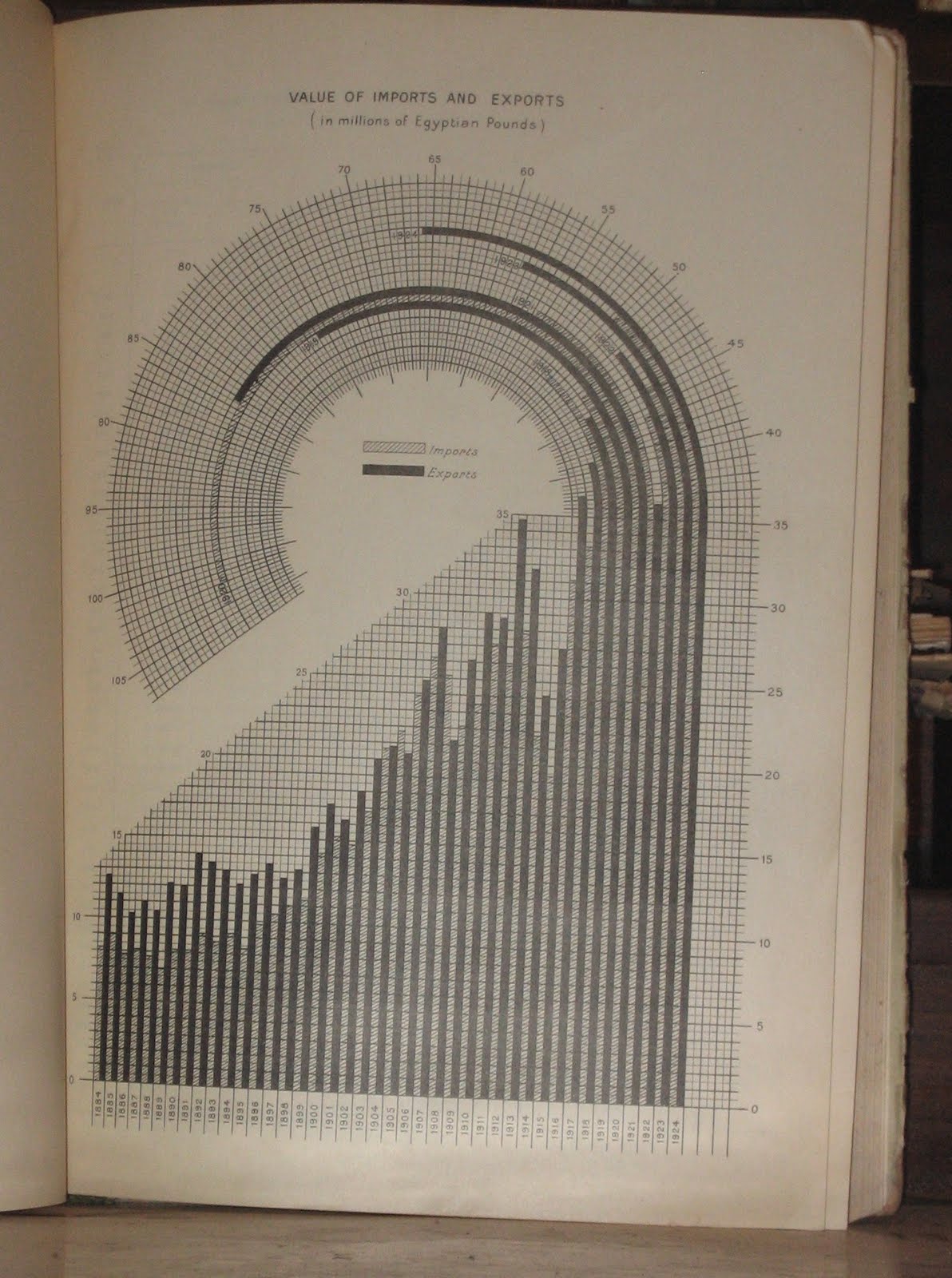
    And just because I stumbled across this picture from that trip, here’s one of my favorite displays of statistics, this from a colonial-era Egyptian book. Look! Imports and exports are both booming… in 1924. It’s such a beautiful chart!

    And finally, check out this BBC graphic of Tahrir Square. Dude, it’s just like Burning Man!

  • Word Frequency

    I’m ran the latest draft of my book through a word-frequency count. 47 uses of “simply”?! That’s simply too many, and I got that down to 11 (mostly just by deleting them–it’s interesting how often “simply” simply isn’t needed). Now I’m working on “certainly,” “of course,” and “actually.” It’s very easy to fall on such linguistic crutches when you’re writing.

    So the total number of different words in my new book is about 4,900 (out of 30,000 words).

    I don’t know why I find that interesting. I also wondered if it’s a lot or a little.

    Turns out I’m not the only one curious about such matter (oh, the world wide webs, how magic you are!).

    Zachary Booth Simpson was all over this, ten years ago.

    Compared to most books, I don’t use many words at all (that’s good news for my friend, Gotti).

    Moby Dick uses 17,227 different words. But Moby Dick is long. And my book is short. It turns out that for books of my length, my vocabulary seems perfectly respectable.

    Thanks, Zach!

  • NYPD Releases Misdemeanor Data

    Sort of. And only in response to a lawsuit.

    Here’s the Times story.

    Why not just give out the raw data so academics like me can actually use it? It might actually help the NYPD and the city. Just sayin’…

  • People Who Touch Your Junk

    People Who Touch Your Junk

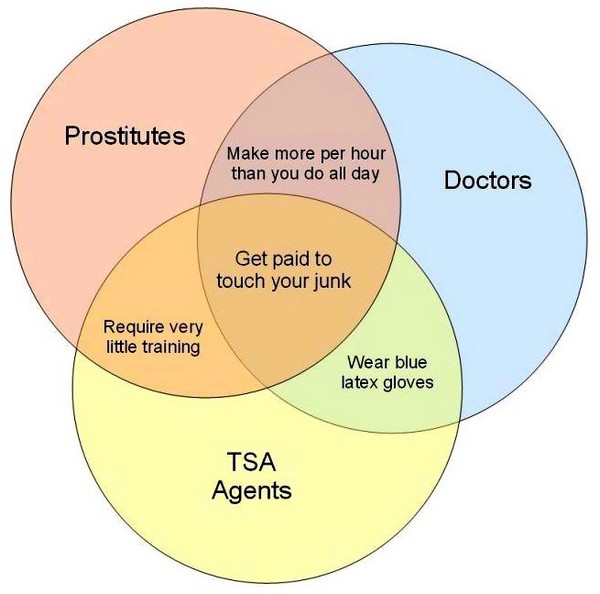
    I love Venn Diagrams. This is a good one:

    It’s from a site I need to visit more, Chartport.org.

  • Drugged Driving! Lock the doors! Hide the Kids! Be Afraid! Be Very Afraid!

    Drug Czar Kerlikowske said, “drugged driving is a much bigger public health threat than most Americans realize and unfortunately, it may be getting worse.”

    [Cue evil music!]

    Except, of course, it’s not.

    Kerlikowske is talking about this, which estimates that one-third of those who die in motor vehicle fatalities test positive for drugs.

    The problem, at least in context of the war on drugs, is how they define “drugs.” Alcohol, nicotine, and aspirin are excluded. That’s nice. But what about Acetominophen plus codeine? Ambien? Vicodin? Yep. Yep. And Yep. Ambien may be the ninth most prescribed drug in the US.

    You might also test positive for the joint you smoked last month, which covers at least six percent of all Americans. And no, they don’t break down which drugs people had in their system. Nor can they know if you’re actually high or impaired on whatever drug you’re taking.

    You can see the complete list drugs tested for starting on page 547 of this big file.

    Seeing how from 1999 to 2009, the number of prescriptions purchased in the United States increased 39%–we’re talking more than 3 billion prescriptions a year (not all of these are tested for)–how could you notfind more drugs in people’s systems?

    In truth, it’s amazing that onlyone-third of drivers tested positive for one of these drugs. It’s not amazing that drug prohibitionists twist, misuse, and sometimes just make up the numbers. They can’t handle the truth.

  • Read More

    If you don’t read The Atlantic, you should. Not only can you act like you’re smart, you might become smart. Or at least a lot smarter than you’ll ever become reading the typical drivel in a cop magazine (yes, I know, “staying alert can save your life”–so remain in “Code Yellow” and read something worthwhile).

    Here’s a short piece on “truth” in politics. “The Truth Lies Here.”

    Academics should read this, about how most of medical science is… what’s the word?… Wrong. (God save us if Dr. Ioannidis ever took on Sociology). (And extra credit because the story is good for the Greeks.)

    And last but not least, read the latest about TSA and pat-downs in Jeffrey Goldberg’s hilarious (and disconcerting) story about airline security.

    I asked him if the new guidelines included a cavity search. “No way. You think Congress would allow that?”

    I answered, “If you’re a terrorist, you’re going to hide your weapons in your anus or your vagina.” He blushed when I said “vagina.”

    “Yes, but starting tomorrow, we’re going to start searching your crotchal area” — this is the word he used, “crotchal” — and you’re not going to like it.”

    “What am I not going to like?” I asked.

    “We have to search up your thighs and between your legs until we meet resistance,” he explained.

    “Resistance?” I asked.

    “Your testicles,” he explained.

    ‘That’s funny,” I said, “because ‘The Resistance’ is the actual name I’ve given to my testicles.”

    The agent snapped on his blue gloves, and patiently explained exactly where he was going to touch me. I felt like a sophomore at Oberlin.

    He felt me up good, but not great. It was not in any way the best pat-down I’ve ever received.

    The best pat-down my wife ever received was in the Vienna Airport. It was five years ago. We were newlyweds. The young woman feeling up my wife was young, stern, fit, and wore leather gloves. I got to watch. She was meticulous. And thorough. We both thought it was hot.

  • Reality-Based Thinking

    The key is to un-learn the academic habit of treating every proposition and argument offered as needing to be taken seriously and requiring a refutation, if false.

    Note to self: Making sh*t up is a valuable research technique. Must use it more often.

    So says Mark Kleiman.

    [thanks to Jay]

  • Gang membership

    Do you ever see a headline that says “Gang Membership Down”?
    I’m suspicious. Gang membership did not increase 25% in one year. That I can guarantee.

  • Right Wing Lies (III)

    Right Wing Lies (III)

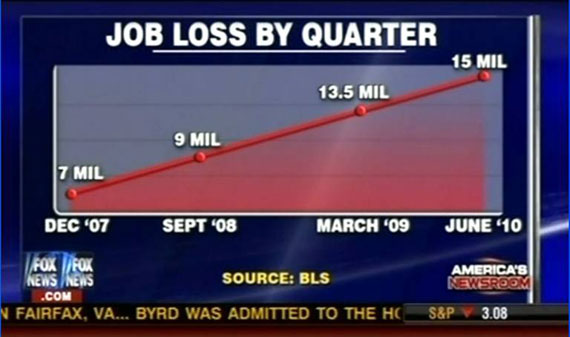
    Fox News says an ever-increasing number of people are losing their jobs. 15 million alone in a 3-month period in 2010!

    That’s patently absurd. But it’s cited to the Bureau of Labor Statistics so it must be true.


    They “corrected” their graph to read: “total unemployed.”


    Straight up, I guess ever since Obama started handing out all that “Obama money.” And you know it must be true because this time they actually spelled out “Bureau of Labor Statistics”! The only problem is that unemployment is notgoing up. It’s been steady at 15 million since August, 2009.

    And then look closer at their chart. Now there’s no law that says you have to write “not to scale” when your draw a graph that isn’t to scale. But common courtesy and a sense of decency would implore you to mention that fact. Otherwise, you know, people could draw the wrong conclusions. Hmmmmm…. Looks like they already decided and didn’t really report.

    The line they draw is straight up and steady. But the numbers aren’t. The first increase is two million. The second increase is 4.5 million. The last increase is 1.5 million. The actually numbers look like this:

    But what are you going to be believe? The truth or Fox’s lying eyes?

    [Taken from Media Matters, which has more details. And discovered through Jay Livingston’s always good Montclair SocioBlog (the best blog I bet you don’t read).]