Tag: tasers

  • “Number Two” at the range

    “Number Two” at the range

    Two days ago in the Bronx, an NYPD sergeant shot and killed Deborah Danner, a 66-year-old with schizophrenia armed with a baseball bat. Deborah Danner’s death is a tragedy. It is a failure of the system. But almost immediately, the officer who shot was stripped of his badge and gun and denounced by the mayor and police commissioner. DeBlasio — who according to the Times, “struggled to answer basic questions about the shooting” — felt he knew enough to throw the cop under the bus:

    The shooting of Deborah Danner was tragic, and it is unacceptable. It should never have happened. It is quite clear our officers are supposed to use deadly force only when faced with a dire situation. And it’s very hard for any of us to see that that standard was met here.

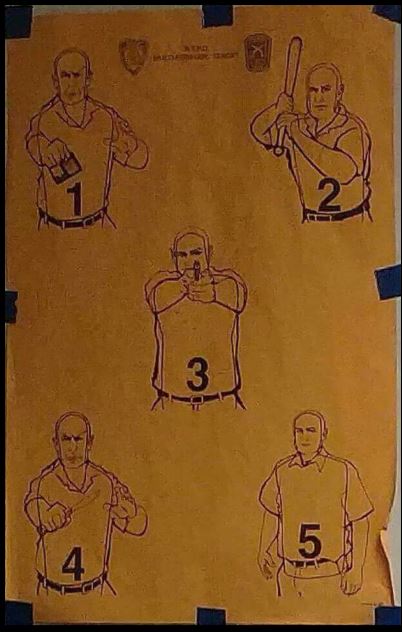
    Really? At NYPD target practice, there’s a simple shoot/don’t-shoot scenario. (This is something we did not have in Baltimore, which might help explain the NYPD’s overall extremely low rate of using lethal force.)

    The guy with a bat is known as “Number Two.” When you hear, “Number Two,” you’re supposed to see the guy with a bat and shoot Mr. Number Two. (Also Three and Four, but not Numbers One or Five.)
    I am not saying this was a good shooting. I am saying that if we don’t want cops to shoot people with baseball bats, why do we train cops to do just that?

    The mayor continued:

    There was certainly a protocol that called for deferring to the Emergency Service Unit (ESU). That was not followed. There was obviously the option of using a taser. That was not employed. We will fully investigate this situation and we will cooperate fully with any prosecutorial agencies. We need to know why this officer did follow his training and did not follow those protocols.

    [The New York State attorney general said he would not investigatethe shooting.]

    Protocol, so I hear, does say that officers confronted with an emotionally disturbed armed person (apparently initially naked and armed with scissors) should back off, close the door, and call for ESU and wait.

    I’m not convinced the department really wants this to happen all the time. This protocol, let’s call it Plan B, would tie up a few officers for a few hours in what would then be a barricade situation. It would also draw on the military-like resources of ESU.

    Plan A is for two cops to simply handle the inncident quickly and professionally, and get back in service to handle the next call. When violating “protocol” is routine, even encouraged, it’s not fair to only crack the whip when things go bad.

    But one thing about these events is they can change police culture quite quickly. ESU is now going to have a lot more work, for better or for worse. But wouldn’t be ironic if ESU responded to every call, especially in light of demands to de-militarize the police? And then what happens when ESU kills somebody? Then we blame ESU?

    Then who do we call? The really issue is that police shouldn’t be responding to this type of call at all.

    Here’s Alex Vitale (whom I’m actually agreeing with!) in the Gotham Gazette:

    The fact that police had to even be dispatched in the first place is a sign that something went wrong.

    Health officials knew about this woman’s condition…. Why was she returned to her apartment without adequate ongoing supervision or care?

    Yet thousands of profoundly disabled people continue to roam the streets and subways or idle away at home with little or no support, leaving police to deal with the crises that inevitably result.

    The mayor was wrong when he said that current training is adequate and this was just the mistake of a single officer. Ultimately, police are the wrong people to be responding to a person experiencing a mental health crisis.

  • Problems with Tasers

    I had no idea TASER was an acronym standing for anything, much less “Thomas A. Swift’s electric rifle“!

    The LA Times reports:

    LAPD officers fired Tasers just over 1,100 times last year…. The devices had the desired outcome — causing someone to submit to arrest — only 53% of the time.

    Is half the time better than nothing or not nearly good enough? Anecdotally, it seems like a lot of bad police shootings are preceded by Tasers not doing what they’re supposed to do. You press the magic button… and nothing happens. And you’re not used to having to go hands-on, fighting, and physically dominating a suspect. So you’re scared and reach for your gun.

    And that’s not the only problem with Tasers.

  • Taser Use

    Great story in the Baltimore Sun about taser use:

    • Nearly 60 percent of those hit by Tasers in Maryland were described by police as “non-compliant and non-threatening,” according to data from 2012 when the state began collecting data through 2014.

    • In one out of every 10 incidents, police discharged the weapon for longer than 15 seconds — a duration that exceeds recommendations from Taser International, the U.S. Department of Justice and policing experts. The data downloaded directly from the devices often shows more activations than officers document in police reports.

    • Officers fired the weapons at the chest in 119 incidents in 2014 — even though Taser has warned since 2009 that doing so could cause cardiac arrest.

    And why?

    From 02:20 of the video in the story:

    The Taser is a great tool because if you go out on a call or something… and he’s fighting… before, if you hit him was a asp [baton] he’s going to get a lot of contusion marks and maybe break some bones. A Taser is not going to do that.

    See contusions look bad. But Tasers sometimes kill. To me the issue has always been whether the Taser is used for a threat (OK) or compliance (bad).

  • RIP Derek Geer and Jason Goodding

    Does all the talk about cops being too quick to shoot people “for no reason” have an effect? (A “Ferguson Effect”?) I don’t know. But it might have been in the back of the mind of 14-year police veteran Deputy Derek Geer. Just two days ago Geer tried to tase an armed 17-year-old boy. For his less-lethal efforts, Geer was killed. He leaves behind a wife and two children, ages 13 and 11.

    Geer was the second cop this week to be shot and killed in a situation where police brought a taser to a gunfight. The first officer killed after using using leth-lethal force was Sergeant Jason Goodding. He and his partner recognized a man with an outstanding warrant. The wanted man resisted arrest, was tasered, and then shot Goodding three times. The other officer then shot and killed the subject. If only the cops had shot the wanted man a few seconds earlier…. Then people would be calling for “justice” for the criminal.

    Update: While writing a post about two killed officers, two other officers were killed. Both were shot and killed by a 67-year-old wanted man. Together these Harford County Sheriff’s deputies had 46 years experience.

  • Me talking about Tasers

    On NPR Weekend Edition. From my basement. I was wearing a snazzy three-piece suit, in case you were wondering. It’s radio, right?

  • “Who gave this reserve cop a gun?”

    Uh, it’s his own gun. But headline aside (writers don’t write the headline), I like to think I make some good points in this CNN piece about Robert Bates, the Tulsa County “reserve deputy” who thought his gun was a Taser and shot and killed a criminal.

  • “You’re doin’ fine, Oklahoma!” Not.

    A 73-year old man, Robert C. Bates, liked to play cops and robbers. He thought he was going to get to Tase a bad guy. But instead of holding his Taser, Bob was holding his personal gun. Bang. You’re dead. Oops.

    Bates wasn’t a real cop. He was a “reserve deputy sheriff,” which isn’t necessarily a bad concept, within reason. But this isn’t reasonable. Bates paid to play. He gave money to the Tulsa County sheriff’s election campaign. Maybe he could have been a deputy sheriff without donating money. But he gave cars to the undercover unit to which he had access. And now, irony of ironies, Bates might be convicted based on the evidence provided by the very eye-glass cameras he perhaps gave to the department!

    Bates didn’t even have good reason to even Tase Eric Harris. Cops were on scene. Harris wasn’t getting the upper hand. He wasn’t going anywhere. Despite what Bates later said, I do not think Bates thought Harris was armed. I say this because Harris was flying. Booking. Like a man who does not have a gun in his waistband. His arms were pumping, not going to his dip. Not in what I saw. And this is very much contrary to what supposedly “independent consultant” Sgt. Jim Clark claimed while defending Bates after being paid to investigate the shooting.

    [And Kudos to the cop who tackled Bates. Good job. He was a fast runner and knew exactly where to tell the driver to stop the car, though the driver was a bit slow in doing so.]

    “This horrible situation is going to be about what a corrupt sheriff’s office does after a bad shooting,” said Daniel Smolen, said a lawyer for the SOB who was shot.

    I think Smolen may be right…. wait. Did I just speak bad of the dead? Yeah. And I say this without at all saying the shooting was justified. And I’m certainly not defending an elected sheriff who allowed the guy to be on the scene with a gun. But what a bastard Harris was: Violence. Drugs. Guns. Robbery. Assault on cops. Escape from prison(?!). The whole nine yards. A real life of crime.

    I mention this in relation to my Washington Post article in which I describe how cops were so bothered about the shooting of Walter Scott. That one was different. This was a tragedy. A fuck up. And blame can and should be placed. But if you want cops to shed a tear over the death of Eric Harris, you’re going to be waiting a long time. Harris was a harbinger of violence and doom.

    [Having watched the whole unedited video in the CNN office today, it’s unfair to just air the part where cops say bad things to Harris. One line — “fuck your breath” — out of context is just a gotcha moment. The media should also show Harris yelling at the cops. Now granted, Harris has just been shot. Maybe you wouldn’t like the line even in context, but the context matters. Harris, on the ground after a dangerous chase, is yelling about how he “didn’t do shit.” This is a man who had just ran from police after selling an illegal gun to an undercover cop. My actual thought when I heard his protests of innocence was, “fuck you!” Though I did manage to just think this and not blurt it out in the middle of a newsroom. I also didn’t just have to chase, catch, and restrain this jerk. This situation, to paraphrase Jay-Z, has 99 problems, but the cops’ words ain’t one.]

    Maybe it’s because as a police officer you’re around of lot of death and even a lot of people murdered. So perhaps it’s inevitable to rank order the value of life. It’s one way you cope with dealing with a lot of death. An innocent kid is worth more than a guilty adult. A robbery victim’s life is worth more than the robber’s life. Somebody who could have prevented his own death by complying with lawful orders deserves less sympathy than somebody who didn’t run. The death of a guy killed after some minor vehicle violation is more tragic than a long-time felon who dies after running and selling undercover cops a gun. Somebody killed with intent is different than somebody killed in an accident. And both of those deaths would be different than somebody who happens to die as a result of less-lethal force.

    So Bates had a Taser. And I think Bates wanted to use his toy. Oh, boy! I suspect moments like this were exactly why Bates had given so much to the Tulsa County Sheriff. He wanted to play cop. Bates and the Tulsa County Sheriff’s Department have made a mockery out of professional policing. Clearly Bates should not have have had a gun and a Taser.

    Let us not start to consider “slip and capture” (a term I had forgotten before today) justification for using a gun instead of a Taser. Yeah, apparently it is possible to hold and fire a gun that you think is a Taser. “Slip and capture” reminds me of the invented concept “excited delirium,” which to some people means it’s OK when people die after getting tased. Just because you give something a name doesn’t make it real, or defensible. At best, “slip an capture” is a description. Bates, from everything he said before and after firing one round, obviously did not intend to shoot and kill Harris. But that doesn’t make it OK. And with proper training you don’t do it.

    And it’s interesting to note that both in this case and the shooting of Walter Scott in South Carolina (and the shooting of Oscar Grant on the Fruitvale BART platform), that these victims would be alive if the cops (or, “cop” in the Oklahoma case) had not been armed with a Taser. I’ve never been a big Taser fan. I wonder if this is something to consider. There’s particularly irony in people being killed because officers have less-lethal weaponry. (Not running from cops is also a wise preservation strategy, though that didn’t help Grant.)

    Finally, let me observe that I don’t know much about Oklahoma except a song (and the history and meaning of “Sooner”). But maybe Oklahoma is not “doin’ fine.”

    Oklahoma (together with fair New Mexico) has the highest rate of police-involved killing in the nation! The rate at which people are being killed by police in Oklahoma is twice the national average and five times the rate in New York or Michigan. Five times higher? That’s a big difference. It’s also the subject of my next post.

  • Bad Taser Judgement from Officer Slager

    This is from back in 2014. This is not a good use of a Taser. It actually makes cuffing him harder. The two really hard parts — getting a guy out of a car and getting hands out from under a resisting person — are done.

    This the guy is still resisting, so it’s probably legal and departmentally justified. But it’s morally and tactically wrong. He was seconds away from being cuffed.

    I also just heard some rumor regarding the S.C. shooting (and I don’t know if it’s true) that Slager somehow ended up with a taser dart in himself. I only this mention because even if Scott had Tased Officer Slager, it doesn’t matter. And I don’t think that did happened Based on the video, if a dart did end up in Slager’s leg, it seem more he somehow tased himself. But it’s irrelevant because it doesn’t change the issue about pulling the trigger on a man who was not a threat at the time you pulled the trigger. I’m curious about what led up to the shooting, naturally, but it doesn’t matter. Slager was dead wrong.

  • Baltimore Officer Down

    From the Baltimore Sun:

    Groman and another officer approached the car from the driver’s side
    and another officer approached from the passenger’s side, police say in
    charging documents. Officers directed the driver, Tavon Sullivan, to get
    out of the car, police say, and he sat on the sidewalk.

    Police say Jones, sitting in the back seat, refused Groman’s orders to exit.
    Groman told Jones to show his hands, which were in his jacket pocket and
    waistband, according to Maj. Stanley Branford, commander of the
    Homicide division, but Jones did not.

    Police say Groman told Jones
    he would be tased if he didn’t comply. Groman pulled out his Taser just
    as Jones pulled out a black Rossi .357-caliber revolver, police say in
    charging documents.

    Detectives said Monday they do not know who fired first. No officers fired a gun, police said.
    After Groman was struck, police said, Jones ran out of the car and was chased by two officers.

    Police say Jones ran into a backyard and was scaling a fence when an officer
    hit him with his Taser, allowing police to arrest him.

    “We’ve had marches nationwide over the fact that we have lost lives in
    police custody,” [Commissioner] Batts said. “I wonder if we’ll have those same marches
    as officers are shot, too.”

    It’s worth noting that 1) Yes, cops get shot at even in situation where the shooter has no realistic chance of getting away with it. 2) No officer fired a shot. And this includes even after the suspect shot an officer and was trying to run away. I mention this because if cops really were out there to murder black people, this would have been a fine chance to get away with a freebie. But that’s not the way police officers think. 3) Had the officer drawn his gun instead of a the less-lethal Taser, well, who knows what would have happened? But the Taser didn’t help keep Groman from being shot. 4) Had the officer drawn his gun, no doubt some people would be complaining about an officer drawing his gun for no good reason.

    Officer Groman is expected to “recover.” But as I’ve said before, you don’t ever completely recover from something like this. My thoughts are with him