Tag: terrorism

  • NYPD’s Muslim surveillance

    I haven’t said anything about the NYPD’s surveillance of Muslims because, well, I have nothing to say. If it’s legal and good, I’m for it. If it’s illegal and bad, I’m against it. If it’s illegal and good, well then it better be damn good!

    But I have no clue. So I’ve kept my mouth shut.

    But what if it’s legal and bad? That’s a possibility raised by an FBI agent, writes Al Baker in the New York Times.

  • Sneak-and-Peek

    Sneak-and-Peek

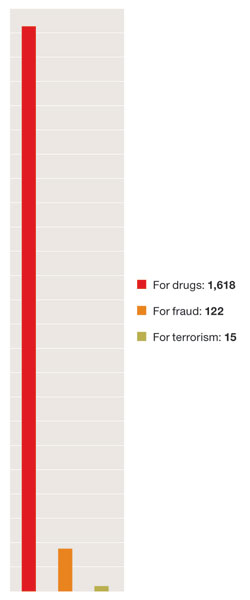
    There’s an interesting chart in New York Magazine that shows what the Patriot Act is used for.

    Delayed-notice search warrants issued under the expanded powers of the Patriot Act, 2006–2009:

    For drugs: 1,618

    For fraud: 122

    For Terrorism: 15

  • Agitatin’

    Radley Balko has a bold post on the killing of Osama Bin Laden, “He Won.”

    Speaking of Balko, he has been nice enough to invite me to guest blog for a week over at The Agitator. So I’ll be posting the same things both here and there. Over there, the grass looks greener: there are tens-of-thousands of readers; here there are hundreds.

  • Terrorist Plot Foiled in Alaska

    I guess those recent congressional hearings did some good. I mean, just a few days after being inspired to focus on radicalized Muslim youth, law enforcement goes out and breaks up a real terrorist plot.

    According the Fairbanks Daily News-Miner, five people were arrested for allegedly conspiring to kill multiple Alaska State Troopers and a federal judge.

    Actually, not. I mean the plot was real. It just has nothing to do with Islam. This was the usual home-grown white-christian kind of terrorist group. And these guys, police take notice, like to target cops. Focus, people!

    But speaking of Muslim terrorists, there’s new video of the Twin Towers falling, this from a police helicopter. Just in case there wasn’t enough disaster video these days.

  • The Problem With King

    Peter King sees nothing wrong with the hearings he’s holding on Muslim radicalization in America. I can’t imagine anything productive or less radical coming from these hearings.

    But my main objection–even fear–is that these hearings will allow the next terrorist attempt to be successful, thus “proving” their point, and creating a horrible vicious cycle.

    How are these hearings dangerous? Because, as any intel expert will tell you, plots get foiled because somebody talks. Have you noticed there hasn’t been a successful attack recently? Perhaps we’re doing something right.

    The NYPD has worked long and hard to build connections (which includes everything from friendly talks to infiltration to snitches to calls to 311). These connections have paid off. Plots have been foiled. The NYPD doesn’t need help identifying radical groups; they need help infiltrating and gathering information from these groups. The police need to keep friendly lines of communication open, and they fear that this hearings will destroy years of hard work. The second people stop talking, we’re in trouble.

    Pissing off good Muslim-Americans for no real gain (unless you could political points as a real gain) is not the answer. Doing things to piss off young Muslim Americans to the point where they might learn to hate America–creating radicals–is certainlynot the answer.

    Seriously now, what am I missing? What are we going to learn? Except for pissing off pansy-ass terrorist-loving unpatriotic people me (I write that sarcastically), what are the potential benefits to these hearing? What is Peter King, a supporter of past IRA terrorism, going to tell law enforcement that we don’t already know?

    [And does anybody notice that King sounds like a bit like Barney Frank? That’s got to be the next worst thing to Santorum.]

  • Fight the Terror

    I received an email from Richard Hughbank with a letter written by Police Major Joseph Bail, Jr. (ret.). This is in response to the Washington Monthlyarticle I linked to a short while back. Hughbank asked if I would post it. It’s too long to post. It’s very long (too long?). But I’m happy to link to it.

    Mostly it’s a character defense of a few of the people attacked in the article, including Hughbank. Please understand I don’t know any of these people from Adam. So I have no idea what the truth is. Nor can I delve into the issues of journalism ethics involved here. Though I do find a 40-year veteran police officer (Major Bail) complaining about being duped by a smooth talking interrogator to be a bit precious. Even I was taught in the police academy, “Don’t get into a battle of words with people who buy ink by the barrel.”

    But as to character anti-defamation, I’m happy to help. Character anti-defamation is a worthy cause.

    But beyond that, honestly… I think the letter supports the article’s main point: people with a thin or false knowledge of Islam are being paid to miss-educate police about Islam and terrorism prevention in the US.

    Let’s assume, for instance, that one of the guys slammed in the piece really did train with the biggest baddest Russian special forces ever. And let’s say that he can can bench 500lb, run a 4-second 100-meter dash, and that in hand-to-hand combat he can kick Bruce Lee’s ass and use it as an ashtray. He’s a real-life Rambo. If we were conducting a tactical raid on terrorists, that would be the guy I would want on my side. But what does special-force training have to do with anti-terrorism education? This isn’t about skills, it’s about knowledge.

    From the letter:

    I am mad that the politically motivated, Islam-loving, terrorist-apologizing media continues to paint the Muslim extremists as reasonable, decent people.

    Honestly, I don’t think anybody in media, “liberal” or otherwise, paints terrorist extremists as reasonable, decent people. But indeed, the “terrorist-apologizing media” might point out that the vast majority of the worlds billions of Muslims are not terrorists or extremists. This seems to be the main point of contention.

    Perhaps the real lesson to be learned from this is that there are people out there who are ideologically motivated to see that America is unprepared for the next terror attacks. And they will do anything possible to undermine us.

    There’s that “us-versus-them” and slightly conspiratorial attitude that worries me. I guess because I disagree with their world-view, by these standards I would be a “them.” But I don’t want to make America unprepared for the next terror attacks! Hell, my city of New York will probably be the target.

    Here’s my fear, which the letter does nothing to lessen: simplistic right-wing anti-Islam thinking makes a successful terrorist attack much morelikely. To defeat “them” (terrorists, not Muslims) we need people like “them” (Muslims, not terrorists) to tell us what “they” are planning to do. Thinking of all Muslims as potential and wannabe terrorists is not only wrong, it will only make it much more likely that the next terrorist attack will succeed. To think that Islam is the enemy is as silly as thinking that every black who lives in the ghetto is a criminal. Not only is it wrong, it makes you an ineffective police officer because you can’t focus your attention on those who need your attention, the criminals who actual want to kill you.

  • How We Train Our Cops to Fear Islam

    Here’s an interesting article by Meg Stalcup and Joshua Craze in The Washington Monthly. The subtitle is: “There aren’t nearly enough counterterrorism experts to instruct all of America’s police–So we got these guys instead.”

    Despite their different backgrounds, the counterterrorism trainers we interviewed have a remarkably similar worldview. It is one of total, civilizational war–a conflict against Islam that involves everyone, without distinction between combatant and noncombatant, law enforcement and military. “Being politically correct inhibits you,” Hughbank said. “I know Islam better than my own religion. Some things need to be called a spade.”

    On one occasion, we asked a student whether gangs–a more conventional subject of police attention–weren’t a more pressing issue for cops than terrorists.

    “Yeah, the gangs are a threat,” answered the officer. “But they don’t have 1.5 billion members.”

    Many of these classes are paid for by tax dollars, taught by people without law enforcement background, exaggerated military backgrounds (John Giduck, author of Terror at Beslan), and are “accredited” by people such as Keith Flannigan (the certification chairman of the scammy “Anti-Terrorism Accreditation Board”) who seems to make up his own college degrees.

    Of course a couple people faking their C.V. isn’t a big deal. What is a big deal is that this bigoted war-like approach to fighting terrorism in dangerous. Real, effective, anti-terrorists efforts are not helped by cops learning B.S. profiling to spot the “terrorists among us” by, say, looking “at the owners of convenience stores.”

    Plots get foiled because people talk to cops:

    In counterterrorism, as in most areas of intelligence and law enforcement, vital information often comes from those closest to the suspected perpetrators–from neighbors, friends, even family members. It was an anonymous handwritten note from an Arab American in Lackawanna, New York, a small city outside Buffalo, that led the FBI to arrest six men.

    Same with the foiled plot described in Jennifer Hunt’s excellent Seven Shots. Teaching cops that 1.5 billion Muslims are potentially terrorists is not the answer.

  • Pssst… Wanna Plant a Bomb?

    I’m not opposed to arresting people who are willing to detonate what they think is a bomb in public places. It’s not easy to arrest a suicide bomber after an attack.

    But consider Glenn Greenwald’s article: “The FBI successfully thwarts its own Terrorist plot” something does smell a little fishy:

    Having stopped a plot which it itself manufactured, the FBI then publicly touts — and an uncritical media amplifies — its “success” to the world, thus proving both that domestic Terrorism from Muslims is a serious threat and the Government’s vast surveillance powers — current and future new ones — are necessary.

    Or take Ted Conover’s (author of New Jackand other great books) excellent article about the Newburgh plot:

    The case seems like a slam-dunk—until you learn more about him. [FBI informant] Hussain, driving a flashy Mercedes and using the alias Maqsood, began to frequent the Masjid al-Ikhlas in down-at-the-heels Newburgh in 2008. Mosque leaders say he would meet congregants in the parking lot afterward, offering gifts and telling them they could make a lot of money—$25,000—if they helped him pursue jihad. The assistant imam said the suspicion Hussain was an informant was so great “it was almost like he had a neon sign on him.” A congregant told a reporter that, in retrospect, everyone wished they’d called him out or turned him in. “Maybe the mistake we made was that we didn’t report him,” the man said. “But how are we going to report the government agent to the government?”

    At no single point during these government investigations is there a moment where I can say: entrapment! And yet there’s little doubt that were it not for the FBI, none of these attacks would have happened (which is, of course, basically the definition of entrapment). Still, it doesn’t seem too much to ask people not to kill others even when offered money and “bombs” by the government.

    If you start dangling tens and hundred of thousands of dollars of poor people, you’re going to find people willing to do anything. And I’d certainly like the FBI to find these suckers before a real terrorist does. Of course it all it takes is money to get people to become terrorists, we’re in trouble. Because there’s lots of money and lots of poor people.

    Maybe, in the end, we’re just safer than we think. Matt Yglasias writes:

    If you assume the existence of a person willing to die for Osama bin Laden’s war on America, located within the United States of America, and in possession of a working explosive or firearm, there’s basically nothing stopping him from blowing up the 4/5/6 platform at Union Square or the 54 bus in DC or the Mall of America or even the security line at DFW airport. And yet it doesn’t happen.

    The Economist concludes:

    It’s far more sensible to take this happy fact as evidence of the further happy fact that the supply of people ready, willing, and able to blow up America’s crowded places is very small.

    [update: Holder defends stings.]

  • Read More

    If you don’t read The Atlantic, you should. Not only can you act like you’re smart, you might become smart. Or at least a lot smarter than you’ll ever become reading the typical drivel in a cop magazine (yes, I know, “staying alert can save your life”–so remain in “Code Yellow” and read something worthwhile).

    Here’s a short piece on “truth” in politics. “The Truth Lies Here.”

    Academics should read this, about how most of medical science is… what’s the word?… Wrong. (God save us if Dr. Ioannidis ever took on Sociology). (And extra credit because the story is good for the Greeks.)

    And last but not least, read the latest about TSA and pat-downs in Jeffrey Goldberg’s hilarious (and disconcerting) story about airline security.

    I asked him if the new guidelines included a cavity search. “No way. You think Congress would allow that?”

    I answered, “If you’re a terrorist, you’re going to hide your weapons in your anus or your vagina.” He blushed when I said “vagina.”

    “Yes, but starting tomorrow, we’re going to start searching your crotchal area” — this is the word he used, “crotchal” — and you’re not going to like it.”

    “What am I not going to like?” I asked.

    “We have to search up your thighs and between your legs until we meet resistance,” he explained.

    “Resistance?” I asked.

    “Your testicles,” he explained.

    ‘That’s funny,” I said, “because ‘The Resistance’ is the actual name I’ve given to my testicles.”

    The agent snapped on his blue gloves, and patiently explained exactly where he was going to touch me. I felt like a sophomore at Oberlin.

    He felt me up good, but not great. It was not in any way the best pat-down I’ve ever received.

    The best pat-down my wife ever received was in the Vienna Airport. It was five years ago. We were newlyweds. The young woman feeling up my wife was young, stern, fit, and wore leather gloves. I got to watch. She was meticulous. And thorough. We both thought it was hot.

  • A Slow Work Day at the FBI

    The FBI has slow work days? I kind of hoped they were pretty busy. But I guess we all have slow work days. But when I have a slow work day I like to listen to a Cubs game or write blog posts or play pinball.

    But when the FBI has a slow work day… well the the Justice Department’s inspector general has released a pretty damning report about FBI work on domestic terrorist organizations. Specifically a 2002 rally in Pittsburgh sponsored by a nonviolent anti-war group was “An ill-conceived project on a slow work day.”

    Did it really start with two agents, feet up in the office?

    “What do you want to do today, Marty?”

    “I don’t care. What do you want to do?”

    [Kudos to anybody that can tell me where that line is from. I don’t know and get this: can’t find it on google! It’s probably a movie from the 1950s as I learned it from my dad. Update: I figured it out. It’s from the movie Marty. Google wins again.]

    “We could keep an eye out on the war-protesters. They’re probably up to no good.”

    The New York Timesreports:

    The IG also concluded that the factual basis for opening some investigations was factually weak and that in several instances there was little indication of any possible federal crime, as opposed to state crimes.

    Regarding the Pittsburgh rally, controversy erupted in 2006 over whether the FBI had spied on protesters at the event several years earlier because of their anti-war views.

    At the time, the FBI issued a news release saying the surveillance had been based on an ongoing investigation.

    FBI Director Robert Mueller told a Senate hearing that the bureau had been trying to identify a particular individual believed to be in attendance.

    Turns out that was not true.

    Why does this matter? Well the Timespoints out that, “Domestic terrorism classification has far-reaching impact because people who are subjects of such investigations are normally placed on watchlists and their travels and interactions with law enforcement may be tracked.”

    My issue is more primal. Every time I hear that anti-war protesters and pacifists are considered a national-security American threat, I reach for my gun. Especially given the FBI’s has a long and shameful track record of investigating “subversives.” Certainly that was the case under J Edgar Hoover. But we’ve moved on, haven’t we?

    And I also have a much more basic complaint. The FBI, part of the Executive Branch, is not a police force (no matter how much they act like one on TV). The line between local police and federal law enforcement can at times seem like very fine line indeed. But it’s an important distinction to keep. For starters it’s a constitutional issue. But it’s also important because local police can be held accountable to local (and state and federal) politicians. And because law enforcement is supposed to be work for us and not become a domestic spying organization.

    Truthfully, I don’t mind the FBI investigating subversives. What I mind how this category is defined. Why do liberals and pacifist seem to get a lot of attention? I mean, you may not agree with them, but pacifists are, well, pacifist. And it just so happens that these anti-war folk (myself included, though I’m not much of a protester) happened to have been right. Maybe the FBI should spend more time investigating those who want to get us into these wars.

    [Since I’ve been around, off the top of my head I can think of US troops occupying, bombing, or invading Kuwait, Iraq, Panama, Grenada, Serbia, Afghanistan, Somalia, and Lebanon (I’m sure I’m forgetting one or two). Did any good come from anyof these? Maybe. But it’s damn hard to make an argument that good has come from all of these collectively.]

    Does that make me suspicious? Maybe. I guess it makes me a liberal. And I suppose the FBI, like most law enforcement, is basically conservative and suspicious of liberals.

    [I just thought of this one: You know you’re a liberal when… the thought of Michael Moore as president scares you less than Sarah Palin.]