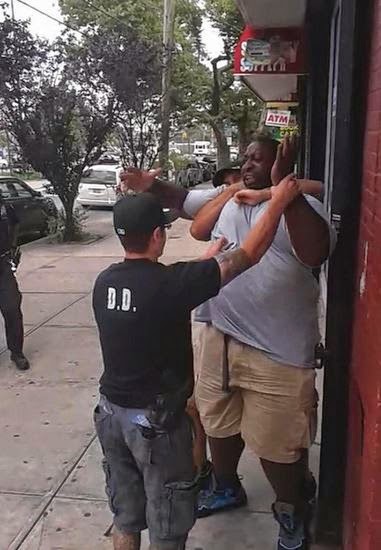
The first thing that jumps to mind in the death of Eric Garneris that somebody who is repeatedly saying “I can’t breath” is, in fact, breathing. It’s a basic rules of choking, first aid, and well, the way we speak. [Update: Seems I’m probably very wrong about this.]
Also, I’m no expert in chokeholds (because most departments forbid them), but what I do know is that a chokehold can either block the windpipe (which won’t kill you, since suffocation takes a while after you pass out) or block the carotid(?) arteries in the neck (which technically isn’t a chokehold but a strangle-hold). The former is done with the arm flat on the windpipe. The latter is more a vice grip, and you’ll go out pretty quickly. It’s pretty lethal. If you’re on the giving end, you have to let go as soon as the person drops if you don’t want the person on the receiving end to die.
I don’t see either of those being a factor here… though it doesn’t look good for the officer in green, Agent 99, who did grab Mr. Garner’s neck, since chokeholds are forbidden. That officer also may have rushed the decision to put Mr. Garner in custody. Generally I’m for a hand-on approach to physically controlling a guy. And it’s not easy to control a man as large as Mr. Garner. I’d be more critical if Mr. Garner died after being Tased.
But this is not a chokehold (though it’s possible one was used later).
And yet the Daily News caption in an article about chokeholds says “Eric Garner was put in a chokehold as Staten Island police tried to subdue him Thursday.” The officer (Agent 99) is using a half nelson and pulling on the guy’s neck for leverage to bring him down and to the right, which he does. He’s not near the windpipe, and this does not seem to be an attempt to choke the guy. So it’s not a chokehold. Does that distinction matter if the guy is dead? Well, yes. Because chokeholds are forbidden, and the guy is dead.
But there’s an important difference between saying “the cops killed him with a forbidden chokehold for resisting” (as I’ve heard people say) and “he died while resisting.” Once you decide the guy is under arrest, what would you do? Mayor DiBlasio said he watched the video like family. Well, I watched it like a cop. And it’s not easy to get cuffs and a large resisting man. Just because he died, which is a tragedy, doesn’t mean he was killed, which is homicide. Certainly it will matter what the autopsy shows.
What you have is a very large and presumably out-of-shape asthmatic man resisting arrest, perhaps because he didn’t deserve to be arrested. (I don’t know, I wasn’t there.) There do seem to be multiple witnesses (actually at the scene, I might add, which isn’t a given when it comes to “witnesses”) saying the same thing: Mr. Garner was a peacemaker trying to break up a fight. [But the officers seem to be arresting Mr. Garner for something else entirely: selling a cigarette.]
Mr. Garner, apparently, has been arrested 30-some times. And that very well may be why police focused on him.
But best I can tell (and again, I may be wrong), Mr. Garner seems to be little more than a repeat offender for the criminal offense of… selling loosie cigarettes! Now of all the idiot war-on-drugs nonsense… illegal cigarette selling should be low on the list of law-enforcement priorities. The guy died for selling loosies? And if he was selling them for 75 cents each (I don’t know the going price for loosies), then they’re cheaper than buying them legally by the pack. If he’s selling them for a dollar, then he’s making a good profit!
Why are about half of all the cigarettes sold in New York illegal? Because the tax is too high, and that has created a very large black market. The thing about legal regulated drug selling is it needs to make sense.
High taxes on cigarettes — $5.85 a pack ($4.35 New York State plus another $1.50 for New York City — were politically popular under Bloomberg, but probably do more harm than good in New York. That, just as much as any chokehold, contributed to the death of Eric Garner.
Selling loosies shouldn’t be a crime.
[The post has been updated. And see this as well, dispelling the idea that if you can talk, you can’t be not able to breathe.]