…but not is the way I wanted. From the Washington Post:
The Supreme Court has unanimously upheld a 10-year prison sentence for cocaine possession, rejecting a claim that harsh penalties in federal law apply only to crack cocaine.
…but not is the way I wanted. From the Washington Post:
The Supreme Court has unanimously upheld a 10-year prison sentence for cocaine possession, rejecting a claim that harsh penalties in federal law apply only to crack cocaine.

My wife is out of town. I think for her return I’ll surprise her with a slightly used Mexican car. I’m sure she’ll love me more than ever. No doubt. The problem is that parking around here can be a real bitch.
An interview with Richard Branson about drugs. In the Guardian: “I’ve seen the war on drugs and I’ve not been impressed.” That must be what they call classic British understatement.
“I’m the sort of person who is extreme at anything they do. I’m therefore careful not to overindulge.” He has admitted to taking other drugs including cocaine and ecstasy in the past. The vast majority of people, himself included, can use drugs safely and occasionally, he says.
It’s the sort of candour that doesn’t play well with politicians, even in an age when the president of the US has openly admitted he has taken drugs, and that he even inhaled. Branson isn’t expecting to convert David Cameron or any other politician overnight: “I talk to a lot of politicians and, individually, almost every single one of them knows that this is the right approach. They all are just terrified of the Daily Mail. If the Daily Mail changes its approach, the politicians will change their approach. If the Daily Mail don’t, they won’t.” The situation is “sad” he says.
…
But the problem is that politicians use the war on drugs to score points off each other. “The opposite of war on drugs is soft on drugs in some people’s minds,” says Branson.The same arguments hold true for prostitution, he says. Politicians don’t want to say it, but if prostitution were decriminalised and brothels were safe places for sex workers and their clients, society would benefit.
Ian Birrell give a nice new twist to the same-old-same-old in the Guardian’s Observer Magazine:
In 1998, the United Nations committed member states to achieve a “drug-free world”, pledging to eliminate or “significantly reduce” use of opium, cannabis and cocaine by 2008. Instead, global opiate use rose by more than one-third over that time, with big rises also for cocaine and cannabis.
…
Politicians say they fear drug use would rise if prohibition is lifted. Evidence from abroad shows they are wrong. Look at Scandinavia, where the tough Swedes and more liberal Norwegians have similar addiction rates. Or Switzerland, where heroin demand and crime fell sharply following new policies based on public health rather than legality. Or Portugal, where heroin use fell by half after decriminalisation.
…
So here is a suggestion for our three main party leaders, who are all young enough to know better: why not hoist the white flag and work out a unified way to end a struggle that does so much more harm than good?The alternative is to carry on fighting like generals in the First World War, ignoring the deaths, the devastation and the wastelands created around the world in a battle than can never be won.
OK. That’s not really news. But this report is kind of a big deal. So says the BBC, the “Global war on drugs has ‘failed’.” Imagine that. The panel included former UN Secretary General Kofi Annan, the former presidents of Mexico, Colombia, and Brazil, the former US Federal Reserve chairman Paul Volcker, the current Prime Minister of Greece, George Papandreou, former US Secretary of State George Schultz, and Virgin rich man Richard Branson. That’s a heavy lineup.
The White House?
“The White House rejected the findings, saying the report was misguided.” Thanks, Obama. Hope you enjoyed that blow when you were younger. And the fact you weren’t arrested for it.
The BBC story is worth quoting at length:
Their report argues that anti-drug policy has failed by fuelling organised crime, costing taxpayers millions of dollars and causing thousands of deaths.
It cites UN estimates that opiate use increased 35% worldwide from 1998 to 2008, cocaine by 27%, and cannabis by 8.5%.
The authors criticise governments who claim the current war on drugs is effective:
“Political leaders and public figures should have the courage to articulate publicly what many of them acknowledge privately: that the evidence overwhelmingly demonstrates that repressive strategies will not solve the drug problem, and that the war on drugs has not, and cannot, be won,” the report said.
Instead of punishing users who the report says “do no harm to others,” the commission argues that governments should end criminalisation of drug use, experiment with legal models that would undermine organised crime syndicates and offer health and treatment services for drug-users.
It calls for drug policies based on methods empirically proven to reduce crime and promote economic and social development.
The commission is especially critical of the US, saying it must abandon anti-crime approaches to drug policy and adopt strategies rooted in healthcare and human rights.
…
The office of White House drug tsar Gil Kerlikowske rejected the panel’s recommendations.
…But something always bothers me when police break down your door and kill you. Doesn’t seem necessary.
update:
The tactics here are terrible. Why are they standing in front of the door? I wouldn’t answer a call for a lost lolcat without standing off to the side. In fact, even today, 10 years later, I still do.
And what’s with that last extra shot? “Pop.” Did he flinch?
I’ve also read that they didn’t let paramedics in for a while because the scene wasn’t secure. The whole point of entries like this is to make the scene secure. Or is it just to play with toys.
I have no idea what kind of guy the dead guy was. And to some extend I don’t care. If was so potentially dangerous, why wasn’t it no-knock raid? And if it wasn’t, why not ring the doorbell? As the old joke goes, “It can’t hurt.”
When the man inside his own home was shot by police officers who busted down his door, the home owner (OK, maybe he was a renter) was holding a gun. The safety was on. Now I’m not a fan of guns, but if I still had one and somebody busted down my door, damn right I would be carrying it. And my gun didn’t have a safety.
Further update: This is from The Agitator:
This isn’t like watching video of a car accident or a natural disaster. This doesn’t have to happen. You’re watching something your government does to your fellow citizens about 150 times per day in this country. If this very literal “drug war” insanity is going to continue to be waged in our name, we ought to make goddamned sure everyone knows exactly what it entails. And this is what it entails. Cops dressed like soldiers breaking into private homes, tossing concussion grenades, training their guns on nonviolent citizens, and slaughtering dogs as a matter of procedure.
The action starts at around 6 minutes into the video.
And please keep in mind, it’s not like we’re suddenly winning the war on drugs because of these tactics.
From over at The Agitator.
It’s reached the point where these “drug war” police don’t even pretend to be anything but money-hungry mercenaries.
One of the nice things about being a police officer is you can explore places that normal people fear to tread (or would get arrested if found). Back in 2001, I wanted a good view to conduct surveillance of a drug corner. So I entered this vacant building. This block has since been torn down.
#1) 1900 Block of E Eager. 1906 E Eager is the third house (with awning) from Mr. George’s corner laundromat. Two short blocks North of Johns Hopkins Hospital, this corner (Wolfe and Eager) is one of the “hottest” (but hardly the only) drug corners in the neighborhood, heroin and crack are sold around the clock, rain or shine. Most of the customers are locals, but a conspicuous minority of whites drive in from the poor suburbs looking for the purer heroin found in the ghetto. This neighborhood, built around the turn of the century and featuring typical Baltimore rowhomes, formstone, and marble stoops, was all white until the 1950s, middle class until the 70s and 80s, now it is mostly vacant, all black, and very poor. Hopkins and city own most of the property. Hopkins has since torn down most of this area.
 #2) The corner looks deserted. It is just 7 in the morning. But a few moments earlier, there were dozens of people roaming about. But a funny thing happens when you park a police car in the middle of the intersection, turn off the motor (otherwise the picture is blurry), and take a picture. People scatter. Note how everybody is walking away. I didn’t take in personally.
 #3) Approaching the rear of 1906 E Eager from N Chapel St. I was looking for a location to observe drug sales on the corner and out of one house in particular.
 #4) Most vacants are boarded up to prevent junkies from entering, or filled with too much trash and damage to let one safely enter. The rear entrance of 1906 E Eager is wide open. The first time, on official police business, I went in alone. The second time, to take pictures, I brought along a partner, just to be safe.
 #5) The rear room on the first floor is what used to be the kitchen. In the northeast corner are old appliances, partially stripped and peeling lead paint, and remnants of alpine wallpaper.
 #6) Another view of the alpine wallpaper.
 #7) Looking southwest in the kitchen, a few more appliances.
 #8) The southeast corner of the kitchen. Like almost all the metal, the iron stove top grates have long been sold for scrap.
 #9) The front room is the living room. A TV and couch remain. Makes me think the home was occupied into the 1990s. The front door is on the right. It’s interesting to me that a big color TV, once somebody’s prized possession, is no longer worth anything.
 #10) The front door is on the left. Vivid woodland wallpaper remains.
 #11) Looking up the staircase between the rooms. One of the stairs is rotted through, but the rest are in pretty good shape. This is a typical staircase for a rowhome. It’s horrible for police. Often there’s no handrail, and you can easily be pushed down. At the top, suspects could be in either or both directions. They don’t teach you about this in the police academy.
 #12) 2nd floor front room. Nice windows for surveillance of the dealers katty-corner across Wolfe St. Otherwise trash, some drug paraphernalia, a mattress against the wall, two pairs of shoes, and a nicely patterned linoleum floor remain.
 #13) Looking East in the upstairs front room. A nice old heating grate, removed from the wall, hasn’t been taken to sell for scrap (or to an antique store in Fells Point). A small water bottle (nicely labeled “water”) is on the floor. This water would be mixed with heroin and heated with lighter in a metal bottle cap from a 40oz bottle of malt liquor. The mixture is then injected. The only thing in these pictures I manipulated is the water bottle. I turned it so I could photograph the word, “water.” I love how it’s neatly labeled.
 #14) Rear room second floor. View looking rear from the stairs. Two layers of floor cover are visible, along with purple latex gloves, and a black tourniquet to make veins bulge for easier injection. An empty container of cornstarch is on the chair. Cornstarch can be put into empty crack vials and repackaged as “burn,” or fake drugs to sell for a quick buck, mostly to whites coming into the neighborhood. Some of these whites then call the police and tell us they were robbed (always of $10 or $20). They don’t get much sympathy. Locals would know not to buy from local junkies. But selling burn is not without risk as selling burn to the wrong person can get you beat up or killed.
 #15) Looking towards the front in the rear room. Mirrors and black pride posters increase the positivity and create a much nicer overall environment. Tupac, Goodie Mob, and Q-Tip. An almost empty bottle of Pepto Bismal lies on the ground, showing that indigestion can strike anyone.
 #16) A poster and broken clock on one wall is just of above the bottles of piss and cans of shit neatly kept in the corner. (Unfortunately my partner knocked over that door you see on the lower right corner, tipping everything over. I’m guessing the loose door was positioned for privacy. It spilled a lot of piss and really smelled really rank after that. We left the place worse than we found it. This wasn’t low-impact policing. Sorry.)
 #17) A 2000 Sears poster celebrating Black History claiming it’s not just for February anymore: “Every family has a history. We celebrate yours every day, every year.” I don’t think this is what they had in mind.
 #18) Bottles of old malt liquor bottles are filled with piss. I have no idea if any of the plumbing worked. Probably not, but it wouldn’t have surprised me if it did. Finding bottles of piss in people’s home was not uncommon. Next to the bottles is a free parenting magazine and a toy box.
 #19) Another view of the main lounge and work area. Given the conditions, this is not where serious drug dealers do their work. This is a place for addicts to shoot up, relax, and scheme how to come up with their next $10 hit.
 #20) A few chairs are set around a collection of empty crack vials. There are also more shoes. Why all the shoes?
 #21) Looking closer, there are dozens of empty crack vials. Every color of the rainbow. The legal use for these vials in for perfumes and oils. The color of the cap on the vial often becomes a sort of brand name: red tops, blacks tops, or orange tops. Other good brand names: Uptown, Bodybag, Capone, and the more generic Ready Rock. Also on the floor are candles, cigarette butts, lighters (lots of them), tin foil, and bottle caps. Heroin and coke is an ever popular mix. John Belushi overdosed on it. Sugar, in the form of candy bars and tasty cakes, can take some of the edge of the beginnings of heroin withdrawal. Or so they say.

Notice that the cup being used as an ashtray is standing and in use. The shoes are lined up. Paper is on the floor. In this disorder, there is order. But it’s almost inevitable that at some point in time they’ll burn the place down. And when that happens, you don’t want to be the neighbor next door.
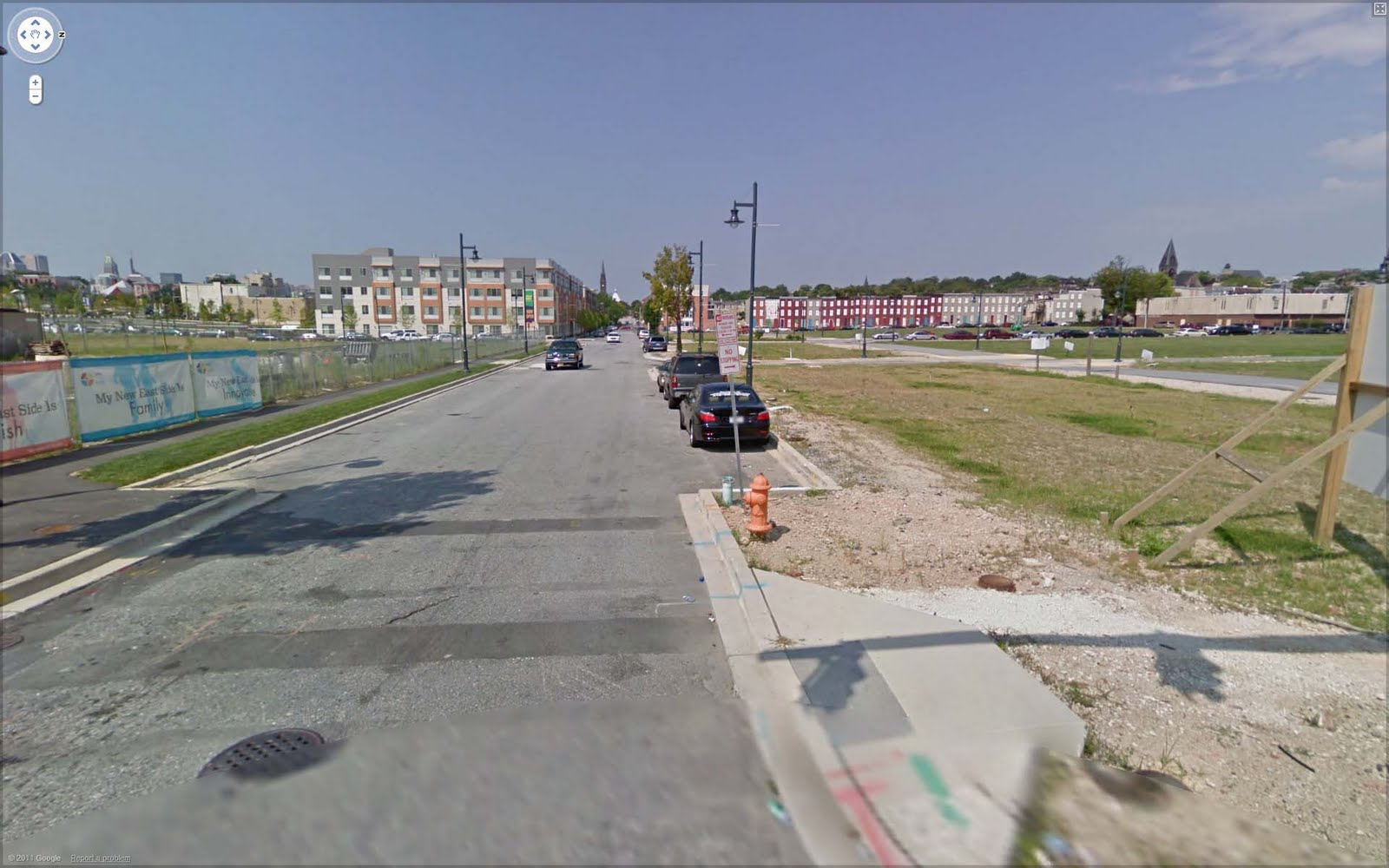
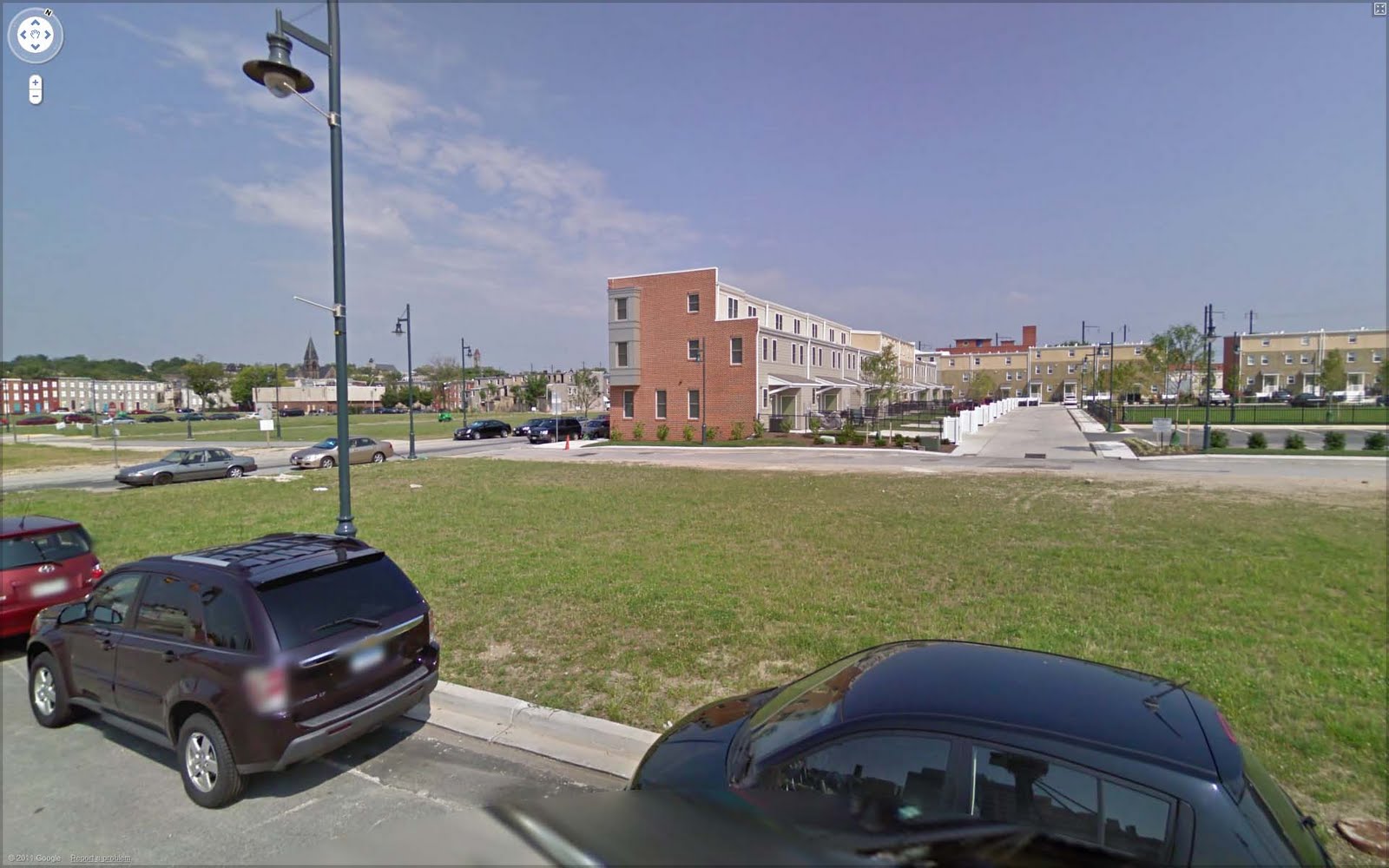
Update: Here’s what those first two pictures look like today (or the last time google drove through):
[If you just stumbled across this blog for the first time, consider buying one of my books: Cop in the Hood and In Defense of Flogging. Talk about great Father’s Day presents. Christmas, too!]
Al Sharpton and Ron Paul are the two people I can’t imagine ever voting for, and yet… God bless ’em for their contributions to presidential debates! They both liven things up, buck the Party Line, and sometimes just make plain sense (though, alas, not all the time).
Here’s Paul talking about drug legalization. He makes it sound like a common-sense mainstream conservative issue. Which of course it should be. Maybe soon it will be.
Making drug legalization a debateable issue (which, honestly, ten years ago it wasn’t) is half the battle. I like to think that organizations like LEAP (which I’m a member of) have helped this happen. Merely considering that the War on Drugs might be, I don’t know, misguided, used to be taboo in polite company. Now a call for heroin legalization gets raucous cheers in Republican debates. It’s great to see this shift because when it comes down to honest debate, the prohibitionists simply can’t win.
[–Peter Moskos]
I’m back from Mexico City, happy to have been there. No, I didn’t get sick (or mugged). Yes, I ate everything (including grasshopper quesadillas, which I can say are tasty, but it’s still best not to lift the tortilla and look at the critters melted in with the cheese). But I’m also happy to be back at low altitude. Seriously, it’s strange and disconcerting to feel out of breath while doing nothing. Also of note: it’s the first trip I’ve ever taken where I didn’t, not even once, hear “Hotel California.”
Back home, I’m greeting with this BBC headline: “Mexico poet Javier Sicilia leads anger at drug violence.” No, I’ve never heard of him, but he’s taken up the cause following his son’s murder:
His harsh criticism of what he calls President Felipe Calderon’s “stupid strategy” to fight drug cartels has resounded with large sections of Mexican society who are increasingly frustrated by the rising violence in many parts of the country.
…
More and more innocent civilians like his son are being killed as “collateral damage of the drugs war”, Mr Sicilia believes. So he focuses his criticism on President Calderon’s strategy.“I think Felipe Calderon is responsible for launching a war in a stupid way,” he says, combining rage with frustration.
“What this war has done is allow the corruption of institutions which had been taking place for years to emerge, but leaving those institutions completely defenceless to face organised crime.”
…
President Calderon – who received Mr Sicilia at the presidential palace after the murders – made an overt reference to the issue in the wake of the demonstrations.“Let us not be confused,” said Mr Calderon at a lunch with business leaders earlier this month.
“We should say ‘Enough!’ to the criminals who kidnap and murder. They are the enemy, not those who fight against them,” he added.
At what point do people in power ever admit: “Maybe, just maybe, what we’re doing isn’t working.” Remember, when Calderon took office, there were about two deaths each day related to the drug war. Now, after five years of “getting tough” and ramping up the drug war, there are more than 40drug-war deaths each day.