But we all know that. He doesn’t keep it secret and thinks it should be legal. But since it’s not, he’s been arrested for it. Again. Of course it’s silly a supposedly free country wastes our money and law enforcement resources arresting senior-citizen for smoking a pretty harmless substance.
Of course it’s probably not a big deal for him. For Willie, getting busted yet again is almost like another feather in his bandanna. It’s more a shame when my students are arrested for such things. They can actually be hurt by a drug arrest. They don’t have much money and go to public university. When I went to college at a very rich private university, I don’t think anybody was everbeen arrested for marijuana possession. (I’m just sayin’…).
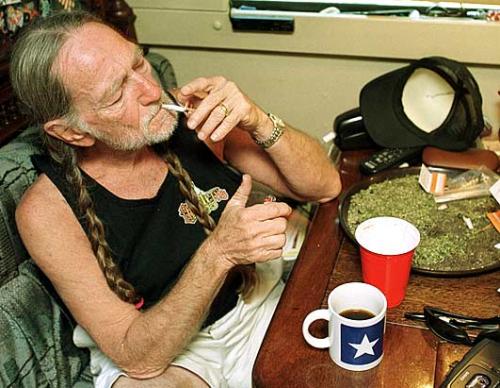 But this arrest bothers me more than usual because Willie Nelson, a US citizen, was detained at a US Border Patrol checkpoint while traveling within the US. Willie Nelson never left the Land of the Free. He was simply minding his own business being driven down US Highway 10 when he was stopped by federal agents at a border checkpoint that isn’t on the border. Seems they make a lot of low-level drug arrests here which probably brings in a little money to little Sierra Blanca and Hudspeth County, Texas.
US Border Patrol can and does stop people at “Interior Checkpoints” without cause. One needn’t be an anti-government survivalist to be slightly bothered by this. The main purpose, supposedly, is to deter illegal immigration. OK. Fine. So why arrest a guy getting stoned in the back of his tour bus? [Update: I should amend that to say the main purpose originally was to deter illegal immigration. Drugs were never mentioned in the original Supreme Court decision. But see the first comment below for yet another example of how the war on drugs creeps into everything.]
Police get power because of fear of terrorism or immigration. But once you give police that power, they can and will (and arguably should) use it as a tool for alllaw enforcement. I’ve written about this problem before, albeit in the slightly different context of airport security. If Border Patrol can stop people on trains and roads within 100 miles of an international border to look for illegal immigrants, then they should do nothing but make sure you’re not an illegal immigrant. Period.
In this case, the officer smelled weed when the door opened. This “plain smell” gives probable cause for further detention and search of a motor vehicle.
And let me just mention how nice it was of Willie to take one for the team. He said the six ounces of found marijuana was his. That’s a lot of weed, even for Willie!
At fixed check points (but not roaming ones) Border Patrol got the authority to stop people at their discretion in US v. Martinez-Fuerte (1976) when the court said:
It is agreed that checkpoint stops are “seizures” within the meaning of the Fourth Amendment…. But it involves only a brief detention of travelers during which “[a]ll that is required of the vehicle’s occupants is a response to a brief question or two and possibly the production of a document evidencing a right to be in the United States.”
The decision was seven to two. The two dissenters, Brennan and Marshall, wrote:
There is no principle … which permits constitutional limitations to be dispensed with merely because they cannot be conveniently satisfied. Dispensing with reasonable suspicion as a prerequisite to stopping and inspecting motorists because the inconvenience of such a requirement would make it impossible to identify a given car as a possible carrier of aliens is no more justifiable than dispensing with probable cause as prerequisite to the search of an individual because the inconvenience of such a requirement would make it impossible to identify a given person in a high-crime area as a possible carrier of concealed weapons.
The lonely dissenters also took objection to the majority’s opinion that, “We further believe that it is constitutional to refer motorists selectively to the secondary inspection area … even if it be assumed that such referrals are made largely on the basis of apparent Mexican ancestry, we perceive no constitutional violation.” That’s a bit scary.
Is such constitutional racial profiling still law of the land or has some more recent case overturned that?

 I just learned through a friend on Facebook that it’s
