Tag: war on drugs

  • Oh, Jamaica

    Gun battles seem to be the order of the day. Police officers have been killed. There’s also looting. But a police spokesman says about the business district, “There was some shootings last night but some amount of calm has returned.” Phew.

    A state of emergency has been declared that basically give police carte blanche to do what they want. Prime Minister Golding says, “These are necessary measures to restore order to a community that is now threatened…. This will be a turning point for us as a nation to confront the powers of evil that have penalised the society.”

    Turning point in the drug war? Why do I not believe him?

    Meanwhile one newspaper says the police have taken a “soft-handed approach.” In the same paper the police commissioner is quoted as saying, “Do not hesitate to respond quickly and take decisive action when attacked by these criminals…. Police personnel have the full backing of the High Command to any response to protect themselves.”

    I wonder if they’ll get Dudas. And I wonder if they’ll get him alive. I’m sure many in government would much prefer him dead and silent than alive and talking.

    My quote of the day comes from Deejay Mavado: “Ask them if me ever bring a rifle come give them, but at the same time me nah tell them not to defend themselves.” That was at a peace meeting.

  • “He does what the government doesn’t do for us”

    “He does what the government doesn’t do for us”

    Jamaica is a rough place. 2.7 million people and 1,500 homicides. That’s a higher homicide rate than Baltimore… but lower than Baltimore’s Eastern District. It’s also dangerous for police, with 5 official line-of-duty deaths per year (though I suspect many more police die in less official ways).

    Jamaican police are known to kill a lot of people, probably between 150 and 300 each year. Now that’s getting tough on crime! Too bad it doesn’t work.

    Now I’ve never been to Jamaica and don’t know what I’m talking about. But here’s my take: You got the drugs. They’re illegal. So you got the drug lords. They got the money. And then you got the government. But the government don’t do anything for the poor folk. So the drug lords do a little and are pretty popular in certain parts. The drug lords are also linked to politics.

    As Amnesty International puts it:

    Gang leaders use the vacuum left by the absence of the state to control huge aspects of inner city people’s lives — including the collection of “taxes”, allocation of jobs, distribution of food and the punishment of those who transgress gang rules.

    Police? They’re in the middle. They probably don’t go into certain neighborhoods and many are bought off. But every now and then police do the right or wrong thing and get caught up in crime or trying to fight crime.

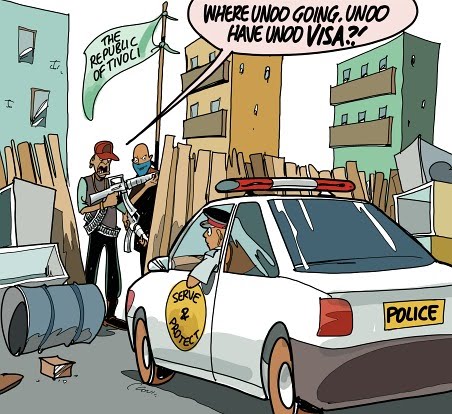
    The latest is that because of US presure, police are trying to get a drug lord, Christopher “Dudus” Coke. He’s wanted in the U.S. But this “don” isn’t going down without a fight. The Harder They Come, baby (I just never get tired of Toots and the Maytals singing “Sweet and Dandy”): A police station torched. Gun battles. Barricades. A government offering to bus people to safety. A Prime Minister saying violence will not be tolerated.

    Of course a lot of the people will fight for Dudus because Dudus keeps the streets safe (or safer than the police can) and Dudus dolls out some handouts, his version of government cheese, which of course is more cheese than the government gives out. Or, as one woman said, “We haffi support all a man like that because him a do what the Government naa do fi wi.”

    [abrasive sound of scratching needle-on-record]

    Say what?! “Naa do fi wi”? Let’s turn to Professor Harriott, political sociologist at the University of the West Indies (my dad did some research there years ago, had good things to say about it):

    The women would have enumerated those benefits, being safe from rapists, etc. Plus there are other traditional benefits like free light, etc, so there are tangible benefits. … It is a communal thing and there is a common identity — one benefits simply by being a member of the group…. There are privileges and obligations, one of which is to protect. If the don makes money and doesn’t let off, then the contract is broken. As long as the don upholds his end, there will not be a problem.

    Ah, that’s my language (I just knew an ivy-league education was good for something). But that quote isn’t as much fun as my girlfriend:

    Inna this area we feel safe, because man from outside and even dem whey live ya cyaan come in and rape we…. If any rape a gwaan, a when we go out a road and man try a thing. Up ya so nuh come een like a place like over Seaview [Gardens] where them don’t have no don in charge and everybody do as them like. Up ya so we have a one man who run things and when anybody bruk the rules, we report him and the boss deal wid him.

    Yesssss. Exactly. Does she know there’s drug money involved? Of course a little of that goes on, but those guys don’t make much money from that… “Lickle a dat gwaan, but dem man dey nuh mek much money offa dem things dey.” Of course they don’t.

    I want to go to Jamaica. I won’t understand a word!

    Cartoon from the Jamaica Observer

    P.S. Jamaica is not going to win the war on drugs either.

  • Police Chief Endorses Marijuana Legalization

    Sometimes, as our drug war continues unabated, it’s easy to forget just how much progress has been made in fighting prohibition.

    Just a few years ago this kind of talk from an active police chief was inconceivable. It’s the kind of talk that encourages honest debate. Which is just what we need because advocates of the drug war will not win an honest debate.

    Meanwhile, a much more typical law-enforcement attitude can be seen in Texas: “We can’t just pull out… we are in it too deep to quit.” Too deep to quit. The logic is underwhelming. I’d prefer to stop digging.

  • Mexican drug raid wins drug war!

    Mexican drug raid wins drug war!

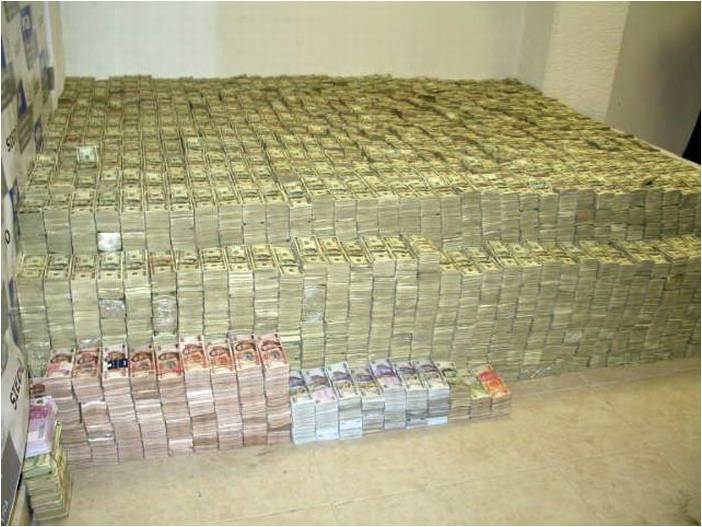
    In 2007, Mexican and US drug agents raided a home in Mexico City. Over $200,000,000 in cash was found. Lot’s of other stuff, too. Like tigers and gold guns!
    It’s pretty impressive. I put the pictures in a PDF file.

    It’s not recent, but I just got an email with the pictures from a student. Unlike a lot of forwarded email sent around, this one is true.

    Amazing how, in hindsight, this one raid really changed the tide in the war on drugs. I will be the first to admit that I was wrong. I mean, since this raid in 2007, drug barons have finally gotten the message that drugs simply do not pay.

    Rule of law has returned to Mexico and police there can now wear their uniform with safety and pride. The economy has improved and fewer illegal immigrants are forced by drug-war violence to come to the US.

    Hell, even in the US drug supply has been so squeezed that every measurable indicator shows that drug use has plummeted.

    Best of all, the Cubs won the World Series last year!

    Did I almost mention that the bulldogs all have rubber teeth and the hens lay soft-boiled eggs?

    There’s a lake of stew and of whiskey too
    You can paddle all around ’em in a big canoe.

    I’ll see you all this coming fall in the Big Rock Candy Mountains.

  • Deaths in Mexico Drug War Pass 22,000

    Not the government wants you to know.

    Immediately after Calderon came to office in late 2006, he deployed up to 50,000 troops in a frontal battle with narcotics cartels, a move that drew widespread praise for its courage. More than three years later, the pace of killings is soaring and public security worries are beginning to affect the tourism industry, which employs nearly one out of eight Mexicans.

    Calderon has earned high praise in Washington.

    Read the whole article by Tim Johnson.

    Ending the drug war in Mexico is one way to curtail illegal immigration in the U.S. I’m just sayin’.

  • Odd Are, It’s Wrong

    There’s a good article by Tom Siegfried in Science News about what’s wrong with statistics.

    Take the idea of statistical significance. Much of social science is based on the (very arbitrary) idea that for any given correlation, there should be a less than 5% chance of that result being due to random chance.

    [And as any sociology grad student knows, if you run 20 random regressions, one will be found to be “significant” at the p < .05 level. This is why quantitative methods are no substitute for having a brain.]

    More counter-intuitive is the idea that a 5% chance that findings are random is most definitely notthe same as saying there’s a 95% chance the result is accurate.

    Take drug testing. You pay some private company too much money to test 400 people. 400 people go to some office and pee in a cup. 38 test positive. So what percent take drugs? You might guess that 38 positives mean 38 people (or 9.5%) take drugs. But you’d be very wrong. Oh, those stats… they are slippery!

    The answer is we don’t know. The results by themselves mean very little. We need more information. And there are two questions that might be asked here: 1) what is the level of drug use overall and 2) does a certain individual takes drugs. The former is a bit easier because you can adjust for errors. But when you’re talking about a individual, there is very little room for error.

    Let’s say we knew the tests are 95% accurate (a big if). If there were 40 drug takers, the drug test would test accurately positive for 38 of these 40. So if we got 38 positives out of 400, could we say that the drug use overall is 40 out of 400 or 10%? No. That’s not how it works in the real world.

    Now let’s say we know there are 20 drug users out of 400. Of course in the real world it’s hard to imagine knowing this “prior probability” before you gave a drug test. And let’s say we also knew that the test were 95% accurate. If we knew all this, then we could say that of the 20 who take drugs, 19 would test positive. And of the 380 who do not take drugs, another 19 would also test (falsely) positive.

    So after the tests, the people making money looking at pee would report that based on their test (which they advertise is “95% accurate!”), 38 of 400 people tested positive for drugs. But we started this based on the assumption that there are only 20 drug users! Of these 38 “positive” results, only 50% are actually drug takes! Half. And that’s a 50% error rate for a test that is “95% accurate”!

    Look at it this way: if nobody among the 400 took drugs, 20 people (5%) would still test positive!

    Want your money back?

    Now if you just cared about the overall usage rates, you could make a simple little table that tells you, based on the accuracy of the tests and the total number of positive results, what percentage of the group actually takes drugs. (Though keep in mind that as long as the actually percentage of drug users is less than the “confidence” level of the test, in this case 95%, the number of “positives” will always be greater than the actual number of users.) Such data would be useful for researchers and major league baseball.

    But the tests don’t tell you which of those who test positive are actually guilty. This, as you can imagine, is a big problem. Consider the employee not hired or the paroled man sent back to the joint for pissing hot.

    Of course you could improve the drug test or re-test those who test positive. But even with a retest at 95% accuracy, 1 in 400 would still falsely test positive twice. Sucks to be him.

    Back in the real world, at least in our free country, we continually re-test those who test negative. But if “positives” are only 50% accurate, what’s the point?

    What does this mean for the world of science and statistics? “Any single scientific study alone is quite likely to be incorrect, thanks largely to the fact that the standard statistical system for drawing conclusions is, in essence, illogical.” Put thatin your quantitative pipe and smoke it.
  • Police Priorities

    Evidently, the MTA (New York’s subways and buses) could raise enough money to prevent massive service cuts if they could only collect the fare from 27 million dollarsof fare evaders.

    Meanwhile, the NYPD arrests more people for misdemeanor drugs possession (half of those for the lowest level of marijuana possession) than it does for fare evasion. That’s an interesting take on our city’s priorities.

    I have a suggestion for Mayor Bloomberg and Mr. Kelly…

  • Calls for Drug Legalization in Mexico

    From the Wall Street Journal:

    Growing numbers of Mexican and U.S. officials say—at least privately—that the biggest step in hurting the business operations of Mexican cartels would be simply to legalize their main product: marijuana. Long the world’s most popular illegal drug, marijuana accounts for more than half the revenues of Mexican cartels.

    “Economically, there is no argument or solution other than legalization, at least of marijuana,” said the top Mexican official matter-of-factly. The official said such a move would likely shift marijuana production entirely to places like California, where the drug can be grown more efficiently and closer to consumers. “Mexico’s objective should be to make the U.S. self-sufficient in marijuana,” he added with a grin.

    He is not alone in his views. Earlier this year, three former Latin American presidents known for their free-market and conservative credentials–Ernesto Zedillo of Mexico, Cesar Gaviria of Colombia and Fernando Henrique Cardoso of Brazil–said governments should seriously consider legalizing marijuana as an effective tool against murderous drug gangs.

  • It’s not new, but is it fair?

    I wasn’t even going to link to this story because I don’t want to repeat myself more than necessary.

    Here’s the point: black New Yorkers are seven times more likely than whites to be arrested for marijuana possession. For a moment, let’s put aside the actually story (not that we should). For the sake of debate, let’s accept the seven times figure (as we should). Let’s also accept that whites smoke just as much weed as blacks (that’s also true). Let’s ignore that fact (not that we should) that these arrests happen even though personal marijuana possession in New York State is decriminalized. And let’s also not concern ourselves with the cost of $53 million to $88 million annually for these arrests. Let’s not worry that these arrests may play an important part in a general “broken windows” approach to crime prevention. And finally, let’s assume that everybody arrested is guilty as charged.

    Here’s my question:Does it matter that blacks are seven timesmore likely than whites to get caught for this drug crime? Perhaps not. I mean, all you have to do to not be arrested in not commit a crime, right?

    Is simple guilt all that is needed to give moral justification to our criminal justice system? Remember, this seven-times discrepancy is not due to the facts that blacks are more likely to committhis drug crime. We’re just talking about the odds of getting caught.

    I mean, what if cops only gave traffic tickets to women. Women who speed and run red lights. But what if basically men were given a pass when it comes to traffic violations. Does it matter? Would this be fair? Perhaps…. since all the tickets were given to guilty women. But for traffic enforcement to be fair, shouldn’t men get tickets, too?

    At some level, I think the very notion of justice–at least justice with any moral legitimacy–depends on the idea that everybody has an equal (or at least somewhat equal) chance of getting caught.

    What do you think?