Only hours after the grieving family had finished burying [Ensign Melquisedet Angulo Córdova, a Special Forces sailor killed last week during the government’s most successful raid on a top drug lord in years] in his hometown, gunmen burst into the family’s house and sprayed the rooms with gunfire, killing his mother and three other relatives, officials said Tuesday.
Clean needles save lives. Clean needles make policing less dangerous because 1) it limits the spread of HIV and and hepatitis, and 2) which would you prefer to get stuck with? So logically, police are big supports of clean needles and needle exchange (oh, wait, I just made that last part up).
There have been countless studies on the matter. There’s really no doubt that giving out clean needles saves lives and does not increase drug use. So the feds have finally repealed a 21-year-old ban on federal funds going to clean needle programs.
Robert Martinez, chief of drug policy under President George H.W. Bush, said government funding for clean needles “undercuts the credibility of society’s message that drug use is illegal and morally wrong.”
If only I could get a clean needle, I’d shoot up my Christmas smack!
Ohhh, that makes me so mad. Nothing like death to send the right message. Nothing like bastard political flunkies preaching about morality. Nothing like admitted illegal drug use from the past three presidents to send the right message.
Sgt T sent me this, related to the previous post: “Metro Atlanta may get a little bloodier. Call it a sign of success.”
They use a bastard version the same retarded thought process here in the states. Early last year the head fed in Atlanta was crowing about how their success in the war on drugs was driving up street violence. To which we could only offer a hearty, “Thanks for the help, assholes!’ Ten years in patrol and I can count one hand, with fingers left over, how many times the feds were willing to help on a major case. But, as we used to say, some people just investigate for a living and some people actually police.
Washington says the rising death toll is a sign the drug gangs are weakening under President Calderon’s military crackdown, which has seen some 49,000 extra troops deploy across Mexico.
You see the rising death toll in Mexico is always a sign that the drug gangs are weakening because, well, when the gangs are weak, they lash and kill lots of people. And when the gangs are strong, then they don’t kill anybody. So we want to attack the drug gangs so they become weak and kill more more people, which is how how we know we’re winning the war on drugs. Or something like that.
Logic like that makes my head hurt.
I do know we’re notwinning the drug war. In Mexico 14,000people have died in drug-prohibition violence in the past four years. You know, ever since President Calderon started his military crackdown to win the war on drugs. And they must be winning, because a whole lot of people are getting killed.
Anyway, one of Mexico’s bad guys, a most wanted, a “boss of bosses,” he was killed by the good guys. Another stirring victory. Keep up the good work. Drive safely. Sleep well. Tip your waitstaff. War is Peace! Ignorance is Strength!
Ward was killed 25 years ago. His assassination and last dying breaths were caught on tape and haunted the memory of many Baltimore police officers, some of whom I worked with.
At a memorial, held where Ward was killed, Commissioner Bealefeld said that it is “not for us to judge the results of his sacrifice.” And certainly a memorial to a slain officer is notthe time and place for that.
But at some point we needto ask. Why are we risking our lives? What are we getting in return? If we don’t ask these questions, more good men and women will die.
The block Ward give his life to protect has long since died. Like too much of Baltimore, it’s vacant, boarded up, and abandoned. Here’s the 1800 block of Frederick, odd side. Ward was killed upstairs in the Formstone house in the center with the potential window display:
By risking his life to protect others, Ward died a hero. That I do not doubt or forget. But it’s hard to imagine that Baltimore or Frederick Avenue would be any worse off today if Ward had simply called in sick that day. And the world would certainly be a better place if Ward and other officers killed in the drug war were still with us. I’ve said this before (to the consternation of some). I don’t want to see any other officers killed for a war we are not winning and cannot win.
When I put my life on the line every night for the men and women of the Eastern, I would often think about the fallen officers pictured on the walls. Ward always stood out for some reason. (I’m not making it up that his picture hangs in the Eastern, am I?) From what I heard he was a good guy. And from his picture, he just seemed more human than most other cops pictured.
Police Commissioner Bealefeld is a good man and the best commissioner Baltimore City has seen in a long while, certainly better than the previous five commissioners (I’ll only vouch for worse commissioners as far back to and including Frazier). Maybe Bealefeld even gets it when he talks about the war on drugs and the “seemingly impossible task” of winning it? Who knows. But the war isn’t his to call off.
Here is Peter Hermann’s takeand his story in the Sun with the sad headline: “At memorial, a new vow to wage war on drugs.”
Maybe it wasn’t such a good idea to invite the neighborhood drug dealers to your place to watch the game.
The guests staying for three days, sold drugs out of his living room, and bound and tortured the guy by pouring boiling water and pennies over his naked body.
Boiling pennies?! Where do they think of these things?
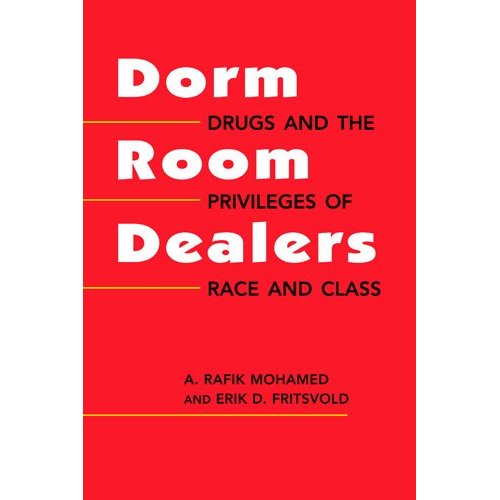
Too many books (my own included) treat drug crimes like it’s some black thing that whites wouldn’t understand unless some kind-hearted interpreters explain to “us” those strange things “they” do.
Well it ain’t like that. Most drug dealers are white. Most drug users are white. It just doesn’t make the news (or get police attention).
And yet, you may be thinking… if most drug crimes are committed by white people, and whites are just as if not more likely than blacks to take and sell drugs, then why do I think of drug criminals as black and why are most people in prison for drug crimes black?
As they say: Ah-hxaaaaaa!
We don’t fight the war on drugs against rich college-educated white folks.
Most prohibition violence in the drug trade happens in non-white neighborhoods. So there’s a reason we focus on crime more on drug crimes in some neighborhoods than others. To me it’s the publicdrug trade that is so brutal.
But what about all those college drug dealers? Why do we never hear about them? Well this book answers that. I might write a proper book review later, but for now let me say this: I mean, I went to college. Anybody who has gone to college knows you can buy drugs in college. It’s like these college drug dealers have no fear of ever getting caught.
Exactly.
These dorm-room dealers sell drugs like they’re dorm-room posters. Everybody can see them. They have no fear. You see, the rules are different for them. College drug dealers get in the game, make some cash (or support their habit), and then graduate and get a job, maybe in daddy’s firm.
Am I oversimplifying? Of course. You should buy the book. If for no other reason than it makes a great ethnographic counterpart to Cop in the Hood. Here’s how the other half deals drugs. There’s a good lesson there for all us all.
Here’s the news story. Abbotsford, by the way, has been labeled “the Murder Capital of Canada” [insert scary music here]. Abbotford, the Murder Captial of Canada,” has a homicide rate of 4.7 per 100,000.
Abbotford, the Murder Captial of Canada, has a homicide rate lower than the U.S. homicide rate.
I have no problem with the force used in this video. In fact, I think it’s a very good use of force (and I’m not saying that just to provoke anonymous insults). Every bit of force is justified, in response to actions the suspect takes, and stops when the suspect complies.
That guy on the ground had two things to do: 1) keep his head down, and 2) not move, especially his hands. Those are very fair requests. Mr. Brown Jacket complies and has no problem. Mr. Slow Learner keeps looking up and trying to move his hands to a place where 1) he could reach for a weapon or 2) get up. Neither is acceptable. The officer responds appropriately.
To me, the greater issue (outside the war on drugs) is the limitations of the gun. Once you’re pointing a gun at somebody who doesn’t do want you want, you kind of lose your power. I mean, if you can’t shoot the guy, what can you do? So the gun, if you call its bluff, only serves to take the officer’s hands out of the equations. That’s not good. But as long as the gun is out (and yes, I’m assuming that officer has a good reasons to suspect the suspects may be armed), all you’ve got are your feet.
There was one time I got out of my car and drew down on two people fighting in the middle of the Monument Street (I had reason to believe, falsely it turned out, that one had a gun). I ordered them to stop fighting. I will never forget as they both, in unison, turned to look down the barrel of my gun, then turned back to each other and re-starting slugging each other again. All I could do was put my gun away. By this time I could see they were not armed.
I did end up macing one of them when the other, unilaterally, listened to my commands to stop fighting. At the request of their father, they both went to jail. Turned out they were brothers.
Everyone would have been happier had I never been there.
 Ward was killed 25 years ago. His assassination and last dying breaths were caught on tape and haunted the memory of many Baltimore police officers, some of whom I worked with.