Tag: war on drugs

  • More wars!

    Why are teen prostitutes “victims” who need to be “rescued” and drug users “criminals” who need to be “punished”?

    Here’s the story in the Miami Herald.

    FBI Deputy Assistant Director Daniel Roberts said, “The goal is to recover kids. We consider them the child victims of prostitution.” Well that’s awfully sweet of him to say. Sounds to me like the FBI is codling prostitutes! Suspicious.

    And if, like “they” say, we’re winning the war on drugs, shouldn’t we start on war on prostitutes? That would solve the problem. Besides… just think… if it weren’t for all the prostitutes walking the street, my little John wouldn’t have been pressured into sleeping with that whore! Let’s have mandatory life sentences! Now that would send the right message and keep our streets safe. Either we’re going to get tough with prostitutes or they’ll be prostitutes in your neighborhood!

    They say sarcasm doesn’t translate well into writing. So I’d like to make it very clear.
  • Kathryn Johnston

    Three years after the police killed Kathryn Johnston the case is almost finished winding through court. Johnston is one of those names you should know, another victim of the war on drugs.

    The Atlanta Journal-Constitution has the whole story. It includes these lines:

    “Tesler said when he joined the narcotics unit, he was told to ‘sit, watch and learn’ from superiors who cut corners to meet performance quotas for arrests and warrants. ‘I was a new part and plugged into a broken system,’”

    “Smith said his moral compass failed when he began to think ‘drug dealers were no longer human.’”

  • Growing Support for Legalized Pot

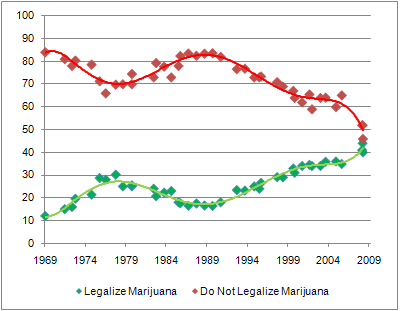
    Growing Support for Legalized Pot


    For the first time more than 40%. Read about it at 538.com.

    My world? I would guess 90% of my friends (99% not counting Baltimore cops) and 75% of my students support legal marijuana.

  • The War on Drugs Had Failed

    That line is nothing new coming from me. But it is something new coming from Fernando Cardoso, Cesar Gaviria, And Ernesto Zedillo. Who the hell are they? Just the former president of Brazil, Colombia, and Mexico. In the Wall Street Journalthey write:

    Over the last 30 years, Colombia implemented all conceivable measures to fight the drug trade in a massive effort where the benefits were not proportional to the resources invested. Despite the country’s achievements in lowering levels of violence and crime, the areas of illegal cultivation are again expanding. In Mexico — another epicenter of drug trafficking — narcotics-related violence has claimed more than 5,000 lives in the past year alone.

    The revision of U.S.-inspired drug policies is urgent in light of the rising levels of violence and corruption associated with narcotics. The alarming power of the drug cartels is leading to a criminalization of politics and a politicization of crime. And the corruption of the judicial and political system is undermining the foundations of democracy in several Latin American countries.

    The first step in the search for alternative solutions is to acknowledge the disastrous consequences of current policies. Next, we must shatter the taboos that inhibit public debate about drugs in our societies. Antinarcotic policies are firmly rooted in prejudices and fears that sometimes bear little relation to reality. The association of drugs with crime segregates addicts in closed circles where they become even more exposed to organized crime.

    Read the whole op-ed here.

  • Robber Killed

    This is the kind of shootings that makes cops smile. Bad guys gets what he had coming. Reminds me of the time in roll call when the sergeant was describing a complicated shooting in Sector One on Barclay St. or Greenmount Ave. It was a confusing tale of a Mexican guy, a black guy, a woman (perhaps girlfriend to one and prostitute to the other), money, a gun, and finally a man shot and killed.

    A friend of mine interrupted to ask, “Who got shot? The robber or the rob-ee. I kind of like it when the robber gets shot.” But in that case is was the rob-ee.

    Not here:

    Sometimes people are surprised to learn that yes, you can (and should) shoot a man holding a gun at somebody. No you don’t need to say anything. No, you don’t need to give a warning. In fact, doing so could endanger an innocent life. If somebody is threatening people with a gun and he points it toward you or anybody else, you cap him. Double tap. Plain and simple. That’s a good shooting.

    In this case it just so happened that an on-the-ball 65-year-old retired police captain was working security. If there had been no security guard, it is true that the odds are nobody would have been killed. But those are odds I wouldn’t want to play.

    The retired officer shot the robber four times (quadruple tap?) and is not being charged. Nice bit of shooting, I would say.

    This robbery and violence related to a legal and regulated drug. That goes against what I say about regulation and drug violence (namely that the former prevents the latter). Too bad there was no legal way for the addict to get his drug. If there were, robbery prevented, addict lives to stay addicted another day, and the retired police officer wouldn’t have to shoot anybody. Everybody wins.

  • Good News for Coke Heads

    The DEA makes up numbers about the price of cocaine and used the funny numbers to claim rising prices and victory in the war on drugs. The UK is more honest and admits that the price of cocaine has fallen by half in the last 10 years and is set to decline even more. The report comes from the International Narcotics Control Board.

    Now of course it is possiblethat prices are falling in the UK and rising here.

    But seriously, if rising cocaine prices means, in theory, that we are winning the war on drugs, what do falling prices mean? I can’t wait to hear the spin from the DEA.

    According the BBC, the report also says:

    Canada has become a primary source of ecstasy for North America and a significant supplier for Asia.

    Poppy cultivation has shrunk in Afghanistan but the US occupied country still produces more than 90% of the world’s opium.

    Perhaps if we weren’t so busy fighting drugs in Afghanistan we could better fight terrorists–and take away their source of income.

  • Mexicans block border to protest drug war

    “Hundreds of people in Mexico have blocked key crossings into the US in protests against the deployment of the army fighting drug traffickers.” Read the complete story in the BBC.

  • Sheriff Leon Lott is an Idiot

    Sheriff Leon Lott is an Idiot

    Lott is the guy who wants to lockup Michael Phelps, the Olympic swimmer, for smoking mari-ju-wana in his county.

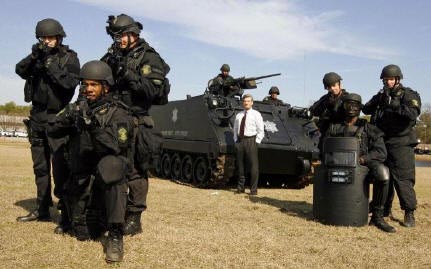
    That at least made me suspectthat Lott is an idiot. But this picture, of Lott in front of his new “peacekeeper”, confirmed it.
    Talk about putting the war back in “war on drugs.” What a dope. Thinking that a tank is an appropriate civilian police vehicle.

    Former Police Commissioner and LEAP member Norm Stamper has a more thoughtful perspective.

    [Update from the AP: “A South Carolina sheriff said Monday he won’t charge swimmer Michael Phelps after a photo of the 14-time gold medalist showed him smoking from a marijuana pipe.”

    But eight others have still been arrested. TimeMagazine saysthat 42% of Americans have smoked weed. So let’s see… eight down, 302,999,992 to go.

    But what’s a sheriff to do when there is clear evidence of minor law breaking? Doing nothing isalways an option.]

  • New Drug Czar

    Do I have faith in any drug czar? No. But who knows. Maybe I’m wrong.
    This guy is interesting. Especially because of the “jaywalking incident” that got him a vote of no confidence from the police union.

  • Latin American Panel: Drug War Failing, Honest Debate Needed

    The drug war has failed, and its repressive policies are having negative consequences in Latin America, a 17-member commission said today. The Latin American Commission on Drugs and Democracy, co- chaired by former presidents Fernando Henrique Cardoso of Brazil, Cesar Giviria of Colombia, and Ernesto Zedillo of Mexico called for an “open and honest debate” on the problem.