Tag: war on drugs

  • 60-day supply of weed

    In Washington state, it’s officially 24 ounces and 15 plants. That’s a lot of marijuana.

    In Holland, by the way, you’re only allowed to have 6 plants. And a “coffee shop,” the place that legally sellsmarijuana, is only supposed to hold 16 ounces at any given times (but for practical reasons, that limit is often ignored).

    Here’s the article in the Seattle Times about what is now the legal limits for a “60-day supply of medical marijuana.”

  • 60% oppose mandatory minimum sentences

    But that means that 40% support mandatory prison terms for non-violent drug offenses. Still I guess it’s less than half. Read the story in the Christian Science Monitor.

  • Another reason to legalize drugs

    The Agitator has a story about a drug raid gone amok. I had never heard about Ryan Frederick or Detective Jarrod Shivers. There is so much I don’t like about this: the war on drugs, a bad CI (confidential informant), a drug raid, and (most of all) a dead police officer. I hate the war on drugs.

    Police should not be busting down the doors of American citizens. That’s not (or didn’t used to be) the American way.

    Click here For a complete list of botched paramilitary police raids.

  • The Solution to the Failed Drug War

    Jack Cole, the founder of LEAP, has an op-ed in today’s Boston Globe.

    WAR AND RACE dominate the presidential campaign, but one nation-shaping war with profound racial consequences eludes the political radar: the drug war.

    I was a frontline soldier in this self-perpetuating, ineffectual effort that has swallowed more than a trillion tax dollars and currently yields nearly 2 million arrests every year for nonviolent offenses. I helped incarcerate some 1,000 young people as part of this irredeemably wrongheaded attempt to arrest our way out of our drug problems. Those arrests will follow them to their graves.

    I know they follow me.

    Read the whole article here.

  • 27 drug raids in one night

    A federal a local task force, HIDTA (“High Intensity Drug Trafficking Area”) busted down 27 doors in what must have been a very long night’s work. I hope people feel safer.

  • War on Drugs: Mexico

    “Tens of thousands protested drug violence this weekend. Many blame the president.”

    Here’s the story by Sara Miller Llana in The Christian Science Monitor.

    In August alone, the teenage son of a Mexican businessman was found dead in the trunk of a car, after being kidnapped at a fake police checkpoint; a dozen decapitated bodies were discovered in the southern state of Yucatán; and in northern Chihuahua state, gunmen fired on a dance hall, killing 13 people, including a baby.

    Mexicans have long been fed up with the escalating violence. But 20 months after conservative President Felipe Calderón launched a massive military effort against drug violence, the bloodshed has only gotten worse.

    Mr. Calderón has scrambled to assuage public outrage, signing a national pact this month with the country’s leaders to improve anticorruption measures for cops and form new antikidnapping squads. But the pressure is on.

    Read the whole story here.

  • U.S. War on Drugs: Bolivia

    U.S. War on Drugs: Bolivia

    George Washington, in his 1796 farwell address, warned about unnecessary foreign entanglements:

    The great rule of conduct for us in regard to foreign nations is, in extending our commercial relations to have with them as little political connection as possible. So far as we have already formed engagements let them be fulfilled with perfect good faith. Here let us stop.

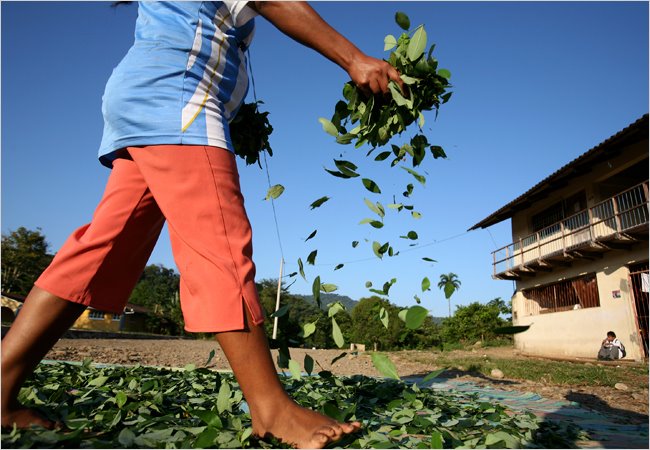
    The U.S. messing up other countries to fight our failed war on drugs is nothing new. Here’s the latest, in an article in the New York Times about the U.S. meddling unproductively in Boliva.

    A few highlights:

    “Two months ago a mob of 20,000 protesters marched to the gates of the American Embassy, clashing with the police and threatening to burn the building down.” The president praised the demonstrators.

    “[President] Morales, a former grower of coca, the raw ingredient of cocaine, is both an antagonist and an active partner in American antidrug policy for the region. He often describes the United States as his leading adversary and has made the right to grow the coca leaf a top symbol of sovereignty and anti-imperialism.

    “Yet he has also gone to unexpected lengths to restrain coca cultivation, and he accepts about $30 million a year from the United States — almost his entire antinarcotics budget — to fight cocaine.”

    “For now, Mr. Morales and the United States remain uneasy bedfellows. Mr. Morales has been hesitant to sever ties with the United States, especially since it provides Bolivia with about $100 million in development aid each year. It also grants duty-free access for Bolivian textiles, an economic lifeline for his country.”

    “The American-backed Anti-Narcotics Special Forces, known as the Leopards, go about their job. Each day at dawn, eight-man teams in camouflage snake out of a military base here in new Nissan Patrol sport utility vehicles, driving down dirt roads into the jungle. Then they get out and walk, chopping through brush with machetes, grasping M-16 rifles, in search of small mobile coca-mashing factories that have pushed Bolivian cocaine production to a 10-year high. When they find one, they set it ablaze.”

    The commander of the unit says, “We depend on the Americans for everything: our bonuses, our training, our vehicles, even our boots.”

    Meanwhile coca cultivation has increased, up 8 percent in 2006 and 5 percent in 2007.

    “Mr. Morales, 48, spent his teenage years in the coca fields of the Chapare after his impoverished family migrated here from the high plains. He then rose through the ranks of the region’s coca growers unions in the 1980s and 1990s, a time when American-backed troops were aggressively trying to eradicate every illegal coca plant in Bolivia.”

    “In defiance, coca growers, or cocaleros, blockaded crucial roads and clashed with security forces. In a new biography of the president, the Argentine writer Martín Sivak describes one episode in which a group of Leopards beat Mr. Morales after he spoke at a rally, leaving him for dead. A photograph in the book shows the president as a wisp of a young man, lying beaten on a stretcher.”
  • The poor mob

    Sometimes I kind of feel sorry for these guys. From the Boston Globe.

    The New England Mafia just is not what it used to be.

    In what would be an unusual move for a man of his rank, the family’s reputed underboss, Carmen “The Cheese Man” DiNunzio, is accused of personally delivering a $10,000 bribe to a near stranger, a man who turned out to be an undercover FBI agent.

    Some of his underlings have supplemented their incomes by shoplifting, and one aging soldier was spotted peddling electric toothbrushes on a street in the North End, State Police said.

    The big break against the mob happened when sentences shot way up. Guys were willing to serve 5 years for their crew. But the threat of 50 yearsmade them sing like birds.

    Legalized gambling also played a part. There’s a lesson in that.

  • No wonder people like him

    I am proudly liberal. I am not an economic libertarian or social conservative.

    With that, I heard Ron Paul interviewed on National Public Radio yesterday. Of course like any politician, he was playing to his audience. On NPR, he’s talking about ending the war in Iraq and not, say, overturning Roe v. Wade. But with what I heard him say, he sure makes a lot of sense. I’d take him over George Bush any day. Of course, I’d take anybody over George Bush.

    When it comes to the war on the drugs (he’s against it) and U.S. foreign policy (on Georgia: “Who cares who started it?” “Why are our troops there in the first place?”), I like him. And unlike too many of his supporters (those that read and comment on this blog excepted, of course), he doesn’t sound like the crackpot he probably is.

  • More bad news from the war on drugs

    Thanks to the War on Drugs, submarines are slipping undetected into the U.S.
    The Boston Globe has the latest story.