Tag: war on drugs

  • What’s wrong with this picture?

    What’s wrong with this picture?

    I heard Harvard Professor Bruce Western speak tonight at New York University. A short while back I heard him speak at John Jay College and he was nice enough to give me his powerpoint presentation. I use some of it in my class.

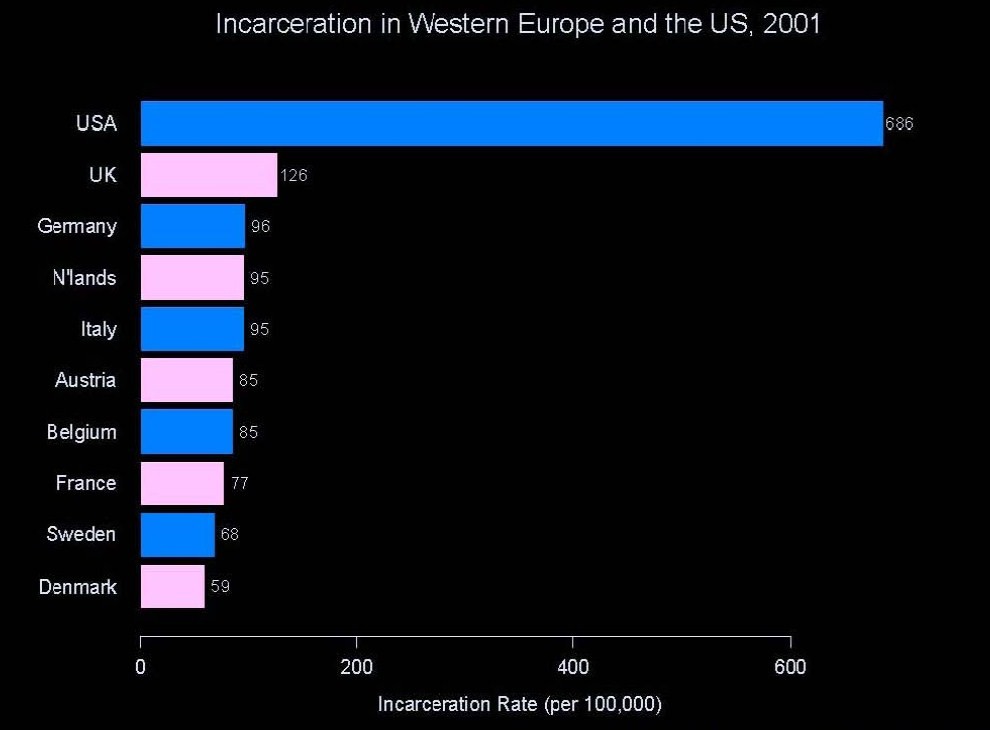
    This is one of those slides:

    We now lock up 730 people per 100,000. And this rate is still going up. That’s more than any country in the world. More than North Korea. More than China. More than Russia. And remember that “rate” takes population into account. Hell, in pure numbers we lock up more people than China. And there are more than a billion of them.

    This massive incarceration only started in the mid-1970s with the war on drugs. Mostly affected are young black male high-school drop outs. Among this cohort, the majoritywill be incarcerated at some point in their lives. Now I know this stuff and even I find it hard to believe. I asked Prof. Western if his data on incarceration included prison andjail andarrests? Nope. Just prison.

    Doesn’t anybody care?

  • In the Big City

    The trial of the officers involved in the Sean Bell Shooting continues with lots of interesting testimony.

    The justice department declares that New York City’s auxiliary police aren’t really police. At least when it comes to paying benefits to the family of two officers killed while patrolling in uniform.

    And Governor Paterson, who I seem to like more and more, first admitted he slept around a bit. Now he says he smoked some weed and snorted some blow… you know, back in the 1970s, when it seems like everyone was doing it. This was the man to party with! Too bad I was only 8.

    The governor said, “Most Americans during that period of time tried a whole lot more than that, and then gone on and led responsible lives.”

    Does this mean he thinks people shouldn’t be locked up for drug use? Probably not. Politicians never have problems being hypocrites when it comes to the war on drugs. But maybe Paterson is different. Here’s hoping.

  • 33,541 Drug Overdose Deaths in 2005

    The Drug War Rant and Stop the Drug War turned me on to a report by the Center for Disease Control. The just released “Deaths: Final Report for 2005” (hey, it takes a while to count all the dead folk) may not be the most uplifting title, but they do breakdown the two-and-a-half million deaths in America (bet you couldn’t have guessed thatnumber).

    Here’s the shocker: 33,541 people died of drug overdoses (see Tables 21 and 22 of the report for details). The report doesn’t breakdown drug overdoses and legal and illegal drugs. But the vast majority of overdose deaths are from illegal drugs (opiates like heroin in particular) and entirely preventable.

    Nobody wantsto overdose on heroin. You take illegal drugs because you want to get high. Overdoses happen because the drug is stronger than you think. Or you get clean and relapse and forget your tolerance is down. People don’t have to die. They would live if only we regulated and labeled this very dangerous drug. Somehow our drug-policy makers have decided that maintaining drug prohibition is worth tens of thousands of death per year. Shame, drug warriors. Shame.

  • Always the narcs getting into trouble

    Too often, almost predictably, undercover vice units are involved in scandal. Even the Sean Bell shooting has a strong narc connection.

    The Night Club Task Force involved in the Sean Bell shooting was formed in reaction to the Chelsea abduction and murder of 18-year-old Jennifer Moore. These undercover vice and narcotics officers worked to establish patterns of wrongdoings in clubs, such as alcohol sales to minors, to force closure with civil proceedings and nuisance abatement laws. Evidently they did a good job. Perhaps the unit should have been disbanded with accolades. Instead, after three months in Chelsea, commanders sent the 20 or so police officers to Queens. In the killing of Sean Bell, this unit’s undercover vice and narcotics mentality is very evident.

    In a drug arrest, it is important to find drugs on a person. Otherwise there is no case. Vice and narcotics officers are ingrained to work in ways that build strong court cases. But guns aren’t drugs. If the officers believed that Bell and his friends were going to get a gun, they should have stopped the suspects before they got to their car. But they wanted an arrest. If the men weren’t in the car with the gun, no court case would have had a change. But still, any illegal gun would be confiscated and them men would spend a night in jail

    Undercover units should be limited to operations that uniformed officers can’t handle. Because plainclothes police know and feel they are police to the bone, when performing police duties they can too easily forget or fail to convince citizens that they are, in fact, police. Badges can be bought on eBay. The flash of a shield isn’t enough, especially when a gun is involved.

    Uniformed foot patrol can work with bars and nightclubs to alleviate problems rather than sting them out of business. There is nothing about a rowdy bar that a good cop or two can’t handle. Local beat cops know the area. Officers on foot are rarely involved in controversial shootings because they are more familiar with the surrounding and less likely to be afraid. The good old-fashioned beat cop… Nobody is better at keeping the peace. Instead of drug cops trying to make a good arrest, beat cops focused on public safety would have saved the life of Sean Bell and the careers of three police officers.

  • Balancing Security and Liberty

    Occasionally I will repost op-eds of mine to give them fresh life and allow people to comment. The following was published in theWashington Post, August 2, 2004. You can read all my op-eds here.

    When you board a plane, both you and your carry-on bags are searched. A civilian employee of the Transportation Security Administration may open and search your checked luggage as well. Although primarily looking for security threats, workers report any illegal or suspicious objects to a supervisor or law enforcement agent, even if the object represents no danger to the flight.

    Two legal concepts allow both you and your bags to be searched despite the Constitution’s protection against unreasonable search and seizure. By being in an airport and trying to board a plane, the Supreme Court says, you have given “implied consent” to being searched. The “plain view” principle, according to the court, states that whatever law enforcement legally finds, feels or sees — even if unrelated to the original investigation or search — is fair game for arrest and prosecution.

    Using security and terrorism as justification, the government is beginning to extend airport-like implied consent zones to more and more of the public sphere, including the entire Boston subway system. Before the Democratic convention, daily commuters, anybody approaching a national political convention, and drivers on vital bridges and tunnels were told to expect random searches without a warrant. Fourth Amendment protection against unreasonable search and seizure does not apply.

    When police are granted greater rights to search without probable cause, they will use these rights. Therefore it’s essential to consider the implications of implied consent and plain view searches in the public sphere. Fear of increased government repression is shared by both ends of the political spectrum. But many others understand that a necessary element of freedom is security. Airline passengers should be screened. The Democratic and Republican national conventions need to be bomb-free.

    Few people object to bomb searches on airplanes. And many would be willing to waive their constitutional rights (if such rights were negotiable) to guarantee their security. But what starts as a necessary security measure will quickly become standard law enforcement procedure even for crimes that are nonviolent and not related to terror. These expanding implied consent zones have staggering implications for American life and freedom far beyond al Qaeda.

    Police officers are experts at bending rules, particularly in the “war on drugs.” As a police officer, I was taught to push the rules of the “Terry search,” which meant that if I articulated fear that a suspect might harm me, I could legally frisk suspects for weapons without probable cause. I know officers who towed cars, again legally, simply so they could “inventory” the contents (technically for safekeeping). In both cases, the real goal was to find illegal drugs and make an arrest.

    One must expect law enforcement to use all its available tools. As a law enforcement officer, why deal with the tedious process of probable cause, judicial approval and paperwork?

    In order to stop and search any suspect, not just a terrorism suspect, law enforcement need only wait for a person to enter an implied consent area such as a subway or a shopping mall. Their action justified by the “war on terror,” police may then conduct a full search. The true object of the search — most likely drug possession, but any contraband will do — is unrelated to terrorism.

    Of course people shouldn’t break the law or carry illegal objects. But the difference between civilian employees searching for bombs in airports and government agents conducting random searches for suspicious objects is the difference between preserving a free society and creating a police state.

    In airport security today, items deemed suspicious are not necessarily dangerous: Large amounts of cash, pirated CDs, pornography and, of course, drugs — not just illegal drugs but even prescription drugs in certain circumstances. In fact, controversial books can be grounds for further investigation and arrest. Such a standard, even if established in airports, is unacceptable and must not be allowed to spread to our streets and subways.

    The solution — the balancing of public safety with constitutional liberties — is surprisingly simple. The only way to prevent creeping use of implied consent is to limit the doctrine of plain view. Before searching a person, the government must choose either plain view or implied consent. If the government must search without probable cause, let it search, but only for illegal weapons or bombs. If security outweighs the Fourth Amendment, the scope of such searches must be limited to objects representing a clear and present danger to public safety. Any unrelated suspicious or illegal objects found must be ignored.

    It is the job of our courts and legislature to strike the balance between security and liberty. By limiting the plain view doctrine, lawmakers or Supreme Court justices have the rare opportunity to be tough on terrorism while guaranteeing the rights and freedom of citizens.
  • The Wire, the War on Drugs, and Jury Nullifcation

    There’s a great article in Timeby Ed Burns, Dennis Lehane, George Pelecanos, Richard Price, and David Simon. They’re the writers for the best show ever, The Wire.

    It’s a powerful piece and you should read the whole thing. Needless to say, they write well.

    Interestingly, they argue that for jury nullification, a concept I have long loved.

    “If asked to serve on a jury deliberating a violation of state or federal drug laws, we will vote to acquit, regardless of the evidence presented.”

    As long as one member of a jury votes to acquit, conviction is impossible. It happened during Prohibition and there are some examples in our current War on Drugs. Vote your conscience. Refuse to convict regardless of the law, the evidence, or the suspect’s guilt. It’s a statement with impact. And it’s a very powerful right we the people have against unjust laws.

    “Jury nullification is American dissent, as old and as heralded as the 1735 trial of John Peter Zenger, who was acquitted of seditious libel against the royal governor of New York, and absent a government capable of repairing injustices, it is legitimate protest.”

    It’s a clever idea and I support it.
    “It will not solve the drug problem, nor will it heal all civic wounds. It does not yet address questions of how the resources spent warring with our poor over drug use might be better spent on treatment or education or job training, or anything else that might begin to restore those places in America where the only economic engine remaining is the illegal drug economy. It doesn’t resolve the myriad complexities that a retreat from war to sanity will require. All it does is open a range of intricate, paradoxical issues. But this is what we can do — and what we will do.”

  • War on Drugs!

    A 13-year-old girl in Tucson was strip-searched by school officials who suspected her of possessing ibuprofen (prescription-strength Advil). She didn’t have any.

    You can read her affidavit here.

  • Shocks the conscience

    One-in-a-hundred adult Americans is behind bars. This figure has shocked some people since it made the headlines the other day.

    The Timesquoted a Professor Cassell as saying that our rate of imprisonment has “very tangible benefits: lower crime rates.” But this isn’t true. The prison rate has been increasing since 1970, so why didn’t crime go down until the mid 1990s? Why should prison get credit for the crime drop of the past 10 years but the not the crime rise for the previous 20?

    There is plenty of research on this matter. Granted, if we locked everybody up, we’d cut all crime outside of prison. But we’re locking up lots of people who aren’t or didn’t have to be hard-core criminals. The link between increased incarceration and lower crime isn’t clear. Even if it exists, it is inefficient.

    Professor Cassell goes on: “it would be a mistake to think that we can release any significant number of prisoners without increasing crime rates. One out of every 100 adults is behind bars because one out of every 100 adults has committed a serious criminal offense.” I don’t like Professor Cassell’s attitude.

    We willrelease virtually everybody in prison. The only question is when, and whether we’ll refill up the beds as quickly as we empty them.

    Economist Steven Levitt (Freakonomics), who promotesthe idea that increased incarceration lowers crime, estimates that the increase in prison population since 1990 accounts for only about 1/3rd of the crime drop. I don’t know if it’s worth it.

    Given the money it takes to lock somebody up, about $24,000 a year per person (and much more in New York), couldn’t we do something better with this money to prevent crime? Like hire more cops and pay them better?

    Others point out that economists’ number-crunching based logic is flawed. Some people are pretty bad and best behind bars. But most criminal work doesn’t disappear when somebody is locked up. Lock up a corner dealer and somebody else willfill the role. Locking up the “bad guys” won’t have any impact when all it does is create new “bad guys.” This is the drug market at work. While we can policeour way out of the crime problem, we can’t arrestour way out of it.

    The real factor is the war on drugs. Prison rates don’t (just) reflect crime and violence. They reflect our desire to incarcerate people.

    Our prison rate was more or less steady from 1900 until the war on the drugs at 100 per 100,000 people. This is a little high compared to other nations like ours, but in the same ballpark. Now it’s over 700 per 100,000. It is shocking.

    We’ve got more people behind bars than China. And they’ve got over four times the population. And we call them repressive. We’re so quick to see prison as the answer. We lock up people now we never would have locked up 35 years ago. Drunken drivers go to jail. My friend Bob just told me his neighbor got locked up for writing bad checks. She wouldn’t have been locked up in 1970. And just think, for the money we pay to lock her up, all her debts could have been paid off. What do you think the people she owed money to would have wanted? Why are we so willing to spend money to punish people but not to right wrongs?

    If one-in-a-hundred behind bars is so shocking, where is the shock for one-in-fifteen black men behind bars? And this doesn’t count the much larger figure of people on probation and parole. There are more black men in the criminal justice system today (jail, prison, probation, and parole) then there were black men enslaved in 1860.

  • A drug tax

    New York Timesace reporter Sewell Chan reports a proposed New York State tax on marijuana ($3.50/gram) and cocaine ($200/gram). If this tax survives court challenges, it is expected to raise over $10 million per year.

    These taxes are always a little strange and constitutionally questionable on grounds of double jeopardy. The real goal is to give law enforcement more tools: if you can’t prove intent to sell, at least you can bang ’em on tax evasion. This is, like Ethan Nadelmann puts it, “a gratuitous piling-on in the drug war.”

    But I’m still for it. Anything that sets the framework for drug regulation (intended or not) is a good thing. If drugs are already “taxed,” it’s a much smaller step to what’s really needed: regulated and controlled selling. And it opens peoples’ mind to the idea that there is legal revenue that can be gained in selling drugs.

    The article says that Tennessee imposed a tax on illegal drugs in 2005 and collected $3.5 million in two years before the law was found to be unconstitutional. I’d be very curious to know if anyof that money was from drug dealers. Probably not. It’s probably just curious spectators of the war on drugs, people like me, eager to collect a drug dealing stamp.

  • Not the sharpest tack in the box

    Cop brags about seized drug theft
    The New York Daily News reports that two narcotic detectives here caught after bragging on their own wire about stealing bags of seized cocaine.

    Corruption always involves drugs. But rarely in such idiotic fashion.