Tag: war on drugs

  • 99 problems but this is no longer one

    The Supreme Court ruled in Rodriguez v. United States (2015) that K9s cannot be used in traffic stops (without cause) if it delays the driver. Period. Previously, the law of the land was that the driver couldn’t be delayed too much. But it wasn’t clear how much was too much. Waiting for a K9 unit was too much. But if the dog was already there, then it was considered OK. No longer.

    Both as a constitutional issue and a strike against the war on the drugs, I think this decision is eminently reasonable. I’m never liked fishing for drugs. And telling otherwise innocent people to wait while dogs sniff around is like a police state. (And besides, we should be skeptical of probably cause based on a dog. Have you ever seen a dog put on the stand?)

    K9s can be really useful to police. To search large buildings, for instance. (Another break-in at the Monument Street Market?) And the threat of calling in the dogs is useful in getting some idiot to come out of his hole he crawled into.

    Post Rodriguez, to search with a dog without cause means you’d have to have another officer doing the traffic stop part while the K9 does his business at the same time. This won’t change policing too much, since there aren’t too many K9 units anyway. But it does make me wonder what those K9 units are going to do when they’re not needed for real police work. I guess they can still give traffic tickets. But it makes the dog kind of superfluous.

    I also think it’s important to point out that this will (slightly) increase officer safety. The police academy is filled with videos of cops getting attacked and killed when they start asking to search a vehicle for drugs. Now one could argue that finding and arresting criminals is part of the job, but if your primary concern is officer safety, the safest thing to do in a traffic stop is give a ticket and let the car drive away.

  • War on Drugs In Mexico

    This isn’t exactly news, but now it’s official… because it’s in the papers: “Study Finds Mexican Troops Did Not Stem Drug-War Killings

  • “13 Years in the Slammer … for Two Joints?”

    I’m generally quick to point out that there aren’t too many people doing long time for small scale drug possession. (Usually this in the context of pointing out that drug decriminalization will not empty our prisons.)

    But it does happen. And it shouldn’t happen. Ever.

    How is anyone in prison for 13 years for possessing two joints? It’s possible if you’re a “habitual offender” and in Louisiana:

    In Bernard Noble’s case, getting caught with a couple of joints morphed into more than 13 years behind bars because of the way the state’s harsh marijuana laws intersect with its harsh habitual offender law (known colloquially as “the bitch.”) Because Noble had two previous drug possession offenses, one 12 years old and one 24 years old, he fell under the purview of the habitual offender law.

    Even though his current offense was trivial (pot is decriminalized in nearly 20 states and possession is legalized in four others and DC) and even though his previous offenses were low-level and non-violent, the statute called for the 13 years, without parole.

    Taking into account Noble’s minor criminal history, his work record, and his role as the breadwinner for a family with seven children, and making special note of his overpayment of child support to children not living with him, his sentencing judge departed from the statute and sentenced him to only five years. Orleans Parish prosecutors appealed the lower sentence to the state Supreme Court and got the 13-year sentence reinstated last year.

    What is wrong with us?

  • If only our cities were more like Amsterdam!

    If only our cities were more like Amsterdam!

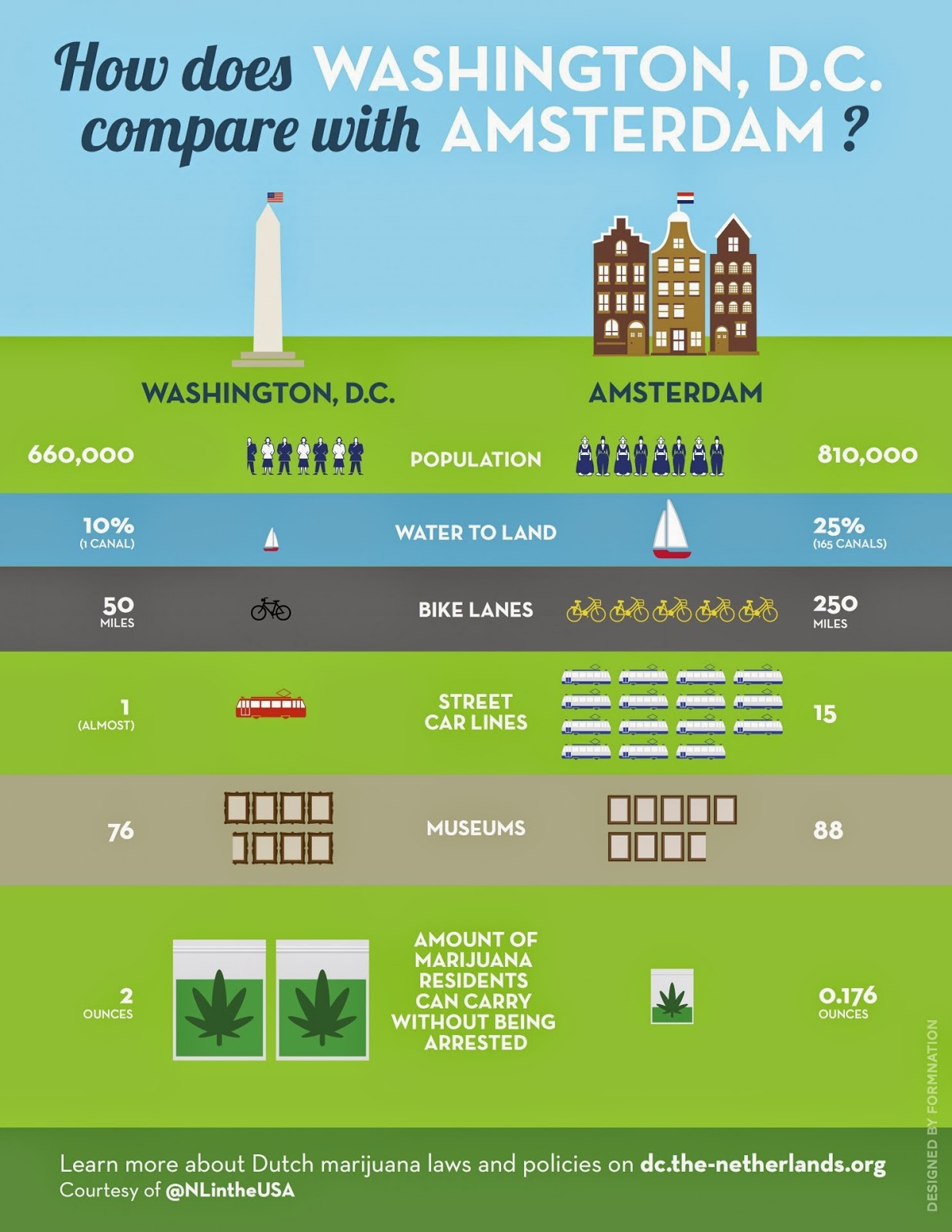
    This comes from the The Netherlands Embassy in Washington, D.C.:

    Initiative 71 became law today, legalizing marijuana in Washington, D.C. under certain circumstances. Mayor Muriel Bowser said this week that the District will not become “like Amsterdam,” as though being “like Amsterdam” would be a bad thing. City Hall even refers to Amsterdam in their official Q&A. To give the people of Washington, D.C. an educated view of how D.C. compares to Amsterdam, the Netherlands Embassy in Washington offers this Q&A about Dutch marijuana laws and policies and an infographic.

    Click through for the Q & A. Here’s the infographic. It’s odd, our American tendency, to take something that works well enough in other countries — be it drug policy or health care — and simple assert that it’s a horrible system best avoided.

  • Policing in California, post Prop. 47

    Being in NYC, I miss a lot of what happens west of the Mississippi (and sometimes even west of the Hudson). So I haven’t really been following California’s Proposition 47.

    Recently I posted about a minor increase in property crime in LA, which was both news to me and made intuitive sense. Sure, it sounds logical to focus law enforcement on drug dealers rather than drug addicts. And who can be against “treatment” (whatever that means). But a block full of east coast heroin junkies or west coast meth heads is not a good block.

    Very much in the spirit of Broken Windows, police need to maintain order. And the threat of arrest is key. It’s not that you can or should arrest every drug addict, but sometimes somebody needs to spend a night in jail. I couldn’t easily build drug distribution cases for prosecution, but if I guy wouldn’t close up shop when asked repeatedly, I could use my discretionary power to make a street-corner drug dealer spend a night in jail. On paper it was just a bullshit small-scale drug possession arrest. But the actual crime was more serious.

    Or take stolen goods. One could argue, for instance, that possession of a few scavenged copper pipes or wires isn’t that big of a deal. But that drug-addict “recycler” is systematically destroying the housing stock of an entire neighborhood. The odds that somebody in possession of stolen goods is doing it for the first and last time is pretty slim. So the hammer of punishment may need to be disproportionate to the individual crime.

    In general, I support any attempt to reduce our prison population and also to move towards a more rational and less criminal drug policy. Prop 47 was supposed to do that. I probably would have voted for it. And it may work in the end. But there are problems now. And it certainly is in the best interests of those who advocate for drug and prison reform to follow through and fix what is broken. Without focusing on behavior and drug distribution, simply decriminalizing hard-drug possession can be the worst of all possible worlds. (I’m reminded of how Kurt Schmoke set the logical policy of “harm reduction” back by a decade with a failed attempt at “drug decriminalization” in 1990s Baltimore.)

    So what’s going on in California? I asked a cop friend out west about the impact of Prop. 47 on policing. His reply is very insightful:

    I do think there has been a noticeable change in terms of diminished felony arrests, although the long-ranging impact of prop 47 may be more problematic. While it may have been structured to simply reduce penalties in order to alleviate prison crowding, I think there will be a negative outcome in terms of how low-level crimes affect communities.

    Basically, I don’t think the public realized the full extent of property and theft crimes which they were voting to essentially decriminalize. For instance, felony “wobblers” such as forgery and fraud where the values don’t exceed $950 have been dropped to misdemeanors, as well as shoplifting or theft charges where the values of the stolen property don’t exceed $950.

    If I’m not mistaken, possession of any controlled substance (for personal use) is now a misdemeanor. For me I see a problematic thread, in that where I work (and live) there is a distinct nexus between methamphetamine use, and theft, and particularly multiple incidents of forgery and check fraud. There is a distinct link between methamphetamine use and theft — at least from what I have observed where I work.

    And I deal with a lot of “speeders” (for lack of a better word) who, if taken into custody, typically have a ton of stolen property in their possession, a violation which has also been dropped down to a misdemeanor. There is a factual interrelation between methamphetamine and organized theft rings in the area I work, and I just don’t think these people are going to show up for court dates on citations. I think they will continue doing what they are doing, which is ripping people off over and over as opportunities arise.

    I do not think that all drugs are the same, and I am a big believer in rehabilitation, but methamphetamine wreaks exponential havoc on people who use it. I haven’t seen too many meth users successfully “bounce back” from meth addiction — and I have seen a lot of extremely damaged people, spiritually eviscerated by this drug, who are now zombies, lurching through town, resorting to scrappy thefts and break-ins and strange, convoluted schemes of identity theft (which are HARD to investigate and prove) and which often involve elements of forgery and fraud.

    There are lots of victims of these property crimes who are very disheartened when they get ripped off — it is a big deal for them. On a more practical note, Merchants (often small businesses) cannot believe I just “cite and release” the people who steal hundreds of dollars of worth of merchandise from their stores. I should also clarify that people who are arrested for most “misdemeanors” are typically issued a citation and are released at the scene (with proper ID), but it requires a felony charge or outstanding warrants for a suspect to go to jail. Receiving a paper citation and being released at the scene does not seem to have the same “heft” as sitting behind bars (usually for a few hours or a day or night) before you see a judge.

    While this may seem simplistic, I do think that jail, in the most basic sense, can be an effective “time out” for folks who have actually been “bad.” I don’t mean to sound reductive, but I do feel it’s beneficial for criminals to face an immediate consequence for some of the nasty stuff they do, so they will at least consider that they should stop doing it. At the very least, getting booked, losing some personal freedom, and spending some time behind bars is an immediate consequence for wrong-doing.

    I do see that prop 47 does essentially “streamline” the process of arraignments and preliminary hearings, in that the DA usually drops a lot of felonies to misdemeanors anyway, BUT I still don’t think that voters realized what they were voting for.

    I also feel if they are going to reduce penalties for all drugs, it would be beneficial to beef up various resources and rehab services for people who are struggling with their addictions. The transient population I deal with struggles with many substance issues, and I don’t judge them for their coping strategies, but I would posit that their addictions are not “helping” them out of despair, but further manifesting it. There are a LOT of people who go to jail, maybe for petty stuff, who spend a little time indoors and out of their routines of self-destruction, whose lives are actually saved and possibly extended because of the forced “time-outs.”

    I am not saying that jail time is a vacation or that it is a permanent corrective measure, but I do think it has some rehabilitative value. I am open-minded but I don’t think prop 47 is a good model.

  • We Got Another Kingpin! (15)

    It’s amazing there are any drug kingpins left since we’ve gotten so many of them.

    It seems there was one last to get: “La Tuta.” Now he’s history. (I’m a bit disappointed in the monicker. “The teacher” is a pretty lame nickname by drug lord standards, I have to say. We may not be running out of kingpins, but they may be running out of good nicknames.)

    “The most wanted drug lord in the country,” according to the NYT.

    I guess Mexico is now safe. Surely this marks the end of the drug war. What a relief.

  • Prop. 47’s effect on jail time

    From LA, where Proposition 47 reclassified many crimes as misdemeanors. Drug arrests are down by about one-third. Property crimes are up nearly 10 percent. The problem seems to be this: “The new law specifies that the financial savings on the incarceration side be reinvested in truancy, drug treatment and mental health programs. But that provision does not take effect until mid-2016.”

    I’d be curious how much and how they determine how much money is being saved by fewer arrests (in court, corrections, and police).

  • This is what rational drug policy looks like

    This is what rational drug policy looks like

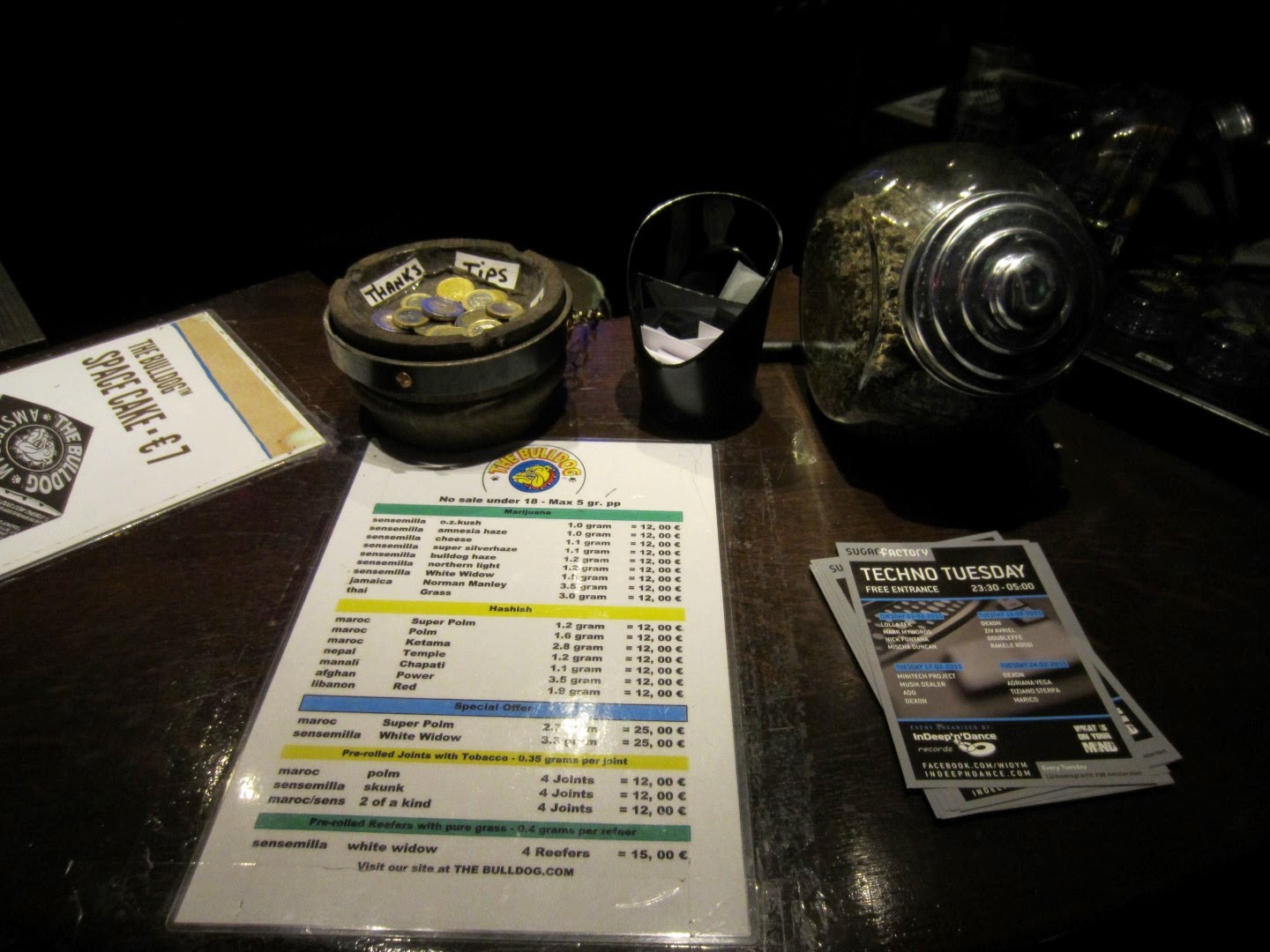
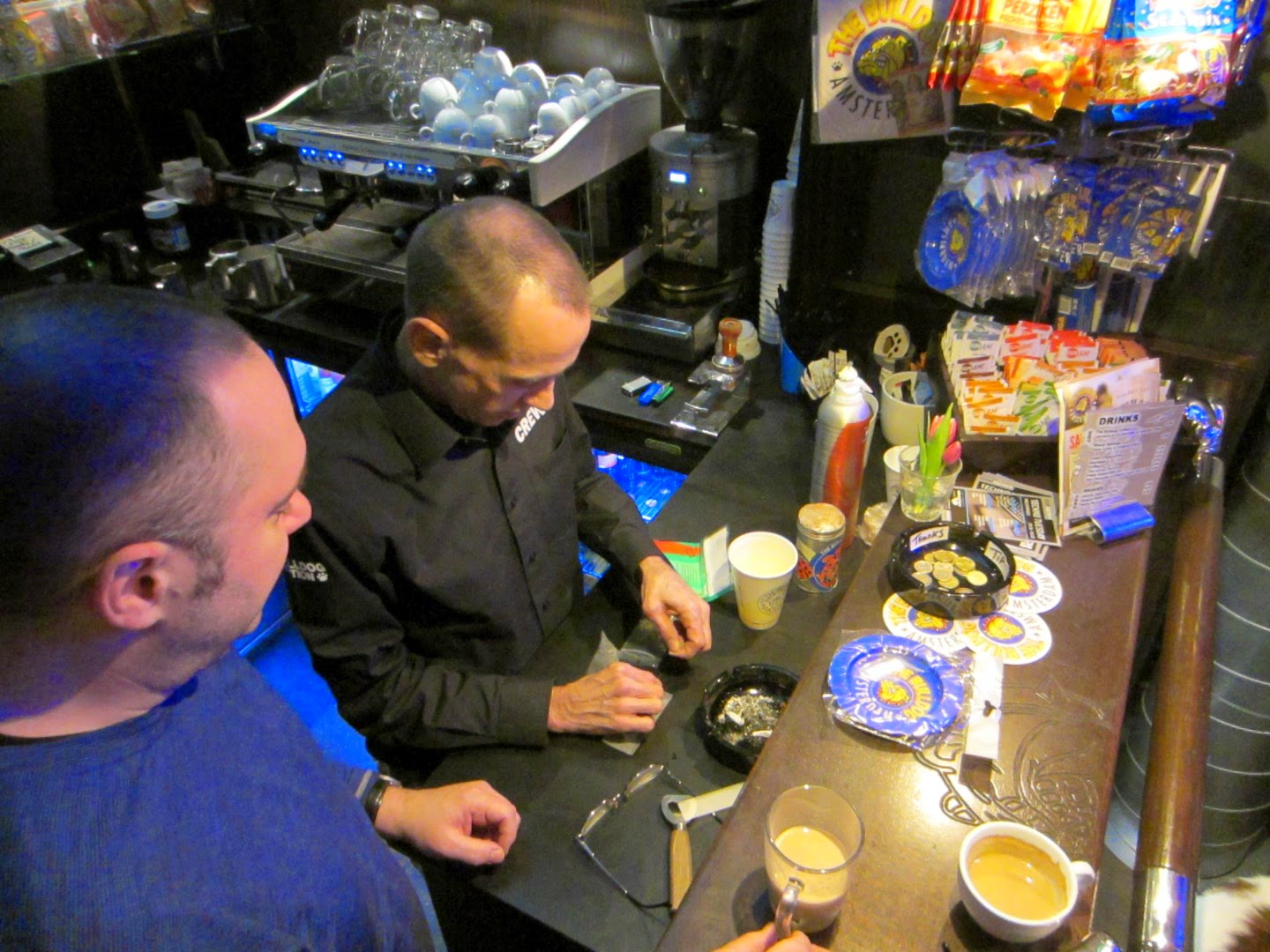
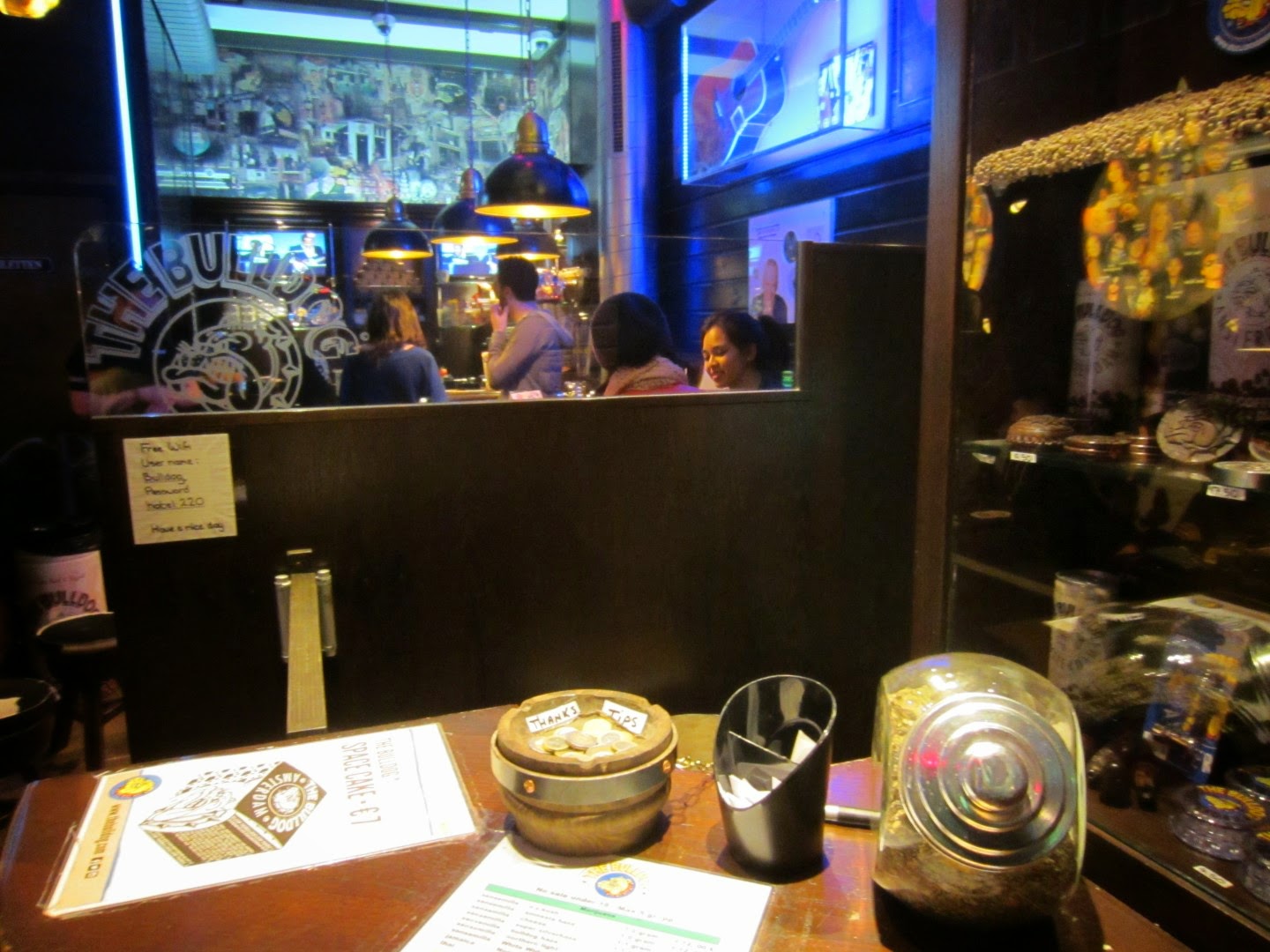
    The other day my wife and I visited a friend from way back who now works in a coffee shop. Actually a famous one, the Bulldog, which is soon to celebrate it’s 40th anniversary.

    Mostly I just love how a legal and regulated drug trade becomes, well, boring.

    There actually is a worker on duty who is registered by the city as a drug dealer. Along with having to get a standard cafe operator’s license, the city A) checked his criminal background and B) made sure his money is legit. That’s it. They also gave tips in the standard cafe license class (along with, you know, the usual: keep hot, hot, and cold, cold, and don’t cross-contaminate) on how to run a business and keep accounts and deal with labor issues. Here, as long as you play their game, they actually want you to succeed.

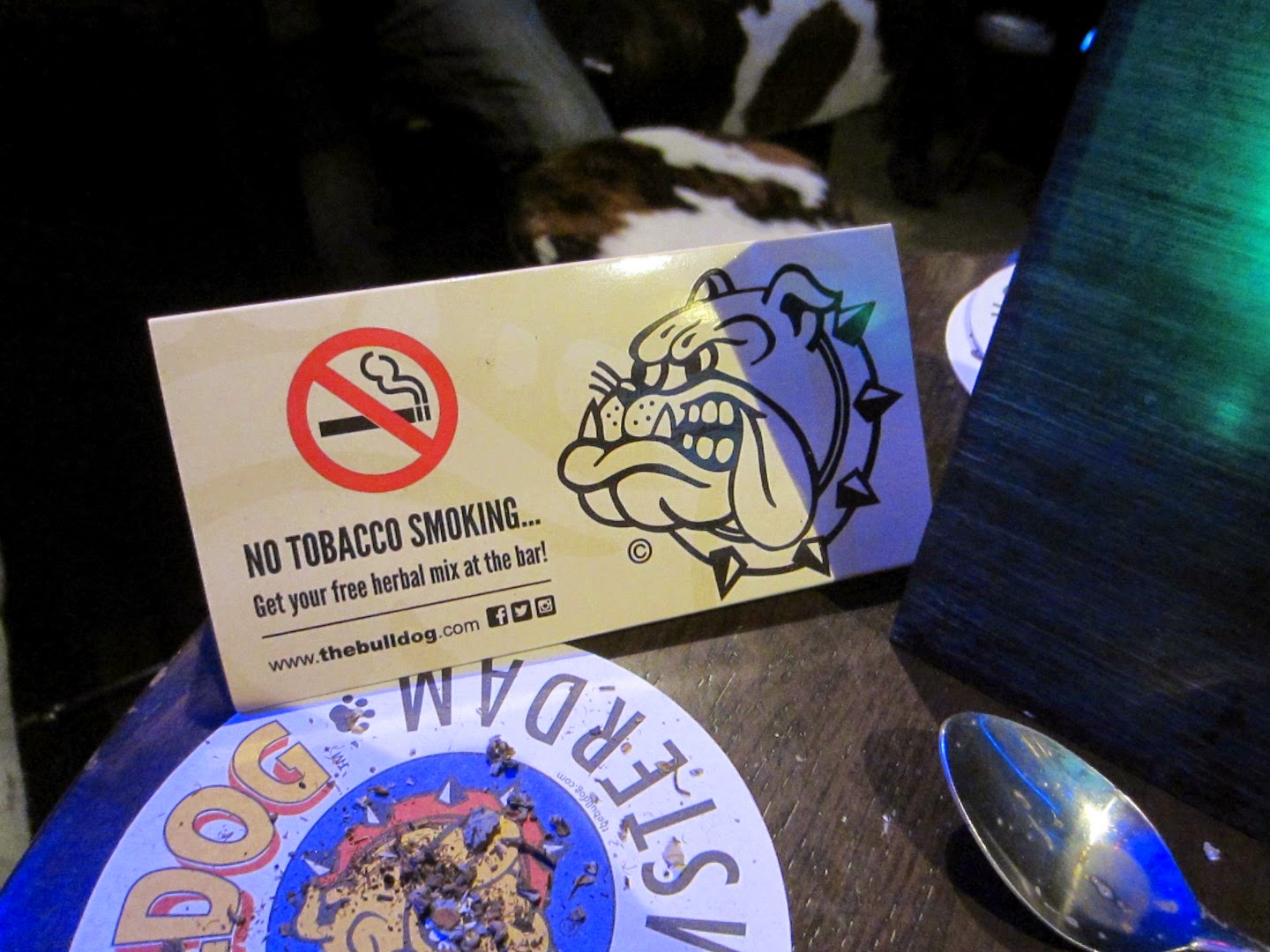
    What’s odd about the coffee shop business is that the business is legal, the drugs they sell are legal in all but name, but the store is only allowed to have 500 grams (1 lb) of weed in stock at any given time (that’s strange, but whatever). So they constantly get re-upped. And at that point in the supply trade, from the guy supplying the coffee shop and up the wholesale ladder, the drugs are illegal. Odd. Also, I think, now there has to be a dedicated drug dealer. Years ago you could order coffee and a joint from the same guy. Now, or at least here, one employee makes the coffees and handles all the business except the drugs. The other sells the drugs. Whatev… It works for the Netherlands. And yes, no tobacco smoking inside a business. That’s illegal.


    This looks a lot better than prohibition, even Dutch prohibition.

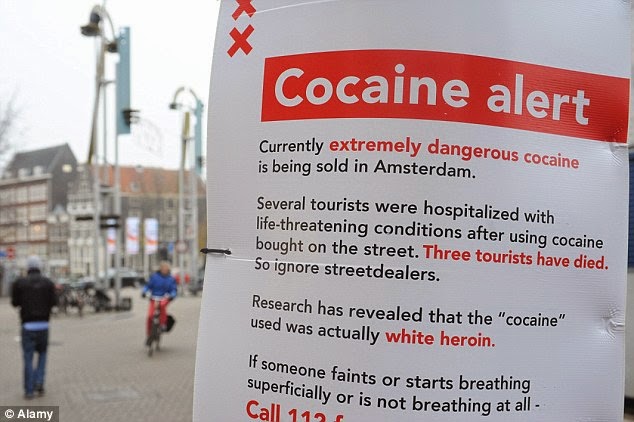
  • Don’t snort the white heroin!

    Don’t snort the white heroin!

    So a few months ago in Amsterdam, a couple British tourists died from a drug overdose. The Brits are kind of like the canaries in a coal mine of tourists. Brits are usually the first to somehow kill themselves, if given the opportunity. (It has to do with alcohol.)

    Anyway, they did die. It turned out that some guy on the street was selling heroin as cocaine. This is odd mostly because heroin is more expensive than cocaine, so the drug dealer probably didn’t know what he was selling. But the end result is people snorted heroin, many went the hospital, and a few died.

    So what do you as a tourist city do? Well most places would cover it up. Or make ads showing happy people having fun in the sun. Well there isn’t much sun here, but jokes aside, what they did in Amsterdam is very impressive. It’s what a rational drug policy looks like.

    First of all, hard drugs (heroin and cocaine) are illegal here. So you can’t go into a coffee shop and buy them. But as this city is a bit of a drug tourist destination, people come here wanting to do drugs. So like anywhere, they find a way to buy them.

    As I have written, police spend effort cracking down on fake drug sellers. But these real drugs. Prohibition deaths. Because both the buyer and seller thought they were buying and selling something else.

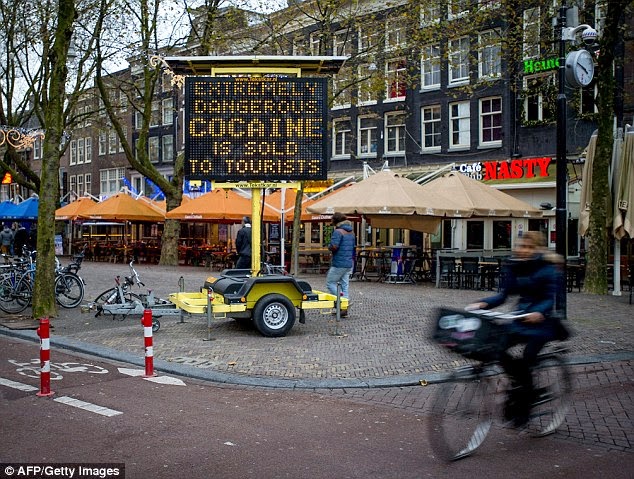
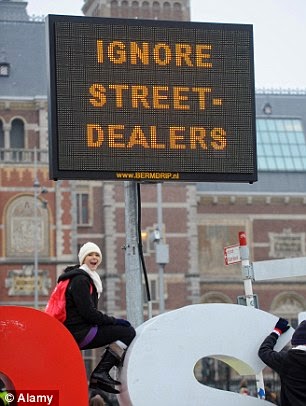
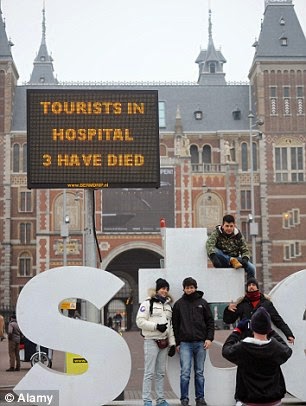
    So the city but up signs to warn tourists. It may seem like common sense, but what American city would do this? And it was an issue here too. I mean, who wants to see such signs in their beautiful city?


    Of course the campaign to warn tourist more than the actual deaths became international news. Is this good for the city’s image? Well, actually, probably, yes.

    And nobody else died. That’s kind of important.

    Here’s what the Mayor Van der Laan wrote on December 3, 2014. It’s very rational. It’s very Dutch:

    Cocaine alert and reputation

    For the past two months, seventeen predominantly young tourists fell victim to so-called ‘white heroin’. Heroin, sold as cocaine on the streets, that is much more dangerous and therefore potentially deadly. Three young Brits died. An indescribable loss to their family members and friends.

    People who say it is not allowed to use hard drugs are, of course, correct. Reality is, unfortunately, unruly. Many people do something illegal now and again. Even nice people, even people who could be our own family and friends. We cannot ignore that reality, and this is the foundation for our drug policy, which, at its core, takes drug usage as a health problem. Not criminalising it (as opposed to many other countries) makes room for education, safety testing and prevention. And this makes people who unexpectedly use too many or contaminated drugs, be able to apply for first aid, without worrying about being prosecuted.

    We hope the police will find the perpetrator soon. In the meantime, our campaign will continue. There are 35 matrix signs with warnings to tourists. We know most young weekend tourists often arrive on Thursdays or Fridays. Special teams distribute flyers at Amstel bus station, Central Station, Schiphol Airport, and in the city centre.

    In addition, we recommend the exclusion tests available at smartshops. They demonstrate whether or not you are dealing with heroin, but should not offer a false sense of security. This is why we are telling users very clearly that the test does not guarantee the drugs are safe to use.

    Tourists have let us know they appreciate these efforts. Many are surprised we openly warn them of the dangers these drugs entail. I get a lot of questions about that. Don’t you think it is bad for the city’s reputation, all those warning signs and (inter)national media attention? people want to know. The answer to that question is ‘no.’ I would find it bad for the city if we did not do this. Amsterdam wants to do everything to prevent new victims. That is the least we can do.

  • This is the DEA’s Brain on Okra

    This is the DEA’s Brain on Okra

    marijuana

    I wonder if an end-the-drug war voter is just an law-and-order conservative whose backyard okra garden was raided by local cops after being spotted from a helicopter funded by the Drug Enforcement Agency Domestic Cannabis Eradication/Suppression Program?

    Barstow County, Georgia, resident Dwayne Perry may be a recent convert: “I do the right thing and they come to my house, strapped with weapons. It ain’t right…. The more I thought it. What could have happened? Anything could have happened.” Indeed.

    Now I don’t know Mr Perry’s politics, but seeing how he is a white man in a conservative Georgia county (Republicans out number Democrats 8:1) I’m assuming he didn’t cast his ballot for any progressive candidate wanting to end the drug war. I wonder if Mr. Perry will see a connection between the so-called “law-and-order” politicians he votes for and the police who mistook him for the enemy? [More likely, as my wife pointed out, he will just blame Obama.]

    But my point does not actually concern Mr. Perry, okra aficionado. It’s almost pointless to keep highlighting absurdities in the war on drugs because if you’re not convinced by now, it’s doubtful one more anecdote will persuade you. Even if this anecdote, you do understand, concerns a helicopter being used to spy on an innocent American which was then followed by a police raid on the backyard garden of an innocent American because the drug warriors incorrectly though okra was marijuana (a relatively benign drug that is partially legal in 23 states and the District of Columbia).

    okra

    Regardless, it is worth reading Christopher Ingraham’s informative Washington Post post about this raid. Did you know that close to 98 percent of all the domestically eradicated marijuana is “ditchweed”? I didn’t! And “ditchweed” — I’m not making this up — is a technical Department of Justice term for wild non-tended marijuana that contains little if any THC. They’d be more productive pulling up kudzu!

    Anyway, I clicked through to the Georgia Department of Public Safety Governor’s Task Force/Drug Suppression (GTF) webpage, because that’s the type of thorough bathrobe-wearing research you can expect of me. I always like to know what our hard-working taxpayer-sucking drug warriors are up to:

    2012 Operational goals were exceeded with an increase over 2011 in plants eradicated, arrests, weapons seized and asset seizures…. GTF initiated and developed intelligence for grow operations throughout the state. The intelligence was then forwarded to local agencies. Subsequent investigations resulted in numerous arrests and seizures. The 2012 statistics indicate the degree of success in achieving primary operational goals.

    Those numbers aren’t easy to read, but let me highlight a few lines:

    2011 Outdoor Grow Plants Seized: 18,710 Plants

    My actual calculator! You probably use a phone.

    2012 Outdoor Grow Plants: 67,634 Plants

    72% increase

    2011 Indoor Grows Located: 20

    2012 Indoor Grows Located: 24

    16% increase

    2011 Asset Seizures: $812,248

    2012 Asset Seizures: $3,952,307

    79% increase

    Notice anything? The math doesn’t make sense. And it’s not that they’re trying the old DEA trick of making shit up to make them look good. I think they’re just dumb. While a couple of computations are actually correct, the grade overall, based on 2.5 correct out of 8, would still be an F.

    Now look, we all make mistakes. I make typos all the time, and it’s easy to punch a wrong number into a calculator. But thinking a 387 percent increase is less than 100 percent is absurd. You can pretty much mentally check “more or less than double” in your head. And a more astute practitioner of basic math skills might just know that 20 to 24 is a nice round 20% increase (and not 16%). After that even I need to break out my calculator. So I did:

    Now I don’t know if bad math is a direct cause and effect related to the Georgia legislature cutting $8.4 billion from public schools, but the math skills of Georgia’s drug warriors are just as bad as their botany identification.

    Regardless, asset forfeiture increased nearly four-fold from 2011 to 2012, presumably because the warriors have a helicopter. They can look in your backyard and, if they find drugs, take your property. These cops weren’t hoping to dig up Mr. Perry’s weeds. They wanted to seize his whole damn house!

    (In my next post I’ll tell you how to figure out percentages. For real.)